


Preparing for business school takes a massive amount of mental energy, and the entrance exam is often the biggest hurdle. If you are balancing a full-time job, family commitments, or college coursework, the idea of studying for a standardized test feels completely overwhelming.
The good news is that the Graduate Management Admission Council recently overhauled the test to make it shorter and much more applicable to the real world. You no longer have to write an analytical essay or memorize obscure grammar rules.
Getting a top score today is all about pure logic, data literacy, and strict time management. You cannot cram for this test over a long weekend. You need a highly structured approach that breaks the process down into manageable daily tasks. A reliable GMAT study plan 2026 will help you avoid burnout, track your progress accurately, and build the mental endurance required for test day. This guide will walk you through exactly how to prepare from the moment you decide to take the exam all the way to the morning of your test.
Understanding the 2026 GMAT Exam Format
Before opening any textbook or buying practice tests, you need to fully understand the current exam structure. The old format is entirely gone, meaning you now face a highly focused test designed to measure higher-order reasoning. You have exactly two hours and fifteen minutes to answer 64 multiple-choice questions.
The new scoring scale ranges from 205 to 805, which changes how business schools evaluate candidate percentiles. Building a solid foundation starts with knowing exactly what subjects remain on the syllabus and what the test makers removed.
Section Breakdown and Timing
The exam is split evenly into three distinct sections, and you get exactly 45 minutes to complete each one. Quantitative Reasoning contains 21 questions focused entirely on algebra and arithmetic. The test makers removed all geometry questions, and you cannot use a calculator for this section.
Verbal Reasoning contains 23 questions focused on reading comprehension and critical reasoning. Sentence correction is gone, meaning you no longer need to study dangling modifiers. Data Insights contains 20 questions that test your ability to read charts, analyze tables, and evaluate multiple data sources. You get an on-screen calculator specifically for this section.
New Features and Adaptive Scoring
The test remains completely computer-adaptive. When you answer a question correctly, the algorithm serves up a harder question next. When you make a mistake, the test gives you an easier question to gauge your floor. Your final score depends heavily on the difficulty level of the questions you manage to get right.
A massive update for the current exam is the review and edit feature. You can now bookmark questions you feel unsure about as you take the test. When you finish a section, you can review those bookmarked items and change a maximum of three answers per section, as long as you have time left on the clock.
|
Feature |
2026 Exam Details |
|
Total Time |
2 hours 15 minutes |
|
Total Questions |
64 multiple-choice questions |
|
Score Range |
205 to 805 |
|
Optional Break |
One 10-minute break |
|
Answer Changes |
Up to 3 edits allowed per section |
Step 1: Establish Your Baseline Score
You cannot effectively map out your preparation journey without knowing your actual starting point. Taking an official, full-length diagnostic test gives you a clear snapshot of your current logical reasoning and math skills. Many students skip this step out of fear, but seeing a low initial score is completely normal and expected.
Once you know your baseline, you can customize your preparation to target your absolute weakest areas first. This data-driven approach saves you hundreds of hours that you might have wasted studying things you already know.
Why the Diagnostic Test Matter?
Do not study before taking your first practice test. You want a raw, unfiltered look at how your brain handles the pressure and the pacing. Set aside a quiet block of time, clear your desk, and take the test without pausing the timer to grab a snack or check your phone. You need to feel the natural fatigue that sets in during the second hour of the exam.
Reviewing Your Initial Results
When you finish, look closely at your individual section scores rather than just the overall number. You might find that you scored in the 80th percentile for verbal reasoning but only the 40th percentile for quantitative reasoning. This split tells you exactly where you need to invest your energy during the first month of your studies. Make a note of which question types took you the longest to answer, as speed is just as important as accuracy.
|
Diagnostic Step |
Action Required |
|
Create Account |
Register on the official mba.com website |
|
Clear Schedule |
Block out 2.5 uninterrupted hours |
|
Mimic Environment |
Use a single monitor and clear workspace |
|
Analyze Data |
Record percentiles for all three core sections |
Step 2: Set a Target Score and Timeline
Setting a random high score is not a strategy; you need a specific target based on the actual business schools you plan to attend. Top-tier programs now look for scores above 645, which roughly matches the 89th percentile on the new scoring scale.
Once you have a target number, you can calculate the exact point gap between your baseline and your goal. This gap dictates whether you need four weeks or four months to prepare. Be realistic about your daily schedule and how much time you can actually commit to studying without burning out.
Researching School Percentiles
Go to the admissions pages of your top five target MBA programs and look for their incoming class profile. They usually list the median exam score or the middle 80 percent range. You want to aim for a score that sits comfortably at or above their median to give your application a solid edge. Keep in mind that a 645 today is roughly equivalent to a 700 on the old exam format.
Calculating Required Study Hours
As a general benchmark, improving your score by 50 points requires roughly 50 to 80 hours of highly focused studying. If your baseline is a 555 and your goal is a 655, you should plan to study for at least 150 hours. Spreading this out over ten to twelve weeks is the most common and effective timeline for successful applicants.
|
Target Score Range |
Percentile |
Competitiveness |
|
675 to 805 |
95th+ |
Elite Top 10 MBA Programs |
|
645 to 665 |
89th to 94th |
Great for Tier 1 Schools |
|
605 to 635 |
70th to 88th |
Competitive for Tier 2 Schools |
|
Below 605 |
Under 70th |
Needs targeted improvement |
Step 3: Gather the Right Study Materials
The quality of your preparation heavily depends on the resources you choose to use. Relying on outdated prep books from five years ago will actively hurt your score because they include retired concepts like geometry and sentence correction.
You need official materials published directly by the exam creators to understand their specific phrasing and logic traps. Supplement these official questions with a reputable online course that teaches modern test-taking strategies. Avoid overwhelming yourself with too many books; pick a few high-quality tools and stick to them consistently.
Official GMAC Resources
Your first purchase should be the current edition of the official guide. Because the test makers write this book, the practice problems perfectly mirror the tone and difficulty you will face on the real test. You should also purchase the official practice exams available online. You get two free exams with your account, but buying the extra four exams is completely worth the investment.
Choosing Strategy Courses
The official guide gives you great practice questions, but it does not teach you how to actually take the test. You need a strategy guide or an online course to learn how to tackle data sufficiency efficiently or how to eliminate wrong answers in critical reasoning. Look for a platform that offers detailed analytics and a built-in error log to track your daily progress.
|
Resource Type |
Purpose |
|
Official Guide 2026 |
Authentic practice questions and format |
|
Official Practice Exams |
Accurate scoring and adaptive pacing practice |
|
Strategy Course |
Learning shortcuts and foundational concepts |
|
Blank Flashcards |
Memorizing prime numbers and basic formulas |
Building Your GMAT Study Plan 2026
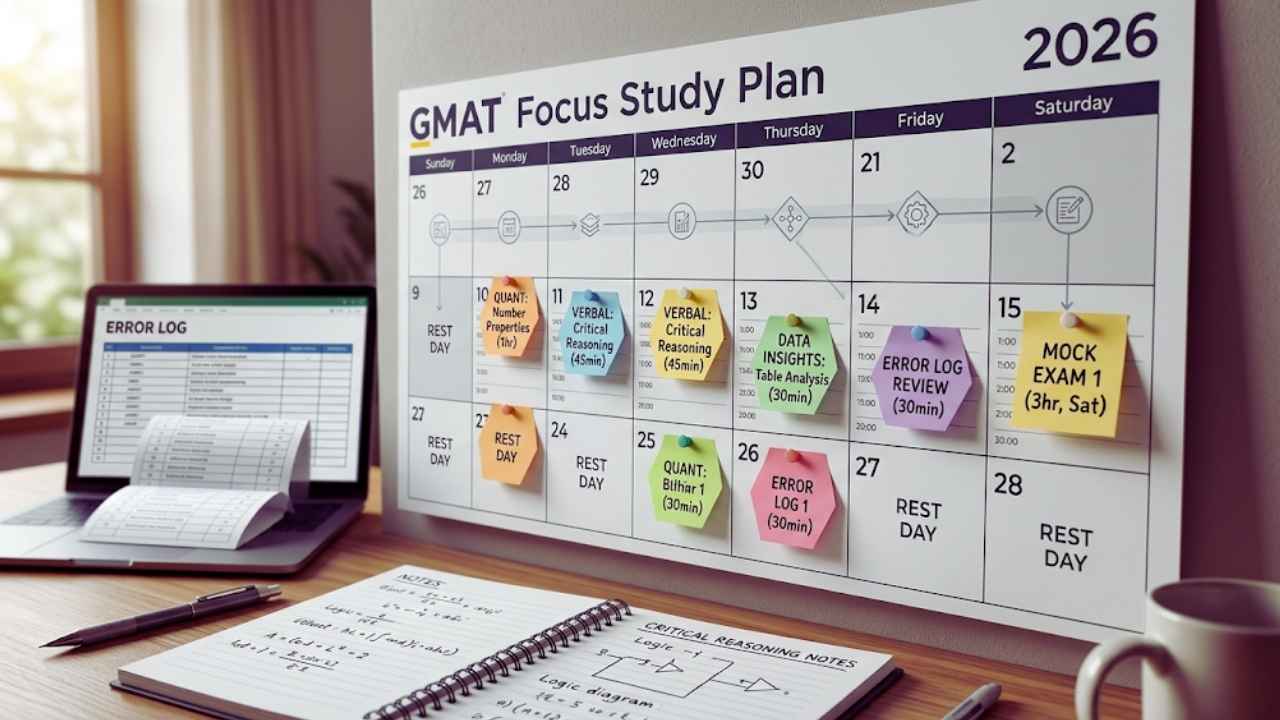
Consistency beats cramming every single time when it comes to standard test preparation. You need to carve out specific blocks of time in your weekly calendar and treat them like non-negotiable work meetings. A successful GMAT study plan 2026 breaks down complex subjects into bite-sized daily tasks rather than vague weekly goals.
Your schedule should include time for learning new concepts, doing practice sets, and deeply reviewing your mistakes. Taking days off to rest your brain is also a necessary part of this daily routine.
Structuring Your Week
If you work a normal full-time job, you might only have one hour a day during the week and a few hours on the weekend. Wake up an hour early to study while your mind is fresh, rather than trying to force yourself to do algebra after a stressful ten-hour shift. Dedicate specific days to specific topics. Use Monday and Tuesday for quantitative reasoning, Wednesday and Thursday for verbal reasoning, and Friday for data insights.
The Importance of the Error Log
Studying is completely useless if you keep making the exact same mistakes over and over again. You must keep a detailed error log spreadsheet. Every time you get a question wrong, write down the concept tested, the specific trap you fell for, and the actionable step you will take to avoid it next time.
|
Day of the Week |
Example Study Activity |
|
Monday |
Quant Algebra basics and 15 practice questions |
|
Tuesday |
Quant Ratio concepts and error log review |
|
Wednesday |
Verbal Reading comprehension passage drills |
|
Thursday |
Verbal Critical reasoning assumption questions |
|
Friday |
Data Insights Table analysis and calculator practice |
|
Saturday |
Full-length mock exam or massive review session |
|
Sunday |
Complete rest: No studying allowed |
Step 5: Master the Core Sections
Doing thousands of random practice problems will not improve your score if you do not understand the underlying strategies for each section. The exam tests your ability to think critically under pressure, not your ability to memorize advanced math or obscure vocabulary.
Each of the three sections requires a completely different approach to time management and problem-solving. By breaking down the specific question types within these areas, you can spot the common traps test makers use. Your GMAT study plan 2026 must dedicate focused blocks of time to mastering these distinct formats.
Conquering Quantitative Reasoning
The math section rarely goes beyond standard high school concepts, but the phrasing of the word problems is designed to confuse you. Because you do not have a calculator, you must master estimation and mental math. Learn to recognize when you can plug the answer choices directly into the equation instead of solving it algebraically. Focus heavily on number properties, ratios, percentages, and basic algebra rules. If a problem takes you more than three minutes to solve, you likely missed a logical shortcut.
Excelling in Verbal Reasoning
Verbal mastery requires a complete shift in how you read text. You cannot passively scan a reading comprehension passage like you would a morning news article. You must read aggressively, constantly searching for the author’s main point, tone, and the structure of their argument. For critical reasoning questions, take ten seconds to clearly identify the premise and the conclusion before you even look at the answer choices. Eliminate answers that use extreme words like always, never, or must, as these are usually traps.
Approaching Data Insights
This section bridges the gap between your math and verbal skills. You will face massive amounts of data in the form of charts, graphs, and multi-tabbed spreadsheets. The biggest challenge here is quickly determining what information is actually relevant and what is purely a distraction. Data sufficiency questions are particularly tricky because they do not ask you to solve the math problem; they only ask if you have enough information to solve it. Practice stopping your calculations the exact second you realize the answer is achievable.
|
Exam Section |
Key Topics to Master |
|
Quantitative Reasoning |
Linear equations, word problems, number properties |
|
Verbal Reasoning |
Argument structure, author tone, logical flaws |
|
Data Insights |
Multi-source reasoning, graphics interpretation |
Step 6: Take Full-Length Adaptive Practice Tests
As you get closer to your test date, your focus has to shift from learning new concepts to building mental endurance. Sitting in front of a computer screen and answering dense logical questions for over two hours is exhausting. Taking full-length, computer-adaptive practice tests is the absolute best way to train your brain for this marathon.
You should aim to complete at least four to six of these timed runs before the real thing. This phase is entirely about perfecting your pacing so you do not run out of time and panic at the end of a section.
Simulating Test Day Conditions
Take your practice exams under the exact same conditions you will face on test day. If your real exam is scheduled for Saturday at eight in the morning, you need to take your mock exams on Saturday at eight in the morning. Use a physical laminated whiteboard and a dry-erase marker for your scratch work, as these are what the test center provides. Do not pause the timer, do not listen to music, and only take the single optional ten-minute break allowed.
Pacing and Guessing Strategies
You have roughly two minutes per question across the entire exam. You must learn to let go of a question that completely stumps you. Wasting five minutes on one stubborn math problem will cost you the time you need to answer three easier questions later on, which will ruin your overall score. Use the new review and edit feature strategically. If a question is taking too long, flag it, make an educated guess, and move forward. You can always come back to it if you have a few minutes left at the end of the section.
|
Practice Test Rule |
Reason for the Rule |
|
No Music or Phones |
Test centers are completely silent and strict |
|
Use Laminated Scratchpad |
Mimics the exact tools you get on test day |
|
Do Not Pause Timer |
Builds actual mental endurance for two hours |
|
Take the 10-Minute Break |
Helps you learn how to reset your focus quickly |
Step 7: Analyze Mistakes and Refine Strategies
Taking a practice test only shows you where you stand; reviewing that practice test is how you actually improve your score. You should spend nearly as much time reviewing a mock exam as you did taking it.
Go through every single question carefully, even the ones you guessed on and happened to get right, to ensure you used the most efficient method available. Identify the root cause of your mistakes, whether it was a calculation error, misreading the prompt, or just poor time management. Group your errors and adjust your GMAT study plan 2026 accordingly.
Deep Dive into the Error Log
When you review a wrong answer, writing down “I messed up the math” is not helpful. You need to be hyper-specific. Write down, “I forgot that a negative number squared becomes positive or I missed the word NOT in the second paragraph.” This level of detail helps you recognize your own bad habits.
Targeted Drills for Weak Spots
Once you identify a clear pattern in your errors, stop taking full practice tests for a few days. Spend that time doing targeted drills. If you keep missing rate and work problems, do sets of fifteen questions focused entirely on that specific topic until the logic becomes second nature.
|
Error Type |
Solution Strategy |
|
Careless Calculation |
Write out all math steps neatly on the whiteboard |
|
Misread the Question |
Read the final sentence twice before calculating |
|
Ran Out of Time |
Practice guessing and moving on at the 2.5-minute mark |
|
Concept Gap |
Go back to the strategy course and re-watch the lesson |
Test Day Preparation and Final Tips
The final week before your exam is not the time to cram new formulas or take grueling, stressful practice tests. Your brain needs time to consolidate all the information and rest before the high-pressure environment of test day. Taper your studying down to light review sessions focusing only on your error log and basic rules.
Make sure your logistics are fully planned out, from your travel route to the exact government ID you need to bring. Staying calm and trusting the work you have put in is your best asset at this final stage.
The Final 48 Hours
Do absolutely no heavy studying the day before the exam. Go for a walk, eat a normal dinner, and get a full night of sleep. Layout your comfortable clothes and pack your bag with your approved ID and a small snack for your break. If you are taking the exam online from your house, clear your entire desk, run the final system check on your computer, and ensure your roommates know to stay completely quiet.
Managing Test Anxiety
It is completely normal to feel a spike of adrenaline when the first question pops up on the screen. Take three deep breaths and remember your pacing strategy. Because the test is adaptive, it is going to feel difficult very quickly. Do not panic if the questions seem incredibly hard; that just means you are doing well and the algorithm is pushing you. Stay fully present in the moment and focus purely on the question directly in front of you.
|
Final Week Checklist |
Status |
|
Confirm test center location or room setup |
Mandatory |
|
Check valid, unexpired government passport/ID |
Mandatory |
|
Review error log one final time |
Recommended |
|
Get 8 hours of sleep the night before |
Highly Recommended |
Final Thoughts
Applying to a top business school requires serious dedication, but breaking the exam process down into manageable daily steps makes it highly achievable. The updated exam format rewards logical thinking, mental agility, and data literacy over brute-force memorization. This actually works in your favor, as it aligns perfectly with the demands of a modern MBA classroom and the corporate world.
By sticking to a structured GMAT study plan for 2026, you will steadily build your reasoning skills, conquer your specific weak spots, and approach test day with genuine confidence. Trust the hours of hard work you put in, stay disciplined with your error log, and keep your eyes on the long-term career goals that motivated you to start this journey in the first place.
Frequently Asked Questions (FAQs) About Study For GMAT 2026
What is considered a good score on the new scale?
Because the new exam dropped the old 200 to 800 scale in favor of a 205 to 805 scale, the numbers look completely different. A score of 645 on the current edition represents roughly the 89th percentile, making it a highly competitive score for top-tier business schools. Anything above a 685 puts you in the elite 97th percentile.
Can I choose the order of the sections?
Yes, you have complete control over the section order. There are six possible combinations to choose from when you start the test. Many successful test takers prefer to tackle their absolute weakest subject first while their mental energy is at its peak, saving their strongest subject for the final 45 minutes.
Is the exam harder now without geometry and sentence correction?
The exam is not necessarily mathematically harder, but it is much more focused. By removing pure memorization tasks like grammar rules and shape formulas, the test makers have placed a much heavier emphasis on pure logical reasoning and data interpretation. You cannot rely on memorization anymore; you have to rely on critical thinking.
How does the review and edit feature actually work?
As you progress through a section, you can click a small flag icon on any question you want to look at again. After you finish the final question of that specific section, a review screen appears showing all your flagged items. If you have time remaining on the clock, you can revisit them and change a maximum of three answers before the section officially ends.