


If you want to trade successfully, you have to get comfortable looking at market data. Stock charts are the ultimate tool for tracking a company’s performance over time. They strip away the loud noise of news headlines, ignore the talking heads on television, and show you the objective truth.
If you want to make smarter investment choices, understanding these visuals is entirely non-negotiable. We are going to break down exactly what they are, how they function, and why they matter so much to modern traders. You don’t need a math background to figure this out. You just need to understand a few basic concepts about supply and demand. Let’s look at the foundational ideas behind these graphs.
|
Concept |
Explanation |
Practical Application |
|
Visual Data |
Translates numbers into readable shapes |
Helps spot historical trends instantly |
|
Market Psychology |
Displays the battle between buyers and sellers |
Reveals true market sentiment |
|
Technical Analysis |
Using past data to predict future moves |
Finding optimal entry and exit points |
What Is a Stock Chart?
At its core, a stock chart is just a visual history of a stock’s price. Every time shares change hands, a transaction gets recorded at a specific price. The chart takes all those thousands of trades and plots them on a grid. You get to see the exact price minute by minute, day by day, or year by year.
It shows you the raw, unfiltered facts without any media bias. While news outlets might hype up a company’s latest product, the chart reveals the actual market reaction. If the chart is dropping while the news is good, the chart is telling you the truth about how investors actually feel.
Why You Need to Know How to Read a Stock Chart?
You might think you can just buy good companies, hold them forever, and ignore the graphs. Sure, looking at a company’s earnings and debt tells you what to buy. But knowing how to read a stock chart tells you exactly when to buy.
Even a phenomenal company can be a terrible investment if you buy at the absolute peak of a hype cycle. Charts help you spot the perfect entry points, manage your risk, and avoid buying right before a massive market correction. They give you the visual data needed to avoid making decisions based purely on your emotions.
The Core Elements of Any Stock Chart
Every single trading platform uses the exact same foundation for its graphs. Whether you log into a free phone app or premium desktop software, the core grid looks identical. You absolutely have to understand how this basic layout functions before you can even attempt to analyze price movements. Getting comfortable with the grid and the basic terminology is your first major hurdle.
Once you understand these underlying mechanics, you can switch between completely different brokerages without ever feeling lost. You will know exactly where to look for the price, the timeframe, and the company ticker. Think of this foundation like the frame of a house. You need it clearly established before you can build any complex trading strategies inside it. Let’s break down the specific parts of this grid so you know exactly what you are looking at.
|
Chart Element |
Function |
Importance |
|
Vertical Axis |
Displays the current and historical dollar price |
Shows exactly how expensive or cheap the shares are |
|
Horizontal Axis |
Displays the chronological timeline |
Tracks the momentum and speed of the stock over time |
|
Ticker Symbol |
The unique letters identifying the specific company |
Ensures you are looking at the correct financial asset |
|
Timeframe |
The duration each individual data point represents |
Allows you to quickly switch between daily and yearly views |
The Price and Time Axes
Think back to middle school math class. A stock chart is built on a standard grid with two main axes. The vertical line running up and down the right side of your screen is the price axis. As the line goes up, the stock costs more money.
The horizontal line across the bottom tracks time. The left side is the past, and the far right edge is the present moment. Watching the price move up, down, and across the timeline gives you the stock’s complete history at a single glance.
Ticker Symbols and Basic Company Information
Look near the top left corner of any chart, and you’ll spot a few capital letters. That is the ticker symbol. Every public company gets a unique code. Apple is AAPL, Microsoft is MSFT, and Ford is simply F.
Right next to the ticker, you’ll see the current price and how much it has changed today. Many platforms also throw in extra details like market cap or dividend yield. This gives you a quick snapshot of the business before you dive into the graph.
Choosing the Right Timeframe
Timeframes control how much data fits into a single point on your chart. If you pick a daily timeframe, each data point covers one full trading day. This is perfect for normal investors who want a smooth, reliable look at a trend. If you pick a one-minute timeframe, each point covers just sixty seconds.
Day traders love this fast-paced view to catch quick moves. Long-term investors often prefer weekly or monthly charts to see massive, multi-year trends without getting distracted by daily bumps.
The Three Main Types of Stock Charts
Once you understand the basic grid, you need to know how the price data gets drawn onto the screen. Traders and financial institutions use three primary visual styles to track prices. Each method has its own specific strengths and weaknesses depending on what you want to achieve. Each unique style offers a completely different level of detail and serves a totally different analytical purpose.
While beginners almost always start with the simplest version available, stepping up to the more detailed visuals will give you a massive edge. You want a format that gives you the whole picture, almost like a high-quality landscape-style feature image of the market’s terrain. Let’s look at the three main ways you can visualize this data.
|
Chart Type |
Visual Style |
Best Use Case |
|
Line Chart |
A single continuous connected line |
Getting a quick overview of historical direction |
|
Bar Chart |
Vertical lines with tiny horizontal opening ticks |
Seeing the exact high and low boundaries of a session |
|
Candlestick Chart |
Colored rectangular bodies with vertical wicks |
Instantly spotting market sentiment shifts and reversals |
Line Charts
Line charts are the most basic option available. If you do a quick search for a stock, you get a line chart. It simply takes the closing price of each day, plots a dot, and connects all those dots with a continuous line.
It completely ignores what happened during the middle of the trading day. Line charts are great if you just want a clean look at the overall direction over a decade. But for active trading, they leave out way too much crucial data.
Bar Charts
If you want more detail, you move up to a bar chart. Traders often call this an OHLC chart, which stands for Open, High, Low, and Close. Instead of a single line, you get a series of disconnected vertical lines. The top of the bar is the absolute highest price of the day, and the bottom is the lowest.
Small tick marks on the left and right show you exactly where the price opened and closed. This lets you see exactly how wild the price swings were during that specific period.
Candlestick Charts
Candlestick charts are the undisputed king of modern trading. They show the exact same data as a bar chart, but they package it beautifully. In fact, a candlestick is essentially a realistic vertical illustrative infographic that gives you all the high and low data at a single glance.
You get the whole story of buyers and sellers in one clean, color-coded visual. You don’t have to squint to see tiny tick marks. You just look at the colors on your screen to know who is winning the battle.
Understanding the Anatomy of a Candlestick
A candlestick has two main parts. The thick rectangular middle is the real body. It shows the difference between the opening and closing prices. Sticking out of the top and bottom are thin lines called wicks or shadows.
These wicks show the absolute highest and lowest prices reached during that timeframe. A long wick means the price spiked up or dropped hard, but got aggressively pushed back before the period ended.
Bullish Versus Bearish Candles
The real magic of candlesticks is the color coding. A green body is a bullish candle. It means the stock closed higher than it opened. Buyers took control, overwhelmed the sellers, and pushed the price up.
A red body is a bearish candle. The stock closed lower than it opened because sellers dominated. A screen full of massive green candles screams heavy buying pressure, while a cascade of red candles signals panic selling.
Essential Concepts for Reading Stock Charts
Staring at red and green candlesticks won’t help you unless you actually know what broader concepts to look for within the data. You need to take a step back from the daily noise and look at the bigger picture. Prices in the financial sector absolutely never move in a perfectly straight line.
They constantly push and pull in distinct, recognizable waves driven by institutional algorithms and retail emotions. By correctly identifying the underlying currents of these waves, you can figure out where the stock is likely to go next. These concepts are the foundation of every successful trading strategy. If you master these ideas, you will instantly be ahead of most retail traders. Let’s dive into the mechanics of how price actually moves.
|
Market Concept |
Simple Definition |
How Professional Traders Use It |
|
Market Trend |
The overarching trajectory of the price action |
To always ensure they trade with the dominant flow |
|
Support Level |
A historical price floor created by high demand |
To find safe, low-risk areas to purchase cheap shares |
|
Resistance Level |
A historical price ceiling created by heavy supply |
To know exactly when to take profits and sell |
|
Trading Volume |
The absolute number of shares traded |
To confirm if a sudden price breakout is legitimate |
Identifying the Trend
There is an old trading rule you should never ignore: the trend is your friend. An uptrend happens when a stock creates a staircase pattern of higher highs and higher lows. Every time it drops slightly, buyers step in at a higher price than before, driving it further up. A downtrend is the exact opposite.
You will see a sequence of lower highs and lower lows. Attempting to buy during a heavy downtrend is like trying to catch a falling knife. You want to trade alongside the trend, not against it.
Support and Resistance Levels
Prices constantly bounce off invisible floors and ceilings. Traders call these support and resistance levels. Support is a price where a falling stock usually stops, rests, and bounces back up. Buyers see the cheap price and rush in, creating a floor.
Resistance is a ceiling where a rising stock usually stalls and drops. Sellers decide the price is high enough and start taking profits. Drawing horizontal lines at these bounce points gives you clear zones to buy or sell.
The Importance of Trading Volume
Look at the very bottom of your chart, and you’ll see a row of vertical bars. That is the volume indicator. It tells you exactly how many shares traded hands during that period. Volume is the fuel behind any price move.
If a stock breaks above a resistance ceiling on massive volume, the move is legitimate. If it breaks out on tiny volume, it is a trap. Never trust a major price move that lacks the trading volume to back it up.
Popular Technical Indicators for Beginners
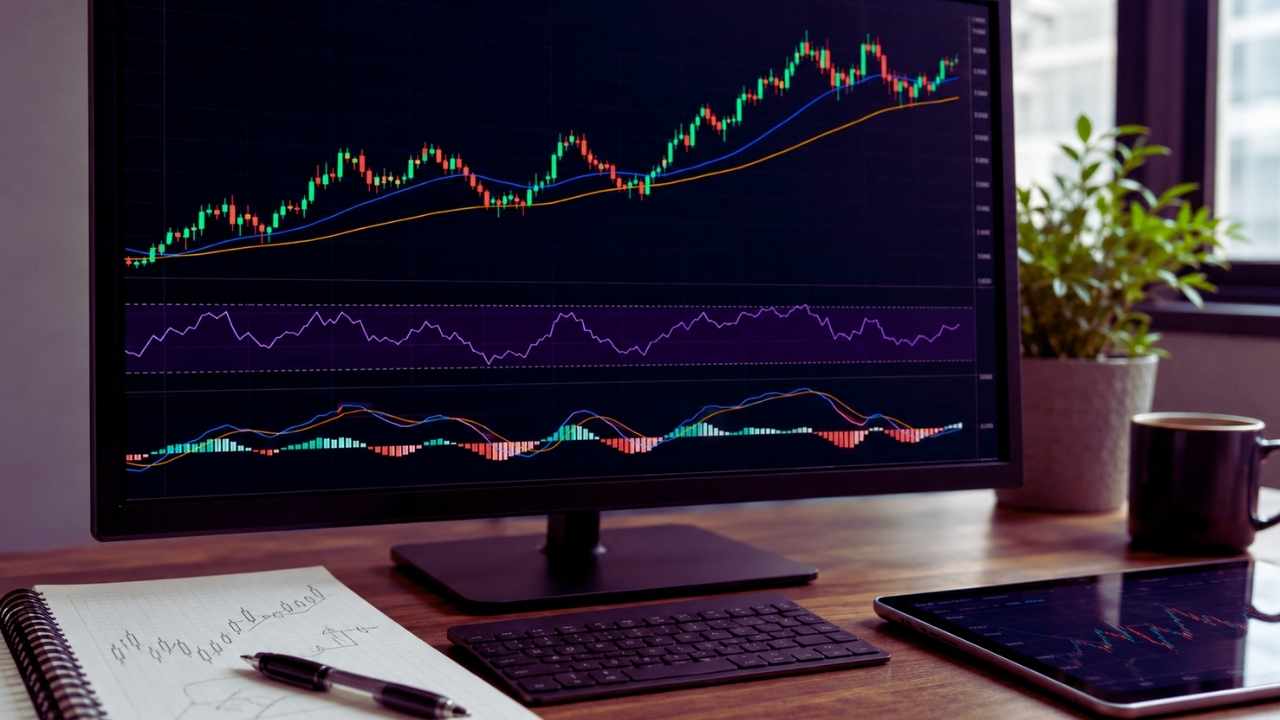
While tracking price and volume is incredibly powerful, technical indicators can give you a fantastic mathematical edge. These tools take raw historical data, run it through complex formulas, and overlay it visually on your chart. They help you confirm trends and spot hidden momentum shifts before they actually happen.
While there are hundreds of crazy, complicated indicators out there, beginners should stick to the tried-and-true basics. Keeping your screen clean is the secret to avoiding analysis paralysis. You only need a few reliable tools to make great decisions. Let’s look at the top three indicators every trader uses.
|
Indicator Name |
What It Actually Does |
Trading Signal Example |
|
Moving Average |
Smooths out daily price swings |
Price crossing above it signals an uptrend |
|
RSI |
Measures the speed of price changes |
A reading below 30 suggests a buying opportunity |
|
MACD |
Tracks momentum and trend shifts |
Lines crossing upward triggers a buy alert |
Moving Averages Explained
A moving average smooths out chaotic daily price swings into one easily readable, flowing line. The fifty-day and two-hundred-day moving averages are the most popular among professionals. If the stock is trading above its two-hundred-day line, it is in a healthy, long-term uptrend.
If it drops below, it is in deep trouble. Traders also watch for crossovers. When a fast fifty-day line crosses up and over a slow two-hundred-day line, it triggers a golden cross. This is a massive bullish signal.
Relative Strength Index
The Relative Strength Index usually sits in a separate box below your main chart. Traders just call it the RSI. It is a single line that wiggles between zero and one hundred to measure momentum.
If the RSI blasts above seventy, the stock is overbought. It went up way too fast and is due for a pullback. If the RSI drops below thirty, the stock is oversold. Panic sellers pushed it too low, and value buyers might step in soon.
Moving Average Convergence Divergence
The MACD sounds incredibly complicated, but it is really just two lines and a bar graph. It helps you catch brand new trends right as they start. You just watch the two lines interact. When the fast line crosses up over the slow line, it triggers a buy signal.
Momentum is shifting upward. When the fast line crosses down under the slow line, it is a sell signal. Using the MACD helps you confirm the trend before you risk your cash.
Common Stock Chart Patterns You Should Know
Human emotions never really change. Greed and fear cause everyday traders to react the exact same way over and over again. Because of this predictable herd mentality, price charts constantly draw the exact same visual shapes. We call these shapes chart patterns.
Recognizing these setups gives you a visual cheat code for predicting future price moves. Once you train your eyes to spot them, you will see them absolutely everywhere. They help you stack the mathematical odds heavily in your favor. Let’s look at a few highly reliable setups you need to memorize.
|
Pattern Name |
Visual Appearance |
What It Tells You About the Market |
|
Head and Shoulders |
Three peaks with the middle highest |
An uptrend is dying and a crash is coming |
|
Double Top |
Looks exactly like the letter M |
A massive wall of sellers blocked the price |
|
Double Bottom |
Looks exactly like the letter W |
A strong support floor has finally formed |
Head and Shoulders Pattern
The head and shoulders pattern is a famous, terrifying warning sign. It marks the absolute death of an uptrend. The stock rises to a peak, dips, pushes to an even higher peak, dips again, and makes a final weak peak.
The bottoms of those dips form a horizontal neckline. Once the price cracks below that neckline, the buyers are officially dead. A long, painful downtrend almost always follows.
Double Tops and Double Bottoms
These patterns look exactly like the letters M and W. A double top happens when a stock hits a high price, drops, and tries to hit that high again, but miserably fails. It forms an M. A massive wall of sellers is sitting at that exact price.
A downtrend is imminent. A double bottom forms a W. The stock hits a low, bounces, and tests that low again. Buyers aggressively defend that bottom line, signaling a fresh uptrend is starting.
Bullish and Bearish Engulfing Candles
Unlike massive formations that take months to build, engulfing patterns only take two days to play out. A bullish engulfing pattern happens right at the bottom of a downtrend. You get a small red candle, followed the next day by a massive green candle that completely covers the previous day’s red body.
Buyers suddenly overpowered sellers overnight. A bearish engulfing pattern is the exact reverse. A massive red candle swallows a small green one, signaling a sudden drop is coming.
Common Mistakes Beginners Make When Reading Charts
Learning the mechanics of charting is incredibly exciting, but it is easy to fall into a few common psychological traps. Being fully aware of these specific pitfalls can save you a massive amount of wasted time, emotional frustration, and money. Knowing exactly what to avoid is arguably just as critical as knowing what to look for.
Beginners often try to force trades that just aren’t there, or they make their screens way too complicated. Keep your strategy clean and simple. Make sure you don’t fall into these classic beginner traps during your first year.
|
Beginner Mistake |
Why It Ruins Your Trades |
The Easy Solution |
|
Indicator Clutter |
Causes severe analysis paralysis |
Stick to price action and one moving average |
|
Ignoring Indexes |
Broad market crashes drag everything down |
Always check the market weather first |
|
Fighting the Trend |
Results in buying right before a massive drop |
Only trade in the proven direction |
Using Too Many Indicators at Once
New traders absolutely love to slap ten different indicators on their screens. They add bands, lines, and oscillators until the chart looks like a neon mess. This is a total disaster. Indicators will inevitably give you conflicting signals.
One tool says buy, the other says sell, and you freeze in analysis paralysis. Keep your screen incredibly clean. Focus heavily on raw price action and volume. Add one or two trusted indicators, and leave the rest alone.
Ignoring the Overall Market Context
You cannot analyze a single stock while ignoring the rest of the financial world. A company might have a perfect bullish chart setup, but if the entire stock market is crashing, that stock is going down too.
A rising tide lifts all boats, and a crashing wave sinks them. Always check the main market indexes like the S and P 500 to check the overall weather before you place a trade on an individual stock.
Trading Against the Primary Trend
Trying to play the hero is a fast track to losing money. Beginners often see a stock crashing for six months and try to buy the absolute bottom. We call this catching a falling knife.
Your timing is rarely perfect, and the stock usually bleeds much lower than you expect. Instead of fighting the current, swim with it. Buy stocks that are already trending up when they take a brief, healthy dip.
Final Thoughts
Learning how to read a stock chart is exactly like learning a brand new language. At first glance, it looks like complete gibberish. But with a little patience and daily practice, the lines and candles start telling a very clear, logical story. You start seeing exactly where the institutional buyers are stepping in and where the panicked sellers are bailing out. It pulls back the curtain on how Wall Street actually operates. Just remember to keep things incredibly simple when you start out.
Don’t clutter your screen with useless, flashy indicators. Focus entirely on identifying the primary trend, respect your support lines, and always check your volume before trusting a big move. Technical analysis won’t make you a millionaire overnight, but it gives you the objective data you need to protect your downside and maximize your upside. Stick to the basics, manage your risk, and let the chart guide your next profitable move.
Frequently Asked Questions (FAQs) About How to Read Stock Chart
What is the absolute best timeframe for a brand new trader to use?
For anyone just starting out, the daily timeframe is universally recommended as the safest and most reliable place to learn. It filters out the chaotic, unpredictable volatility of minute-by-minute trading. This allows you to clearly see the true, overarching direction of the market without panicking over small intraday dips.
Do I really need to purchase expensive, professional charting software?
You absolutely do not need to spend a single penny on software when you are in the learning phase. Fantastic platforms like TradingView and standard brokerage applications offer highly advanced, real-time visual tools completely free of charge. These free versions contain every pattern and indicator you could possibly need.
Does analyzing a stock chart guarantee that my trades will make money?
No method of analysis can ever provide a one hundred percent guarantee because the markets are inherently chaotic. Charts simply provide a visual history of past human behavior, helping you identify high-probability setups. Unexpected news events can instantly destroy a perfect technical setup, which is exactly why you must always use stop-loss orders.
What is the main difference between fundamental analysis and technical analysis?
Fundamental analysis requires you to dig into a corporation’s balance sheets and profit margins to determine its true value. Technical analysis completely ignores the actual business and focuses solely on the historical price data and visual patterns on a graph. The best investors use fundamentals to pick the right company and technicals to find the perfect entry price.
What is a logarithmic scale and why do long-term investors prefer it?
A standard linear scale spaces dollar amounts equally on the vertical axis. A logarithmic scale spaces the vertical axis strictly by percentage changes. Long-term investors prefer the logarithmic scale for multi-decade charts because it prevents massive recent dollar gains from visually hiding the explosive percentage growth a company experienced during its early years.