


Stepping into a modern hiring loop feels like facing a two-headed monster: the soft-skills chat and the grueling hard-skills test. You might be a brilliant systems architect who freezes when asked about workplace conflict, or a charismatic project lead who draws a blank when handed a dry-erase marker.
In 2026, the job market is unapologetic. According to recent data from Ashby, a single job posting now attracts an average of 340 applicants. The application-to-interview conversion rate sits at a brutal 2% to 5%. Getting a callback isn’t just a win; it’s beating incredible odds. But once you are in the door, you have to prove you are the whole package.
Companies do not just hire a list of proficiencies; they hire a person. That is why understanding the nuances of a behavioral vs technical interview is your biggest advantage. Employers want to know you can write clean code and build scalable pipelines. But they also need to know you won’t lose your cool when a Friday afternoon deployment crashes the system.
Let’s break down exactly what hiring managers look for in both rooms, examine current market realities, and map out a stress-free plan to ace both.
The Real State of Tech Hiring in 2026
We cannot plan your prep without looking at the current numbers. Generative AI tools have changed the game. Rote syntax knowledge is no longer a golden ticket. Instead, engineering leaders look for deep problem-solving and rapid adaptability.
Karat’s 2026 engineering survey of 400 hiring leaders revealed a massive shift: 71% of leaders say AI is making technical skills harder to assess because developers can now use tools to produce functional code in seconds. Because of this, standard coding rounds have become notoriously volatile. Data from technical interview platforms shows an 80% to 90% failure rate in coding rounds, and even top-tier engineers face a roughly 22% failure risk on any single technical screen simply due to the luck of the draw.
At the same time, the payoff for surviving this gauntlet is huge. Industry studies show that 73% of engineering leaders view top-performing engineers as worth at least triple their base compensation. A developer who effectively partners with AI, communicates clearly, and adapts to shifting business goals ships features at lightning speed.
|
Metric |
Current Estimate |
What It Means for You |
|
Resume-to-Interview Rate |
2% – 5% |
Your resume must lead with measurable data and actual business outcomes. |
|
Average Applicants per Role |
340 candidates |
You are competing against massive noise. Referrals and networking matter more than ever. |
|
Coding Screen Failure Rate |
80% – 90% |
Technical tests are getting harder to compensate for AI assistance. Preparation is non-negotiable. |
|
Length of Interview Process |
4 to 6 weeks |
52% of companies stretch their hiring over a month. You need mental stamina. |
Decoding the Behavioral vs Technical Interview
Let’s simplify the core difference. A technical screen proves you can do the work today. A behavioral screen proves you can still do the work six months from now when deadlines shrink and the team is stressed.
If you treat a behavioral vs technical interview like the exact same conversation, you will hit a wall. In a behavioral round, dead air kills your momentum. You need a narrative flow. But do not make the mistake of thinking silence is acceptable in a technical round, either. If you go quiet while solving a code challenge, the interviewer gets no signal on your thought process.
|
Feature |
Behavioral Interview |
Technical Interview |
|
Core Goal |
Predict future success based on your past choices. |
Evaluate raw logic, system design, and execution speed. |
|
Format |
Conversational stories (“Tell me about a time…”). |
Live coding, system whiteboarding, or AI pairing. |
|
What They Grade |
Adaptability, ownership, communication, grit. |
Algorithmic logic, edge-case spotting, clean syntax. |
|
Biggest Mistake |
Rambling without a point or blaming old teammates. |
Coding in total silence and ignoring system constraints. |
Winning the Behavioral Interview: Prove Your Adaptability
Memorizing generic scripts will not work. You need a vault of versatile stories. Hiring managers hate long-winded, overly technical monologues that miss the business impact. They want you to zoom out and show how your work helped the company move faster or save money.
Top tech companies evaluate candidates on a strict rubric. They look for specific traits: motivation, proactivity, perseverance, conflict resolution, empathy, and the ability to handle ambiguity. When an engineering manager asks about your biggest professional failure, they are testing your maturity. Tech moves fast, and things break constantly. Teams want people who own their mistakes, fix them fast, and share the lessons.
Did you know that 47% of interview failures happen because the candidate simply did not research the hiring company? That is the most preventable mistake you can make. Review their core values and map your stories to those values.
The Rise of Collaboration Skills
Because AI coding assistants handle basic scripting, human communication is now a premium skill. Companies want engineers who navigate ambiguity. You must show how you handle sudden shifts in product requirements, manage stakeholders who demand unrealistic features, and mentor junior peers without micro-managing.
Mastering the STAR Method
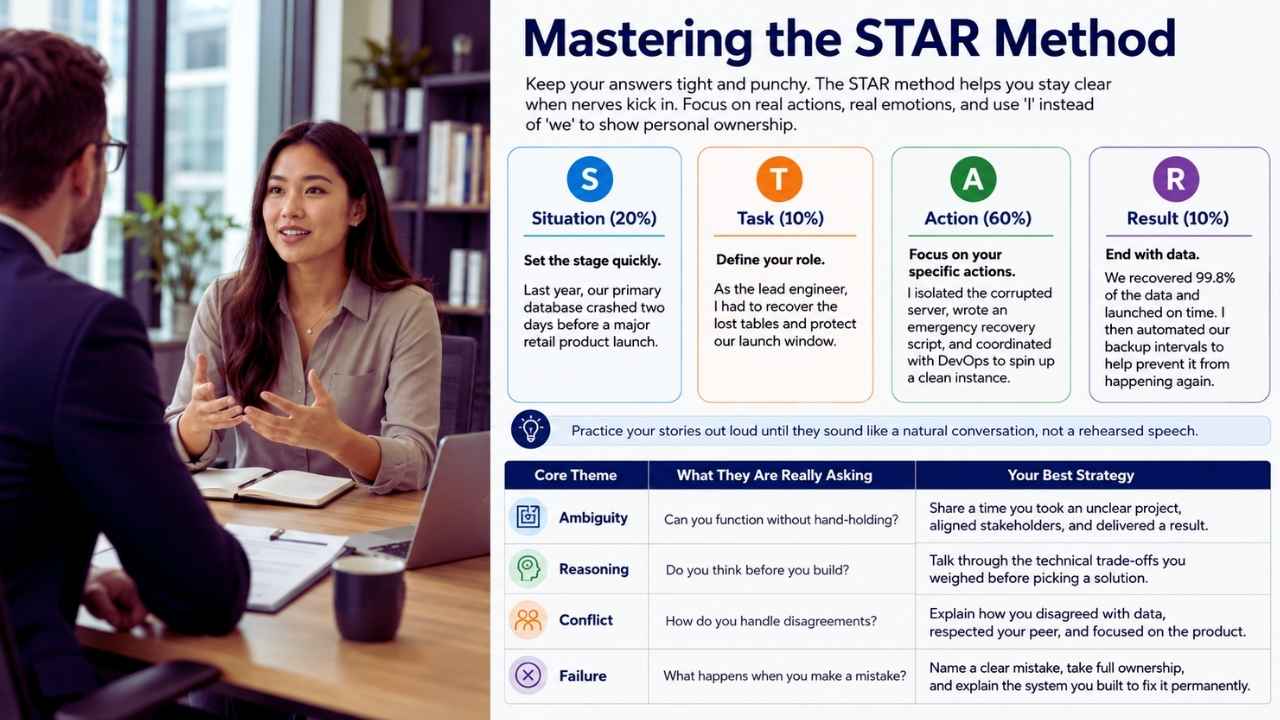
To keep your answers tight and punchy, use the STAR method. It keeps you from rambling when nerves kick in. Focus your responses on actual behaviors and emotions, and always use “I” instead of “we” to show personal ownership.
- Situation (20% of your answer): Set the stage quickly. “Last year, our primary database crashed two days before a major retail product launch.”
- Task (10% of your answer): Define your role. “As the lead engineer, I had to recover the lost tables and protect our launch window.”
- Action (60% of your answer): What did you do? Focus on your specific actions. “I isolated the corrupted server, wrote an emergency recovery script, and coordinated with DevOps to spin up a clean instance.”
- Result (10% of your answer): End with data. “We recovered 99.8% of the data and launched on time. I then automated our backup intervals to make sure it never happens again.”
Practice your stories out loud until they sound like a natural conversation, not a rehearsed speech.
|
Core Theme |
What They Are Really Asking |
Your Best Strategy |
|
Ambiguity |
Can you function without hand-holding? |
Share a time you took an unclear project, aligned stakeholders, and delivered a result. |
|
Reasoning |
Do you think before you build? |
Talk through the technical trade-offs you weighed before picking a solution. |
|
Conflict |
How do you handle disagreements? |
Explain how you disagreed with data, respected your peer, and focused on the product. |
|
Failure |
What happens when you make a mistake? |
Name a clear mistake, take full ownership, and explain the system you built to fix it permanently. |
Conquering the Technical Interview: Logic Over Syntax
The technical screen is where the real pressure hits. But if you know how the game is scored, you can control the room. Take-home projects are losing their signal value because teams cannot verify if a candidate used an AI tool to write the entire application. As a result, the industry has swung heavily back to live, observed problem-solving.
Live Coding and AI Pair Programming
A growing trend is the “Human + AI” interview. Progressive companies know you will use AI tools on the job, so they want to see how you use them under pressure. They evaluate how you phrase prompts, whether you spot AI hallucinations, and how quickly you fix buggy code generated by the model.
If you are in a traditional live coding setting, there is one rule you must follow: do not go silent. Experienced interviewers note that going silent is the number one reason candidates fail. When you stop talking, the interviewer has no data to evaluate. If you make a mistake in your head and type it out without speaking, the interviewer just thinks you do not know the material. But if you say, “I’m thinking about a nested loop here, but that hits an inefficient $O(n^2)$ time complexity. Let’s use a hash map instead to keep it at $O(n)$,” you win. You just proved you value performance.
Another massive trap? Writing code before having a plan. Jumping straight to the keyboard usually results in solving the wrong problem. Clarify the constraints first: “Will this input ever exceed 5 million rows?” or “Do we need to handle negative numbers?” Get the interviewer’s buy-in on your approach before writing real code.
Core Technical Patterns to Master
You don’t need to memorize thousands of questions. Focus on the core patterns that appear constantly in modern screens:
- Arrays and Strings: Master the two-pointer technique and sliding windows.
- Hash Maps: The absolute holy grail of interviews. They turn slow brute-force solutions into fast constant-time lookups.
- Trees and Graphs: Know your Breadth-First Search (BFS) and Depth-First Search (DFS) traversals inside out.
What to Do When You Get Stuck?
You will hit a wall at some point. Interviewers intentionally push your limits to see how you handle frustration. Another major red flag for interviewers is a candidate who argues or gets defensive when given a hint. The ability to incorporate feedback is a core trait they grade.
When you do not know an answer, don’t try to guess or fake it. Say, “I haven’t used this specific framework in production, but looking at how it handles state, here is how I would troubleshoot this issue.” Then walk them through your process. Tell them exactly what you would look up in the documentation. Showing your path to an answer is far better than pretending to be a walking encyclopedia.
|
Interview Style |
What to Expect |
How to Win |
|
Live Algorithmic Screens |
Shared screens on platforms like CoderPad. |
Talk out loud. Write down your edge cases and logic before typing code. |
|
AI Copilot Pairing |
Coding live while using approved AI assistants. |
Show prompt efficiency, question the AI’s logic, and catch subtle bugs. |
|
System Design Rounds |
Designing large architecture on an interactive canvas. |
Start high-level. Ask about scale, users, and data flow before diving into microservices. |
|
Take-Home Technicals |
Building a standalone app or tool over a weekend. |
Write production-ready code. Include unit tests, clear documentation, and clean architecture. |
The Integrated Prep Playbook
Separating your behavioral vs technical interview prep is a mistake. The best candidates mix them together. You might finish a highly complex coding challenge, only for the interviewer to instantly ask, “How would you explain this design choice to a non-technical client?” If you answer with dense engineering jargon, you fail the soft-skills test.
Given that 52% of companies now stretch their interview process across 4 to 6 weeks, you need a routine that builds endurance. Do not try to cram everything into a single weekend.
|
Day |
Focus Area |
What to Do |
|
Monday |
Core Patterns |
Solve 2 or 3 algorithmic puzzles focusing on Hash Maps and Arrays. |
|
Tuesday |
Story Architecture |
Outline three strong STAR stories focusing on ambiguity, failure, and team conflict. |
|
Wednesday |
Live Fire Practice |
Set a timer and solve a code challenge while explaining your thoughts out loud to a mirror. |
|
Thursday |
Translation Skills |
Practice explaining a complex technical project to a friend who doesn’t work in tech. |
|
Friday |
Company Context |
Dig into the target company’s engineering blog to understand their architecture and team values. |
Set up realistic mock interviews. Find a peer or use an online platform to practice under pressure. Writing code alone on your couch is comfortable; writing it while a principal engineer watches your cursor hover over a bug is entirely different. Get honest feedback on your pacing, tone, and logic.
Final Thoughts
Getting the offer requires balancing logic with human connection. The behavioral vs technical interview process isn’t a conflict between two different skill sets; it’s a balance. Your technical ability gets you the invite, but your communication, humility, and resilience secure the job.
Stop treating your coding skills and your soft skills as separate tools. Bring them together. Work out loud during your technical rounds, and bring real engineering context to your behavioral stories. Put in the practice, tighten your storylines, speak through your code, and walk into your next interview ready to show them you can handle both the code and the culture.
Frequently Asked Questions (FAQs) About Behavioral vs Technical Interview
Why do so many solid developers fail coding rounds?
It is almost always a breakdown in communication, not a lack of coding skill. Candidates jump straight into writing code without verifying constraints, ignore the interviewer’s hints, or fail to explain their choices. The interviewer cares about your thought process, not just a passing test suite.
Can personality save a completely broken technical round?
Rarely. If your code does not work and your logic is fundamentally flawed, being polite won’t get you past the engineering bar. However, if you are right on the line—maybe you ran out of time to optimize the final loop but your approach was sound—excellent communication and high self-awareness will absolutely push you into a “yes.”
What exactly is a “Human + AI” technical interview?
It is a live coding session where you can actively use tools like GitHub Copilot or ChatGPT. The interviewer isn’t testing if you can memorize syntax; they are testing if you can architecturalize a solution, prompt an AI cleanly, and spot bugs in the generated code.
How do I answer a behavioral question if I don’t have a matching story?
Be transparent. Say, “I haven’t faced that exact situation yet, but here is a similar challenge I dealt with…” or “If that happened on my current team, here is the exact framework I’d use to handle it step-by-step.” Never invent a fake story; interviewers ask follow-up questions that easily tear holes in made-up scenarios.
How long should I spend explaining my code?
Keep it punchy. Take 2 to 3 minutes to explain your plan and confirm time complexity before you start writing. When you finish, take 60 seconds to summarize how the code handles edge cases and note any trade-offs you made.