


Every single day, major corporations buy up rivals or combine forces to dominate the market. You see these massive shifts splashed across financial headlines, usually lumped under the familiar abbreviation M&A. But using these terms interchangeably is a mistake that obscures how corporate power actually shifts.
When parsing these large-scale corporate shakeups, understanding the exact difference between merger and acquisition structures is essential for investors, employees, and business leaders alike. At their core, both corporate actions completely reshape how businesses operate, handle finances, and command market share. They represent two unique strategic paths used to achieve rapid growth, enter new territories, and beat out the competition. One path relies on mutual cooperation to build a brand-new corporate entity from scratch. The other path relies on outright purchasing power, where a dominant company takes complete control of another.
The digital era has accelerated these deals significantly. Small tech startups and massive e-commerce companies are bought or merged every week as traditional brick-and-mortar brands try to buy their way into digital relevance. To understand how these power moves impact the economy, we have to look past the corporate jargon. We need to examine the mechanics, legal structures, and real-world outcomes of these transactions.
|
Key Aspect |
Mergers |
Acquisitions |
|
Core Philosophy |
Two equals combining to build a new entity |
A larger entity buying a smaller target |
|
Legal Identity |
Both original companies dissolve into a new one |
Buyer keeps its name; target loses independence |
|
Power Balance |
Evenly split power dynamic between boards |
One-sided control dominated by the buyer |
|
Primary Goal |
Long-term operational harmony and market scale |
Rapid asset grab or immediate market expansion |
What is a Merger?
A merger happens when two separate business entities voluntarily decide to pool their assets, debts, and operations into one single brand-new legal entity. In this specific scenario, the original companies completely vanish from a legal standpoint. Their stocks are recalled, their corporate structures are completely rewritten, and a brand-new name usually goes up on the corporate headquarters.
The primary philosophy driving this move is mutual gain, where both leadership teams believe they are stronger together than apart. Because a merger requires a mutual agreement, the entire process is generally cooperative. The boards of directors from both sides spend months negotiating terms, deciding who gets which executive seat, and how to distribute new stock. Shareholders from both companies must vote on the deal before it can legally close.
Once approved, the newly formed corporation issues fresh shares of stock to the existing shareholders based on an agreed ratio. True mergers are rare in the modern business environment. It is incredibly difficult to find two corporations that match each other perfectly in terms of cash flow, asset value, and market influence. It is even harder to convince two different sets of powerful executives to share control of a single ship. When they do pull it off, it can instantly change the competitive balance of an entire global industry.
|
Merger Element |
Operational Impact |
Strategic Purpose |
|
Legal Status |
Both original corporations are legally dissolved |
To create a clean, unified legal entity |
|
Stock Structure |
Old shares are exchanged for completely new stock |
To distribute ownership fairly among partners |
|
Management |
Joint leadership team formed from both sides |
To retain top executive talent from both firms |
|
Timeline |
Takes a long time due to complex legal consensus |
To ensure total alignment before launching |
Types of Mergers
Companies execute different types of mergers depending on who their target is and what specific market goals they want to achieve. Business leaders look at their current market position and choose a merger style that specifically targets their biggest weaknesses or fastest growth opportunities.
Horizontal Mergers
A horizontal merger takes place when two direct competitors operating in the exact same market space decide to join forces. These companies sell similar products, target the same customer demographics, and utilize identical distribution systems. The main goal here is to eliminate a direct competitor, capture a larger share of the market, and achieve massive economies of scale.
By pooling resources, the new company can drastically cut duplicated marketing, manufacturing, and shipping costs. You often see this in the banking or telecommunications sectors, where regional players combine to form a national powerhouse. It instantly removes a rival from the chessboard and allows the combined company to dictate market prices more effectively.
|
Horizontal Merger Details |
Description |
|
Core Strategy |
Combine with a direct market competitor |
|
Main Benefit |
Immediate increase in total market share |
|
Cost Savings |
Eliminates duplicate marketing and operational costs |
|
Common Industry |
Banking, telecommunications, and retail |
Vertical Mergers
A vertical merger occurs when two companies that operate at completely different stages of the same supply chain combine operations. For example, a major apparel brand might merge with the textile mill that supplies its raw fabric. This move is not about eliminating competitors; it is about securing full operational control over production.
By bringing suppliers or distributors in-house, the parent company can protect itself from supply chain disruptions and lower its overall manufacturing costs. This type of deal gives a company massive pricing power, as they no longer have to pay a markup to third-party vendors. It streamlines the journey from raw material to the customer’s hands.
|
Vertical Merger Details |
Description |
|
Core Strategy |
Combine with a supplier or a distributor |
|
Main Benefit |
Total control over the product supply chain |
|
Cost Savings |
Removes third-party vendor markups and delays |
|
Common Industry |
Manufacturing, automotive, and energy |
Conglomerate Mergers
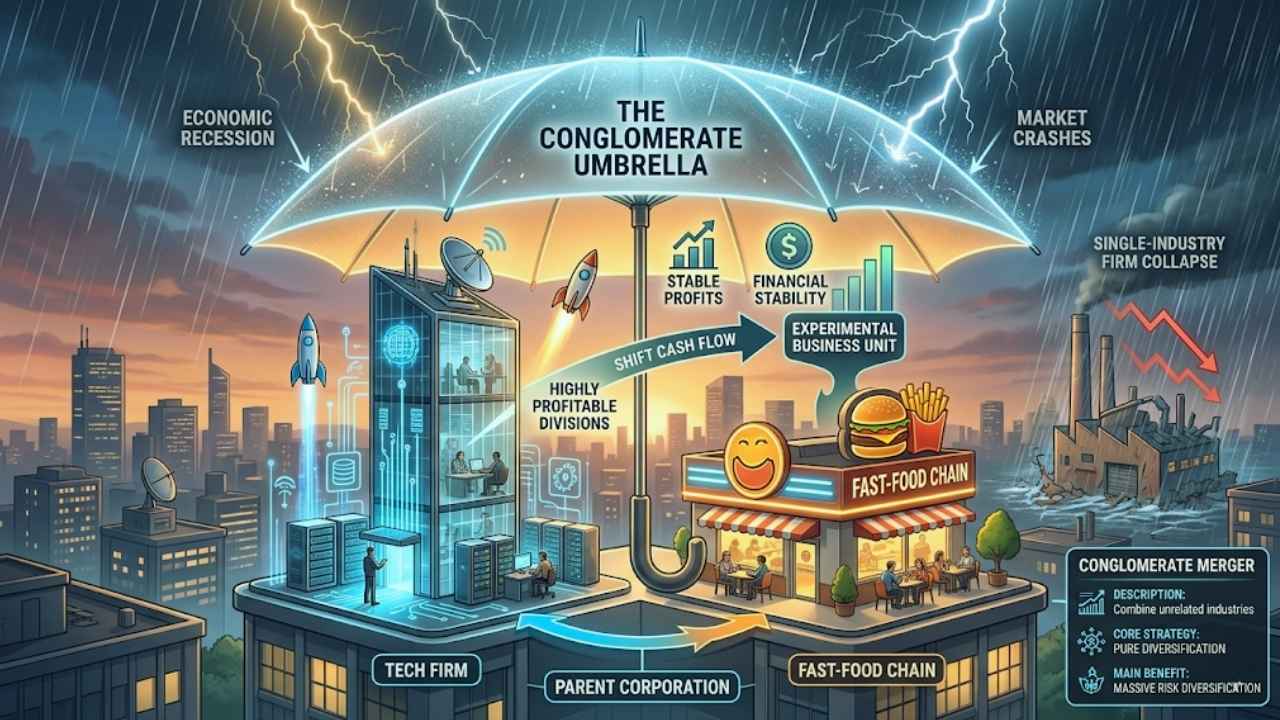
A conglomerate merger involves two businesses that have absolutely nothing in common regarding products, services, or industries. A tech firm merging with a fast-food chain would be a textbook example of a conglomerate merger. The driving motivation behind this strategy is pure diversification.
If one industry hits a massive economic recession, the profits from the unrelated business segment can keep the parent corporation financially stable and profitable. This approach creates a massive corporate umbrella that shields investors from sector-specific market crashes. It allows executives to shift cash flow from highly profitable divisions to support newer, experimental business units.
|
Conglomerate Details |
Description |
|
Core Strategy |
Combine with a business in a completely unrelated industry |
|
Main Benefit |
Massive risk diversification across multiple sectors |
|
Cost Savings |
Shared corporate-level administrative overhead |
|
Common Industry |
Holding companies and global investment firms |
Market Extension Mergers
When two companies sell the same types of products but operate in entirely separate geographic regions, they use a market extension merger. This allows a company to instantly scale into a new country or territory without spending years building brand recognition from scratch.
Instead of fighting local brands, the business simply merges with a local leader to gain immediate access to their established infrastructure and client base. It completely bypasses the expensive trial-and-error phase of entering a foreign market. You instantly inherit local supply routes, cultural brand loyalty, and an entire workforce that understands the regional consumer base.
|
Market Extension Details |
Description |
|
Core Strategy |
Combine with a similar company in a new region |
|
Main Benefit |
Instant access to a brand-new geographic customer base |
|
Cost Savings |
Avoids the cost of launching a new brand from scratch |
|
Common Industry |
Consumer goods and international retail |
Product Extension Mergers
A product extension merger happens between two companies that sell related, but non-competing, products within the same general market. Their goods complement each other perfectly, meaning they share the same target audience. By merging, the companies can bundle their products together, utilize the same sales teams, and cross-sell to each other’s existing customer accounts.
This drives up total revenue without increasing marketing costs. Think of a toothbrush manufacturer merging with a toothpaste company. They already talk to the exact same buyers, so combining forces allows them to dominate the bathroom cabinet with a single, unified sales pitch.
|
Product Extension Details |
Description |
|
Core Strategy |
Combine with a company selling complementary goods |
|
Main Benefit |
Massive cross-selling opportunities to shared audiences |
|
Cost Savings |
Consolidates sales teams and marketing campaigns |
|
Common Industry |
Software, cosmetics, and household goods |
What is an Acquisition?
An acquisition is an outright corporate purchase where one buying company buys a controlling stake in a target company. Unlike a merger, this process does not result in the creation of a brand-new legal entity. The acquiring company remains completely intact, keeping its original name, tax identity, and board of directors.
The target company, however, loses its independence entirely and either becomes a subsidiary or gets dissolved into the buyer’s existing departments. Acquisitions are defined by a clear, undeniable imbalance of financial and operational power. The buyer is almost always a massive corporate powerhouse with deep cash reserves or significant borrowing leverage.
Because the buyer is paying for the target, they hold all the cards during negotiations. They dictate exactly how the business will run, which products will survive, and which employees will keep their jobs moving forward. Corporations choose acquisitions because they are much faster than organic development. Buying a small company that has already built and perfected that software allows the buyer to dominate the market instantly.
|
Acquisition Element |
Operational Impact |
Strategic Purpose |
|
Ownership |
Buyer takes full legal control of all assets |
To expand the buyer’s portfolio immediately |
|
Target Brand |
Can be absorbed completely or kept as a subsidiary |
To leverage existing brand equity and loyalty |
|
Financial Source |
Financed via corporate cash, stock, or heavy debt |
To leverage current capital for future growth |
|
Speed |
Can be executed quickly if funding is secured |
To capture market opportunities before rivals do |
Types of Acquisitions
Acquisitions are structured based on what the buyer wants to own and how the target company’s leadership views the transaction. Buyers carefully evaluate whether they want the entire company or just the most valuable pieces.
Asset Acquisitions
In an asset acquisition, the buying company does not want to buy the entire corporation. Instead, they choose specific assets to purchase, such as patents, manufacturing plants, customer lists, or proprietary software code. This is an incredibly safe way to buy because the purchaser leaves behind all the target company’s legal liabilities, debts, and pending lawsuits.
This method is heavily used when buying pieces of a struggling or bankrupt business. You get to cherry-pick the absolute best parts of the failing company without taking on the toxic debt that ruined them. It requires highly specific legal contracts to clearly define exactly which physical or digital items are changing hands.
|
Asset Acquisition Details |
Description |
|
Core Focus |
Purchasing specific equipment, data, or patents |
|
Risk Level |
Very low, as previous debts are left behind |
|
Ideal Scenario |
Buying from a bankrupt or restructuring company |
|
Main Advantage |
Ability to cherry-pick the most valuable pieces |
Stock Acquisitions
A stock acquisition happens when the buyer purchases the majority of the target company’s voting shares directly from the owners or public investors. By gaining more than fifty percent of the stock, the buyer wins absolute voting control over the company’s board of directors and internal operations.
The major catch here is that the buyer inherits everything, meaning they take full responsibility for all existing debts, regulatory fines, and legal problems. This is the most common way large public companies take over smaller rivals. It gives the buyer the entire operating machine, intact and running, allowing them to instantly add the target’s full revenue stream to their quarterly earnings reports.
|
Stock Acquisition Details |
Description |
|
Core Focus |
Buying the majority of voting shares for total control |
|
Risk Level |
High, as the buyer assumes all corporate debt and lawsuits |
|
Ideal Scenario |
Taking over a fully functional, profitable business |
|
Main Advantage |
Instantly absorbs the target’s entire revenue stream |
Friendly vs Hostile Takeovers
The entire atmosphere of an acquisition depends on how the target company reacts to the offer. This reaction completely changes the timeline, the legal fees, and the stress levels of everyone involved.
A friendly takeover occurs when the target company’s board of directors analyzes the purchase offer and agrees that it benefits their shareholders. Both leadership teams collaborate closely to make the transition as smooth and painless as possible for staff and consumers alike. A hostile takeover is an entirely different story. This happens when the target company’s management team explicitly rejects the acquisition bid, but the buyer refuses to back down.
The buyer bypasses management entirely and goes directly to the public shareholders with a tender offer, offering to buy their stock at a premium price. If enough shareholders take the cash, the buyer forces the deal through, fires the resisting management, and takes over the company aggressively.
|
Takeover Style |
Management Reaction |
Execution Strategy |
|
Friendly Takeover |
Board approves and supports the buyout |
Cooperative planning and unified public relations |
|
Hostile Takeover |
Board actively fights and rejects the offer |
Aggressive tender offers directly to public shareholders |
Key Differences Between Mergers and Acquisitions
To truly understand how these deals play out, you have to look past the financial announcements. The actual difference between merger and acquisition pathways comes down to legal ownership, operational control, and cultural survival.
|
Comparison Area |
Mergers |
Acquisitions |
|
Entity Count |
Two companies become one brand-new entity |
Two companies become one parent and one child |
|
Funding Type |
Mostly stock-for-stock swaps |
Cash payments, stock debt, or asset buys |
|
Cultural Vibe |
Collaborative integration of two working styles |
Mandatory assimilation into the buyer’s culture |
|
Job Security |
Broad layoffs due to overlapping roles |
Targeted layoffs, mostly in the target company |
Structure and Power Dynamics
The biggest distinction between these two strategies is how power is shared once the ink dries on the contract. A merger is built on a foundation of operational equality. Both companies bring something valuable to the table, and they design a new corporate ladder that attempts to balance both cultures. The board of directors is typically split evenly, ensuring that neither side can completely run over the other without a massive fight.
An acquisition has zero balance of power. It is an exercise in top-down corporate hierarchy. The buyer has bought the right to make every single decision, and the target company must follow orders. The executive team of the acquired business is often replaced with managers chosen directly by the parent company, ensuring total compliance with the new owner’s corporate playbook.
|
Dynamics |
Mergers |
Acquisitions |
|
Leadership Control |
Shared evenly among both executive teams |
Dominated entirely by the purchasing company |
|
Board Structure |
A newly formed board with equal representation |
The buyer’s existing board maintains ultimate control |
|
Corporate Hierarchy |
Built from scratch to accommodate both sides |
Target company fits into the buyer’s existing org chart |
Financial Implications
The financial mechanics used to fund these deals are completely different. Mergers rarely require a massive mountain of upfront cash. Instead, they rely heavily on stock-for-stock swaps. Shareholders of both original companies trade in their old stock certificates for brand-new shares in the combined corporation. This keeps cash free to fund future operations and protects the new company from starting its life buried under heavy bank debt. Acquisitions require a massive deployment of capital.
The buyer must offer a substantial cash premium to convince shareholders to give up their ownership stakes. If the buyer does not have billions in cold cash sitting in the bank, they must secure massive corporate loans or issue junk bonds to fund the purchase. This places an immediate financial burden on the parent company to generate massive profits quickly.
|
Financials |
Mergers |
Acquisitions |
|
Primary Currency |
Stock swaps and newly issued corporate shares |
Cash payouts, leveraged debt, or existing stock |
|
Debt Impact |
Usually minimal, preserving operating cash flow |
Often high, as buyers take on massive bank loans |
|
Shareholder Value |
Based on the future performance of the new brand |
Based on the immediate cash premium offered |
Legal and Tax Considerations
Government regulators keep an incredibly close watch on both types of deals to protect everyday consumers from corporate monopolies. In the United States, federal agencies closely examine these transactions to ensure they will not drive up prices or kill healthy market competition. If a deal looks like it will harm consumers, the government will file lawsuits to block it completely.
From a tax perspective, stock-based mergers are highly attractive because they can often be structured as tax-deferred events. Shareholders do not have to pay capital gains taxes until they sell their new shares down the road. Cash acquisitions trigger immediate tax consequences. The moment a shareholder accepts cash for their stock from a corporate buyer, they owe capital gains taxes on that money, making acquisitions slightly less tax-efficient for the sellers.
|
Legal & Tax |
Mergers |
Acquisitions |
|
Regulatory Scrutiny |
Extremely high, to prevent market monopolies |
High, specifically looking at market share dominance |
|
Tax Status |
Often structured as a tax-free or tax-deferred swap |
Usually triggers immediate capital gains taxes for sellers |
|
Legal Complexity |
Highly complex to dissolve two firms and build one |
Straightforward transfer of legal ownership |
Cultural Impact
The human element is where these deals face their toughest challenges. Mergers require two completely different corporate cultures to learn how to live together under one roof. Employees from both sides often clash over things like software systems, dress codes, management philosophies, and daily workflows. This friction can slow down productivity for months as teams fight over whose old way of doing things was better.
In an acquisition, there is no debate about culture. The acquired company is expected to drop its old habits and instantly adopt the culture, policies, and systems of the parent corporation. While this eliminates long debates, it often creates massive resentment, fear, and anxiety among the acquired staff. Employees feel conquered rather than partnered with, which frequently leads to a mass exodus of top talent.
|
Culture |
Mergers |
Acquisitions |
|
Employee Morale |
Often anxious but hopeful for a shared future |
High anxiety, fear of job loss, and feeling conquered |
|
System Integration |
A collaborative choice on which software to use |
Target must abandon their tools and use buyer systems |
|
Talent Retention |
Focuses on keeping top performers from both sides |
Buyer often replaces target leadership immediately |
Why Do Companies Pursue Mergers and Acquisitions?
Corporate leaders do not undertake these highly stressful, multi-billion-dollar deals just for media attention. They do it because the strategic rewards can completely transform a company’s financial future.
|
Strategic Driver |
Main Benefit |
Expected Outcome |
|
Synergy |
Removes redundant staff and operations |
Drastic reduction in daily overhead costs |
|
Speed |
Bypasses traditional product development |
Immediate entry into new global markets |
|
Tech Access |
Absorbs patented intellectual property |
Instant leap ahead of industry competitors |
|
Talent Grab |
Brings in highly skilled specialist teams |
Stronger innovation pipeline for future growth |
Synergy and Growth
Synergy is the ultimate holy grail of corporate dealmaking. The core idea is that combining two businesses will create a single entity that is far more efficient and profitable than the two companies operating separately. Operational synergy allows companies to fire duplicate human resource teams, close overlapping warehouses, and consolidate accounting departments.
This wipes out millions in waste, letting more profit flow directly to the bottom line. It also provides massive financial leverage. A larger, combined company can negotiate aggressively lower rates with material suppliers, simply because their order volume is now twice as big. The sheer scale of the new business creates a financial momentum that crushes smaller, independent competitors.
|
Synergy Goals |
How It Works |
|
Cost Reduction |
Firing duplicate executives and closing overlapping offices |
|
Buying Power |
Using larger order volumes to demand cheaper raw materials |
|
Borrowing Power |
Larger asset bases secure much lower interest rates from banks |
Market Expansion
Trying to grow a business organically by entering a new country from scratch is an uphill battle. You have to learn new local laws, build warehouses, hire local workers, and try to convince skeptical consumers to trust your brand. M&A provides an instant shortcut.
By merging with or acquiring a company that already possesses an established distribution network and local customer loyalty, a brand can scale its global footprint in a single afternoon. Instead of fighting a brutal price war to win over a foreign market, you just buy the company that already won it. It is the fastest, most effective way to jump borders and turn a national brand into a global empire overnight.
|
Expansion Tactics |
How It Works |
|
Instant Infrastructure |
Acquiring functional warehouses and trucking fleets globally |
|
Brand Inheritance |
Taking over a brand that local customers already trust deeply |
|
Regulatory Bypass |
Avoiding years of red tape by buying an already-licensed firm |
Diversification
Putting all your corporate eggs in one basket is a massive financial risk. If a company only makes one specific product and consumer tastes shift, that company can go bankrupt overnight. Mergers and acquisitions allow smart companies to diversify their revenue streams across completely different markets.
By owning businesses in multiple sectors, a corporation can use profits from a booming division to offset temporary losses in a struggling division. It stabilizes the stock price and gives investors peace of mind. If you own both a luxury car brand and a budget grocery chain, an economic downturn that hurts car sales will likely boost your grocery sales, keeping your overall corporate ship afloat in rough waters.
|
Diversification Tactics |
How It Works |
|
Revenue Shielding |
Using different industries to balance seasonal sales dips |
|
Trend Protection |
Surviving shifts in consumer behavior by offering varied goods |
|
Capital Reallocation |
Moving cash from slow industries to fast-growing tech divisions |
Acquiring New Technology and Talent
In our modern tech-driven world, innovation happens faster than large corporations can adapt. Big companies are often slow, bureaucratic, and terrible at inventing disruptive technologies. Instead of spending five years trying to build a new software tool in-house, large corporations find it much easier to buy the hot new startup that has already built it.
This strategy secures the patent and brings the brilliant engineers who created it into the parent company. It is commonly called an “acqui-hire” in the Silicon Valley world. You aren’t just buying the code; you are buying the brilliant minds who wrote it, injecting fresh, innovative energy directly into your stale corporate structure.
|
Tech & Talent Tactics |
How It Works |
|
Acqui-hiring |
Buying a company solely to absorb its genius engineering team |
|
Patent Hoarding |
Securing exclusive rights to disruptive new digital tools |
|
R&D Shortcuts |
Skipping years of failed experiments to buy a finished product |
Real-World Examples of Mergers and Acquisitions
To see how these abstract concepts work in the real economy, we can look at some of the most famous and impactful corporate deals in business history.
|
Deal Type |
Famous Example |
Main Outcome |
|
Horizontal Merger |
Exxon & Mobil |
Created a massive global energy powerhouse |
|
Strategic Acquisition |
Disney & Pixar |
Revitalized Disney’s entire animation division |
|
Hostile Takeover |
Kraft & Cadbury |
Forced ownership change over board objections |
Famous Mergers
One of the largest horizontal mergers in history happened when Exxon and Mobil decided to combine in the late 1990s. Both were massive, competing oil giants descended from the same historic oil monopoly. Faced with falling energy prices, they chose to combine as equals rather than fight each other. The resulting company, ExxonMobil, achieved immense cost savings by streamlining its global drilling, refining, and gas station networks.
Another great example is the merger of British Airways and Iberia to form the International Airlines Group. Both national carriers retained their customer-facing brands, but behind the scenes, they combined their fleets, procurement, and route planning. This allowed them to compete far more effectively against low-cost European airlines while sharing the massive financial burden of purchasing new aircraft.
|
Merger Example |
Industry Context |
Strategic Win |
|
Exxon & Mobil |
Global oil and energy |
Massive operational cost savings during an oil slump |
|
British Airways & Iberia |
International aviation |
Combined fleet purchasing power and route sharing |
High-Profile Acquisitions
When it comes to brilliant acquisitions, Disney purchasing Pixar Animation Studios in 2006 stands out as a masterclass. Disney did not merge with Pixar; they bought the studio completely for over seven billion dollars. Pixar became a subsidiary, keeping its creative culture intact while gaining access to Disney’s massive global theme park and merchandise distribution network. This deal completely revitalized Disney’s animation dominance for a generation.
On the retail side, Amazon’s purchase of Whole Foods for over thirteen billion dollars was a massive acquisition move. Amazon used its deep cash reserves to buy a premium physical grocery chain with hundreds of physical stores. This move allowed the e-commerce giant to instantly acquire a massive physical footprint and an established cold-storage supply chain, completely changing how it handles fresh food delivery nationwide.
|
Acquisition Example |
Industry Context |
Strategic Win |
|
Disney & Pixar |
Entertainment and film |
Acquired cutting-edge 3D tech and creative genius |
|
Amazon & Whole Foods |
E-commerce and grocery |
Gained an instant nationwide physical retail footprint |
The M&A Process: How Does It Work?
Bringing two massive corporate structures together requires a highly disciplined, multi-step process that takes months of intense planning and execution. Long before any public announcements hit the news, knowing the precise difference between merger and acquisition steps helps internal teams prepare for the massive logistical mountain ahead.
|
Process Phase |
Primary Action |
Key Professionals Involved |
|
Strategy & Valuation |
Determining target worth and growth goals |
Corporate executives and investment bankers |
|
Due Diligence |
Auditing books, legal risks, and digital health |
Forensic accountants and corporate attorneys |
|
Post-Deal Integration |
Merging software, staff, and office cultures |
Integration managers and HR specialists |
Valuation and Strategy
The entire journey begins with long-term strategic planning. Corporate leaders look at their market vulnerabilities and determine if buying a company or merging with a rival is the best way to achieve their growth goals. Once they identify a viable target, investment bankers perform detailed valuations.
They dissect the target’s public financial records, assess its physical real estate, value its patents, and calculate its future earnings to figure out a fair offer price. This is a highly mathematical phase where emotions must be set aside. The goal is to figure out exactly how much value the target brings to the table, and set a hard ceiling on what the buyer is willing to pay.
|
Valuation Steps |
Description |
|
Financial Modeling |
Projecting the target’s future cash flow and profit margins |
|
Asset Appraisal |
Putting a strict dollar value on real estate and patents |
|
Synergy Estimation |
Calculating exact dollar amounts saved by combining operations |
Due Diligence
Once an initial offer is accepted, the buying or merging companies enter a high-stakes investigation phase called due diligence. This is where teams of forensic accountants, lawyers, and specialists check every single detail of the target company’s business. They audit past tax returns, review employment contracts, and check for hidden legal liabilities.
In our modern digital economy, this step also involves intensive digital audits to verify the target’s cybersecurity infrastructure and search traffic health. If the due diligence team finds massive hidden debts or pending lawsuits, the buyer will either demand a massive discount or walk away from the deal entirely.
|
Due Diligence Areas |
Description |
|
Financial Audit |
Verifying all tax returns, debts, and revenue reports |
|
Legal Audit |
Checking for pending lawsuits and flawed employee contracts |
|
Digital Audit |
Testing cybersecurity strength and SEO traffic stability |
Post-Merger Integration
The moment the contracts are signed and the money changes hands is not the end of the journey; it is where the real hard work starts. Post-merger integration is the incredibly complex process of combining two distinct operational machines into one smooth system. IT teams have to migrate databases, human resources must unify payroll benefits, and marketing departments must coordinate branding messages.
This phase requires constant communication to keep workers calm and prevent operational chaos. If you mishandle the integration, your best employees will quit, your customer service will tank, and you will destroy the very value you just paid billions to acquire.
|
Integration Focus |
Description |
|
IT Migration |
Combining email servers, software tools, and customer databases |
|
HR Alignment |
Unifying payroll systems, vacation policies, and health benefits |
|
Brand Merging |
Creating a unified marketing message for the newly combined entity |
Why Do M&A Deals Fail?
Despite spending millions on elite advisors, consultants, and bankers, historical data shows that over seventy percent of corporate mergers and acquisitions fail to achieve their original financial goals. It turns out that regardless of the difference between merger and acquisition dynamics, failure rates remain stubbornly high across every industry.
|
Failure Cause |
Primary Impact |
Result |
|
Culture Clash |
Drives away top talent and creates toxic workspaces |
Loss of intellectual property and skill |
|
Poor Planning |
Breaks supply chains and crashes internal IT systems |
Massive loss of customer trust and revenue |
|
Overpaying |
Burdens the parent company with unpayable bank debt |
Severe financial distress and stock drops |
Cultural Misalignment
The primary reason corporate deals fall apart has nothing to do with numbers, spreadsheets, or finance. It comes down to human nature and culture clashes. When a highly creative, fast-moving tech startup is bought by a slow, highly traditional corporation, the cultural shock can be devastating.
The startup employees quickly grow frustrated by new corporate rules, feel stifled by endless management meetings, and leave the company, taking the vital skills and innovation with them. You cannot force two wildly different groups of people to suddenly work together perfectly. If leadership ignores the human element, the deal will fail spectacularly.
|
Culture Clash Elements |
Description |
|
Workflow Friction |
Agile startups forced into slow corporate approval processes |
|
Communication Breakdown |
Lack of transparency creates paralyzing fear among staff |
|
Talent Exodus |
Star employees quit rather than conform to a new culture |
Poor Integration Planning
Many corporate executives focus all their time and energy on winning the financial bidding war, completely forgetting to plan for how the business will actually run on day one after the deal closes. If the two companies use software systems that cannot talk to each other, daily operations will grind to a halt.
Customer service lines get jammed, shipments get lost, and frustrated clients will quickly abandon the brand for competitors. A lack of clear, day-one operational planning leads to total chaos. You need dedicated teams whose sole job is to map out exactly how the new company will function from the moment the ink dries.
|
Integration Failures |
Description |
|
Software Incompatibility |
Teams cannot share files or access customer history |
|
Leadership Vacuum |
Unclear reporting structures lead to delayed decision-making |
|
Customer Neglect |
Internal chaos distracts teams from serving the actual buyers |
Overvaluation
In the high-stakes world of corporate dealmaking, ego can often cloud executive judgment. When multiple companies get locked into a fierce bidding war for a popular target, buyers often end up paying a massive premium that far exceeds the target’s actual worth.
If a parent company takes on billions in high-interest debt to buy a company that cannot generate enough cash flow to cover the interest payments, the entire corporate structure can collapse. Paying too much out of pride guarantees the deal will never be profitable. It places an impossible financial burden on the new entity right from the starting line.
|
Overvaluation Risks |
Description |
|
Ego Bidding |
CEOs paying way too much just to beat a rival buyer |
|
Fake Synergy |
Assuming cost savings that are mathematically impossible to reach |
|
Debt Crushing |
Taking out massive loans that eat up all future profit margins |
Final Thoughts
Navigating the modern corporate world requires a clear grasp of the difference between merger and acquisition strategies. While a merger represents a cooperative partnership where two equal companies dissolve to build a new, stronger legal entity, an acquisition is a straightforward purchase where a larger buyer absorbs a smaller target.
Both paths offer powerful avenues for rapid expansion, technological advancement, and market dominance. However, they also carry massive financial and cultural risks that can destroy shareholder value if managed poorly. True corporate success relies on executing thorough due diligence, over-communicating with employees, and ensuring that the human elements of the business are never ignored for financial metrics.
Frequently Asked Questions (FAQs) About Mergers vs Acquisitions
What happens to employee benefits during a corporate transition?
When companies combine, the human resources teams must build a brand-new corporate benefits framework. Employees from the acquired or smaller company are usually transitioned over to the parent company’s existing insurance plans, retirement accounts, and vacation tracking systems, which can sometimes result in changes to overall coverage or out-of-pocket costs.
Minority shareholders who disagree with a buyout price can exercise appraisal rights under corporate law. This legal mechanism allows disgruntled shareholders to request a judicial review of the transaction to ensure that the buyout price offered by the acquiring corporation reflects the fair market value of the stock.
What is a reverse merger and how does it work?
A reverse merger happens when a private company fast-tracks its way onto the public stock exchange by acquiring a public company that is already listed. Instead of going through a traditional initial public offering process, the private firm buys a majority stake in a shell company, combines operations, and instantly gains public trading status.
How do companies calculate corporate synergy before a deal closes?
Financial analysts estimate synergy by looking closely at overlapping operational costs. They calculate the money saved by closing duplicate corporate offices, combining supply chains, and consolidating software systems. Revenue synergies are estimated by projecting how much additional money can be made by cross-selling products to the combined customer base.
What is a carve-out transaction in corporate finance?
A carve-out is a specific type of strategic divestiture where a parent corporation sells a minority stake in one of its corporate subsidiaries to outside investors. This allows the parent company to raise immediate cash while still holding a controlling interest in the business unit, letting it grow independently.