


Checking your credit score often feels like looking at a weather report for a city you have never visited. You see a number, it goes up or down, and you wonder what you did to cause the shift. In the financial world of 2026, this three-digit number is your most important asset. It dictates the interest rate on your mortgage, the likelihood of getting a car loan, and even the security deposit you pay for a new apartment.
While it might seem like the bureaus are using a magic 8-ball to decide your fate, the reality is much more structured. Your score is built on a specific set of credit score factors that track your habits over years. If you understand these rules, you can stop guessing and start building a score that opens doors instead of closing them.
The Foundation of Modern Lending
Lenders are not in the business of taking huge risks. They want to know that if they give you money today, they will get it back with interest tomorrow. To figure this out, they rely on complex algorithms that turn your financial history into a single grade. These credit score factors are the variables in that equation.
By 2026, these models have become even more sensitive to your daily habits, such as how you use digital wallets or if you pay your utility bills on time. Understanding the weight of each factor allows you to prioritize your efforts. You do not need to be perfect in every category to have a great score, but you do need to be consistent where it counts the most.
|
Core Factor |
Weight in FICO |
Importance Level |
Primary Goal |
|
Payment History |
35% |
Very High |
Pay every bill on time. |
|
Amounts Owed |
30% |
High |
Keep card balances very low. |
|
Length of History |
15% |
Medium |
Keep your oldest accounts open. |
|
Credit Mix |
10% |
Low |
Have a variety of loan types. |
|
New Credit |
10% |
Low |
Limit hard inquiries and new apps. |
Why Multiple Scores Exist?
You might notice that your score on a banking app is different from the one a car dealer sees. This is because there is no single “credit score.” There are dozens of versions of the FICO and VantageScore models. Some are tailored for auto lenders, while others are built for credit card issuers. All of them, however, look at the same underlying credit score factors to reach their conclusion.
1. Payment History – The 35% Powerhouse
Payment history is the undisputed king of all credit score factors. It makes up more than a third of your total score because it is the most reliable predictor of future behavior. Lenders figure that if you have paid every bill on time for the last five years, you are probably going to pay the next one too.
Conversely, even a single payment that is 30 days late can send your score screaming downward. In 2026, with the integration of real-time banking data, any slip-up is noticed almost instantly. This is the one area where you simply cannot afford to be lazy if you want to keep your financial reputation intact.
|
Status of Payment |
Impact on Score |
Duration on Report |
Action Needed |
|
On-Time |
Consistent growth |
Forever |
Set up autopay today. |
|
30 Days Late |
Sharp drop |
7 Years |
Pay immediately to stop 60-day mark. |
|
90 Days Late |
Major damage |
7 Years |
Contact lender for a settlement. |
|
Collection |
Severe penalty |
7 Years |
Pay in full to improve newer models. |
Managing Your Payment Timeline
To keep this factor in the green, you need a system that removes human error. Life gets busy, and it is easy to forget a small store card payment. Automation is your best friend here. Set every bill to at least the minimum payment on its due date. If you do happen to miss a payment, do not wait for the next statement. Call the company immediately and ask for a one-time “goodwill” removal of the late mark. Often, if you have been a good customer, they will help you out before they report the mistake to the bureaus.
2. Amounts Owed – The Strategy of Utilization
The second most important of the credit score factors is how much of your available credit you are using. This is known as your credit utilization ratio. If you have a total credit limit of $10,000 across all your cards and you carry a balance of $3,000, your utilization is 30%.
Lenders get nervous when they see this number climb too high because it suggests you might be relying on debt to survive. In 2026, the best scores go to those who keep their utilization under 10%. It shows you have access to money but have the discipline not to touch it unless it is absolutely necessary.
|
Utilization Percentage |
Lender Perception |
Score Effect |
Recommended Action |
|
1% – 9% |
Highly Responsible |
Maximum Boost |
Keep it here for best results. |
|
10% – 29% |
Good Borrower |
Positive |
Fine for most lending needs. |
|
30% – 49% |
Borderline Risky |
Slight Negative |
Start paying down balances. |
|
50% + |
High Risk |
Heavy Drop |
Stop spending and pay ASAP. |
The Secret of Statement Dates
One thing many people do not realize is that the balance reported to the bureaus is usually the balance on your statement date, not your due date. If you spend $4,000 and pay it off on the due date, the bureau might still see that $4,000 balance and think your utilization is high. To combat this, try making a payment a few days before your statement closes. This ensures that the “snapshot” taken of your credit shows a very low balance, giving your score a quick and easy boost without you actually spending any less money.
3. Length of Credit History – The Value of Time
Time is something you cannot buy or hack, and that is why the length of your credit history accounts for 15% of your score. This factor looks at how long your accounts have been open and the average age of everything on your report.
A long, clean history tells a lender that you have survived different economic cycles and still managed your money well. In an era of “fast” everything, your oldest credit card is a badge of honor. It proves you have been in the game for a long time and know how to handle your responsibilities over the long haul.
|
Account Type |
Impact on Age |
Strategy |
Why It Matters |
|
Oldest Account |
High |
Never close this card. |
It sets the “ceiling” for your age. |
|
Newest Account |
Moderate |
Limit new applications. |
New accounts pull the average down. |
|
Average Age |
High |
Slow and steady wins. |
Lenders like to see 7+ years. |
|
Closed Accounts |
Low |
Stays on report 10 years. |
Impact is delayed but real. |
Why You Should Never Close Old Cards?
It is a common mistake to close an old credit card that you no longer use. You might think you are tidying up your financial life, but you are actually cutting your history short. If that card has no annual fee, just put it in a drawer and use it once a year to buy a coffee so the bank doesn’t close it for inactivity. Closing your oldest account can instantly shrink your credit age and cause a sudden drop in your score. If you must get rid of a card with a high fee, ask the bank to “downgrade” it to a free version so you can keep the history without paying for it.
4. Credit Mix – Proving Versatility
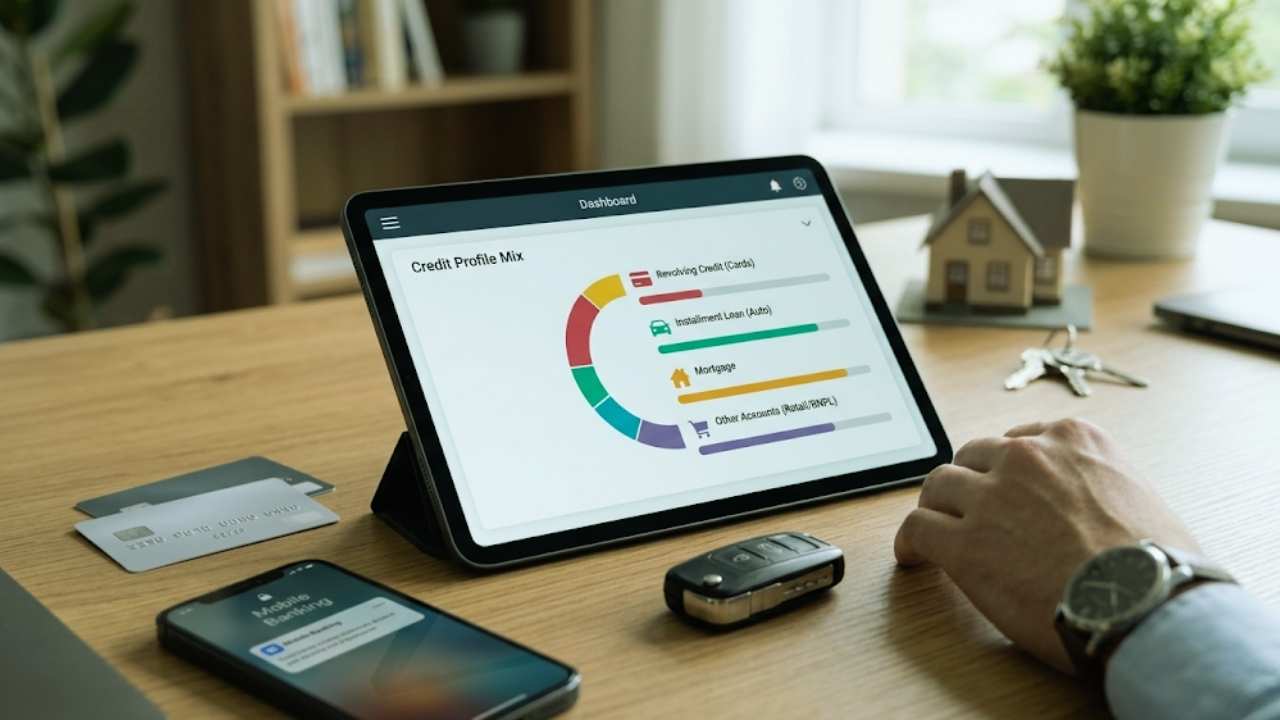
Lenders want to see that you can handle more than just a single credit card. This is why credit mix makes up 10% of your total score. This factor looks at the variety of your accounts, such as credit cards, retail accounts, installment loans, and mortgages.
Being able to juggle a fluctuating credit card balance alongside a fixed monthly car payment shows a level of financial maturity that lenders find attractive. In 2026, even things like “Buy Now, Pay Later” loans are starting to factor into this mix, offering more ways to show you are a versatile borrower.
|
Debt Category |
Example |
Frequency of Payment |
Impact on Mix |
|
Revolving |
Credit Card / HELOC |
Monthly / Variable |
Essential for high scores. |
|
Installment |
Auto / Student / Personal |
Monthly / Fixed |
Adds stability to profile. |
|
Mortgage |
Home Loan |
Monthly / Fixed |
The “gold standard” of mix. |
|
Retail |
Store Brand Cards |
Monthly / Variable |
Good for building early history. |
Do Not Take Loans You Do Not Need
While having a good mix is helpful, you should never take out a loan just for the sake of your credit score. This factor only accounts for 10% of the total. Paying interest on a personal loan just to “improve your mix” is a losing strategy. Instead, let your credit mix grow naturally over time as you hit life milestones, like buying a car or a home. If you only have credit cards right now, focus on managing them perfectly. The rest of the mix will take care of itself as your financial life expands and your needs change.
5. New Credit – The Risk of Overextending
Every time you apply for a new loan, a “hard inquiry” is recorded on your credit report. This makes up the final 10% of your credit score factors. Lenders view several new applications in a short window as a sign of financial distress.
They wonder why you suddenly need so much credit and if you are about to go on a spending spree you cannot afford. In 2026, the systems are very sensitive to “credit seeking behavior,” so it pays to be strategic about when and how often you apply for new accounts.
|
Action |
Inquiry Type |
Score Effect |
Duration |
|
Applying for Card |
Hard Inquiry |
-5 to -10 points |
1 Year (on score) |
|
Checking Own Score |
Soft Inquiry |
Zero effect |
N/A |
|
Mortgage Shopping |
Multiple Hard |
Treated as one |
14-45 day window |
|
Employer Check |
Soft Inquiry |
Zero effect |
N/A |
Mastering the Rate Shopping Window
If you are looking for a big loan, like a mortgage or an auto loan, the scoring models give you a “grace period.” They know that you want to find the best interest rate, which requires talking to multiple banks. As long as all those inquiries happen within a short window—usually 14 to 45 days—they are treated as a single event. This allows you to shop around for the best deal without worrying that every bank you talk to is dragging your score down further. Just make sure you do all your shopping in one concentrated burst rather than spreading it out over several months.
Trends in 2026: The Rise of Trended Data
The way we look at credit score factors is shifting toward what the industry calls “trended data.” In the past, your credit report was just a snapshot of what you owed on a specific day. Now, lenders are looking at the direction your debt is moving.
Are you paying off your balances every month, or are you only making the minimum payments while your debt slowly grows? This “direction” can be just as important as the number itself. People who are actively trending toward less debt are seen as much lower risk than those whose debt is ballooning, even if their scores are currently the same.
|
2026 Innovation |
What It Tracks |
Why It Matters |
|
Trended Data |
24-month balance history |
Shows if you are paying down debt. |
|
Rent Reporting |
Monthly housing payments |
Helps people without traditional loans. |
|
BNPL Integration |
Short-term installment loans |
Adds to your credit mix diversity. |
|
Cash Flow Data |
Checking account activity |
Proves you have income to cover debt. |
How to Use Trended Data to Your Advantage?
To win with trended data, you want to show a consistent downward slope in your revolving debt. Even if you cannot pay a card off entirely, making payments that are slightly larger than the minimum every month tells the algorithm that you are in control. It distinguishes you from the “revolvers” who are stuck in a cycle of debt. In 2026, your score is no longer just about where you are; it is about where you are going. Keeping your financial trajectory moving in the right direction is the key to unlocking the best interest rates available.
Improving Your Score: A Practical Checklist
If you need to move the needle on your score quickly, you have to focus on the factors that respond the fastest. Payment history takes a long time to build, but utilization can change in a single month. If you have a big purchase coming up, such as a house or a new car, start your “credit diet” at least three to six months in advance. This gives the bureaus enough time to record your new, lower balances and reflect the most positive version of your financial self to the world.
- Check your report for errors once a month using a free monitoring app.
- Pay down the card with the highest utilization percentage first.
- Ask for a credit limit increase on your oldest cards but do not spend more.
- Do not open any new accounts within six months of a mortgage application.
- Use rent-reporting services to get credit for the bills you already pay.
Final Thoughts
Your financial health is a marathon, not a sprint. While these five credit score factors might seem complicated at first, they really boil down to two simple habits: pay your bills on time and do not overextend yourself. If you can master those two things, you have already conquered 65% of the equation.
By staying informed about how the system works in 2026, you can make smarter decisions that save you thousands of dollars in interest over your lifetime. Remember, your credit score is a tool designed to work for you. Treat it with respect, keep a close eye on the details, and you will find that the world of finance becomes much easier to navigate.
Frequently Asked Questions (FAQs) About How Credit Scores Work
1. Does my salary affect my credit score?
No, your income is not one of the credit score factors. A person making $30,000 a year can have a perfect 850 score, while a millionaire can have a 500 score. However, lenders will look at your income separately to ensure you can afford the monthly payments for a specific loan.
2. Is it better to have zero debt or a little bit?
Actually, having a tiny bit of reported debt—like 1% utilization—is often better than 0%. It shows the scoring model that you are actively using your credit and managing it well. If every card shows a $0 balance, the model sometimes lacks the data to give you those final few points.
3. How long do inquiries stay on my report?
Hard inquiries stay on your report for two years. However, they only affect your score for the first 12 months. After that year is up, the “penalty” vanishes, though the record of the application remains visible to lenders for one more year.
4. Can checking my own score hurt it?
No. Checking your own score is a “soft inquiry.” You can check it as many times a day as you want without losing a single point. In fact, keeping a close eye on your score is one of the best habits for maintaining long-term financial health.
5. Why did my score drop when I paid off a loan?
This is a common frustration. When you pay off a loan, you lose an active account with a positive payment history. It can also slightly change your credit mix. While it feels wrong, these drops are usually small and temporary, and your score will stabilize quickly.