
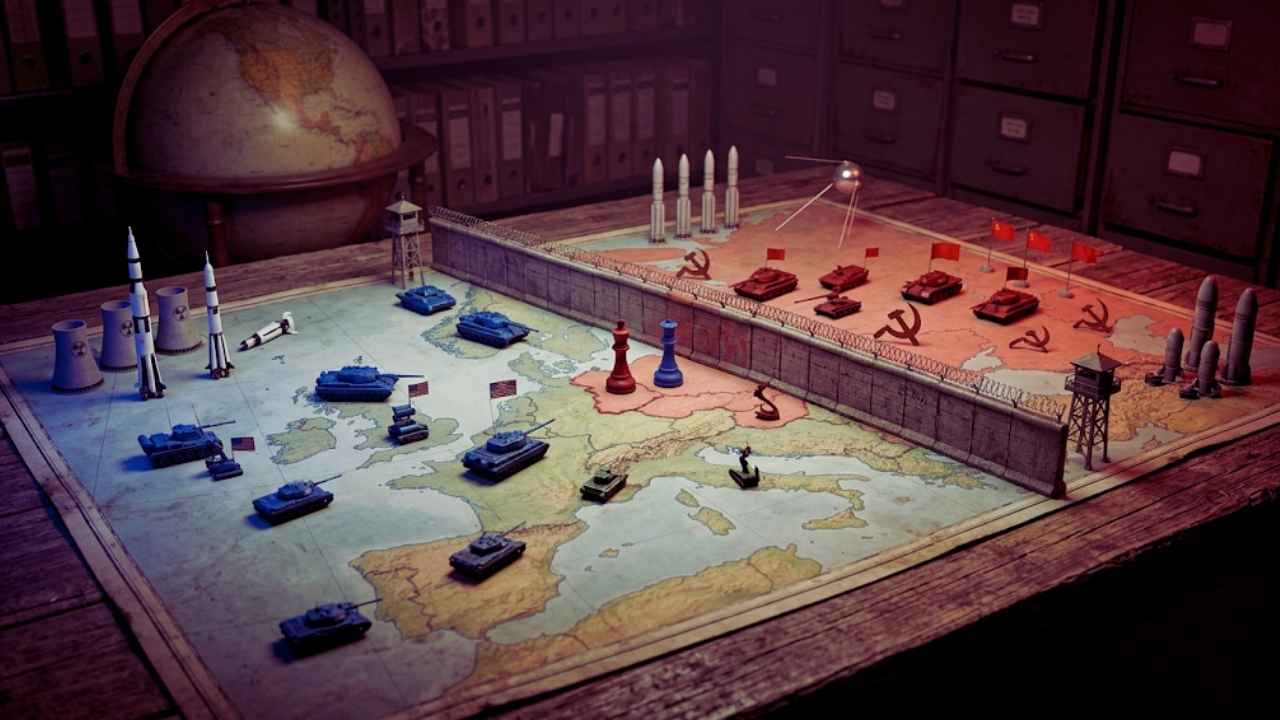
History is packed with massive conflicts, but none shaped the modern world quite like the tense standoff between the United States and the Soviet Union. If you want the Cold War explained without all the dense academic jargon, you are in the exact right place.
From the ashes of World War II to the fall of the Berlin Wall, this era defined global politics, drove humans to the moon, and pushed the world to the brink of absolute nuclear destruction. Let us look at how two superpowers divided the globe and fought a ruthless war of ideas, spies, and proxy battles.
The Cold War Explained: What Was It?
The conflict was a prolonged period of intense geopolitical tension and political rivalry between the United States and the Soviet Union. It kicked off shortly after World War II ended in 1945 and lasted until the Soviet Union finally collapsed in 1991. Instead of fighting directly on a traditional battlefield, these two superpowers fought for global dominance through economic pressure, espionage, and propaganda. Having the Cold War explained requires looking at the highly unique ways these nations battled without actually declaring a formal war.
|
Feature |
Description |
|
Time Period |
1945 to 1991 |
|
Primary Rivals |
United States vs. Soviet Union |
|
Type of Conflict |
Political, economic, and ideological standoff |
|
Ultimate Result |
Collapse of the Soviet Union |
Why Was It Called the “Cold” War?
People use this term because the two main nations never directly fired weapons at each other. A hot war involves direct armed combat between the primary enemies. The United States and the Soviet Union avoided this mainly because both sides eventually built up massive stockpiles of nuclear weapons. They knew that a direct military clash would lead to mutually assured destruction. That means a full nuclear war would likely wipe out both countries entirely. So, the war stayed cold at the top level, even though it fueled deadly conflicts in other parts of the world.
The Two Superpowers: USA vs. USSR
At the center of this standoff were two massive nations with completely opposite worldviews. On one side stood the United States an economic giant that pushed for democratic governments, individual rights, and free markets. On the other side was the Union of Soviet Socialist Republics, commonly known as the USSR. The Soviet Union championed strict government control, collectivism, and a communist economy where the state owned absolutely everything. These two superpowers simply could not agree on how the world should function after World War II.
The Main Causes of the Cold War
The roots of this decades long standoff grew from a messy mix of political mistrust and the chaotic fallout of global warfare. Once the shared threat of Nazi Germany was eliminated, the temporary alliance between the US and the USSR quickly fell apart. Both sides desperately wanted to reshape the world in their own image, making a major clash completely unavoidable. Here is a quick look at the main factors that sparked the conflict.
|
Cause |
Detail |
|
Ideology |
Capitalism and Democracy vs. Communism and Totalitarianism |
|
Post War Goals |
US wanted free trade while USSR wanted a secure buffer zone |
|
Broken Promises |
Soviets refused to allow free elections in Eastern Europe |
|
Nuclear Fear |
US secrecy regarding the atomic bomb created deep Soviet mistrust |
Ideological Differences: Capitalism vs. Communism
The biggest cause of the conflict was ideology. The United States ran on capitalism, where private businesses and consumers drive the economy. Politically, Americans voted for their leaders and held constitutional rights like freedom of speech. The Soviet Union ran on communism. The government controlled the entire economy, and private property was basically illegal. Politically, the USSR was a dictatorship with only one political party, and citizens had very few personal freedoms. Each side viewed the other as a dangerous threat to the future of humanity.
The Aftermath of World War II
During World War II, the United States and the Soviet Union actually fought together to defeat Germany. But this was purely an alliance of convenience. The Soviet Union lost tens of millions of people during the war and wanted to build a buffer zone of friendly communist countries in Eastern Europe to stop any future invasions. Meanwhile, the United States wanted to rebuild Europe into a group of stable, democratic countries that could trade freely. These totally opposite goals created immediate friction.
The Iron Curtain Descends on Europe
As Soviet troops pushed the German army back at the end of the war, they took control of a huge chunk of Eastern Europe. Instead of letting these countries hold free elections as promised, Soviet leader Joseph Stalin installed puppet communist governments loyal to Moscow. This completely split the European continent. Former British Prime Minister Winston Churchill gave a famous speech in 1946 saying an iron curtain had fallen across Europe. This invisible boundary cut off trade, travel, and communication between the democratic West and the communist East.
Key Policies and Alliances
As the divide across Europe grew permanent, both superpowers created specific policies and massive military alliances. They wanted to secure their own territories and stop the other side from gaining any more ground. This led to a global chess game involving money, weapons, and treaties. Below is a breakdown of the major alliances that defined the era.
|
Alliance or Policy |
Creator |
Purpose |
|
Truman Doctrine |
United States |
Policy to actively stop the spread of communism globally |
|
Marshall Plan |
United States |
Billions in financial aid to rebuild Western European economies |
|
NATO |
Western Powers |
Defensive military alliance to protect against Soviet attacks |
|
Warsaw Pact |
Soviet Union |
Rival military alliance tying Eastern Europe to Moscow |
The Truman Doctrine and the Marshall Plan
In 1947, US President Harry S. Truman rolled out a foreign policy based entirely on containment. The Truman Doctrine stated that the US would actively work to stop communism from spreading to any new countries. To back this up, the US launched the Marshall Plan in 1948. This program pumped billions of dollars into rebuilding Western Europe. The idea was simple: if countries had strong economies and happy citizens, they would not want a communist revolution. The plan worked perfectly, helping Western Europe bounce back quickly while Eastern Europe continued to struggle.
NATO and the Warsaw Pact
The political divide eventually turned into a formal, heavily armed military standoff. In 1949, the United States, Canada, and several Western European countries formed the North Atlantic Treaty Organization. It was a defensive alliance where an attack on one member meant an attack on everyone. A few years later, the Soviet Union fired back by creating the Warsaw Pact. This treaty tied the Soviet Union and its Eastern European satellite states into a unified military command, deeply freezing the dividing lines across the globe.
Defining Events of the Era
The conflict was packed with high stress standoffs, rapid technological leaps, and terrifying moments where the world almost ended. Seeing the Cold War explained through these specific events shows just how intense the rivalry actually was. From dividing entire cities to launching rockets into space, the two superpowers constantly tried to outdo each other.
|
Event |
Year |
Significance |
|
Sputnik Launch |
1957 |
Started the Space Race and fueled US fears of missile technology |
|
Berlin Wall Built |
1961 |
Physically divided Berlin to stop citizens from fleeing communism |
|
Cuban Missile Crisis |
1962 |
The closest the world ever came to an all out nuclear war |
|
Apollo 11 Moon Landing |
1969 |
The United States effectively won the Space Race |
The Division of Germany and the Berlin Wall
After World War II, the winning allies divided Germany. The western zones eventually merged into democratic West Germany, while the Soviet zone became communist East Germany. The capital city of Berlin sat deep inside East Germany, but the city itself was also split in half. Life in West Berlin was free and wealthy, but East Berlin was poor and tightly controlled by secret police. To stop people from running away to the West, the East German government built the Berlin Wall in 1961. Guarded by soldiers and barbed wire, the wall became the ultimate physical symbol of communist oppression.
The Arms Race and the Threat of Nuclear War
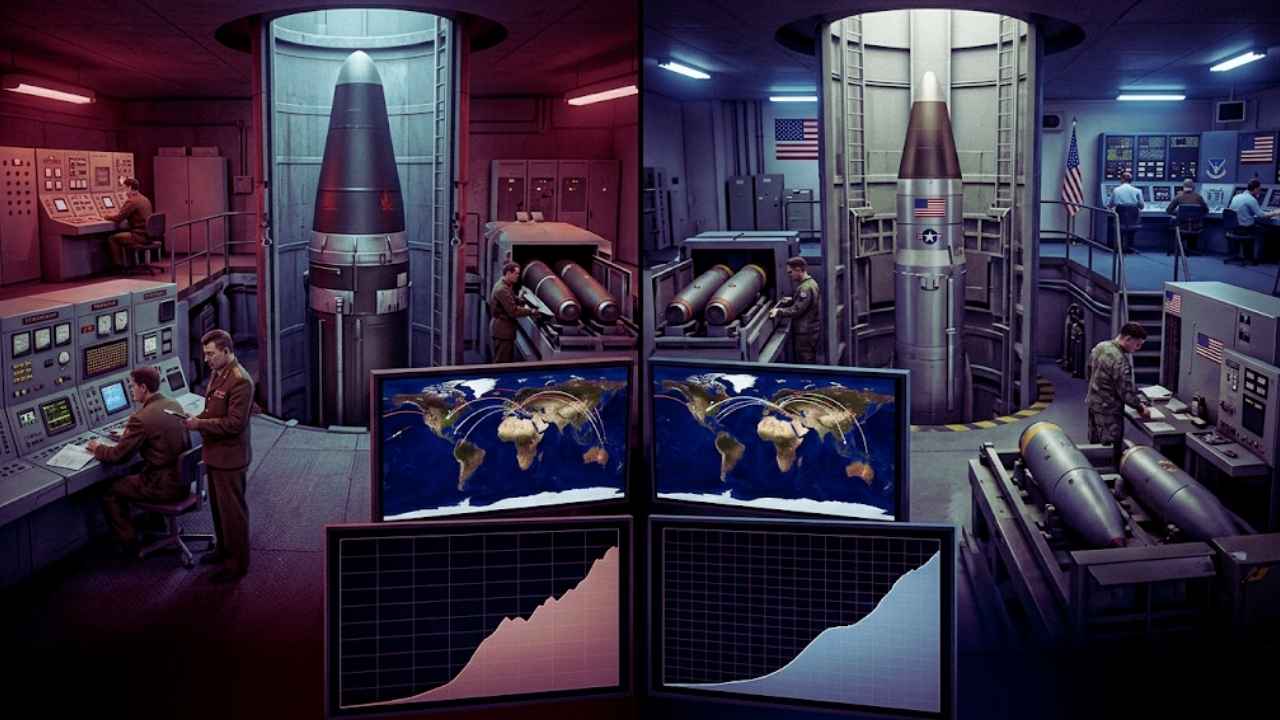
The US and the USSR spent decades in a terrifying arms race. The United States dropped the first atomic bombs to end World War II, but the Soviets successfully tested their own bomb in 1949. This kicked off a massive competition to build more destructive weapons. Soon, both sides had hydrogen bombs and long range missiles that could strike across the planet in minutes. This led to the concept of Mutually Assured Destruction. Neither side wanted to attack first because it would guarantee their own complete destruction, keeping the world in a constant state of fear.
The Space Race: Battle for the Stars
The competition went far beyond weapons and spilled directly into science. The Space Race started in 1957 when the Soviets launched Sputnik, the first artificial satellite. They scored another massive win in 1961 when cosmonaut Yuri Gagarin became the first person in space. Panicked that they were falling behind, the United States poured money into NASA. President John F. Kennedy promised to put a man on the moon before the end of the decade. The US won that specific race on July 20, 1969, when Neil Armstrong and Buzz Aldrin finally walked on the lunar surface.
The Cuban Missile Crisis
The absolute most dangerous moment of the entire conflict happened in October 1962. The Soviet Union secretly started putting nuclear missiles in Cuba, just 90 miles off the Florida coast. When US spy planes took photos of the missile sites, a tense 13 day standoff began. President Kennedy ordered a naval blockade around Cuba and demanded the missiles be removed. For a few terrifying days, global nuclear war seemed almost certain. Finally, the Soviets agreed to remove the weapons in exchange for a US promise not to invade Cuba.
Proxy Wars: Where the Cold War Got Hot?
Even though the main superpowers never shot at each other directly, they poured money and weapons into regional conflicts all over the world. These were called proxy wars. If a civil war started in a smaller country, the Soviets backed the communist side, and the US backed the anti communist side. Here are the most devastating proxy conflicts of the era.
|
Conflict |
Years |
Outcome |
|
Korean War |
1950 to 1953 |
Ended in a stalemate with the country still divided today |
|
Vietnam War |
1955 to 1975 |
US withdrew, and the country unified under a communist government |
|
Soviet~Afghan War |
1979 to 1989 |
Soviets withdrew after heavy losses, severely damaging their economy |
The Korean War
The first massive proxy fight was the Korean War, running from 1950 to 1953. Korea was divided into a communist North and a capitalist South. In 1950, the North invaded the South to try and unite the country under communism. The United States and a United Nations coalition stepped in to help South Korea, while the Soviet Union and China backed the North. After three years of brutal fighting and millions of deaths, the war ended in a tie. The two countries are still divided at the exact same border today.
The Vietnam War
The Vietnam War was one of the most painful proxy conflicts for the United States. Vietnam was also split into a communist North and an anti communist South. Fearing that all of Southeast Asia would fall to communism, the US sent hundreds of thousands of troops to fight the Northern forces and local guerillas known as the Viet Cong. Despite having better weapons, the US struggled against the highly motivated guerilla fighters. The war became incredibly unpopular in America, leading to a US withdrawal in 1973. Vietnam eventually unified under a communist government.
The Soviet Afghan War
In 1979, the Soviet Union invaded Afghanistan to support a weak communist government fighting a massive rebellion. This became a total disaster for the Soviets. Their massive military got stuck in a miserable guerilla war against local resistance fighters called the mujahideen. The United States secretly sent billions of dollars in weapons to the Afghan fighters to help them destroy Soviet helicopters and tanks. After ten years of heavy losses, the Soviets finally retreated in 1989. This expensive failure seriously damaged the Soviet economy.
How Did the Cold War End?
For a long time, people thought the standoff would just go on forever. But by the 1980s, the Soviet Union was falling apart from the inside. The state run economy was broken, people waited in long lines just to buy basic bread, and the arms race was bankrupting the government. The conflict finally ended through a mix of economic collapse and widespread political revolutions.
|
Factor |
Description |
|
Economic Strain |
Soviet economy collapsed under the weight of military spending |
|
Gorbachev’s Reforms |
Policies of openness accidentally encouraged democratic revolutions |
|
Eastern Bloc Uprisings |
Citizens in Soviet satellite states protested and overthrew their governments |
|
Dissolution |
The USSR officially broke apart into 15 independent countries in 1991 |
Mikhail Gorbachev’s Reforms: Glasnost and Perestroika
A new leader named Mikhail Gorbachev took over the Soviet Union in 1985 and realized the system was failing. He tried to fix things with two major policies. Perestroika aimed to restructure the economy by allowing a little bit of private business. Glasnost meant political openness, giving citizens the freedom of speech and the press for the first time in Soviet history. But instead of saving the communist system, these reforms actually sped up its collapse. Once people were allowed to speak freely, they instantly demanded full democracy.
The Fall of the Berlin Wall
Gorbachev’s changes caused a massive ripple effect across Eastern Europe in 1989. When people realized the Soviet army would no longer shoot protestors, peaceful democratic revolutions swept through the region. Communist governments fell apart in Poland, Hungary, and Romania. Then, on November 9, 1989, the East German government finally caved to pressure and opened its borders. Thousands of people rushed the checkpoints, and guards simply let them through. Crowds climbed on top of the Berlin Wall and smashed it with hammers, symbolically ending the divide.
The Dissolution of the Soviet Union
With Eastern Europe free, the Soviet Union itself started to crack. The 15 internal republics that made up the massive country began declaring their own independence. Facing a ruined economy and having lost all his political power, Gorbachev resigned on December 25, 1991. The very next day, the Soviet Union officially dissolved. The massive communist empire disappeared from the map, replaced by Russia and 14 other independent nations. The decades long standoff was officially over.
The Legacy and Impact of the Cold War
The world we live in right now was entirely shaped by this specific era. Even though the Soviet Union is gone, the political decisions and technological leaps from that time still affect our daily lives. From international alliances to the gadgets in our pockets, the legacy of this conflict is literally everywhere.
|
Area of Impact |
Detail |
|
Geopolitics |
The US emerged as the sole global superpower |
|
Modern Technology |
The Space Race led directly to satellites, GPS, and the early internet |
|
Global Alliances |
NATO remains the most powerful military alliance in the world |
|
Borders |
The collapse created 15 new independent nations in Europe and Asia |
Global Political Shifts
When the conflict ended, the United States was left as the only global superpower. This led to a massive expansion of democratic capitalism around the world. The military alliances built during those tense decades, especially NATO, still serve as the foundation for international security today. The borders of modern Europe, the independence of former Soviet states, and the ongoing tension between the West and countries like Russia all trace their roots directly back to this era.
Technological and Cultural Advancements
The intense competition forced both sides to pour unbelievable amounts of money into science and education. The Space Race pushed humans to the moon and led to the satellite networks that power our modern GPS systems. The military need for secure communication networks laid the early groundwork for what eventually became the internet. Even popular culture was completely shaped by the constant fear of spies and nuclear weapons, inspiring countless books and movies that still resonate today.
Final Thoughts
Trying to get the Cold War explained can seem overwhelming because it covers so much history, but the core story is simple. It was a massive, 46 year staring contest between two heavily armed superpowers with totally different ideas on how the world should work.
While they managed to avoid blowing up the planet, their rivalry fueled devastating proxy wars, drove humanity into space, and completely rewired global politics. The Soviet Union may be gone, but the echoes of that long, cold standoff still shape the way nations interact today.
Frequently Asked Questions (FAQs) About Cold War Explained
Who officially won the conflict?
The United States and its Western democratic allies are widely considered the winners. The standoff ended with the total economic and political collapse of the Soviet Union in 1991, leaving the US as the dominant global superpower and capitalism as the primary economic system worldwide.
Did anyone actually die during the era?
Yes, millions of people died. While the main superpowers never fought each other directly in Europe or North America, they funded massive proxy wars in places like Korea, Vietnam, Afghanistan, and across Latin America. These regional conflicts resulted in massive civilian and military casualties.
What was the Red Scare?
The Red Scare refers to periods of intense anti communist paranoia in the United States, especially during the 1950s. The government actively investigated regular citizens, Hollywood actors, and politicians suspected of being communist spies, often ruining their lives with little to no actual evidence.
How much did the conflict cost the United States?
While exact numbers are tough to calculate over 46 years, economists estimate the direct military costs for the US were somewhere between $4 trillion and $6 trillion. This massive spending often required the government to borrow heavily, shifting the financial burden to future generations of taxpayers.
What was the closest the world actually came to nuclear war?
The Cuban Missile Crisis in 1962 is widely considered the closest humanity has ever come to intentional global nuclear annihilation. The 13 day standoff over Soviet missiles in Cuba forced both leaders to realize a single mistake could trigger a war neither side would survive.