


Saving money often feels like a constant uphill battle. You work hard, pay your bills, and by the time the end of the month rolls around, there is barely anything left to put away. It is a common frustration, but it does not have to be your permanent reality. Recent economic data from the U.S. Bureau of Economic Analysis shows that as of early 2026, the national personal saving rate hovered around 3.6 percent.
That means the average person is saving far less than what financial experts recommend. The idea of learning how to save 20 percent of your income might sound intimidating at first, especially if you are currently living paycheck to paycheck.
However, it is an entirely achievable goal when you break it down into actionable steps. You do not need to adopt an extreme frugal lifestyle or stop enjoying your life to hit this target. This guide will walk you through real, proven strategies to help you reach that milestone. We will explore how to restructure your budget, make painless cuts to your daily spending, and set up systems that do the heavy lifting for you. Whether you are building an emergency fund, aiming for a house down payment, or funding a comfortable retirement, these tactics will give you the clarity you need.
Understanding the 20 Percent Savings Rule
When you set out to save 20 percent of your income, you are committing to a benchmark that fundamentally changes your financial future. This specific percentage provides a solid foundation for long-term stability while still allowing you to live comfortably right now. It forces you to prioritize wealth creation without feeling entirely restricted. Financial experts rely on this number because it strikes the perfect balance between aggressive investing and reasonable daily living.
What is the 50/30/20 Budgeting Method?
One of the most popular ways to manage personal finances is the 50/30/20 rule, popularized by Senator Elizabeth Warren. This framework divides your after-tax income into three distinct categories to ensure your needs are met, your wants are fulfilled, and your future is secured. Half of your income, or fifty percent, is dedicated to absolute necessities. These are the non-negotiable expenses you need to survive and keep your life running smoothly. Rent or mortgage payments, groceries, utility bills, health insurance, and minimum debt payments fall into this category. If you find that your necessities are taking up more than half of your paycheck, it might be a sign that you need to evaluate your living situation or look for ways to increase your earnings.
Thirty percent of your income is allocated to your wants. This is the fun money that makes life enjoyable. It covers dining out, streaming subscriptions, hobbies, vacations, and shopping for things you do not strictly need. Having a dedicated allowance for your wants prevents you from feeling deprived, which is the main reason people abandon their budgets. You get to spend this money guilt-free because you know your other obligations are handled.
The final twenty percent is earmarked for savings and debt repayment beyond the minimums. This is the portion of your income that builds your net worth over time. It includes contributions to retirement accounts, building an emergency fund, saving for large purchases, and aggressively paying down high-interest credit card debt. Sticking to this final bucket is the secret to getting ahead financially.
The 80/20 Budget Approach
If meticulously tracking every single dollar into three categories feels too restrictive, the 80/20 budget offers a much simpler alternative. This strategy, sometimes called the pay-yourself-first method, requires you to immediately set aside twenty percent of your income into savings as soon as you get paid. You remove the money before you even have a chance to look at it.
Once that money is safely tucked away, you have the freedom to spend the remaining eighty percent however you choose. You do not need to worry about whether a purchase is a need or a want, as long as you do not exceed the money left in your checking account. This method is highly effective for people who hate traditional budgeting but still want to ensure they are hitting their financial goals. It removes the stress of categorization and focuses purely on the end result.
|
Budgeting Method |
Best For |
Core Concept |
Flexibility Level |
|
50/30/20 Rule |
Beginners needing structure |
Splits income into needs, wants, and savings |
Moderate |
|
80/20 Rule |
Those who hate tracking |
Save 20 percent first, spend the rest freely |
High |
|
Envelope Method |
Chronic overspenders |
Hard limits on specific cash categories |
Low |
Step-by-Step Guide to Saving 20 Percent of Your Income
Transitioning from saving nothing to saving a massive chunk of your paycheck will not happen overnight. It requires a systematic approach to understand your current habits and make intentional adjustments. You have to treat your personal finances like a small business to figure out where the leaks are. By following a structured plan, you can map out exactly how to hit your target.
Step 1: Track Your Current Spending Habits
You cannot change your financial habits if you do not know what they are. The first step is to track every single penny you spend for at least one full month. You can use a dedicated budgeting app, a simple spreadsheet, or even a pen and a notebook. Record your fixed expenses like rent and car payments, but pay special attention to your variable expenses.
In recent years, quick commerce apps and rapid food delivery services have become massive budget drains. Small orders that cost just a few dollars quietly add up to hundreds of dollars a month without you realizing it. Do not judge your spending during this tracking phase; simply observe and record the data accurately. The goal here is raw honesty.
Step 2: Categorize Your Expenses
Once you have a month of data, group your expenses into logical categories. You can use the necessities and wants framework, or create your own custom buckets like housing, transportation, food, entertainment, and debt. Total up the amount spent in each category and calculate what percentage of your total income it represents.
This visual breakdown will instantly highlight the problem areas in your budget. For instance, you might realize that dining out is consuming fifteen percent of your income, which is a prime target for reduction. Categorization takes the emotion out of spending and replaces it with hard data you can act on.
Step 3: Identify Areas to Cut Back
With a clear picture of your spending, you can start making strategic cuts. The goal is to free up enough money to comfortably save 20 percent of your income every month. Look for low-hanging fruit first. These are expenses you can eliminate without significantly impacting your quality of life, like unused gym memberships or redundant streaming services.
Once you have tackled the easy wins, examine your larger expenses. Can you negotiate your car insurance rates? Is it possible to refinance your student loans for a lower interest rate? Every dollar you trim from your outgoing expenses is a dollar you can redirect toward your future wealth.
|
Step |
Action Required |
Expected Outcome |
Tools to Use |
|
1. Track Spending |
Record every transaction for 30 days |
Expose hidden money leaks |
Spreadsheets, financial apps |
|
2. Categorize |
Group transactions into buckets |
Reveal highest spending areas |
Calculator, highlighters |
|
3. Cut Back |
Eliminate waste and negotiate bills |
Free up cash for savings |
Phone calls to providers |
Real Strategies to Reduce Monthly Expenses
Cutting expenses is the fastest way to boost your savings rate immediately. However, you need sustainable strategies that you can maintain over the long run because extreme frugality usually leads to burnout. Instead of cutting out everything you love, focus on making smart, calculated adjustments to your lifestyle that lower your baseline costs.
Lowering Your Housing and Utility Costs
Housing is typically the largest expense in any budget, meaning it also offers the greatest potential for massive savings. If your rent or mortgage is taking up more than thirty percent of your income, you are likely house poor. This makes aggressive saving incredibly difficult because your cash is tied up in your living space.
If your lease is up for renewal, consider downsizing to a smaller apartment or moving to a slightly more affordable neighborhood. If moving is not an option right now, think about getting a roommate to split the cost of rent and utilities. For homeowners, renting out a spare room on a short-term basis can generate significant extra income to offset your mortgage.
You can also lower your monthly utility bills with a few simple daily habit changes. Turn off lights when you leave a room, unplug electronics that are not in use, and adjust your thermostat by just a few degrees. Installing energy-efficient lightbulbs and weatherstripping your doors can also lead to noticeable savings on your electricity and heating bills over a year.
Smart Grocery Shopping and Meal Planning
Food is another major budget category where costs can easily spiral out of control, especially with recent inflation trends. The most effective way to rein in your food spending is through weekly meal planning. Take some time each weekend to plan your breakfasts, lunches, and dinners for the upcoming week. Write down a detailed grocery list based on your plan and stick to it strictly when you go to the store.
Avoid shopping when you are hungry, as this biological trigger often leads to impulse purchases. Consider swapping name-brand products for generic store brands, which are usually identical in quality but cost significantly less. Incorporating a few meatless meals into your weekly rotation can also dramatically reduce your grocery bill, as plant-based proteins like beans and lentils are much cheaper than chicken or beef.
Furthermore, minimizing food waste is crucial for your wallet. Buy only what you know you will consume before it spoils, and make a conscious effort to eat your leftovers. Taking a packed lunch to work instead of buying a sandwich every single day can easily save you over a hundred dollars a month.
Managing Subscriptions and Entertainment
In the age of digital streaming and subscription boxes, small recurring charges silently eat away at your take-home pay. Take a ruthless inventory of all your active subscriptions across your credit cards and app stores. This includes streaming video services, premium music apps, software licenses, and monthly physical product deliveries.
Cancel anything you have not actively used in the past thirty days. If you have multiple television streaming services, consider keeping only one active at a time. You can binge-watch the shows on one platform for a few months, cancel it, and then subscribe to a different one.
When it comes to entertainment, look for free or low-cost alternatives in your local community. Visit public parks, check out books and movies from the local library, or host a game night at home with friends instead of going out to an expensive bar. You can still have a rich social life without spending a fortune.
|
Expense Category |
Common Money Drain |
Savings Strategy |
Potential Monthly Savings |
|
Housing |
Living alone in a large space |
Get a roommate or downsize |
Hundreds of dollars |
|
Groceries |
Buying name brands and wasting food |
Meal plan and buy generics |
Fifty to a hundred dollars |
|
Entertainment |
Multiple unused streaming apps |
Rotate one service at a time |
Twenty to fifty dollars |
Automate Your Savings to Pay Yourself First
Willpower is a finite resource that drains as the day goes on. If you rely on yourself to manually transfer money into your savings account at the end of the month, you will almost certainly fail at some point. Life gets busy, unexpected expenses pop up, and it is entirely too easy to justify spending the cash instead. The absolute secret to consistent wealth building is automation.
Setting Up Direct Deposits
The most foolproof way to save 20 percent of your income is to never let it hit your checking account in the first place. If your employer offers direct deposit, talk to your human resources department to see if you can split your paycheck across multiple different bank accounts.
Instruct them to route exactly twenty percent of your net pay directly into a separate savings account, and let the remaining eighty percent flow into your primary checking account. By doing this, you are prioritizing your financial goals before you have a chance to spend a single dime on groceries, rent, or entertainment. You quickly learn to live solely on the eighty percent that is available to you, and your savings grow automatically in the background without any daily effort on your part.
Utilizing High-Yield Savings Accounts
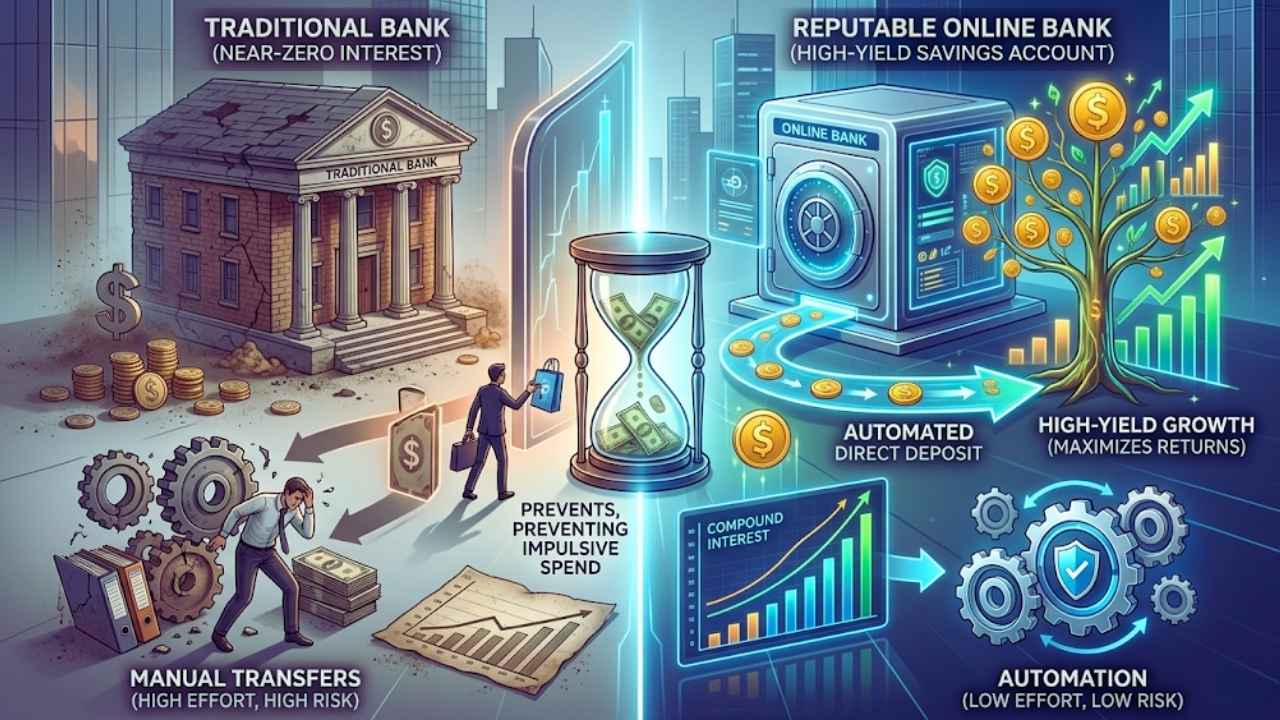
Where you keep your saved money matters just as much as the act of saving itself. Traditional brick-and-mortar banks often offer interest rates that are practically zero. This means your money is actually losing purchasing power to inflation every single day it sits in a standard account.
Instead, open a high-yield savings account with a reputable online bank. Because these modern institutions do not have the massive overhead costs of maintaining physical branches, they pass those savings on to you in the form of much higher interest yields. Keeping your savings in a separate institution from your daily checking account also adds a psychological and logistical barrier. It takes a few days to transfer the money back to your checking account, which prevents you from making impulsive, late-night purchases with your hard-earned savings.
|
Saving Method |
Effort Required |
Risk of Failure |
Growth Potential |
|
Manual Transfers |
High |
High (relies on willpower) |
Low (usually standard banks) |
|
Automated Direct Deposit |
Low (set it once) |
Low (happens in background) |
High (if using high-yield accounts) |
How to Increase Your Income to Boost Savings?
There is a mathematical limit to how much you can cut your expenses. Eventually, you will trim your budget down to the bare essentials, and you still might fall short of your goals. When you reach this frugal floor, the only way to accelerate your progress is to focus on the other side of the equation and increase your income.
Asking for a Raise or Promotion
The most efficient way to increase your earnings is to maximize the value of the job you already have. If you have taken on new responsibilities, consistently exceeded your performance metrics, or acquired new certifications, you might be overdue for a raise.
Do your research online to understand the current market rate for your exact position in your geographical area. Document your achievements and the concrete value you bring to the company in a clear list. Schedule a formal meeting with your manager to discuss your compensation, presenting your case professionally and confidently. If a raise is not immediately possible due to budget constraints, ask what specific milestones you need to hit to earn a promotion in the near future.
Starting a Side Hustle
The gig economy has made it easier than ever to earn extra cash outside of your primary nine-to-five job. A side hustle can provide a dedicated stream of income that you can funnel entirely toward your wealth goals.
Consider how you can monetize your existing skills and hobbies. If you are a strong writer, look into freelance copywriting or technical editing. If you are good with animals, offer pet sitting or daily dog walking services in your neighborhood. You can drive for a rideshare company, deliver groceries on weekends, or tutor students online. The key is to find something that fits flexibly around your regular work schedule and does not cause you to burn out from exhaustion.
Selling Unused Items
Take a look around your home right now. You are likely surrounded by items you no longer need or use that hold real financial value. Decluttering your living space can provide a fantastic, immediate cash injection for your bank account.
Go through your bedroom closets, garage, and attic spaces. Gather up old electronics, gently used designer clothing, furniture, and unread books. You can sell high-quality clothing on dedicated fashion resale apps, list electronics and furniture on local marketplace websites, or hold a traditional weekend garage sale. Not only will you clean up your physical environment, but you will also give your financial journey a highly motivating initial boost.
|
Income Strategy |
Time Investment |
Earning Potential |
Best For |
|
Negotiating a Raise |
Low (prep time only) |
High (permanent salary bump) |
Established employees |
|
Starting a Side Hustle |
High (weekly hours) |
Variable (depends on gig) |
Energetic self-starters |
|
Selling Old Items |
Medium (cleaning/listing) |
One-time cash burst |
People with cluttered homes |
Overcoming Common Budgeting Challenges
Saving a large portion of your income is a marathon, not a quick sprint. Along the way, you will inevitably face obstacles that threaten to derail your progress and test your patience. Anticipating these challenges and having a logical plan to handle them is crucial for long-term success.
Dealing with Unexpected Expenses
No matter how carefully you budget your month, life will always throw curveballs at you. Your car will break down on the highway, a medical emergency will arise, or your roof will spring a massive leak during a storm. These unexpected expenses are the absolute number one reason people abandon their budgets entirely in frustration.
This is why your very first financial priority should be establishing a starter emergency fund, even before you try to hit the full twenty percent goal. Aim to save a quick thousand dollars or one month of essential living expenses first. When an emergency strikes, you can use this cash instead of relying on high-interest credit cards. Once the crisis has passed, you simply resume your normal plan and replenish the fund.
Staying Motivated Over the Long Term
Saving money can sometimes feel like a heavy sacrifice, especially when you are watching your friends spend freely on lavish vacations and brand new cars. It is incredibly easy to lose your motivation when the rewards of saving are months or years away in the future.
To stay on track, you need to clearly define your personal financial motivations. Are you saving so you can finally quit a toxic job? Are you saving to provide a secure future for your children? Write your goals down on paper and keep them visible on your fridge or bathroom mirror. Additionally, celebrate your small milestones along the way. When you hit your first five thousand dollars, treat yourself to a modest, budget-friendly reward. Recognizing your progress reinforces the positive behavior.
Avoiding Lifestyle Inflation
As you progress in your career and your income naturally grows, there is a strong psychological tendency to increase your spending to match your new earnings. This phenomenon, known as lifestyle inflation, is the silent killer of wealth creation. You get a raise, so you buy a more expensive car or move into a luxury apartment building, and suddenly your savings rate drops back down to zero.
To combat lifestyle inflation effectively, you must commit to maintaining your current standard of living even as your paychecks get bigger. When you receive an annual raise or a holiday bonus, pretend it never actually happened. Immediately adjust your automated transfers so that the extra money goes directly into your investment accounts. By keeping your expenses totally flat while your income rises, you can easily surpass your goals.
|
Challenge |
Why It Happens |
How to Overcome It |
|
Unexpected Bills |
Life is unpredictable |
Build a starter emergency fund first |
|
Loss of Motivation |
Results take a long time |
Set visible goals and reward small wins |
|
Lifestyle Inflation |
Making more money triggers spending |
Automate raises directly into savings |
What to Do with the 20 Percent You Save?
Simply holding onto the money is only the first part of the mathematical equation. To truly achieve lasting financial success, you need to deploy that cash strategically. Leaving huge sums of money in a basic checking account means you are losing purchasing power to inflation over time. Here is exactly how you should allocate your newly saved funds.
Building an Emergency Fund
As mentioned earlier, a starter emergency fund is essential for peace of mind, but your ultimate goal should be much larger and more robust. Financial planners generally recommend keeping three to six months of essential living expenses in a highly liquid, easily accessible account.
If you have a very stable corporate job and low fixed expenses, three months might be perfectly sufficient. If your income is irregular, you work as a freelancer, or you have multiple dependents counting on you, leaning toward the six-month mark provides a much safer cushion. This specific money should not be invested in the volatile stock market; it needs to be protected in a high-yield savings account so it is guaranteed to be there when disaster strikes.
Paying Off High-Interest Debt
If you are currently carrying balances on credit cards or personal loans with interest rates above eight to ten percent, paying those off is the best guaranteed financial return on your money. The massive interest you are charged on these toxic debts will almost always outpace any returns you could make by investing in the market.
Allocate a significant portion of your savings to aggressively attack this debt. You can use the debt avalanche method, which focuses on paying off the balance with the highest interest rate first, saving you the most money mathematically. Alternatively, the debt snowball method focuses on paying off the smallest balance first to build quick psychological momentum. Choose the strategy that keeps you the most fired up.
Investing for Retirement and Wealth Creation
Once your emergency fund is fully funded and your high-interest consumer debt is eliminated, your money should be directed toward investments that will grow your wealth over decades. The earlier you start investing, the more you benefit from the incredible math of compound interest.
Start by taking full advantage of any employer match offered in your workplace retirement plan like a 401(k). This is essentially free money, and failing to claim it is leaving part of your total compensation on the table. After securing the company match, look into opening an individual retirement account (IRA), which offers massive tax advantages for long-term holding. Broadly diversified index funds are excellent, low-cost options that do not require you to pick individual stocks. Consistently investing month after month is the most proven path to becoming a millionaire.
|
Savings Priority |
Account Type to Use |
Goal Benchmark |
|
1. Emergency Fund |
High-Yield Savings Account |
3 to 6 months of living expenses |
|
2. Toxic Debt |
Credit Cards / Personal Loans |
Zero balance on high-interest accounts |
|
3. Retirement |
401(k) or IRA (Index Funds) |
Max out annual contribution limits |
Final Thoughts
Figuring out how to save 20 percent of your income is one of the most impactful financial decisions you will ever make in your adult life. It is not about completely depriving yourself of the things you enjoy, but rather about bringing deep intentionality and structure to how you manage your resources. By understanding the principles of the 50/30/20 rule, relentlessly tracking your daily expenses, and fully automating your finances, you remove the stress and guesswork from wealth building.
The journey requires real patience and a willingness to adjust your lifestyle, but the peace of mind that comes from total financial security is worth far more than any temporary purchase. Start today by reviewing your last bank statement, identify one single expense you can reduce right now, and set up your first automated bank transfer. Over time, these small, deliberate actions will compound beautifully.
Frequently Asked Questions (FAQs) About Save 20 Percent Income
Is saving 20 percent of my income enough for retirement?
For most people starting in their twenties or early thirties, saving this percentage of their gross pay is generally sufficient to build a highly comfortable retirement nest egg. This assumes that the money is invested in a diversified portfolio that earns a reasonable rate of return over several decades. However, if you are starting to save much later in life, or if you plan to retire extremely early, you may need to save a significantly higher percentage to catch up.
What if I can only save 5 or 10 percent right now?
Do not let the ideal target discourage you from saving anything at all. If you can only afford to save five percent of your paycheck today, start exactly there. The most important thing is building the physical habit of setting money aside consistently every month. As you pay off debt or increase your income, you can gradually increase your rate by one percent every few months until you reach your ultimate goal.
Should I save 20 percent before or after taxes?
The traditional 50/30/20 rule is based on your after-tax income, also known as your take-home pay. This makes monthly budgeting much simpler because you are dealing with the actual cash that hits your bank account. However, when financial planners discuss saving for retirement, they are usually referring to your pre-tax gross income. If your goal is aggressive wealth building, aiming for pre-tax numbers will yield much better long-term results.
Does paying off debt count toward my savings goal?
Yes, paying down debt absolutely counts as part of your overall savings allocation. Every single dollar you use to reduce your principal loan balance is a dollar that increases your overall net worth. This is especially true for toxic, high-interest consumer debt like credit cards. Once you clear those obligations, you seamlessly transition that money into investments.
How do I stop spending money on impulse purchases?
One of the most effective strategies is the 24-hour rule. When you see something you want to buy that is not a necessity, force yourself to wait a full 24 hours before making the purchase. Most of the time, the emotional urge to buy will fade, and you will realize you do not actually need the item. Deleting saved credit card information from your favorite shopping sites also creates friction that slows down impulse buying.
What are “stealth” expenses, and how do they ruin budgets?
Stealth expenses are small, recurring costs that fly under the radar. Things like in-app purchases, micro-subscriptions, expedited shipping fees, and digital storage upgrades are prime examples. Because they are often under five dollars, your brain ignores them. Tracking every transaction with a modern budgeting app exposes these leaks so you can plug them.