


Buying a home or renewing your current loan is always a massive step. The financial climate today just adds another layer to that process. After the rollercoaster of rate hikes in 2022 and 2023, and the cooling periods of 2024 and 2025, the housing market in 2026 has reached a strange middle ground.
Average 30-year fixed mortgage rates currently sit near 6.4%, down from the painful 8% peak we saw a few years ago. Central banks have made some cuts, but geopolitical tensions keep everyone guessing about what happens next. This stabilized yet slightly unpredictable environment brings up the most hotly debated topic among homebuyers right now. If you are stepping into the property market today, you are likely wondering whether a fixed vs variable rate mortgage 2026 makes the most sense for your wallet.
There is no magical single answer that applies to every buyer. The best choice depends entirely on your personal budget, how much risk you can stomach, and your long-term housing plans. However, looking closely at current economic forecasts can point you in the right direction. Analysts from major financial institutions predict fixed rates might dip down to around 5.75% by mid-year before potentially climbing back up. Let us dive deep into what these loan options mean for you, the current market predictions, and the strategies you can use to secure the smartest possible deal.
Understanding the Mortgage Landscape in 2026
Before comparing your loan options, you need to firmly grasp what these products actually are. A mortgage is more than just borrowing cash to buy property. It is an agreement on how much it will cost you to hold that debt over decades. The rate you choose dictates your exact monthly payment, your long-term interest costs, and your freedom to sell or refinance later. The 2026 market offers clear choices, but you have to understand the mechanics behind them to avoid expensive mistakes. Let us break down how each primary loan type functions under current lending rules.
|
Mortgage Type |
Rate Structure |
Payment Predictability |
Best For |
|
Fixed-Rate |
Locked for the term |
100% predictable |
Budget-conscious buyers |
|
Variable-Rate |
Fluctuates with market |
Subject to change |
Flexible buyers wanting lower initial rates |
What Is a Fixed-Rate Mortgage?
A fixed-rate mortgage does exactly what the name implies. It locks down your interest rate for a specific timeframe. In the United States, you can often secure this rate for the full 15 or 30 years of the loan. In other countries like Canada or the UK, you might lock it in for a two-year or five-year term. During this locked period, your principal and interest payment remains identical every single month.
If you sign for a fixed-rate loan today at 6.2%, you know down to the penny what you will owe next month and next year. This setup provides massive predictability. Families operating on a tight monthly budget find this incredibly useful. You stay completely protected from wild financial markets. Even if central banks hike rates to fight sudden inflation, your monthly housing bill will not move an inch.
What Is a Variable-Rate Mortgage?
A variable-rate mortgage, sometimes called an adjustable-rate mortgage or a tracker loan, functions entirely differently. Instead of a static rate, your interest cost moves up and down based on a broader financial benchmark. This benchmark usually ties back to the prime lending rate established by the central bank.
When you take out a variable loan, the bank gives you a rate that sits a certain percentage above or below prime. If the central bank cuts interest rates to boost the economy, your mortgage rate drops alongside it. This instantly lowers your monthly housing costs or helps you pay off your principal balance much faster. On the flip side, if the central bank raises rates, your mortgage rate climbs, taking your monthly payments up with it.
How the 2026 Economy Affects Your Decision?
Deciding between loan types requires you to look beyond your own bank account and observe the wider economy. The year 2026 presents a highly specific financial climate. We have moved past the aggressive inflation spikes of the early 2020s, and borrowing costs have slowly cooled. However, things like global trade conflicts and fluctuating oil prices mean the path ahead remains slightly murky. You have to consider these macroeconomic factors because they directly influence how much your bank will charge you over the next five to ten years.
|
Economic Factor |
Current 2026 Status |
Impact on Fixed Rates |
Impact on Variable Rates |
|
Inflation |
Cooled but lingering |
Keeps rates relatively high |
Could prevent further rate cuts |
|
Central Bank Policy |
Holding steady / minor cuts |
Stabilizes long-term yields |
Lowers immediate borrowing costs |
|
Geopolitical Tension |
Moderate to high |
Drives up bond yields |
Creates uncertainty for future prime rates |
The Role of Central Banks and Interest Rates
Central banks act as the conductors of the borrowing market. In early 2026, many central banks have held their base rates somewhat steady after implementing a few welcome cuts throughout 2024 and 2025. The Federal Reserve, for example, dropped rates by 75 basis points last year. Lenders watch these base rates closely to figure out what they should charge everyday consumers for housing loans.
When central banks hint at future rate cuts, variable loans look very appealing because buyers expect their payments to shrink over time. But when data suggests inflation might return, fixed rates look much safer. Right now, economists hold mixed views. Some predict further rate drops by mid-2026 if the economy slows down. Others think rates will plateau or bump up slightly if energy costs keep climbing.
Inflation and Its Impact on Your Monthly Payments
Inflation is the quiet engine driving all mortgage trends. High inflation destroys purchasing power, forcing central banks to hike interest rates to stop people from spending so fast. When inflation drops back down toward a normal target of around two percent, central banks can relax and make borrowing cheaper again.
In 2026, inflation sits much lower than the crazy peaks of 2022. But it has not disappeared completely. Unpredictable oil prices and global supply chain hiccups still pose a threat. Picking a variable loan today means you are betting that inflation stays calm and rates drop. Picking a fixed loan means you are essentially buying an insurance policy against inflation suddenly spiking again.
The Pros and Cons of a Fixed-Rate Mortgage
You need to weigh the specific upsides and downsides of locking in your borrowing costs. Millions of people choose fixed rates simply because it feels safe and traditional. But it is important to know exactly what you gain and what you give up when you sign that contract. Understanding these elements ensures you do not feel trapped or regretful later on.
|
Feature |
Advantage |
Disadvantage |
|
Payment Certainty |
Exact budget planning |
Cannot benefit if market rates drop |
|
Protection |
Immune to central bank rate hikes |
Pay a premium for this security |
|
Breaking the Contract |
None while active |
Extremely high prepayment penalties |
Why Choose a Fixed Rate?
The greatest benefit of a fixed loan is mental peace. Knowing your exact housing bill lets you plan the rest of your life without anxiety. You can save for college, plan vacations, and build your retirement accounts without fearing a sudden jump in your mortgage payment.
Also, when you lock in during a moderate market, you secure manageable costs for years. In mid-2026, fixed rates in the low sixes feel much more affordable than the eight percent rates seen just a few years ago. If you are someone who panics over financial news, a fixed loan offers unmatched stability. You will sleep soundly knowing your lender cannot ask you for more money next month.
The Drawbacks of Locking In
The biggest downside to locking in is missing out on potential savings. Banks charge a premium for the safety they sell you. Because the lender assumes the risk that rates might rise, they price fixed loans slightly higher than the starting rate of a variable loan.
If the economy cools and central banks cut rates further throughout 2026 and 2027, fixed-rate holders remain stuck paying their higher locked-in amount. While variable-rate borrowers watch their monthly bills shrink, you will only access those cheaper rates by breaking your contract. Refinancing a fixed loan usually triggers massive prepayment penalties and closing costs, which often erase any savings you hoped to gain.
The Pros and Cons of a Variable-Rate Mortgage
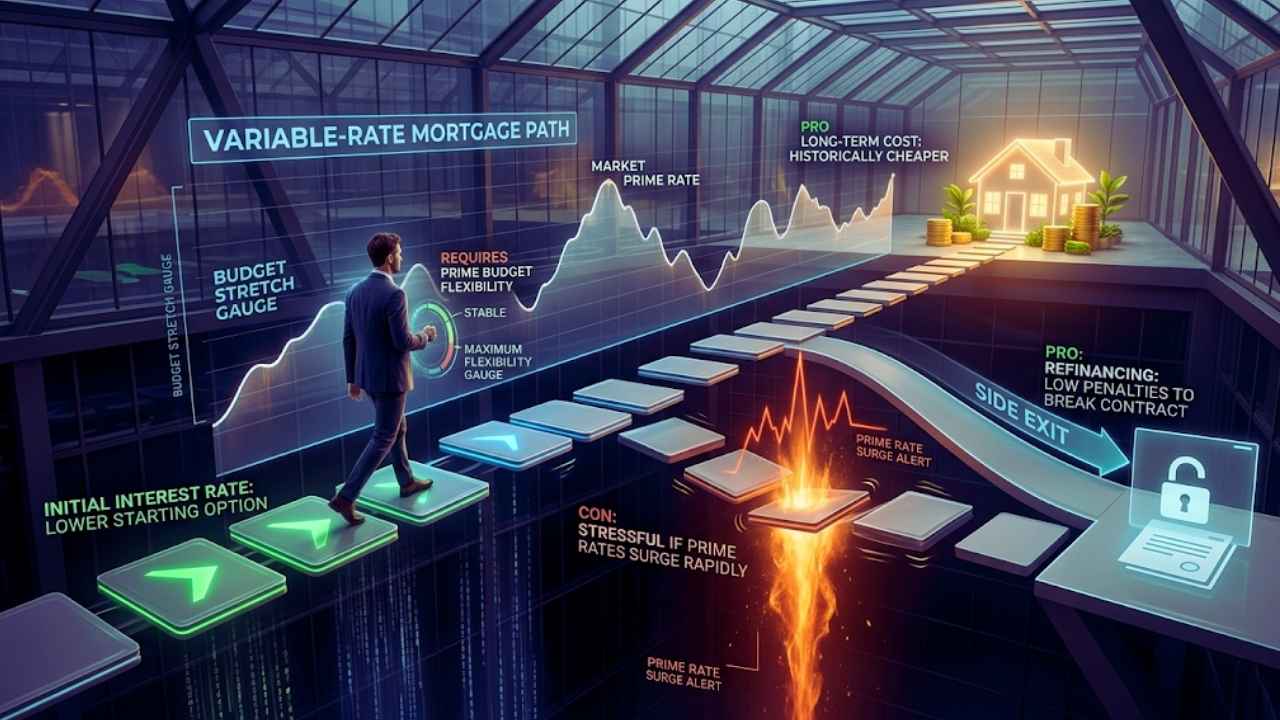
Variable loans demand a higher tolerance for risk, but they have historically saved homeowners a lot of money over time. Let us look at the real benefits and the hidden traps of letting your rate float with the market. This choice requires you to stay engaged with financial news, but the financial payoff can be substantial if things go your way.
|
Feature |
Advantage |
Disadvantage |
|
Initial Interest Rate |
Usually lower than fixed options |
Can increase at any time |
|
Long-term Cost |
Historically cheaper over 25 years |
Requires strong budget flexibility |
|
Refinancing |
Low penalties to break contract |
Stressful if prime rates surge rapidly |
Why Choose a Variable Rate?
The most obvious reason to go variable in 2026 is the upfront savings. Variable rates almost always start lower than fixed rates because you are the one taking on the market risk, not the bank. This lower starting point means more of your money goes straight toward paying off your actual house rather than just paying bank interest.
If forecasts hold true and rates drop slightly later this year, your variable rate falls automatically. You do not have to sign new papers or pay refinance fees to get the cheaper rate. Furthermore, the penalty to break a variable loan is typically just three months of interest. If you need to sell your house suddenly or want to lock into a fixed rate later, getting out is relatively cheap and easy.
The Risks of Market Fluctuations
The major danger of a variable loan is payment shock. If the global economy shifts and inflation flares up, central banks will raise their base rates. When they do, your mortgage cost goes up immediately. For families living paycheck to paycheck, a single percentage point increase can mean hundreds of dollars in extra monthly bills.
Even though experts think rates will drift down or stay flat in 2026, the market is never guaranteed. Things like overseas conflicts or sudden trade tariffs can ruin an expert forecast overnight. If you take a variable loan, you absolutely must have the cash flow to handle potential rate hikes without losing sleep or skipping meals.
Fixed vs Variable Rate Mortgage 2026: A Direct Comparison
When placing these two paths side by side for this specific year, the contrast becomes very clear. The fixed vs variable rate mortgage 2026 debate really boils down to how much you value certainty versus potential savings. Fixed rates give you a safe harbor in an economy that still feels slightly bruised from recent inflation battles. They protect you completely from worst-case scenarios, but they demand a slightly higher monthly payment today. They also close the door on automatic savings if the economy cools down.
Variable rates give you a cheaper entry point and the flexibility to ride the wave down if borrowing costs drop. They align well with current predictions that suggest a slow, downward trend in rates over the next year. But they require you to stay alert. You must be ready to absorb unexpected financial shocks if the market suddenly turns hostile.
Right now, looking at the spread between the two options is critical. Historically, variable rates sat much lower than fixed rates. Today, that gap still exists but it has narrowed. Reviewing this exact numerical spread with a financial advisor will show you exactly how many dollars you save today by choosing the variable path.
|
Feature Comparison |
Fixed Rate in 2026 |
Variable Rate in 2026 |
|
Current Average Rate |
~6.4% (30-year) |
Often starts 0.5% – 1% lower |
|
Market Outlook |
Rates predicted to dip to ~5.75% |
Payments will drop if central banks cut |
|
Risk Level |
Very Low |
Moderate to High |
|
Penalty to Break |
Very High (Interest Rate Differential) |
Low (Typically 3 months interest) |
How to Choose the Right Mortgage for Your Financial Situation?
Reading economic theory helps, but applying it to your own life is the real challenge. Your choice should not rely just on what the news anchors say. It has to fit your actual household budget and your lifestyle. Follow these practical steps to figure out which loan type actually belongs in your life.
|
Decision Step |
Action Required |
Result |
|
Budget Check |
Calculate monthly income vs expenses |
Determines your capacity for payment shock |
|
Goal Setting |
Decide how long you will stay in the house |
Guides the need for contract flexibility |
|
Professional Help |
Speak to an independent broker |
Uncovers hidden fees and exact rate spreads |
Assess Your Financial Comfort Zone
Start by looking honestly at your monthly cash flow. Map out your income and every single mandatory expense. If you take a variable loan and rates shoot up by two full percentage points over the next eighteen months, can you still afford the house easily?
If that scenario breaks your budget or causes you intense panic, a fixed loan is easily the better route. The mental toll of stressing over money is never worth the potential savings of a variable rate. However, if you have a massive emergency fund, plenty of leftover cash each month, and a calm mindset, a variable loan could serve as a smart wealth-building tool.
Evaluate Your Long-Term Homeownership Goals
Your future timeline changes everything. How many years do you honestly plan to live in this specific building? If you are buying a forever home to raise your kids in for the next twenty years, locking down a solid fixed rate provides brilliant long-term stability.
If you are just buying a starter home and expect to move or upgrade in three years, a variable loan looks much better. Because variable loans carry much smaller penalties for breaking the contract early, you will have total freedom to sell the house and move on without handing the bank a massive fee.
Consult with a Mortgage Broker
The lending market shifts daily, and banks constantly change their promotional discounts to win your business. Sitting down with an independent broker is incredibly wise. Brokers have access to dozens of different lenders, not just one bank, so they can show you the entire landscape.
They can run the exact math for your loan amount. They will show you the exact dollar savings of a variable rate if the central bank cuts rates by half a percent. They will also outline the specific penalties hiding in the fine print of fixed contracts. Their guidance ensures you do not accidentally trap yourself in a loan that ruins your financial plans.
Final Thoughts
Picking between a fixed vs variable rate mortgage 2026 is easily one of the heaviest financial choices you will make right now. The current environment offers a delicate mix of cooling inflation and lingering global doubts. There is no universally correct answer that fits every single buyer on the market.
If your main goal is budget certainty, emotional calm, and total protection against awful economic surprises, a fixed loan is a brilliant tool. It lets you lock in today’s rates and ignore the news. If you have extra room in your monthly budget and want to position yourself to win if rates drop as predicted, a variable loan could save you a massive amount of money over time. Look at your emergency funds, map out your future moves, and talk to a broker. Aligning your loan choice with your actual life goals ensures you can enjoy your new home without letting financial stress ruin the experience.
Frequently Asked Questions (FAQs) About Fixed vs Variable Mortgage
Are mortgage rates expected to go down in 2026?
Many analysts suggest that rates will decline slightly, potentially hitting the high fives by mid-year. Inflation has slowed enough to give central banks room to relax. However, unexpected jumps in energy prices or supply chain issues could easily force rates back up. Predictions are helpful but never guaranteed.
Can I switch from a variable rate to a fixed rate later?
Yes, most lenders let you convert your variable loan into a fixed loan at any point during your term without charging a huge penalty. This serves as a great safety net. If you see rates climbing fast, you can lock in to protect your monthly budget from further damage.
Why are fixed rates sometimes higher than variable rates?
Banks charge you extra for the safety of a fixed rate. When you lock in, the bank guarantees your payment will never change, even if it suddenly costs the bank more money to fund your loan. That slightly higher starting rate is basically the fee you pay for financial peace of mind.
What happens if I break a fixed-rate mortgage early?
If you sell the property or refinance before your fixed term ends, the bank will hit you with a prepayment penalty. For fixed loans, this is usually calculated using the Interest Rate Differential. Depending on your loan size, this penalty can easily reach tens of thousands of dollars. Always read the exit terms before signing.
Is a variable rate only for risk-takers?
Not at all. Variable rates do carry uncertainty, but many conservative buyers use them as a calculated tool. If you have a flexible budget and plan to pay extra toward your principal every month, the lower initial rate of a variable loan helps you pay off the house much faster.