


You have probably heard the old saying about not putting all your eggs in one basket. It sounds like basic common sense you learn as a kid. But in the financial markets, that simple idea forms the absolute core of smart wealth management. Think about it.
If you drop a basket holding all your eggs, your entire breakfast hits the floor. Spread those eggs across several baskets, and a clumsy mistake only costs you a minor setback. This exact concept sits at the heart of investment diversification.
Financial markets love to keep us guessing. A tech giant might crush its earnings report today, only to get slapped with a massive regulatory fine tomorrow. Global events, from supply chain headaches to sudden political shifts, send shockwaves through the global economy faster than ever before. If your entire life savings sits in a single company or one specific industry, you are exposing yourself to an insane amount of risk. I have seen way too many beginners lose their confidence and their cash because they bet the farm on one hot stock.
This guide breaks down exactly what investment diversification means in the real world. We will look at why it matters for your long-term financial health and how you can actually implement these strategies today. Whether you are funding your first brokerage account or totally revamping a tired retirement plan, understanding how to spread your risk is a skill you cannot afford to ignore.
What Is Investment Diversification?
At its core, investment diversification is a defensive strategy. It means mixing a wide variety of investments within a single portfolio to manage risk. When you buy a single stock, your financial success depends entirely on that one specific company. If the business thrives, you make money. If the business fails, faces lawsuits, or loses ground to a fierce competitor, you lose your shirt. Spreading your money around fixes this massive vulnerability.
By owning pieces of hundreds of different companies, plus some real estate, and maybe a few government bonds, you detach your financial future from the fate of any single business. I always tell new investors to think of it like managing a baseball team. You do not want a roster made entirely of pitchers, no matter how hard they throw. You need catchers, fast outfielders, and heavy hitters to actually win the World Series. In the investing world, your heavy hitters are high-growth tech stocks, while your steady catchers are government bonds. You need all of them working together to handle whatever the market throws your way.
|
Concept Aspect |
Everyday Analogy |
Real World Financial Example |
|
Single Point of Failure |
Carrying all groceries in one weak paper bag |
Putting your entire life savings into one startup stock |
|
Risk Spreading |
Using multiple sturdy canvas bags |
Buying a mutual fund that owns five hundred different stocks |
|
Strategic Mix |
Building a balanced sports roster |
Holding stocks, government bonds, and real estate together |
|
The Ultimate Goal |
Reaching home safely even if one bag breaks |
Retaining your wealth even if one entire sector crashes |
Defining the concept in plain English
Let us keep it incredibly simple. Diversification just means not risking all your money on the exact same outcome. If you invest purely in airline stocks, your entire net worth tanks the minute a global event halts travel.
But if you also own shares in healthcare, consumer goods, and energy companies, that travel halt barely leaves a scratch on your total balance. You are buying a tiny slice of the entire global economy rather than trying to guess which specific company will win the day.
How correlation coefficients work behind the scenes?
To really get why this works, we have to talk about correlation. This measures how two different assets move in relation to one another on any given day. If two assets have a perfect positive correlation, they move in the exact same direction. That offers zero protection. If they have a negative correlation, one goes up when the other goes down.
The secret to a bulletproof portfolio is finding investments that have a low or negative correlation. For example, stocks and government bonds often move independently. When the economy is roaring, people buy stocks. When panic hits, people dump their stocks and buy safe government bonds. If you own both, the rising price of your bonds offsets the losses in your stock account.
The difference between asset allocation and diversification
People mix these two terms up all the time, but they are different steps in your planning phase. Asset allocation is the big-picture decision. It is deciding to put sixty percent of your money in stocks and forty percent in bonds based on your age and goals. Investment diversification is the next step down.
Once you allocate that sixty percent to stocks, you have to ensure those stocks represent different industries, sizes, and countries. Asset allocation builds the frame of your financial house, while diversification furnishes the individual rooms.
Why Diversification Matters for Your Financial Future?
The financial markets are naturally wild and volatile. Prices jump around constantly based on breaking news, quarterly earnings, and random political tweets. If your portfolio is heavily concentrated in one specific area, your net worth will swing violently from day to day. These massive daily swings absolutely terrify the average person. They lead directly to emotional, panic-driven decisions. I cannot tell you how many people I have watched sell their best stocks at the absolute bottom of a crash simply out of raw fear.
By holding a mix of assets that react differently to global events, you drastically lower the overall volatility of your portfolio. Your account balance will still fluctuate, but the drops will be much less severe and a whole lot easier to stomach. A smoother ride makes it infinitely easier to sleep at night and stick to your long-term plan. Honestly, peace of mind is just as valuable as raw financial returns when you are managing wealth over a lifetime.
|
Volatility Level |
Emotional Impact on You |
Long Term Consequence |
|
High Volatility |
Constant anxiety and stress checking accounts |
High probability of panic selling during market dips |
|
Moderate Volatility |
Mild concern during breaking news events |
Easier to stay invested but requires some mental discipline |
|
Low Volatility |
Peace of mind and emotional detachment |
Steady growth without the urge to mess with your accounts |
|
Zero Volatility |
Total safety but frustration with slow growth |
Loss of purchasing power due to inflation over time |
Reducing portfolio volatility and stomach-churning drops
Nobody likes watching their life savings drop twenty percent in a single week. It physically hurts. Spreading your money across different assets acts like a shock absorber for your wealth.
When the tech sector takes a beating, your utility stocks and government bonds often hold steady or even go up. This balancing act prevents your overall account from nosediving, keeping you sane and stopping you from hitting the sell button out of sheer panic.
Protecting against company-specific and industry-specific risks
Imagine working for a massive company and investing your entire 401k right back into your employer. If that company goes under due to a massive scandal, you lose your paycheck and your life savings on the exact same day.
It is a nightmare scenario. Even safe companies face new competitors and changing trends. By owning shares in thousands of different businesses, one single bankruptcy becomes a tiny blip on your radar rather than a total financial wipeout.
Capturing returns across different market cycles
Every single year, a different type of investment takes the lead. One year, international stocks crush the US market. The next year, real estate leaves everything else in the dust. Nobody possesses a crystal ball to predict the next winner.
By holding a little bit of everything, you guarantee that you always own the best-performing asset class. You capture the upside of the booming sectors while your slower assets provide a stable, reliable anchor.
Aligning your money with your personal risk tolerance and timeline
A diverse approach lets you customize your investments to fit your exact life stage. A twenty-five-year-old has decades to recover from a market crash and can load up on aggressive growth stocks.
A sixty-five-year-old needs money for groceries next month and needs the stability of bonds. Mixing these assets lets you dial your risk level up or down perfectly. It transforms a generic list of stocks into a highly personalized financial safety net.
The Building Blocks: Key Asset Classes to Know
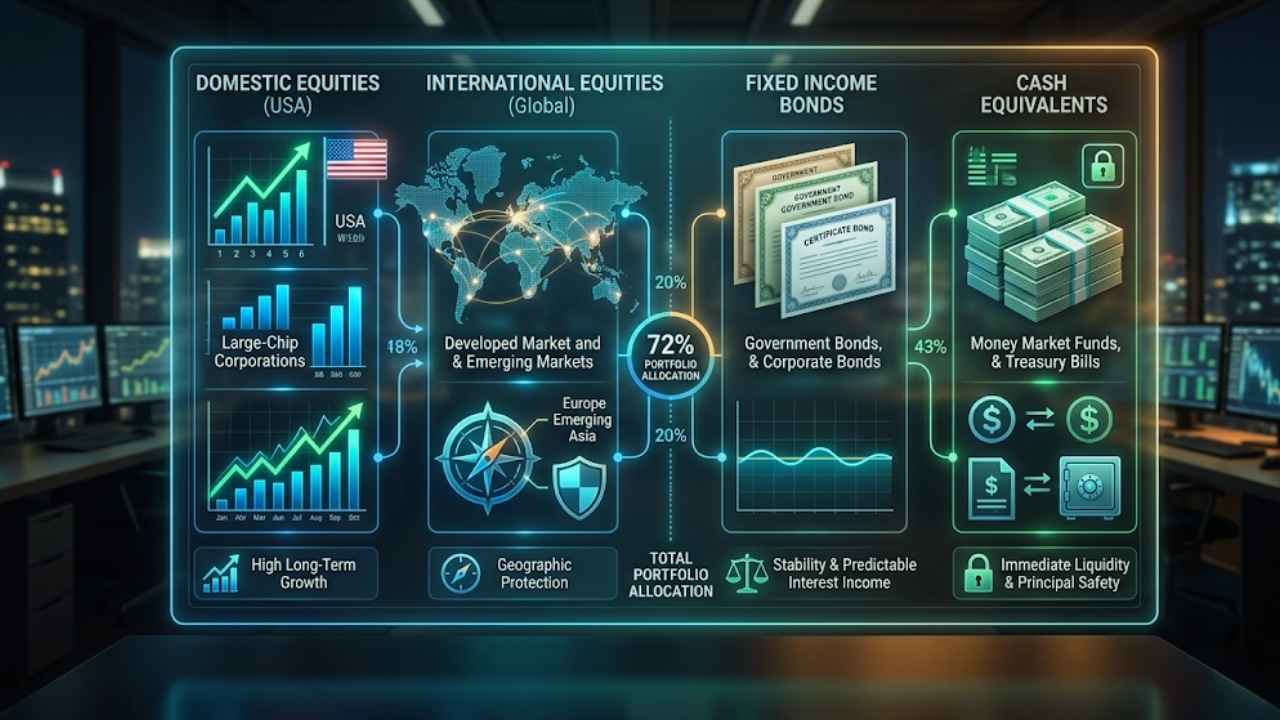
To build something strong, you have to know your materials. The investment universe is split into several major categories, each offering a unique risk profile and expected return. Stocks represent partial legal ownership in a publicly traded company. Historically, they provide the highest financial returns of any major asset class available to the average person. They are the heavy-lifting engine for wealth creation.
But they are also incredibly volatile. You can spread risk within the stock category by holding massive global corporations alongside smaller, aggressive companies. Geographic variety is just as crucial. While domestic companies might dominate for a decade, international markets eventually take their turn at the top. By holding stocks from developed nations in Europe alongside emerging markets, you actively protect yourself against a localized recession hitting your home country. You are basically buying a piece of the entire global economy.
|
Asset Category |
Primary Purpose in Your Portfolio |
General Risk Level |
|
Domestic Equities |
High long term growth and wealth creation |
High |
|
International Equities |
Geographic protection against local recessions |
Moderate to High |
|
Fixed Income Bonds |
Stability and regular predictable interest income |
Low to Moderate |
|
Cash Equivalents |
Immediate liquidity and absolute principal safety |
Very Low |
Domestic and international stocks
Stocks are how you grow your money fast enough to beat inflation over the long haul. When you buy a stock, you become a part-owner of that business. If they sell more products, your shares go up.
But relying only on companies in your home country is a massive blind spot. You need exposure to international markets. Spreading your dollars globally means you benefit from innovation happening everywhere, not just in your own backyard.
Government, corporate, and municipal bonds
If stocks are the engine, bonds are the brakes. A bond is just a formal loan you make to a government or a corporation. They promise to pay you interest and return your money later. Government bonds are incredibly safe.
Corporate bonds pay higher interest but carry a bit more risk. Adding bonds to your portfolio lowers your overall return slightly, but it drastically reduces your chance of losing half your money during a vicious bear market.
Real estate and physical commodities
Alternative investments move completely independently from Wall Street. Real estate is the classic example. You can buy physical properties or just buy shares in real estate trusts on the stock market.
They pay out steady rental income and usually hold their value when inflation spikes. Commodities like physical gold act as a historic safe haven. When trust in paper money falls, tangible hard assets step up to protect your purchasing power.
Cash and cash equivalents for liquidity
Holding cash might feel like a waste since inflation slowly eats its value. But keeping a chunk of your wealth in high-yield savings or money market funds is a vital defensive move. Cash gives you absolute options.
If you face a sudden medical bill or lose your job, you can pay for your life without being forced to sell your stocks at a massive loss during a market crash.
How to Build a Diversified Portfolio from Scratch?
Building a strategy that actually works does not require a finance degree or a million dollars in seed money. By following a highly logical, step-by-step process, absolutely anyone can build a robust investment plan from scratch. Before you buy a single asset, you need to know exactly what you are saving for. Money you need for a house down payment in two years entirely belongs in a safe cash equivalent account.
Money you are saving for a retirement that is thirty years away should primarily sit in aggressive growth stocks. You also need to be brutally honest with yourself about your personal risk tolerance. If watching your account balance drop by twenty percent in a single month would make you physically sick, you immediately need a more conservative mix of assets. Building a plan you can actually stick with through the hard times is far more important than mathematically chasing the absolute highest returns. A perfect spreadsheet plan is useless if you abandon it the minute the news gets scary.
|
Step in the Process |
Action You Need to Take |
Expected Outcome |
|
1. Assess Your Goals |
Determine your timeline and risk comfort level |
A clear understanding of your true financial needs |
|
2. Choose Allocation |
Pick a strict ratio of stocks to bonds |
A foundational blueprint for your money |
|
3. Spread Investments |
Buy different sectors and global regions |
True safety within each specific asset class |
|
4. Utilize Index Funds |
Buy ETFs or broad mutual funds |
Instant, cheap, and totally automated variety |
Step 1: Assess your current financial landscape and goals
Start by asking yourself when you actually need the cash. Short-term goals need safety. Long-term goals need growth. Next, test your nerves. Everyone says they can handle high risk when the market is going up.
Think about how you felt during the last major market crash. If you panicked, build a safer portfolio today. Know yourself before you risk your money.
Step 2: Choose your ideal asset allocation mix
Based on your timeline, pick a target ratio. The classic sixty forty mix gives you sixty percent in growth stocks and forty percent in stable bonds. It is a solid middle ground.
Younger, aggressive investors might push for ninety percent stocks. Retirees might flip it to mostly bonds. Pick your ratio and write it down. Having a written rule stops you from making dumb emotional trades later.
Step 3: Spread investments within each asset class
Once you pick your percentages, spread the money out. If you allocate eighty percent to stocks, do not just buy three tech companies. Buy banks, healthcare providers, energy producers, and grocery chains.
If you buy bonds, mix federal debt with corporate loans. You want a tiny slice of everything so that a disaster in one specific industry goes entirely unnoticed in your overall balance.
Step 4: Consider mutual funds and ETFs for automatic variety
Trying to buy individual shares of five hundred companies is a massive waste of your time and money. The cheat code is the index fund or the exchange-traded fund. These funds pool money from thousands of people to buy a giant basket of stocks.
With one single purchase, you instantly own a tiny piece of the entire market. It is the cheapest and easiest way to achieve perfect global investment diversification.
The Danger of Over-Diversification
While spreading your risk is essential to your financial survival, it is entirely possible to overdo it. In the industry, we call this the diworsification trap. It happens when you add so many different mutual funds, random assets, and complex trading strategies to your account that you actually hurt your performance without making yourself any safer. More is absolutely not better when it comes to your brokerage account.
If you own ten completely different mutual funds that all happen to focus on large American tech companies, you are not spreading risk at all. You just own the exact same underlying companies wrapped in ten different packages. You end up paying unnecessary active management fees to multiple fund managers for the exact same exposure. Keep your account remarkably clean and incredibly easy to understand. A boring, simple portfolio usually wins the race.
|
Concept |
Action Taken |
Real World Consequence |
|
True Spread |
Buying one US fund and one International fund |
Excellent global coverage with absolutely zero overlap |
|
Diworsification |
Buying five different large cap US growth funds |
Massive overlap paying multiple high fees for the same stocks |
|
Complexity Trap |
Adding obscure derivatives and private equity |
Impossible to track performance and highly expensive to manage |
|
Clean Simplicity |
Using three total market index funds |
Maximum global coverage with minimum mental effort |
Understanding the diworsification trap
Adding a tenth mutual fund to your account rarely adds any real value. It just creates clutter. When you own too many similar funds, you water down your best-performing assets.
Your massive winners get dragged down by a bunch of mediocre funds you bought just for the sake of adding something new. Stick to a handful of broad index funds and ignore the noise.
How too many assets can drag down your returns?
Every time you add an overly safe asset to your pile just to feel secure, you lower your future returns. If you hold half your retirement money in pure cash out of fear, your wealth will never outpace inflation.
You dodge the stock market crashes, but you guarantee a slow, silent loss of purchasing power. Safety is incredibly expensive. You have to take on calculated risk to grow your wealth.
Finding the sweet spot between risk and reward
The goal is never to eliminate risk entirely. Zero risk means zero reward. The goal is to find the exact right amount of risk that lets you sleep well while still growing your net worth.
Build a sensible mix of stocks and bonds based on your age, completely remove the overlapping junk funds, and then stop touching it. A simple, well-designed plan beats a complex, messy one every single time.
Rebalancing: Keeping Your Strategy on Track
Imagine you start the brand new year with exactly fifty percent of your money in stocks and fifty percent in safe bonds. If the stock market goes on an absolute tear and shoots up thirty percent, while the bond market stays flat, your portfolio is suddenly out of whack. Without you doing a single thing, your account might now sit at sixty-five percent stocks. You are accidentally taking on much more risk than you originally planned.
If the market aggressively crashes the following month, you will lose significantly more money than your original plan intended. Portfolios naturally drift toward the highest-performing assets over time. Because the markets constantly move, your perfectly planned percentages will be ruined within a few months if you totally ignore them. Rebalancing is the simple maintenance required to keep your risk profile exactly where you want it.
|
Rebalancing Method |
How It Triggers |
Who Should Use It |
|
Time Based |
A specific calendar date every single year |
Hands off folks who want minimum account maintenance |
|
Threshold Based |
When an asset drifts five percent off target |
Active monitors looking to optimize every tax efficiency |
|
Cash Flow Directed |
Using new cash deposits to buy the lagging assets |
Beginners who want to completely avoid paying selling fees |
|
The Hybrid Approach |
Checking yearly but only trading if drifted far |
The vast majority of standard everyday retail investors |
Why portfolios drift over time?
Assets grow at totally different speeds. Your tech stocks might surge while your real estate trusts move sideways. Over a few years, your aggressive assets will naturally take over a huge chunk of your pie chart.
Left unchecked, a balanced retirement account can silently morph into a highly risky, aggressive portfolio right when you need safety the most.
Time-based versus threshold-based rebalancing
You have two easy ways to fix this drift. Time-based means you pick a date, like your birthday, and force your account back to its target percentages once a year.
Threshold-based means you only intervene if a category drifts more than five percent away from your goal. Both methods work great. Pick the one that fits your personality and stick with it.
The psychological challenge of selling winners to buy losers
Rebalancing forces you to sell the assets that made you the most money and use that cash to buy the assets that are currently losing. Human nature hates this. We want to chase the winners.
But rebalancing forces you to mechanically practice the ultimate rule of wealth: buy low and sell high. It removes emotion from the driver’s seat and lets the math do the heavy lifting.
Final Thoughts
Navigating the financial markets does not require you to predict the future or somehow guess the next massive tech trend before anyone else. Successful long-term wealth building relies on humility. It requires acknowledging that tomorrow is a total mystery. Investment diversification is simply the professional way of admitting we have no clue what happens next. By spreading your hard-earned money intelligently across different assets, industries, and regions, you build a financial fortress that can handle almost any economic storm.
Take a hard look at your current accounts today. Make sure your setup matches your actual timeline and your stomach for risk. A properly balanced portfolio gives you something way more valuable than just good financial returns. It delivers the absolute peace of mind you need to actually enjoy your life without stressing over the daily chaos of the stock market.
Frequently Asked Questions (FAQs) About Investment Diversification
People always ask the same basic questions about stocks and bonds, but when you dig into what investors actually search for, you find some deeply specific concerns. I have pulled together a few of the more uncommon questions to clear up exactly how this strategy plays out in real life.
How does this strategy impact my taxes?
Moving money around has consequences. If you sell stocks in a regular brokerage account to rebalance, you owe capital gains tax. Smart investors use asset location. They put their highly taxed corporate bonds into tax-free retirement accounts and keep their long-term growth stocks in regular accounts. Thinking about where you hold your assets saves you a massive headache come tax season.
Can you be diversified globally but still fail?
Absolutely. Thirty years ago, a crash in Asia barely touched the US market. Today, the global economy is deeply tangled. A supply chain issue in one hemisphere wrecks profits in the other. While buying international stocks is smart, you cannot rely entirely on geographic borders to save you anymore. You need different asset types, like physical real estate and commodities, to truly break the chain.
Why do billionaires sometimes ignore this rule?
You see the headlines. A famous founder has ninety-nine percent of their net worth tied up in one company. It makes the rules look stupid. But here is the truth: founders build wealth through extreme, risky concentration. They bet their lives on one idea. But the moment they secure that wealth, their private money managers immediately diversify their portfolios to protect the fortune from vanishing. Concentration builds it; diversification keeps it.