


Forget everything you knew about getting a job in tech. The old playbook is dead. Three years ago, you could grind through coding challenges, memorize some Python syntax, and land a comfortable junior developer job. Not anymore.
Today, generative models write basic code faster and better than you do. The demand for pure code monkeys has fallen off a cliff. But the demand for people who can actually build, deploy, and babysit intelligent systems? It is through the roof.
If you want a high-paying AI/ML career in 2026, you have to change your mindset. Companies do not want you to build the next ChatGPT. They want you to take existing AI models, plug them into their messy, outdated databases, and make their business run faster.
Businesses are throwing billions at automation. But they have a massive problem: they cannot find enough people who actually know how to put these tools into production safely. That talent shortage is your golden ticket. Let’s cut through the hype and look at exactly what you need to learn, build, and say to land a top-tier tech job right now.
The Real State of Tech Hiring in 2026
Look at the numbers. They tell a crazy story. Companies aren’t firing their engineering teams because of AI; they are restructuring them. They want people who can multiply productivity. The January 2026 Indeed Hiring Lab report made it clear: while the broader labor market is stuck in a “low-hire, low-fire” freeze, job postings mentioning AI are exploding.
According to PwC’s 2026 Global AI Jobs Barometer, the job market has split in two. AI is making routine jobs cheaper, but it is professionalizing technical jobs. If you know how to build a data pipeline or orchestrate a language model, your value just skyrocketed.
|
Market Metric |
The 2026 Reality |
What It Means For You |
|
Wage Growth Premium |
Hit 62% average (up from 57% last year) |
Companies gladly overpay for deployment skills. |
|
Job Expansion |
AI jobs grew 69% vs. 9% for the broader market |
Demand is eating supply. You hold the leverage. |
|
Productivity Gains |
163% jump at “super-star” AI firms |
You must prove you can make a business faster. |
|
Data & Analytics Shift |
45% of all data job postings now mention AI |
AI is no longer a niche; it is the default standard. |
We are seeing a 62% wage premium for workers with practical deployment skills. In sectors like consumer markets, that premium hits an astonishing 118%. Why? Because a good engineer using modern frameworks can do the work of ten traditional engineers. The top 20% of companies adopting these systems are seeing a 163% productivity boom relative to 2018. They want to hire people who understand this leverage.
The conversation isn’t about algorithms taking your job. It’s about how fast a company can hire you to build their infrastructure so their competitors don’t crush them.
Pick Your Lane: Top Roles for an AI/ML Career in 2026
You don’t need a math Ph.D. to get into this field. Seriously. The industry needs pragmatic builders, not theoretical researchers. You have a few distinct paths, and picking the right one based on your background is half the battle. Pure research roles are shrinking, while applied engineering roles are dominating.
|
Job Title |
What You Actually Do All Day |
2026 Salary Range (US) |
|
Applied ML / LLM Engineer |
Hooking models to business data to solve real problems. |
$150,000 – $250,000+ |
|
ML Platform / MLOps |
Building cloud infrastructure so models don’t crash. |
$160,000 – $230,000+ |
|
AI Product Manager |
Figuring out what users actually want the system to do. |
$130,000 – $200,000+ |
|
AI Ethical Compliance Officer |
Auditing models so the company avoids massive lawsuits. |
$130,000 – $180,000+ |
Here is a breakdown of the specific roles dominating job boards right now.
The Applied LLM Engineer (Foundation Models)
This is the sweet spot. You aren’t inventing new neural networks. You are a system designer. You take an API from OpenAI or Google, connect it to a company’s internal wiki, and build a chatbot that helps customer service reps find answers in seconds. You spend your days managing latency, calculating API costs, designing retrieval pipelines, and making sure the model doesn’t hallucinate and spit out garbage. You are evaluated on how well the product actually works in the real world.
The MLOps Platform Engineer
Models are useless if they break when a thousand people try to use them at once. As systems scale, infrastructure becomes the bottleneck. MLOps (Machine Learning Operations) engineers build the foundations: training pipelines, feature stores, and retraining frameworks. They set up Docker containers and manage Kubernetes clusters. If you have any background in IT, DevOps, or system administration, pivot here. Every applied ML team depends on a strong platform engineer to move fast without breaking things.
AI Risk and Governance Specialist
Here is a wild stat: analysts forecast that by the end of 2026, companies will face thousands of legal claims due to insufficient algorithmic guardrails. High-stakes systems can cause massive damage if they fail in a hospital or deny a loan based on biased data. Plus, the EU AI Act drops its heavy enforcement hammer in December 2027. Companies are terrified. They are hiring compliance officers to audit models, track data lineage, and ensure legal safety. You can crush this role if you come from a legal, cybersecurity, or auditing background.
The “Senior Junior” Problem (And How to Beat It)
If you are trying to land your first tech job, you face a new reality. The traditional junior developer role is dead. The career ladder is compressing faster than anyone predicted.
Companies used to hire juniors to write basic tests, fix simple bugs, and write boilerplate code. Now, coding assistants do that instantly. So, what do they expect from a human junior? Senior-level critical thinking.
|
Skill Area |
The Old Way (Pre-2023) |
The 2026 Way |
|
Daily Tasks |
Writing repetitive code syntax |
Prompting tools, reviewing outputs, architecting systems |
|
Expectations |
Do what you are told |
Solve ambiguous problems autonomously |
|
Core Competency |
Memorizing algorithms |
High-level judgment, empathy, and leadership |
|
The Interview |
Whiteboarding a sorting algorithm |
“AI-free” critical reasoning tests |
According to PwC’s analysis of 2.4 million job postings, entry-level roles exposed to these new technologies are now seven times more likely to demand traditionally senior skills like leadership, creativity, and strategic judgment. In fact, postings for these “seniorized” entry-level roles have grown 35% since 2019, while traditional entry-level jobs actually declined by 10%.
You use the tools to write the code, but you have to design the system. Getting through the interview is harder now. Hiring managers are terrified of candidates who just copy-paste from chatbots but don’t understand the underlying logic. To combat “cognitive atrophy,” Gartner notes that half of global organizations now force candidates to take offline, unassisted coding tests. You cannot fake your way through the fundamentals.
The Tech Stack You Actually Need
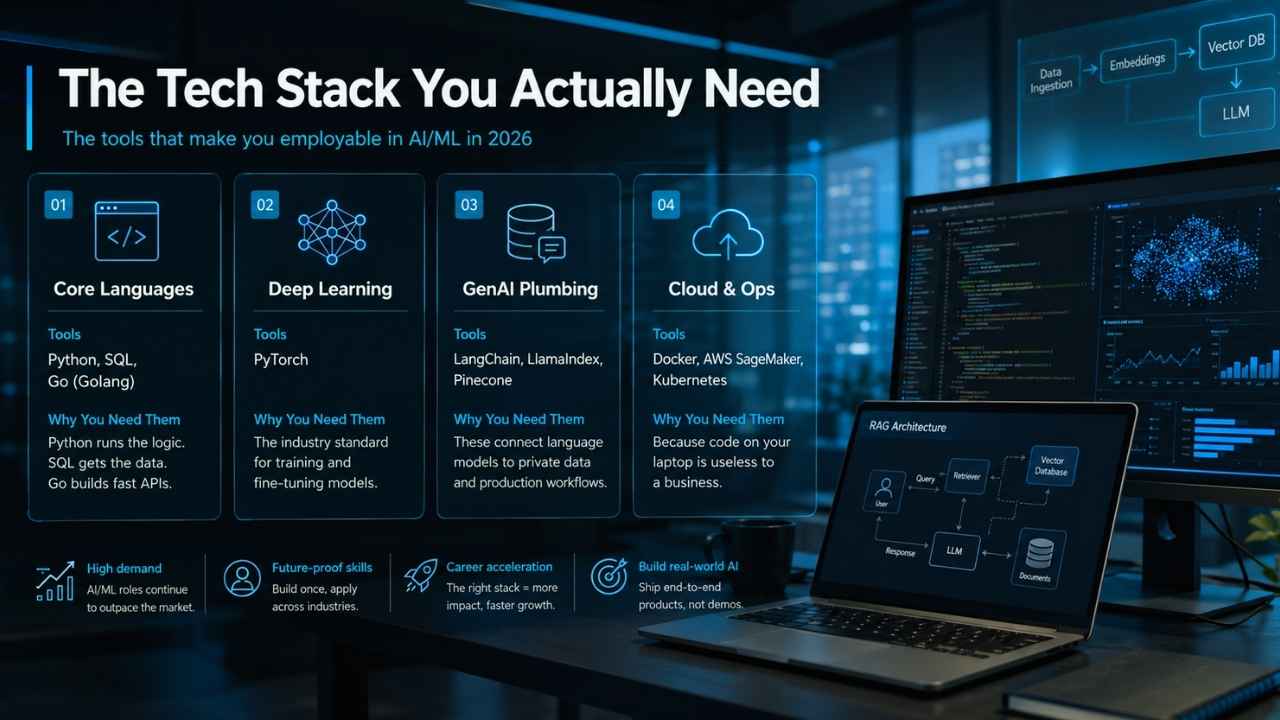
Stop getting distracted by every new paper that drops on Twitter. You only need to master a specific stack to be dangerous and employable.
To build a solid foundation for your AI/ML career in 2026, focus on the tools that companies actually use in production, not just the shiny new toys academics play with.
|
Category |
The Tools You Need |
Why You Need Them |
|
Core Languages |
Python, SQL, Go (Golang) |
Python runs the logic. SQL gets the data. Go builds fast APIs. |
|
Deep Learning |
PyTorch |
The undisputed industry standard for tweaking models. |
|
GenAI Plumbing |
LangChain, LlamaIndex, Pinecone |
You need these to connect language models to private data securely. |
|
Cloud & Ops |
Docker, AWS SageMaker, Kubernetes |
Because code on your laptop is useless to a business. |
Master Python and SQL
Python is non-negotiable. Learn its data structures, object-oriented programming, and how to handle errors properly. But do not ignore SQL. The dirty secret of this industry is that 80% of the work is just getting data out of a database and cleaning it up. If your SQL skills are weak, you will fail. Also, keep an eye on Go (Golang). Companies love Go for building the high-speed backend infrastructure that serves these massive models.
Vector Databases and Orchestration
This is the money-maker right now. You have to understand Retrieval-Augmented Generation (RAG). Language models don’t know a company’s private secrets. You have to feed that data to them. You do this by turning text into math (embeddings) and storing it in a vector database like Pinecone, ChromaDB, or Weaviate. Then, you use a tool like LangChain to grab that data and hand it to the API. Master this workflow, and you will never struggle to find a job.
Build a Portfolio That Gets You Hired
Resumes are practically useless now. Hiring managers assume a machine wrote yours. They only care about what you can prove. You need a portfolio of live, working applications.
|
Project Idea |
What It Proves to Employers |
Tools to Use |
|
Financial RAG App |
You can ground an LLM in messy, private data safely. |
LangChain, Pinecone, Streamlit, OpenAI API |
|
End-to-End API |
You know how to serve a model to the real world. |
FastAPI, Docker, Scikit-Learn |
|
Industry Tool |
You understand business pain points, not just math. |
Python, AWS, Hugging Face |
|
Speed Audit |
You care about cloud costs and system latency. |
PyTorch Profiler, MLflow, Grafana |
Stop building Titanic survival predictors. Stop building housing price calculators. Everyone builds those in their first week of a bootcamp. They show zero business value.
Build Things That Solve Problems
Go find real, messy data. Download 500 PDF transcripts of corporate earnings calls. Build an application that stores them in a vector database. Create a web interface using Streamlit or Next.js where a user can ask, “Why did revenue drop in Q3?” and the system answers based only on those PDFs, citing its sources.
Document Your Decisions
When you put this on GitHub, write a killer README file. Explain why you chose Pinecone over an open-source alternative. Explain how much it costs to run your app per day. Discuss the latency. If your app takes 10 seconds to answer, explain how you would architect it to take 2 seconds. When you talk about trade-offs, cloud costs, and user experience, hiring managers stop seeing you as a student and start seeing you as a peer.
Vertical Specificity: The Secret Cheat Code
Here is the biggest secret in tech right now: the best jobs aren’t at Google or Meta. They are at regional banks, logistics companies, and hospital networks.
Over half of all technical hiring happens outside of traditional tech companies. These industries are desperate to automate their workflows, but they don’t have the internal talent to do it safely.
|
Industry |
Why They Are Hiring |
Your Unfair Advantage |
|
Technology & Telecoms |
System architecture, deep learning models |
Accounts for 11% of all AI job growth. |
|
Healthcare |
Predictive diagnostics, patient triage |
Knowing HIPAA laws and medical workflows. |
|
Financial Services |
Fraud detection, automated compliance |
Understanding banking regulations and risk. |
|
Logistics / Retail |
Supply chain routing, warehouse automation |
Market expected to hit $4.99 billion by 2035. |
If you have a non-technical background, this is how you win. A regional bank will happily hire a former financial analyst who spent six months learning PyTorch over a fresh computer science grad. Why? Because the analyst already understands banking regulations. They know what the business actually needs. Combine domain expertise with modern tools, and you become practically unfireable.
Final Thoughts
At the end of the day, securing an AI/ML career in 2026 is about execution. The market doesn’t care about the certificates you bought online. It cares about what you can build, deploy, and fix when it breaks.
The skill gap is massive right now. The salaries reflect a deep desperation from companies trying to catch up to the future. Your barrier to entry is just your willingness to sit down, shut out the noise, and do the hard work of learning the modern tech stack.
Stop watching endless YouTube tutorials. Start building real applications. Solve messy, boring business problems. Lean hard into your human skills—leadership, empathy, and critical problem-solving—because those are the only things an algorithm can’t fake. Do that, and you’ll write your own ticket in the most lucrative job market we’ve ever seen.
Frequently Asked Questions (FAQs) About AI and Machine Learning Careers in 2026
Will I really have to pass an “AI-free” test?
Yes. As companies worry about the atrophy of critical thinking skills, Gartner predicts 50% of organizations mandate offline, unassisted coding tests to ensure you possess foundational logic and problem-solving abilities.
How does the EU AI Act impact hiring?
It accelerates the need for compliance and governance professionals. Following the recent “AI Act Omnibus” amendment, the enforcement deadline for most standalone high-risk systems is set for December 2, 2027. Systems embedded in regulated products have until August 2028. Companies are hiring heavily right now to prepare for these cliff edges.
What are “death by AI” claims?
As AI is deployed in high-stakes fields like healthcare and transportation, the cost of failure is massive. Analysts forecast that by the end of 2026, over 2,000 legal claims will emerge due to insufficient AI guardrails, making risk mitigation and auditable pipelines a top priority for employers.
Do I need a Ph.D. to get hired?
Absolutely not. The focus has shifted entirely from theoretical research to applied engineering. A strong portfolio of deployed apps and the ability to cleanly integrate APIs beats a theoretical degree every time.
How does AI “professionalize” a job?
It automates the tedious boilerplate work, forcing the human worker to focus entirely on advanced system architecture, strategy, and problem-solving. This makes the human’s unique expertise even more valuable.