

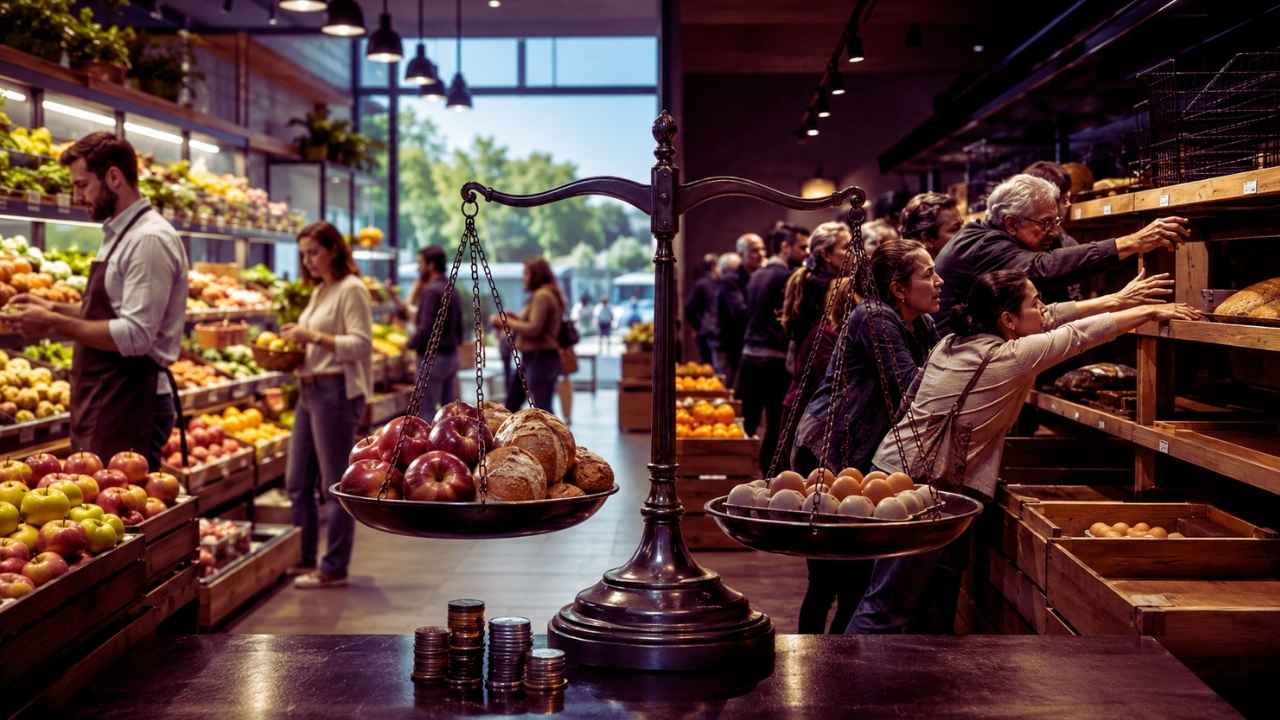
Ever wonder why an umbrella costs double on a rainy day? Or why your Uber fare spikes the second a concert ends? You aren’t just looking at corporate greed. You’re watching basic economics in action.
If you want to know why things cost what they do, you have to understand how supply and demand works. It’s the invisible engine running every transaction on earth. From the price of a gallon of gas to a vintage comic book, these two forces push and pull until they hit a final price.
Forget the dense textbook definitions. We’re looking at the actual mechanics of the market. Let’s use real-time events—like the summer 2026 oil squeeze and Amazon’s lightning-fast pricing algorithms—to show you exactly why prices rise, fall, or flatline.
The Foundation of Every Market
Before we dive into price tags, let’s define a market. You might picture Wall Street traders shouting at each other, but a market is simply any place where buyers and sellers meet. It can be a local farmer’s market, a digital storefront on Shopify, or a massive global commodity exchange. In every single arena, two groups play a massive game of tug-of-war. Buyers want to pay as little as possible to keep cash in their wallets. Sellers want to charge as much as possible to pad their margins.
The tension between these two groups creates the price tag. If sellers push the price too high, buyers walk away. If buyers refuse to pay enough to cover production costs, sellers stop making the product altogether. It is a constant, ruthless negotiation happening millions of times a second. Take the global oil market right now in the summer of 2026. Shipping chokepoints have squeezed global inventory, pushing Brent crude prices to around $105 a barrel. Sellers are holding a restricted asset, forcing buyers to pay a massive premium just to keep their logistics networks running.
|
Market Player |
Primary Goal |
Typical Behavior |
Impact on Final Price |
|
Buyers (Demand) |
Maximize personal value |
Hunt for deals, wait for seasonal sales |
Pushes prices downward |
|
Sellers (Supply) |
Maximize profit margins |
Raise prices, limit steep discounts |
Pushes prices upward |
|
The Market Engine |
Find sustainable balance |
Adjusts inventory to match behavior |
Sets the final price tag |
Breaking Down How Supply and Demand Works
To see exactly how supply and demand works at its core, look at the clash between physical availability and human desire. Think of supply as how much of something actually exists. Think of demand as how many people desperately want to buy it. Mix those two elements together, and you get a rock-solid market price. If a local bakery bakes 10 chocolate croissants, and 50 people line up to buy them, the bakery charges a premium. But if they bake 500 croissants and only 10 people show up, they have a massive problem.
They must slash prices just to get rid of the pastry before it goes stale. You can see this exact dynamic right now in the tech industry. In mid-2026, an explosive boom in artificial intelligence has created an absolute frenzy for memory chips and data center components. Tech giants are hoarding hardware to secure their own futures. Because memory manufacturers like SK Hynix cannot build chips fast enough to satisfy the market, supply is severely restricted. As a direct result, prices for basic AI server rack components are swinging up to 40% higher in a single week.
|
Market Condition |
Physical Supply Level |
Buyer Demand Level |
Real-World Price Impact |
|
High Scarcity |
Severely Restricted |
Explosive |
Prices skyrocket immediately |
|
Market Oversupply |
Flooded Inventory |
Non-existent |
Prices crash; goods collect dust |
|
Balanced Market |
Steady Availability |
Predictable Needs |
Prices stay reliably flat |
The Demand Side: Why We Buy?
Let’s focus on the buyer for a minute. The “Law of Demand” states a simple, undeniable truth: as prices drop, people buy more. As prices go up, they buy less. If your favorite coffee shop suddenly charges $15 for a standard latte, you probably start brewing coffee at home. You didn’t stop wanting caffeine. You just stopped wanting it at that specific price point. Your personal demand completely dried up. But human behavior is incredibly complicated, and our desires shift constantly.
Factors like shifting income levels, cultural trends, and available substitutes constantly rewrite what we want. Look back at the 2026 oil spike. Because fuel costs hit $105 a barrel, global energy experts noted a massive shift in buyer behavior. The high prices forced consumers and businesses to adapt, killing off an estimated 1.1 million barrels a day in global demand. People drove less, airlines optimized routes, and buyers essentially forced their own demand downward because the price tag simply became too painful to swallow.
|
Demand Driver |
Real-World Example |
Immediate Impact on Buyer Behavior |
|
Income Changes |
You land a massive promotion at work |
You purchase more luxury and premium goods |
|
Product Substitution |
Beef gets far too expensive at the butcher |
You buy chicken or pork for the week instead |
|
Cultural Trends |
A celebrity wears a specific jacket online |
Stores empty out as everyone copies the look |
The Supply Side: Why Sellers Produce?
Now let’s flip the script to the producers. The “Law of Supply” dictates that as prices rise, sellers try to make and distribute more of a product. Why? Because higher prices equal bigger profit margins. If a toy company sees an action figure selling for triple its retail price on secondary markets, they fire up their factories immediately. They want to produce as many figures as physically possible to capture that cash before the hype dies down.
However, physical reality limits exactly how much a company can supply. You cannot just print more beachfront real estate. You cannot instantly grow avocados if a random freeze wipes out the harvest. Look at the cocoa market. Severe weather and crop diseases wrecked West African cocoa farms in 2024 and 2025. By July 2026, cocoa prices are still hovering above $5,000 a metric ton. Farmers desperately want to supply more beans to capture those high prices, but early surveys show the upcoming crop might drop another 18%. Nature is physically blocking the supply.
|
Supply Driver |
Real-World Example |
Immediate Impact on Seller Behavior |
|
Material Costs |
Raw lumber and steel prices spike drastically |
Developers pause construction on new homes |
|
New Technology |
An efficient new harvesting machine drops |
Farmers supply massive amounts of crops faster |
|
Weather Events |
A historic drought hits fertile farmland |
Food supply drops drastically and shelves empty |
Finding the Sweet Spot: Market Equilibrium
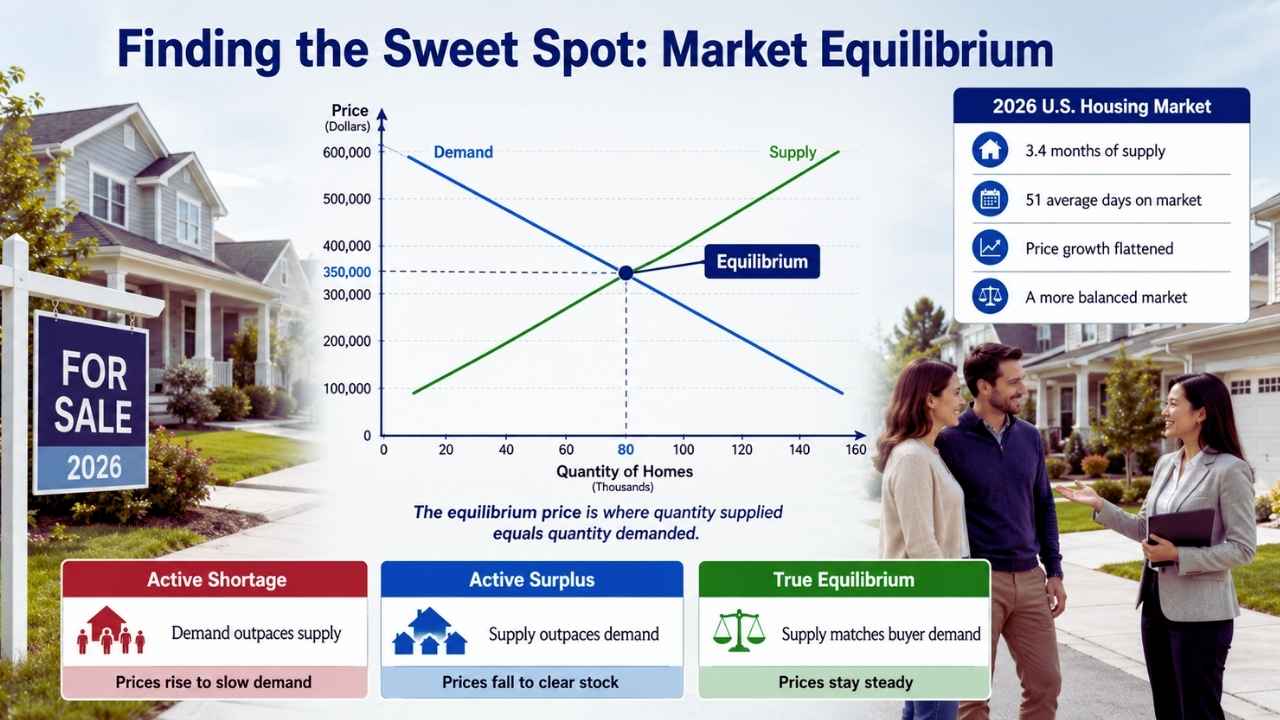
Buyers want rock-bottom prices. Sellers want sky-high profits. How does a single transaction ever happen? The answer is market equilibrium. Equilibrium is the exact price point where the amount sellers want to supply perfectly matches the amount buyers want to purchase. It is the absolute sweet spot. There are zero shortages, and no dusty inventory sits abandoned on the shelves.
You can witness this transition perfectly in the 2026 U.S. housing market. For years, low supply and insane demand pushed home prices into the stratosphere. But by the summer of 2026, the market finally cooled into neutral territory. Inventory crept up to a solid 3.4 months of supply. Homes started sitting on the market for an average of 51 days, and massive price spikes completely flatlined. Supply caught up to a softened demand, creating a balanced negotiating table for everyone involved.
To see how these curves interact when variables shift, experiment with this market simulator:
|
Current Market State |
What is Actually Happening |
The Market’s Natural Correction |
|
Active Shortage |
Demand heavily outpaces available supply |
Sellers raise prices to artificially slow demand |
|
Active Surplus |
Supply heavily outpaces current demand |
Sellers discount prices heavily to clear stock |
|
True Equilibrium |
Supply perfectly matches buyer demand |
Prices remain perfectly steady and predictable |
What Happens When the Curves Shift?
Markets absolutely do not live in a vacuum. Real-world events constantly mess with the delicate balance between buyers and sellers. External shocks rewrite the established rules of a market in an instant. Weather, wars, global shipping delays, and wild pop culture trends constantly push and pull the underlying numbers.
A celebrity endorsement shifts the demand curve for a specific brand of sneakers so fast that overseas factories simply cannot keep up. Conversely, if a shipping route gets blocked by a geopolitical conflict, the supply of everyday electronics plummets instantly. Think back to the global microchip shortage during the pandemic. Factories shut their doors right as millions of people decided to buy new gaming consoles and laptops. Supply fell off a cliff while demand shot into space, breaking the market entirely.
|
Sudden Shifting Event |
Impact on Global Supply Level |
Impact on Buyer Demand Level |
Final Market Price Shift |
|
Viral Social Media Trend |
Stays exactly the same as before |
Spikes massively overnight |
Prices jump significantly higher |
|
Major Global Conflict |
Drops as shipping routes get blocked |
Stays exactly the same as before |
Prices jump significantly higher |
|
New Technological Innovation |
Increases significantly and rapidly |
Stays exactly the same as before |
Prices drop significantly lower |
Price Elasticity: The Hidden Variable
You probably notice that some products see huge price swings, while others barely budge even during a global crisis. Why does this happen? The answer lies in price elasticity. Elasticity essentially measures how sensitive you are as a buyer to a price tag change. If a product is highly elastic, you abandon it the second the price goes up.
Think about restaurant meals or luxury vacations. If a local steakhouse suddenly doubles its prices, you just eat somewhere else. But if a product is completely inelastic, you pay whatever the seller demands. Insulin is a tragic example. If the price goes up, patients cannot stop buying it. They need it to survive. Gasoline operates similarly. If you drive 30 miles to your office every morning, you buy gas, even at inflated prices. You definitely complain about it, but you still swipe your card at the pump.
|
Type of Economic Good |
Buyer Price Sensitivity |
Common Real-World Examples |
Result of a Sudden Price Hike |
|
Highly Elastic Goods |
High (Wants and Luxuries) |
Designer clothes, vacations |
Sales volume plummets quickly |
|
Highly Inelastic Goods |
Low (Needs and Essentials) |
Medication, electricity, salt |
Sales volume remains steady |
|
Cross-Elastic Goods |
Substitutable Alternatives |
Butter versus Margarine |
Buyers switch brands entirely |
When the Government Steps In?
Sometimes, the free market creates incredibly unfair scenarios. When things get completely out of hand, governments step in and force prices up or down using blunt tools like price ceilings and price floors. A price ceiling legally stops a price from going any higher. Take rent control in major coastal cities.
The government explicitly tells landlords they cannot charge more than a specific amount per month. This protects current renters from getting priced out, but it sparks brutal unintended consequences. Since profits are legally capped, developers stop constructing new apartments. The city then ends up with a permanent housing shortage. On the flip side, the minimum wage acts as a price floor on human labor. It forces employers to pay a base rate, completely ignoring what the free market might normally suggest.
|
Type of Government Intervention |
What It Actually Does |
Common Real-World Market Example |
Unintended Market Side Effect |
|
Legally Enforced Price Ceiling |
Caps the maximum allowed price |
Urban rent control regulations |
Permanent housing stock shortages |
|
Legally Enforced Price Floor |
Sets a minimum allowed price tag |
Federal minimum wage labor laws |
Can create localized labor surpluses |
|
Targeted Market Subsidies |
Gov covers part of production costs |
Agriculture, solar panel grants |
Artificially boosts market supply |
The Future: Algorithms and Dynamic Pricing
We no longer live in a world governed by plastic sticker guns in grocery store aisles. Today, massive software algorithms control exactly how supply and demand works in the digital space. This concept is called dynamic pricing. Airlines and massive hotel chains have utilized it quietly for decades to maximize their quarterly profits.
If you try to book a quick flight to a sunny beach for spring break, the algorithm registers the high demand and immediately raises your ticket price. But today, dynamic pricing operates everywhere. Uber’s surge pricing acts as pure supply and demand executed perfectly by a machine. Amazon takes this to the absolute extreme, automatically changing product prices millions of times every single day to match competitor discounts and track user behavior in milliseconds.
Read Also:
|
Modern Pricing Model |
How It Works in Practice |
Who Uses This Specific Strategy |
|
Static Pricing Model |
Price stays the exact same all year |
Traditional grocery and retail shops |
|
Dynamic Pricing Model |
Algorithms change price per minute |
Uber, major Airlines, Amazon |
|
Tiered Pricing Model |
Different prices for varied access |
SaaS software, large theme parks |
Final Thoughts
Next time you see a crazy price tag at the grocery store or a massive discount online, you don’t need to guess why. You’re watching the eternal tug-of-war between buyers looking for a deal and sellers trying to make a living.
When you fully understand how supply and demand works, the world makes sense. Prices aren’t arbitrary numbers designed to frustrate you. They are the direct result of millions of human decisions, limited physical resources, and the search for perfect market balance. Whether it’s a spike in global cocoa prices or your Uber ride home, the math remains exactly the same.
Frequently Asked Questions (FAQs) About How Supply And Demand Works
Can demand exist without any supply?
Yes. It’s called latent demand. People want a teleportation device, but supply is zero because the tech doesn’t exist. Demand is massive, but no market forms.
Why do luxury companies destroy unsold inventory?
To restrict supply and protect brand value. High-end fashion houses burn unsold clothing rather than put it on a clearance rack. Discounting items increases the supply of cheap luxury goods, ruining their exclusive reputation.
Can supply create its own demand?
Yes. Economists call this Say’s Law. When Apple created the first iPad, nobody actively demanded a tablet. But the sheer existence of a great new product created the demand for it.
What is a Veblen good?
A Veblen good breaks normal rules. It’s a luxury item where demand increases as the price goes up. Think of a Rolex. The high price tag is the entire point. Buyers want it specifically because it shows off their wealth.