


You open your favorite news app, and the headlines are flooded with red charts. Experts are arguing on television about geopolitical conflicts in the Middle East, politicians are pointing fingers over national debt, and everyone seems panicked about the global economy slowing down. In the middle of all this noise, you might pause and ask yourself: exactly what is a recession, and why does it matter to my wallet right now?
It is easy to assume the economy is failing just because prices at the grocery store are painfully high or the stock market had a bad week. I see people confuse a sluggish economy with a full-blown crisis all the time. But a true economic downturn is specific, measurable, and historical. It affects everything from the interest rate on your credit card to the security of your job.
With 2026 bringing fresh anxieties over trade tensions, hidden government debt, and slowing growth in developing nations, understanding the mechanics of a financial slump is more critical than ever. Let’s break down how these financial contractions actually work, who makes the official call, and what real-time global data tells us about our current risks.
What Is a Recession Exactly?
If you ask a casual investor what is a recession, many people will tell you it happens when a country’s Gross Domestic Product (GDP) drops for two quarters in a row. This is the popular shortcut definition that you will hear on almost every financial news network. GDP measures the total value of all goods and services produced in a country.
If that number shrinks for six straight months, the economy is clearly losing steam. Journalists and day traders love the two-quarter rule because it is extremely easy to track and provides a clean, mathematical trigger point for their daily reports. However, the real definition is slightly more complicated and nuanced. A true economic downturn involves a significant, widespread decline in economic activity that lasts more than a few months.
It is not just about GDP shrinking in a vacuum. It bleeds into how many people have jobs, how much stuff factories are producing, and how much money people are spending at retail stores. When a real economic contraction hits, you feel it in your local community, not just in a spreadsheet.
|
Feature |
Description |
|
Popular Definition |
Two consecutive quarters of negative GDP growth. |
|
Broad Definition |
Widespread decline in overall economic activity across multiple sectors. |
|
Duration |
Usually lasts from a few months to over a year, depending on the severity. |
|
Scope |
Directly affects jobs, personal income, retail sales, and manufacturing output. |
The NBER: The Official Economic Referee
In the United States, an economic slump is not official just because a major news network says so or because politicians claim the sky is falling. A specific group makes the call: the National Bureau of Economic Research (NBER). The NBER is a private, non-partisan organization. Inside the NBER sits the Business Cycle Dating Committee. This group of prominent economists looks at a massive dashboard of data to figure out exactly when a growth cycle peaks and when a downward cycle bottoms out.
Understanding what is a recession officially means understanding the NBER’s criteria. They do not rely on GDP alone because GDP is only calculated every three months and often gets heavily revised later. Instead, the committee looks at the “Three D’s”: Depth, Diffusion, and Duration. Depth measures how bad the drop in activity actually is, as a tiny fractional dip does not count.
Diffusion looks at whether the pain is spread out across the whole country, rather than just one struggling industry. Duration measures how long the slump lasts. Because they wait for all this data to settle and confirm the trend, the NBER usually declares a downturn several months after it has already started.
|
NBER Metric |
What They Look For |
|
Depth |
The absolute severity of the economic decline and wealth destruction. |
|
Diffusion |
The spread of the financial decline across multiple unrelated industries. |
|
Duration |
The length of time the negative economic decline persists without recovery. |
|
Key Indicators |
Employment numbers, real personal income, and national retail sales. |
What Actually Causes the Economy to Shrink?
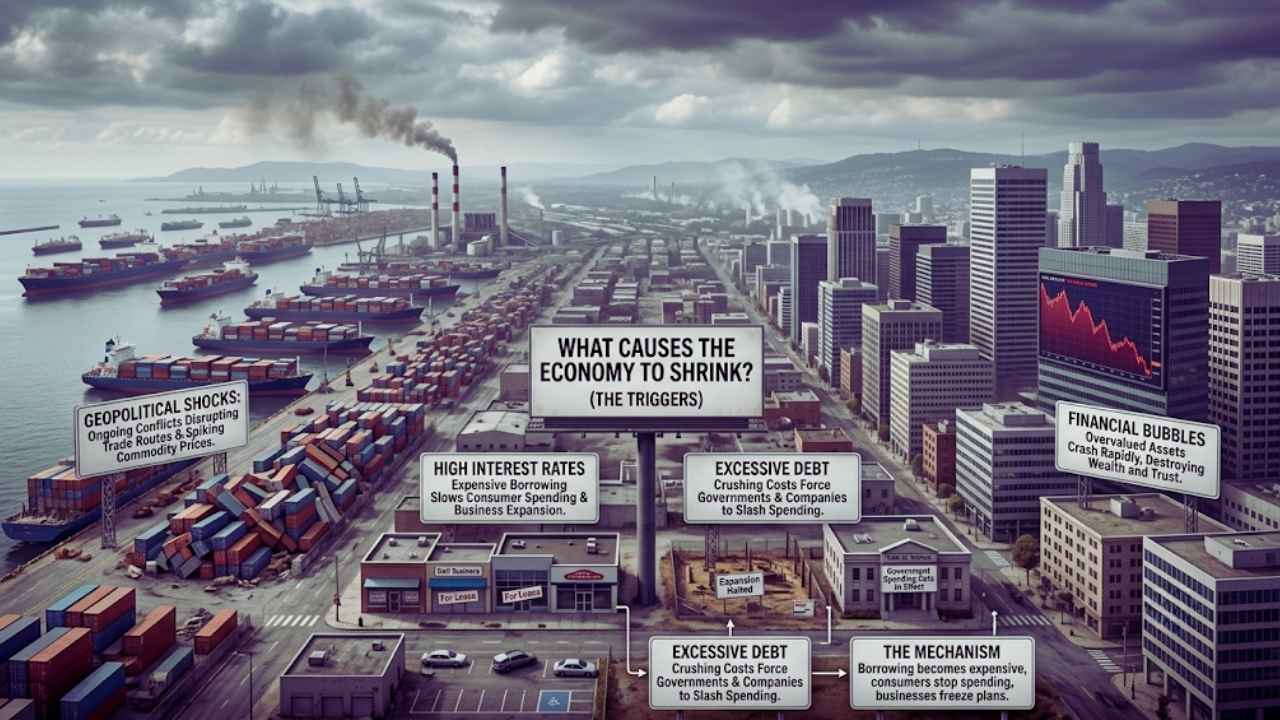
Economies grow and shrink in natural cycles, but specific triggers push a slowing economy over the edge into a full contraction. Looking at the global landscape in 2026, we can see these triggers evolving dramatically. The World Economic Forum recently identified “geoeconomic confrontation” as the absolute top short-term risk to the global economy. Wars and international blockades choke off global supply chains, disrupt commodity markets, and spike energy prices almost overnight.
This immediately halts trade and forces companies to scale back operations. Another massive trigger is excessive debt combined with high interest rates. When borrowing money becomes incredibly expensive due to central banks fighting inflation, car loans, mortgages, and business lines of credit suddenly cost a fortune.
Consumers stop spending on luxury goods, businesses freeze their expansion plans, and the economy hits the brakes hard. We are currently seeing a dangerous variation of this in emerging markets, where high sovereign debt levels are pushing borrowing costs to the breaking point, forcing governments to slash spending.
|
Cause |
Mechanism |
|
Geopolitical Shocks |
Ongoing conflicts disrupt trade routes and immediately spike commodity prices. |
|
Financial Bubbles |
Overvalued assets crash rapidly, destroying massive amounts of wealth and trust. |
|
High Interest Rates |
Expensive borrowing slows down consumer spending and business expansion. |
|
Excessive Debt |
Crushing borrowing costs force governments and companies to aggressively cut spending. |
Global Recession Risks in 2026
If you want a real-time pulse on the economy right now, you have to look at the latest 2026 data from global financial institutions. According to the International Monetary Fund’s April 2026 World Economic Outlook, global growth is projected to slow down to 3.1 percent, heavily burdened by conflicts in the Middle East and rising defense budgets that are driving up national deficits.
The World Bank is even more pessimistic in their recent June 2026 Global Economic Prospects report, projecting a slowdown in global growth to just 2.5 percent. They explicitly warned that the 2020s are on track to become a “lost decade” of income growth for developing nations. The World Bank also noted that average oil prices are expected to sit at 94 dollars per barrel, but if the Strait of Hormuz experiences severe blockades, oil could skyrocket to 115 dollars per barrel.
If that worst-case energy shock happens, global economic growth could plummet to a catastrophic 1.3 percent. Compounding these issues is the revelation of hidden government debts in emerging markets, which are causing sovereign borrowing costs to explode and pushing vulnerable nations closer to default.
|
2026 Risk Factor |
Current Impact |
|
IMF Growth Forecast |
Downgraded to 3.1 percent globally due to escalating Middle East conflicts. |
|
World Bank Warning |
Developing nations face a “lost decade” of stagnant per capita income growth. |
|
WEF Top Risk |
Geoeconomic confrontation heavily threatens supply chains and multilateral trade. |
|
Worst-Case Scenario |
Global growth could drop to 1.3 percent if severe energy price spikes occur. |
The Warning Signs and Leading Indicators
Before a crash happens, the dashboard lights start blinking furiously. Economists track leading indicators to forecast trouble months before it arrives on Main Street. The most famous warning sign is the inverted yield curve. Usually, a 10-year government bond pays out higher interest than a 2-year bond because your money is locked up longer.
But when investors panic about the near future, they rush to buy 10-year bonds for safety, driving the yield of the short-term 2-year bond higher than the long-term 10-year bond. This specific inversion has successfully predicted nearly every major downturn in the last fifty years. Beyond bond math, you can look at real-world corporate behavior. Companies completely freeze their hiring processes long before they actually start firing people.
If you notice job openings drying up and temporary workers getting let go across multiple industries, executives are clearly bracing for hard times. Furthermore, a sustained drop in the Purchasing Managers Index shows that factories are receiving fewer product orders, meaning consumer demand is already evaporating.
|
Warning Sign |
What It Means |
|
Yield Curve Inversion |
Short-term government bonds begin paying more than long-term bonds. |
|
Hiring Freezes |
Companies quietly stop replacing workers who leave their current positions. |
|
Declining PMI |
Factories are receiving significantly fewer product orders from retailers. |
|
Consumer Confidence |
People feel incredibly pessimistic and hoard money instead of spending it. |
How Downturns Impact Everyday Life?
A shrinking economy is not just a bunch of lines on a screen; it creates intense, undeniable friction for everyday people and local businesses. The most painful and obvious outcome is widespread job loss as unemployment numbers spike. But even for those who are lucky enough to keep their jobs, their leverage in the workplace completely disappears.
Annual raises are delayed indefinitely, holiday bonuses get canceled, and you can forget about negotiating a better job title. Credit also becomes incredibly hard to get. Banks get incredibly nervous about defaults, so they demand much higher credit scores for mortgages, slash your existing credit card limits, and reject vital small business loans.
This lack of cash flow causes local shops to struggle, leading to even more community layoffs. Your investment portfolios will shrink as stock markets generally crash before and during the early stages of a downturn. However, the stock market is forward-looking and often bottoms out and starts recovering long before the actual economy feels healthy again.
|
Affected Area |
Direct Consequence |
|
Employment |
Mass corporate layoffs, stagnant worker wages, and canceled annual bonuses. |
|
Credit Access |
Banks demand higher credit scores and aggressively shrink existing credit lines. |
|
Stock Market |
Broad market sell-offs severely reduce personal retirement account values. |
|
Real Estate |
Property values often drop dramatically as overall buyer demand weakens. |
Final Thoughts
The next time you see sheer panic on the evening news or hear politicians screaming about the national debt, you will not have to guess what is a recession. It is a natural, albeit painful, part of the economic lifecycle that clears out bad debt and unsustainable business models.
Whether it is triggered by a massive asset bubble, a geopolitical supply shock like the World Economic Forum is actively warning about in 2026, or a central bank aggressively jacking up interest rates, these periods force the entire financial system to reset. While they cause intense friction through job losses and expensive credit, history proves that economies eventually recover and reach new heights.
By keeping a close eye on leading indicators and understanding how global debt and trade tensions actually impact your wallet, you can separate the media hype from reality, remain calm, and protect your own financial future.
Frequently Asked Questions (FAQs) About What Is a Recession
Can we have a recession with low unemployment?
Yes, though it is incredibly rare. If the economy shrinks due to a massive supply chain failure (like ships unable to pass through a conflict zone) but companies hoard their workers because skilled labor is hard to find, GDP can drop while employment stays strong. Economists call this a “jobful” downturn, and it breaks all the traditional rules.
Is a depression just a really bad recession?
Essentially, yes. There is no official NBER mathematical definition for a depression. Economists use the word “depression” to describe an extreme contraction that drags on for years, featuring GDP declines of over 10% and staggering unemployment rates—think of the 25% unemployment during the 1930s Great Depression.
Do the wealthy actually feel the impact?
Yes and no. Wealthy individuals often lose the most raw dollar value on paper because their net worth is tied up in the stock market and commercial real estate. But because they have massive cash reserves, they never face the threat of eviction or skipping meals. In fact, many wealthy investors hoard cash specifically to use these periods to buy up cheap stocks and distressed real estate at steep discounts.