


A certificate won’t magically get you hired. No serious recruiter thinks that way. But the right certification can still help you get noticed. It gives employers a quick signal that you studied a real skill, used a real platform, or passed a recognized exam.
That matters in 2026. AI is changing daily work. Cloud platforms run more business systems. Cybersecurity risks keep growing. Data now guides decisions in almost every department. That is why people keep searching for the best online certifications for 2026. They want flexible learning that can lead to better jobs, stronger freelance offers, remote work, or a promotion.
The catch is simple. Not every certificate pays off. Some are just nice-looking badges. Others prove skills that employers already ask for. These certifications connect to real jobs, trusted platforms, and practical career paths.
Why online certifications matter more in 2026
|
2026 career trend |
Why it matters |
|
AI is reshaping work |
Workers need proof they can use new tools well |
|
Cloud adoption keeps growing |
Companies need skilled cloud admins and architects |
|
Cyber threats are rising |
Security skills are harder to ignore |
|
Data is part of every team |
Analytics helps workers make better decisions |
|
Remote hiring is competitive |
Certifications and projects build trust faster |
|
Skills-based hiring is growing |
Employers want proof, not only degrees |
Online certifications matter because work is changing faster than old education paths can handle. A four-year degree still has value. But workers also need shorter, sharper ways to learn new tools. That is where online certifications help.
A strong certification gives structure. It tells you what to learn first, what to practice, and how to prove your knowledge. For career switchers, that structure can save months of confusion. The best results come when you pair the certificate with a small project. A certificate says, “I learned this.” A project says, “I can use this at work.”
What makes a certification worth your money?
|
What to check |
Why it matters |
|
Trusted issuer |
Recruiters recognize the name |
|
Practical exam or assessment |
Proves more than attendance |
|
Online study access |
Makes learning flexible |
|
Online testing option |
Helps learners outside major cities |
|
Job-market demand |
Connects the credential to real roles |
|
Portfolio potential |
Helps you show proof of work |
|
Renewal rules |
Avoids surprise costs later |
A good certification should answer one clear question: “What skill does this prove?” If the answer feels vague, skip it. The strongest certifications usually come from major cloud providers, professional bodies, or trusted education platforms. They test real skills. They show up in job descriptions. They also help you build something useful.
Do not choose a certificate only because it is trending. Choose it because it fits your next role.
For example, an IT support worker may get more value from Azure Administrator or CompTIA Security+ than from an advanced machine learning exam. A content marketer may get more value from Google Digital Marketing and analytics skills than from Kubernetes.
Best online certifications 2026: quick comparison
Each certification connects to a skill area employers already care about: cloud architecture, AI, cybersecurity, data analysis, DevOps, dashboards, project delivery, or digital marketing. Some are better for beginners. Others are better for workers who already have experience. That distinction matters because picking the wrong level can waste time and money.
The smartest move is to choose based on your target role. If you want a cloud job, choose cloud. If you want analytics, choose data. If you want to manage delivery, choose project management.
1. AWS Certified Solutions Architect – Associate
|
Quick facts |
Details |
|
Best for |
Cloud engineers, IT workers, developers |
|
Exam level |
Associate |
|
Exam duration |
130 minutes |
|
Format |
65 multiple-choice or multiple-response questions |
|
Online option |
Pearson VUE testing center or online proctored exam |
|
Strong roles |
Cloud engineer, solutions architect, systems engineer |
|
Main skills |
AWS architecture, storage, compute, networking, security, cost control |
AWS is still one of the biggest names in cloud computing. Companies use AWS to host websites, run apps, store data, manage analytics, and support AI products. That creates steady demand for people who understand cloud systems.
The AWS Certified Solutions Architect – Associate certification proves that you can design secure, reliable, and cost-aware systems on AWS. This is one of the best online certifications for 2026 for people who want to move into cloud work without starting at an expert level.
Who should take it?
This certification suits IT support workers, system administrators, junior cloud engineers, software developers, DevOps beginners, and technical freelancers. You do not need to be a senior engineer. But you should understand basic networking, databases, storage, compute, and security before booking the exam.
It is also a smart choice if you already use AWS at work but do not have a formal credential yet. The certification gives structure to your learning, which helps if you feel lost inside the huge AWS service catalog.
Why it pays off?
Cloud skills work across many industries, including finance, healthcare, media, e-commerce, SaaS, retail, and government. This certification helps because it proves more than basic AWS awareness. It shows that you can think about architecture, reliability, security, and cost.
It also gives you a strong next step. After this exam, you can move toward AWS Developer, SysOps Administrator, DevOps Engineer, Security Specialty, or Solutions Architect Professional. For many workers, this certificate can be the bridge from general IT into a real cloud role.
What you should learn before the exam?
Start with core AWS services before touching advanced topics. Focus on EC2, S3, IAM, VPC, RDS, Lambda, CloudFront, CloudWatch, and basic security design. You should know when to use each service and why one option may be better than another.
Do not study only definitions. The exam often tests scenarios, so you need to understand trade-offs. For example, you may need to choose between cost, speed, security, and reliability. That is exactly how cloud decisions work in real jobs.
What to build after earning it?
Do not stop after passing the exam. Build something small but useful. Good portfolio ideas include a static website on S3 and CloudFront, a secure VPC with public and private subnets, a serverless contact form using Lambda, or an EC2 app connected to RDS.
You can also create a cloud cost optimization report for a sample business. Add a short explanation with each project. Explain the problem, your architecture choice, the security setup, and how you controlled cost.
2. Google Cloud Professional Cloud Architect
|
Quick facts |
Details |
|
Best for |
Advanced cloud architecture |
|
Exam level |
Professional |
|
Validity |
2 years |
|
Online option |
Online-proctored or onsite-proctored exam |
|
Best roles |
Cloud architect, cloud consultant, technical lead |
|
Main skills |
Cloud design, security, compliance, migration, operations |
The Google Cloud Professional Cloud Architect is not a beginner exam. It is built for people who already understand cloud systems and want to prove they can design them at a higher level.
The certification focuses on secure, scalable, reliable, and cost-effective solutions on Google Cloud. It also tests business judgment. A cloud architect needs more than platform knowledge. You need to think about cost, risk, performance, compliance, and long-term support.
Who should take it?
This credential fits cloud engineers, IT architects, DevOps engineers, senior system administrators, cloud consultants, and technical leads. If you are new to cloud, start with foundational Google Cloud learning first. This certification makes more sense after hands-on experience.
It is also useful for people who work with data-heavy systems, AI platforms, or enterprise cloud migration projects. You should be comfortable reading business cases and turning them into technical architecture.
Why it pays off?
Cloud architects sit close to business decisions. They help companies reduce downtime, control cloud bills, plan migrations, secure systems, and support growth. That mix of technical skill and business value can make this certification powerful.
The role is not only about building. It is also about choosing the right design before teams spend money and time. That is why experienced cloud workers often use this certification to move toward senior roles.
What you should study?
Focus on IAM, network architecture, compute options, containers, storage choices, database selection, compliance, monitoring, and disaster recovery. Do not ignore case studies. Google Cloud architecture exams often ask you to balance business needs with technical choices.
You should know how to explain why one design is more secure, cheaper, or easier to operate than another. The best preparation includes labs, architecture diagrams, and scenario-based practice.
What to build after earning it?
Build an architecture portfolio, not just a list of services. Create one sample migration plan, one high-availability design, and one cost-optimized architecture. Add diagrams, assumptions, risks, and trade-offs.
You can also create a “before and after” cloud modernization plan for a fake company. This kind of portfolio helps recruiters see that you can think like an architect, not just pass an exam.
3. Microsoft Certified: Azure Administrator Associate
|
Quick facts |
Details |
|
Best for |
Microsoft cloud environments |
|
Exam |
AZ-104 |
|
Exam time |
100 minutes |
|
Exam status |
Proctored assessment |
|
Strong roles |
Azure administrator, cloud admin, IT administrator |
|
Main skills |
Azure identity, compute, storage, networking, monitoring, governance |
Azure is a smart choice if you work in a Microsoft-heavy company. Many organizations already use Microsoft 365, Teams, SharePoint, Windows Server, Entra ID, and Azure together. That creates a clear need for people who can manage Azure resources safely.
The Azure Administrator Associate certification proves that you can manage identity, storage, compute, networking, monitoring, and governance inside Azure. It is practical, job-focused, and useful for workers moving from traditional IT into cloud administration.
Who should take it?
This certification works well for help desk workers, system administrators, IT support professionals, network administrators, Microsoft 365 admins, and cloud operations staff. It is a strong fit if your company already uses Microsoft tools. You can often apply what you learn right away.
You should understand basic IT operations before starting. If you know users, groups, networks, virtual machines, and backups, you are already close to the right starting point. This is also a good option for workers who want cloud responsibility without jumping straight into architecture.
Why it pays off?
Not every company needs a cloud architect right away. Many need someone who can handle daily cloud work. That includes user access, virtual machines, storage, backups, network rules, monitoring, and policy settings.
Azure skills are especially useful in enterprise workplaces because many companies already rely on Microsoft systems. This certification can help you move from support work into cloud administration or infrastructure operations.
What you should practice?
Build hands-on confidence with virtual machines, storage accounts, virtual networks, Entra ID users and groups, role-based access control, Azure Monitor, backup tools, and Azure Policy. Do not only watch tutorials. Use labs and practice tasks.
Try creating a test environment, setting permissions, monitoring performance, and fixing common configuration issues. That practical work makes the certification more valuable because Azure admin jobs are hands-on.
What to build after earning it?
Build a small Azure admin portfolio. You can create a sample company setup with users, groups, access roles, virtual machines, storage, backup rules, and monitoring alerts.
Document how you secured access and controlled permissions. A simple “Azure admin setup for a 50-person company” project can show real workplace thinking.
4. Google Cloud Professional Machine Learning Engineer
|
Quick facts |
Details |
|
Best for |
AI and machine learning careers |
|
Exam level |
Professional |
|
Exam duration |
2 hours |
|
Format |
50–60 multiple-choice and multiple-select questions |
|
Online option |
Online-proctored or onsite-proctored exam |
|
Strong roles |
ML engineer, AI engineer, data scientist |
|
Main skills |
Vertex AI, ML pipelines, model deployment, monitoring, responsible AI |
AI is everywhere now. But there is a big gap between using AI tools and building AI systems. The Google Cloud Professional Machine Learning Engineer certification focuses on applied machine learning. It covers ML solution design, data preparation, model building, deployment, monitoring, and responsible AI.
The current exam guide also includes generative AI-related tasks, which makes the credential more relevant for 2026. This is one of the strongest options for people who want to move beyond basic AI tool use.
Who should take it?
This certification fits data scientists, ML engineers, AI developers, data engineers moving into ML, cloud engineers working with AI, and software engineers with Python and ML basics. It is not the best first certificate for total beginners.
You should already understand Python, statistics, data cleaning, model evaluation, and cloud basics. If you are new, start with data analytics, Python, SQL, and basic machine learning before moving here.
Why it pays off?
Companies do not just need people who can write prompts. They need people who can turn AI ideas into working systems. That means handling messy data, model drift, deployment, monitoring, governance, cost, and responsible AI.
This certification helps prove you understand the full machine learning workflow. That makes it one of the best online certifications 2026 for workers who want serious AI roles, not just surface-level AI knowledge.
What you should study?
Focus on the full ML lifecycle. You need to understand data preparation, feature engineering, model selection, training, evaluation, deployment, monitoring, and retraining.
You should also study Vertex AI, pipelines, model governance, explainability, and responsible AI practices. For generative AI, learn where large models fit, where they do not, and how to evaluate outputs safely.
What to build after earning it?
Build one strong AI project instead of five weak demos. Good ideas include a classification model deployed on Google Cloud, a document summarization workflow, a recommendation model, a fraud detection demo, a model monitoring dashboard, or a generative AI app using cloud tools.
Explain your data source, model choice, evaluation method, risks, and limits. That kind of write-up shows maturity and helps you stand out from people who only show screenshots.
5. Certified Kubernetes Administrator
|
Quick facts |
Details |
|
Best for |
DevOps and cloud-native roles |
|
Issuer |
Linux Foundation and CNCF |
|
Exam type |
Online, proctored, performance-based |
|
Exam duration |
2 hours |
|
Strong roles |
DevOps engineer, platform engineer, Kubernetes administrator |
|
Main skills |
Kubernetes clusters, workloads, networking, storage, troubleshooting |
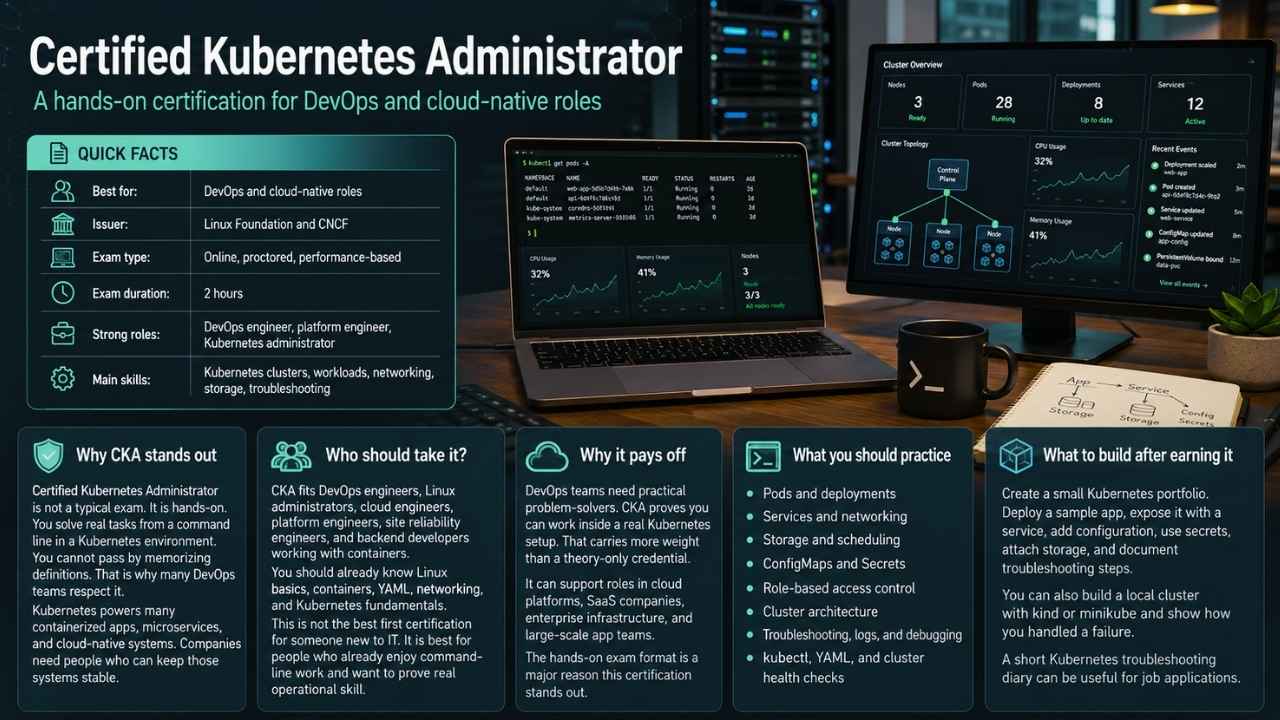
Certified Kubernetes Administrator is not a typical exam. It is hands-on. You solve real tasks from a command line in a Kubernetes environment. You cannot pass by memorizing definitions.
That is why many DevOps teams respect it. Kubernetes powers many containerized apps, microservices, and cloud-native systems. Companies need people who can keep those systems stable.
Who should take it?
CKA fits DevOps engineers, Linux administrators, cloud engineers, platform engineers, site reliability engineers, and backend developers working with containers. You should already know Linux basics, containers, YAML, networking, and Kubernetes fundamentals.
This is not the best first certification for someone new to IT. It is best for people who already enjoy command-line work and want to prove real operational skill.
Why it pays off?
DevOps teams need practical problem-solvers. CKA proves you can work inside a real Kubernetes setup. That carries more weight than a theory-only credential.
It can support roles in cloud platforms, SaaS companies, enterprise infrastructure, and large-scale app teams. The hands-on exam format is a major reason this certification stands out.
What you should practice?
Focus on pods, deployments, services, networking, storage, scheduling, ConfigMaps, Secrets, role-based access control, cluster architecture, troubleshooting, logs, and debugging. Practice with a timer because speed matters.
You should be comfortable using kubectl, reading YAML, fixing broken workloads, and checking cluster health. The exam is not about pretty notes. It is about solving problems under pressure.
What to build after earning it?
Create a small Kubernetes portfolio. Deploy a sample app, expose it with a service, add configuration, use secrets, attach storage, and document troubleshooting steps.
You can also build a local cluster with kind or minikube and show how you handled a failure. A short “Kubernetes troubleshooting diary” can be surprisingly useful for job applications.
6. CompTIA Security+
|
Quick facts |
Details |
|
Best for |
Cybersecurity foundation |
|
Level |
Beginner to intermediate |
|
Online option |
Online testing is available through Pearson VUE |
|
Strong roles |
SOC analyst, junior security analyst, IT security support |
|
Main skills |
Threats, vulnerabilities, identity, risk, networks, security operations |
CompTIA Security+ is one of the best starting points for cybersecurity. It is vendor-neutral, so you are not tied to one platform. It covers threats, vulnerabilities, risk, identity, network security, cryptography, security operations, and governance.
It will not make you a senior security expert overnight. But it gives you a strong base, especially if you already understand basic IT.
Who should take it?
Security+ suits IT support workers, junior network admins, career switchers with tech basics, students, help desk workers moving into security, and people preparing for SOC analyst roles. If you are completely new to IT, learn networking and operating systems first.
Security+ works best when you already understand how computers, accounts, networks, and permissions work. It is also useful for non-security IT workers who want to add stronger security awareness to their current role.
Why it pays off?
Cybersecurity remains one of the strongest career areas. Companies handle more data than ever, and attackers keep changing their methods. That means security skills are useful across almost every industry.
Security+ can help you move toward junior security jobs or strengthen your resume for IT roles with security duties. It is a foundation, not the whole career. But foundations matter.
What you should study?
Focus on threats, vulnerabilities, identity, access control, network security, risk management, incident response, security operations, and governance. Do not only memorize terms. Learn how common attacks work and how teams respond.
Practice reading logs, spotting weak configurations, and explaining security risks in plain language. Cybersecurity is technical, but communication matters too.
What to do after Security+?
Get hands-on practice quickly. Try a basic home lab, Linux command practice, network traffic analysis, log review, SIEM basics, incident response write-ups, beginner capture-the-flag labs, and cloud security basics.
You can also write short reports explaining what you found and how you would fix it. Security careers reward proof. Show what you can analyze, not just what you studied.
7. Google Data Analytics Professional Certificate
|
Quick facts |
Details |
|
Best for |
Beginner data analytics |
|
Learning format |
100% online |
|
Experience needed |
No degree or prior experience required |
|
Strong roles |
Data analyst, reporting analyst, business analyst |
|
Main skills |
Spreadsheets, SQL, data cleaning, R, dashboards, data storytelling |
The Google Data Analytics Professional Certificate is one of the most beginner-friendly paths into analytics. It teaches spreadsheets, SQL, data cleaning, visualization, dashboards, basic analysis, and communication.
It also includes AI training from Google experts, which makes it more useful for 2026 learners. This certificate is not a shortcut to a senior data role. But it is a strong first step for people who want to learn data in a structured way.
Who should take it?
This certificate fits beginners, career switchers, office workers who handle reports, marketers, finance assistants, operations staff, students, freelancers, content teams, and publishers.
Editors, SEO teams, and content managers can use analytics to understand traffic, engagement, search performance, and audience behavior. That makes it practical for people who work with content, business, marketing, or operations.
Why it pays off?
Data is not just for data teams anymore. Marketing, product, sales, finance, HR, media, ecommerce, and operations teams all need people who can read numbers and explain what they mean.
This is one of the best online certifications 2026 for non-tech professionals who want a practical upgrade. The career value gets stronger when you pair the certificate with clear portfolio projects.
What you should learn deeply?
Pay close attention to SQL, spreadsheets, data cleaning, visualization, and data storytelling. These skills appear again and again in entry-level analytics work.
Do not rush through the hands-on tasks. The point is not only to finish the course. The point is to become comfortable working with messy data. Also learn how to explain insights in simple language. That is what managers usually need.
How to make it stronger?
Build a small portfolio after finishing the certificate. Good ideas include a website traffic report, SEO content performance dashboard, sales analysis, customer survey analysis, ecommerce conversion report, SQL query project, or data cleaning case study.
Keep it simple. A clear insight beats a crowded dashboard. Write two or three lines explaining what changed, why it matters, and what action a business should take.
8. Salesforce Certified Tableau Data Analyst
|
Quick facts |
Details |
|
Best for |
Business intelligence and dashboards |
|
Official name |
Salesforce Certified Tableau Data Analyst |
|
Exam questions |
60 scored questions plus up to 5 unscored questions |
|
Exam time |
105 minutes |
|
Passing score |
65% |
|
Online option |
Proctored exam onsite or online |
|
Strong roles |
BI analyst, data analyst, reporting analyst |
Tableau is still a major name in business intelligence. Many teams use it to turn raw data into dashboards and reports. The Salesforce Certified Tableau Data Analyst credential proves that you can connect data, transform it, analyze it, create charts, and share insights.
This is not about making pretty graphs. Good dashboard work helps teams make faster, smarter decisions.
Who should take it?
This certification fits data analysts, BI analysts, marketing analysts, finance analysts, operations analysts, reporting specialists, and dashboard freelancers. It is best for people who already understand basic analytics.
If you are brand new, start with Google Data Analytics first, then move into Tableau. This credential is especially useful if your target jobs mention dashboards, reporting, business intelligence, or stakeholder reporting.
Why it pays off?
Many businesses have too much data and too little clarity. A good BI analyst can reduce manual reporting, spot trends, and help teams act faster.
That makes Tableau skills useful in e-commerce, media, SaaS, healthcare, finance, operations, and sales. The certification helps show that you can do more than drag charts onto a screen. You can build reports that answer business questions.
What you should practice?
Practice connecting data, cleaning fields, joining tables, using calculations, building dashboards, adding filters, and explaining insights. Also practice dashboard design. A dashboard should not feel like a wall of numbers.
Your goal is to make the next action obvious. A good Tableau analyst thinks like both a data person and a business user.
What to build?
Create dashboards that answer real questions. Good examples include a monthly revenue dashboard, SEO performance dashboard, ecommerce conversion dashboard, customer support dashboard, ad campaign ROI dashboard, or editorial performance dashboard.
Keep the layout clean. Use filters, labels, and clear takeaways. Add one short paragraph under each dashboard explaining the business insight.
9. Project Management Professional Certification
|
Quick facts |
Details |
|
Best for |
Experienced project leaders |
|
Issuer |
Project Management Institute |
|
Level |
Advanced |
|
Online option |
Online proctored option available, with restrictions |
|
Strong roles |
Project manager, program manager, delivery manager |
|
Main skills |
People leadership, process, business value, delivery, risk |
The PMP is one of the most respected project management credentials. It is not for complete beginners. PMI requires real project leadership experience and project management education or approved training.
That is part of the value. PMP tells employers that you have managed real work, not just watched a few lessons. It works across industries because almost every organization needs people who can turn plans into finished work.
Important 2026 update
PMI has announced a new PMP exam coming in July 2026. The updated exam includes 180 questions, 240 minutes, and more interactive, scenario-based tasks. It is designed to reflect real project environments more closely.
That means candidates should check the latest PMI exam outline before scheduling. Do not rely on old study guides without checking whether they match the current exam version.
Who should take it?
PMP fits project managers, team leads, delivery managers, operations managers, consultants, product-adjacent professionals, and people who manage budgets, timelines, and stakeholders. It is best for workers who already lead projects in some form.
If you do not meet PMP requirements yet, consider CAPM first. The PMP is most useful when you can connect it to real project results.
Why it pays off?
Project management works across tech, construction, healthcare, finance, media, education, manufacturing, consulting, and government. Strong project managers keep work moving. They manage scope, risk, people, budgets, timelines, and communication.
That skill stays useful even when tools change. PMP can support promotion into senior project, program, delivery, or operations roles.
What you should study?
Focus on project planning, stakeholder management, risk management, agile and hybrid delivery, budget control, scope control, communication, team leadership, business value, and change management.
PMP is not only about memorizing terms. It tests judgment. You need to choose the best response for realistic project situations. That is why scenario practice matters.
How to show PMP value on your resume?
Do not only list the credential. Connect it to delivery results. Mention projects completed, budgets managed, timelines improved, teams coordinated, or risks reduced.
For example, a stronger resume line would be: “Led a cross-functional website migration project and reduced delivery delays by improving stakeholder review cycles.” PMP becomes more powerful when it supports a record of real leadership.
10. Google Digital Marketing & E-commerce Certificate
|
Quick facts |
Details |
|
Best for |
Digital marketing and ecommerce |
|
Learning format |
Online |
|
Experience needed |
No degree or prior experience required |
|
Strong roles |
Digital marketer, ecommerce assistant, marketing coordinator |
|
Main skills |
SEO, email marketing, analytics, ecommerce, customer loyalty, AI for marketing |
Not every valuable certification is technical. Digital marketing still matters because every business needs customers. The Google Digital Marketing & E-commerce Certificate teaches search marketing, SEO basics, content marketing, email marketing, ecommerce stores, marketing analytics, customer loyalty, and campaign planning.
Google says the program includes AI training and hands-on activities for marketing strategy and research. That makes it a useful starting point for 2026 marketing work.
Who should take it?
This certificate fits junior marketers, content writers, ecommerce assistants, social media managers, small business owners, freelancers, bloggers, publishers, and career switchers.
This certification connects well with SEO, content planning, audience growth, affiliate content, ecommerce, and digital publishing. It is also useful for creators who want to understand the business side of content. You do not need a marketing degree to start, but you should be ready to practice.
Why it pays off?
Marketing teams need people who can do more than post online. They need people who understand search intent, audience behavior, email funnels, analytics, campaign planning, ecommerce tools, and conversion.
This certificate gives beginners a broad base. It can also help small business owners make better decisions instead of guessing what works.
What you should learn deeply?
Pay close attention to SEO, email marketing, analytics, ecommerce conversion, and customer loyalty. These are practical skills that show up in real marketing work.
Do not treat social media as the whole field. Digital marketing is much wider than posting graphics and captions. The strongest marketers understand traffic, leads, conversions, retention, and measurement.
What to build after it?
Create a small marketing portfolio. Good examples include an SEO content plan, keyword map, email welcome sequence, ecommerce product page audit, Google Analytics report, paid campaign mockup, social media content calendar, or customer loyalty plan.
For content publishers, build a sample article strategy with keywords, search intent, internal links, and conversion goals. The certificate teaches the basics. Your samples prove you can use them.
Which certification should you choose by career goal?
|
Career goal |
Best certification path |
|
Cloud engineer |
AWS Solutions Architect or Azure Administrator |
|
Enterprise cloud admin |
Azure Administrator Associate |
|
Senior cloud architect |
Google Cloud Professional Cloud Architect |
|
AI or ML engineer |
Google Cloud Professional Machine Learning Engineer |
|
DevOps engineer |
Certified Kubernetes Administrator |
|
Cybersecurity analyst |
CompTIA Security+ |
|
Data analyst |
Google Data Analytics, then Tableau Data Analyst |
|
BI analyst |
Salesforce Certified Tableau Data Analyst |
|
Project manager |
PMP |
|
Digital marketer |
Google Digital Marketing & E-commerce |
Do not choose a certification just because it is trending. Choose it because it matches the job you want next. A strong certificate should help you move toward one clear role, not confuse your resume with unrelated skills.
Start by searching job descriptions for your target role. Read what employers actually ask for. Then choose the certification that matches your current level and the tools that appear most often.
Best path for beginners
Beginners should avoid jumping into advanced exams too early. If you are new to tech, start with Google Data Analytics, Google Digital Marketing, CompTIA Security+, or basic cloud learning before advanced cloud or AI exams.
The goal is to build confidence and job-ready skills. Once you complete a beginner certificate, build one project and use it to apply for internships, freelance tasks, junior roles, or internal projects.
Best path for IT workers
IT workers can move faster because they already understand systems, users, networks, and troubleshooting. Good next steps include AWS Solutions Architect, Azure Administrator, CompTIA Security+, or Kubernetes if you already work near DevOps.
Choose based on your workplace. If your company uses Microsoft tools, Azure may pay off faster. If job posts in your market mention AWS more, start there. Use your current IT experience as proof that you can apply the certification.
Best path for business and marketing workers
Business and marketing workers should focus on analytics, digital marketing, dashboards, and project management. Google Data Analytics can help you read reports better. Tableau can help you build dashboards. Google Digital Marketing can improve SEO, ecommerce, and campaign planning. PMP can help if you already manage teams or projects.
These skills work well together. A marketer who understands data and project delivery can become far more valuable than someone who only writes posts.
How to know if a certification is worth the money?
|
Question to ask |
Why it matters |
|
Does it appear in job descriptions? |
Shows employer demand |
|
Is the issuer trusted? |
Builds recruiter confidence |
|
Does it test real skills? |
Makes it more credible |
|
Can you learn or test online? |
Adds flexibility |
|
Does it match your target role? |
Keeps your effort focused |
|
Can you build a project from it? |
Helps prove practical ability |
|
Does it expire? |
Affects renewal cost |
|
Is the cost reasonable? |
Protects your ROI |
A certificate works best when it helps you tell a clear career story. Before paying, search the certificate name on job boards. Look at how often employers mention it and what roles include it.
Also check the renewal rules. Some certifications expire after a set period, and you may need to renew, retake an exam, or earn continuing education credits. A cheaper certificate is not always better. A more expensive one is not always better either. The right question is whether it helps you move toward a real opportunity.
Check employer demand first
Do not rely only on course ads. Search your target job title and location. Read 20 job descriptions. Track repeated tools, skills, and certifications.
If a credential appears often, it may be worth your time. If no employer mentions it, be careful. It may still teach useful skills, but it may not help much as a resume signal.
Check the exam format
The exam format tells you a lot about the value of a certification. Hands-on exams, proctored exams, and scenario-based assessments usually carry more weight than simple completion badges.
For example, CKA is respected partly because it is performance-based. AWS and Google Cloud exams are respected because they test practical platform knowledge through scenarios. A certificate that requires no exam, no project, and no assessment may be useful for learning but weaker for career signaling.
Check the total cost
Look beyond the sticker price. Some certifications require paid courses, practice exams, renewal fees, retakes, or continuing education. Others are subscription-based through learning platforms.
Also consider time cost. A difficult exam may take weeks or months of study. That is not bad if the payoff is clear. But it is a problem if the certificate does not match your career goal.
Common mistakes to avoid
|
Mistake |
Better move |
|
Taking a certificate only because it is popular |
Match it to your career goal |
|
Collecting too many beginner certificates |
Build projects instead |
|
Studying only theory |
Use labs and hands-on practice |
|
Picking an advanced exam too early |
Build the foundation first |
|
Expecting instant salary growth |
Use the credential to apply and negotiate |
|
Ignoring renewal rules |
Check validity before paying |
|
Not updating LinkedIn |
Add the credential, skills, and projects |
|
Using exam dumps |
Use official guides and ethical practice tests |
The biggest mistake is treating the certificate as the finish line. It is not. A certification is a signal. The real payoff comes from using the skill, showing proof, and applying for the right roles.
Another mistake is collecting unrelated certificates. That can make your resume look unfocused. A focused path looks stronger. For example, data analytics plus Tableau makes sense. AWS plus Kubernetes makes sense. Digital marketing plus analytics makes sense.
Do not skip hands-on practice
Watching lessons feels productive, but it is not enough. Cloud learners need labs. Data learners need messy datasets. Cybersecurity learners need logs and scenarios. Marketing learners need campaign samples. Project managers need real delivery examples.
Hands-on work turns information into skill. It also gives you something to show in interviews.
Do not expect instant results
A certification can help, but it does not guarantee a job. You still need a clear resume, strong LinkedIn profile, proof of work, and targeted applications.
Think of the certificate as one piece of your career package. The best results come when your certificate, portfolio, resume, and target role all point in the same direction.
Do not use exam dumps
Exam dumps are risky and unethical. They can violate certification rules and damage your credibility. They also do not teach the skill.
Use official guides, labs, practice exams, documentation, and real projects instead. Employers do not need someone who memorized stolen questions. They need someone who can solve problems.
Resume and LinkedIn tips after certification
|
Where to add it |
What to include |
|
Resume headline |
Match the credential to the target role |
|
Certification section |
Name, issuer, date earned |
|
Skills section |
Add related tools and platforms |
|
LinkedIn license section |
Add credential ID if available |
|
Featured section |
Add project links |
|
Work experience |
Mention how you used the skill |
|
Cover letter |
Connect the skill to the employer’s problem |
After earning a certificate, update your job materials quickly. Add the certification name, issuer, date earned, credential link or ID, related tools, and one proof-based project.
Do not bury the credential at the bottom if it matches your target role. For example, if you are applying for a cloud role, your AWS or Azure certification should be easy to see.
Write stronger resume bullets
Avoid weak lines like “Completed AWS certification.” Write something more specific: “Earned AWS Certified Solutions Architect – Associate and built a secure sample cloud architecture using VPC, EC2, RDS, IAM, and CloudFront.”
That second version sounds better because it connects learning to real work. For data roles, mention SQL, dashboards, analysis, and insights. For cybersecurity, mention logs, risks, tools, and response steps.
Specific beats generic every time.
Add proof to LinkedIn
LinkedIn is not only a place to list certificates. Use the Featured section to add project links, dashboards, GitHub repos, case studies, or short write-ups.
Write a short post after earning the certification. Explain what you learned, what you built, and what role you are targeting. This helps recruiters understand your direction.
Match your profile to one target role
Do not make your profile look like you are chasing every career at once. If your target is cloud engineer, highlight cloud projects. If your target is data analyst, highlight dashboards and SQL. If your target is digital marketer, highlight SEO, campaigns, analytics, and ecommerce.
A clear profile makes hiring decisions easier. Confusion kills opportunities.
How to build a portfolio around your certification?
|
Certification area |
Portfolio idea |
|
AWS |
Cloud architecture diagram and deployed sample app |
|
Google Cloud Architect |
Migration plan or high-availability design |
|
Azure Administrator |
Sample company cloud admin setup |
|
Machine Learning |
Deployed model with evaluation notes |
|
Kubernetes |
Containerized app with troubleshooting notes |
|
Security+ |
Home lab and incident response write-up |
|
Data Analytics |
SQL project and dashboard |
|
Tableau |
Business dashboard with insights |
|
PMP |
Project case study with timeline and risks |
|
Digital Marketing |
SEO plan, email sequence, and campaign report |
A portfolio makes your certification more believable. You do not need a huge project. You need a clear project that proves the skill.
Keep each project simple, clean, and explained in plain English. Hiring managers are busy. Make it easy for them to see what you did and why it matters.
Use the problem-solution-result format
Every project should explain three things. What was the problem? What did you build or analyze? What was the result or lesson?
This format works for cloud, data, cybersecurity, marketing, and project management. Even a sample project becomes stronger when you explain your thinking.
Keep screenshots clean
Screenshots help, but do not overload the portfolio with them. Use a few clear visuals: architecture diagram, dashboard view, report summary, or project timeline.
Add short captions so readers know what they are seeing. A clean portfolio feels more professional than a messy dump of images.
Add a short skills list
Under each project, list the tools and skills used.
For example: AWS S3, CloudFront, IAM, VPC, cost optimization, security design.
This helps recruiters match your project to job requirements. It also improves keyword relevance on LinkedIn and portfolio pages.
Final Thoughts
The best online certifications for 2026 are not the ones with the loudest marketing. They are the ones that connect to real jobs and prove useful skills. Cloud, AI, cybersecurity, data analytics, DevOps, project management, and digital marketing all have strong career value. But the certificate is only part of the story.
Pick one target role. Choose one trusted certification. Build one project. Then use that proof to apply, freelance, negotiate, or move up inside your company. A good certificate should not just decorate your resume.
It should help you say something stronger:
“I learned this. I practiced it. I can use it at work.”
That is when an online certification starts to pay off.
Frequently Asked Questions (FAQs) About The Best Online Certifications 2026
Can online certifications replace a degree?
Sometimes they can help you enter skills-based roles, especially when paired with projects. But they do not replace degrees in every field. Some employers still require degrees for senior, research-heavy, licensed, or regulated roles.
A certification works best when it proves a specific job skill. Think of it as career evidence, not a full replacement for every type of education.
Which online certification is best for beginners?
Google Data Analytics, Google Digital Marketing & E-commerce, and CompTIA Security+ are practical starting points. They do not require deep professional experience before you begin.
AWS Solutions Architect can also work for beginners who already understand basic IT and networking. The best beginner certification is the one you can finish, practice, and turn into a project.
Are AI certifications worth it in 2026?
Yes, but only if they teach applied skills. A useful AI certification should cover data, automation, model use, responsible AI, evaluation, deployment, or business application.
Generic AI theory is less useful. Employers want people who can use AI safely and productively, not just talk about it.
How many certifications should I earn in one year?
For most people, one or two focused certifications are enough. More is not always better. Too many unrelated certificates can make your career direction look unclear.
A better plan is one certification, one strong project, and targeted applications. Depth beats clutter.
What should I do after earning a certificate?
Build proof immediately. Update your resume, LinkedIn profile, and portfolio. Add the credential, tools, project links, and short results.
Then apply for roles that match the certification. Do not wait months. Use the momentum while the material is fresh.