


We have all been there. You decide to finally get your life together and operate at peak capacity. You plan to wake up at 5 AM, run three miles, meditate for twenty minutes, and read an entire business chapter before checking a single email. It works beautifully for exactly three days.
By Thursday, you smash the snooze button, and the whole plan falls completely apart. I see driven founders and ambitious professionals burn themselves out constantly trying to force new routines using nothing but sheer willpower. But willpower is a finite battery that drains rapidly every time you make a conscious decision. The problem is not your lack of drive. It is your strategy. You are trying to pave a brand new behavioral highway in your brain from scratch.
There is a much smarter way to build better routines without fighting your own biology. You just piggyback new behaviors onto things you already do automatically. Having habit stacking explained is the ultimate game-changer for anyone who struggles with consistency. By anchoring a tiny new habit to a rock-solid existing routine, you skip the need for motivation entirely. Here is exactly how to engineer your day using this method, the 2026 brain science behind why it works, and how to scale it up for massive professional growth.
The Brain Science Behind the Strategy
|
Brain Function |
Scientific Definition |
How It Impacts Your Daily Life |
|
Basal Ganglia |
The brain’s deep storage center for automatic, pattern-based routines. |
Handles tasks you execute without thinking, like brushing your teeth or making coffee. |
|
Context Memory |
Recall triggered by a stable physical and emotional environment. |
Performing actions in the exact same place makes new routines stick exponentially faster. |
|
Neuroplasticity |
The physical wiring of brain cells (neurons that fire together, wire together). |
Linking a new action physically builds a permanent new pathway in your brain structure. |
|
Cognitive Load |
The total amount of mental energy and working memory used at one time. |
Stacking requires almost zero mental effort compared to starting a habit from scratch. |
Your brain is notoriously lazy, and I mean that in the absolute best way possible. It constantly looks for ways to save energy, so it puts repetitive actions on autopilot. You never consciously think about grinding coffee beans or steering your car on your daily commute. You just do it. This happens in a brain region called the basal ganglia. When your brain recognizes a pattern, it files it away permanently.
The neural pathway for checking your phone in bed is a massive, paved superhighway. The pathway for doing pushups before breakfast is a dirt trail. Habit stacking uses that paved highway to get to the dirt trail. You give your brain a built-in trigger, allowing the old, hardwired habit to act as the cue for the new one.
Recent data backs this up in ways that completely change how we view productivity. A 2026 report from the University of South Australia showed that over 66 percent of our daily behaviors run purely on habit rather than active choice. Even better, once you start an automatic sequence, you complete it almost 88 percent of the time. Tie your new goal to a sequence you already do, and failure becomes almost impossible.
Dr. Eike Buabang at Trinity College Dublin recently published 2026 research showing that our brains balance two competing systems: goal-driven effort and automatic response. By slipping a new action onto the end of an existing routine, you hijack the automatic response system. You no longer have to convince yourself to act.
Find Your Anchor Habits
|
Anchor Trait |
Why You Absolutely Need It |
A Real-World Example |
|
Frequency |
Must precisely match your new habit’s desired schedule. |
Taking a morning shower happens every single day. |
|
Reliability |
Happens no matter how tired, stressed, or busy you feel. |
Turning on your office laptop or making morning coffee. |
|
Context |
Matches your physical location and current energy level. |
Sitting at your desk matches the energy of writing tasks. |
|
Precision |
Features a clear, undeniable, and exact ending point. |
Closing the laptop lid is much better than “after work.” |
You cannot just slap a new habit onto any random part of your day and expect it to stick. If you attach a new goal to something you only do occasionally, you will fail before you even start. To get habit stacking explained properly and actually working in your life, you need to identify your anchors. An anchor is an action you perform with absolute certainty every single day, regardless of how tired or stressed you feel.
Grab a pen and map out your daily autopilot. Your list should include actions like turning off the alarm, starting the coffee maker, brushing your teeth, opening your laptop, or turning off the lights at night. These actions are thoughtless and deeply wired into your brain.
The real secret lies in matching your physical environment and your energy state. Do not stack a high-energy habit onto a low-energy anchor. Doing burpees right after you sit on the couch to relax makes absolutely no sense to your nervous system. Instead, stack deep breathing after you sit on the couch. If you want to exercise, stack those burpees right after you lace up your running shoes.
A 2026 Harvard study on behavioral health showed that using this specific, context-matched method increased habit adherence by 40 percent over 90 days compared to control groups. When the context matches perfectly, the brain accepts the new behavior without triggering any internal resistance.
Build Your First Stack
|
Step |
Required Action |
How To Execute It Correctly |
|
1. Anchor |
Pick a reliable, daily anchor habit. |
Ensure the action happens every single day without fail. |
|
2. Shrink It |
Make the new habit take less than two minutes. |
Read exactly one page, do five squats, or write one sentence. |
|
3. Formula |
Write the intention down on paper. |
Use the syntax: “After I [Anchor], I will [New Habit].” |
|
4. Celebrate |
Give yourself a quick, physical mental win. |
A quick fist pump releases dopamine to cement the pathway. |
Behavioral scientists like B.J. Fogg and James Clear popularized this incredibly simple formula. It looks easy on paper, but it only works if you follow the strict rules of implementation. Ambitious people mess this up all the time because they try to go too big too fast. They try to stack a massive routine onto a small trigger, saying things like, “After I pour my coffee, I will work out for an hour.”
That never works because the friction is far too high for a new neural pathway to handle. You have to scale it back using the two-minute rule. Change it to, “After I pour my coffee, I will put on my gym shoes.” That is the entire stack. Once your shoes are on, going outside takes zero effort. You only stack the start of the habit, not the entire massive task.
To make this bulletproof, you must write down the exact formula. Use this specific sentence structure: “After I perform my current habit, I will perform my new habit.” Be hyper-precise with your wording. Saying you will do something “after lunch” is far too vague for your brain to process as a cue.
Change it to, “After I close my laptop for lunch, I will do ten push-ups.” That gives your brain a specific, undeniable physical trigger. You then need to celebrate the completion immediately. Give yourself a quick fist pump or a mental nod. That tiny celebration releases a hit of dopamine, which physically wires the new behavior into your brain faster.
Real Examples for High Performers
|
Professional Goal |
The Anchor (Your Reliable Cue) |
The Stacked Habit (Your New Action) |
|
B2B Growth |
Opening your project management dashboard |
Writing down your top three sales metrics on a sticky note |
|
Financial Health |
Checking your US neobank app on Friday |
Moving five percent of rental income to a tax-savings account |
|
Mental Focus |
Sitting down with your first morning coffee |
Completing a strict one-minute breathing exercise |
|
Physical Fitness |
Parking your car at the corporate office |
Taking the stairs instead of using the elevator |
Running a digital publication, leading a B2B SaaS startup, or managing a high-performance sales team fries your brain by noon. Decision fatigue is a very real threat to your bottom line. A 2026 report from ZipDo showed that 72 percent of entrepreneurs report experiencing burnout symptoms, and 57 percent work over 80 hours a week. A recent Xero study revealed that small business owners lose an average of 33 workdays a year entirely to stress and financial anxiety.
For high performers, having habit stacking explained is a literal lifesaver. It protects your mental bandwidth so you can focus on product-led growth tactics instead of remembering to drink water. Think of it like watching Sachin Tendulkar at the crease. The man did not just rely on spontaneous flashes of brilliance. His incredible leadership and run-scoring machine were built on an unbreakable foundation of tiny, repeated rituals.
You can apply this exact mindset to your professional and financial health. Reacting to emails all day kills deep work and stifles your company’s growth metrics. Use the Priority Stack: “After I open my laptop, I will write down my top three targets before looking at my inbox.” You can also use this for financial planning. Use the Wealth Stack: “After I pay a vendor invoice, I will log the exact expense category in my tracker.”
Staying fit directly boosts your cognitive performance, but finding time for a long gym session is tough. Try the Commute Stack: “After I park at the office, I will do a two-minute mindfulness routine in the driver’s seat.” These micro-actions keep you sharp without ruining your schedule.
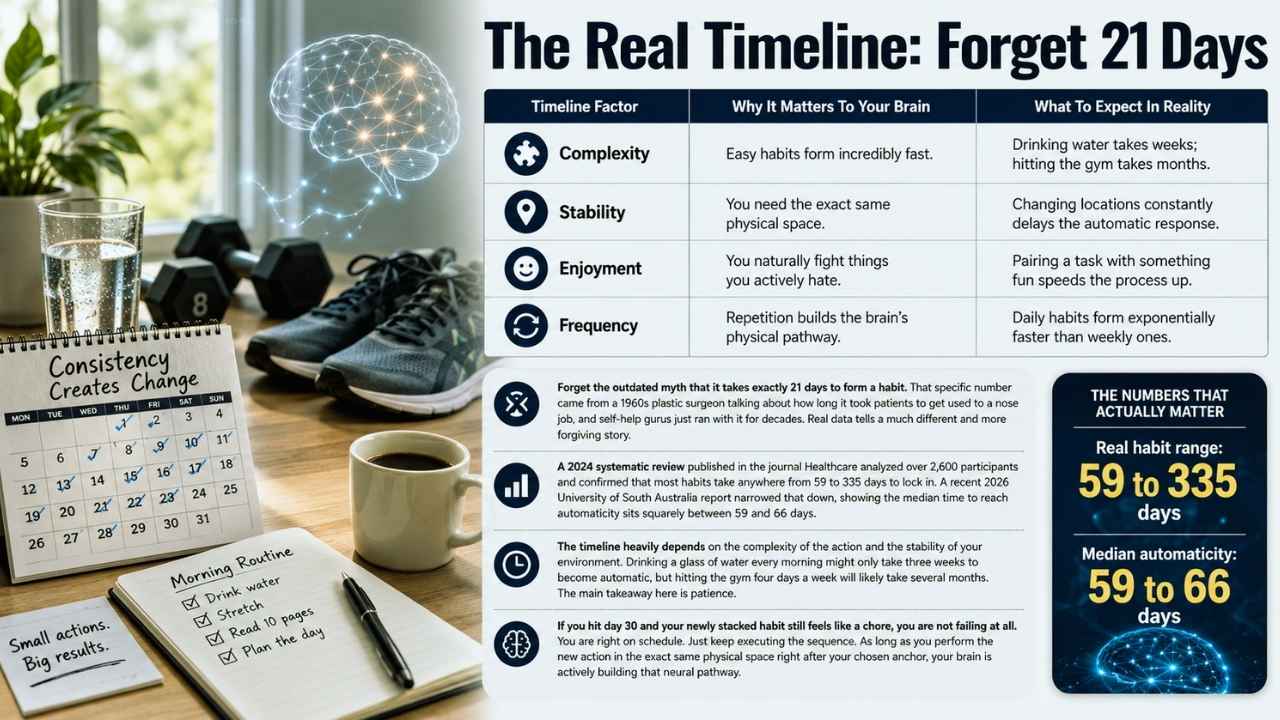
The Real Timeline: Forget 21 Days
|
Timeline Factor |
Why It Matters To Your Brain |
What To Expect In Reality |
|
Complexity |
Easy habits form incredibly fast. |
Drinking water takes weeks; hitting the gym takes months. |
|
Stability |
You need the exact same physical space. |
Changing locations constantly delays the automatic response. |
|
Enjoyment |
You naturally fight things you actively hate. |
Pairing a task with something fun speeds the process up. |
|
Frequency |
Repetition builds the brain’s physical pathway. |
Daily habits form exponentially faster than weekly ones. |
Forget the outdated myth that it takes exactly 21 days to form a habit. That specific number came from a 1960s plastic surgeon talking about how long it took patients to get used to a nose job, and self-help gurus just ran with it for decades. Real data tells a much different and more forgiving story.
A 2024 systematic review published in the journal Healthcare analyzed over 2,600 participants and confirmed that most habits take anywhere from 59 to 335 days to lock in. A recent 2026 University of South Australia report narrowed that down, showing the median time to reach automaticity sits squarely between 59 and 66 days.
The timeline heavily depends on the complexity of the action and the stability of your environment. Drinking a glass of water every morning might only take three weeks to become automatic, but hitting the gym four days a week will likely take several months. The main takeaway here is patience.
If you hit day 30 and your newly stacked habit still feels like a chore, you are not failing at all. You are right on schedule. Just keep executing the sequence. As long as you perform the new action in the exact same physical space right after your chosen anchor, your brain is actively building that neural pathway.
Don’t Make These Mistakes
|
The Critical Mistake |
Why It Causes You To Fail |
How to Fix It Immediately |
|
Floating Anchors |
The environment constantly changes. |
Tie your habit to a static location like a desk or a sink. |
|
Vague Goals |
Your brain does not know when to start. |
Change “after working out” to “after taking off my shoes.” |
|
Doing Too Much |
You run out of mental energy on bad days. |
Stick strictly to the two-minute rule for all new habits. |
|
Skipping Weekends |
It completely breaks the fragile brain connection. |
Pick anchors that happen seven days a week without fail. |
Even when you understand the mechanics perfectly, human nature often gets in the way. People usually wreck their progress by choosing floating anchors. If you say, “After dinner, I will read a book,” you are setting yourself up to fail because dinner floats. Sometimes you eat at a noisy restaurant, and other times you eat at your desk while working late.
Your brain gets confused because the environment keeps changing. You must change it to something static, like, “After I put my plate in the kitchen sink, I will read one page.” The kitchen sink never moves, giving your basal ganglia a rock-solid, predictable cue every single time.
The second massive mistake is the ambition trap. You feel highly motivated on day one, so you plan a ten-step morning routine that includes journaling, running, meditating, and reading. By day four, you are exhausted and you quit everything. You have to earn the right to advance to more complex routines.
Do not add a second habit to your stack until the first one happens without thinking. You also cannot skip weekends. Your brain does not care what day of the week it is. If you skip your routine on Saturday and Sunday, you break the fragile brain connection you spent all week building. Pick anchors that happen seven days a week to ensure uninterrupted neural growth.
Advanced Tactics: Chaining and Environment
|
Advanced Tactic |
How It Works In Practice |
Best Used For |
|
Habit Chaining |
Linking several small habits in a direct row. |
Creating frictionless morning routines that run on autopilot. |
|
Environment Design |
Putting physical cues next to the exact anchor. |
Reading more books, taking vitamins, or staying hydrated. |
|
Temptation Bundling |
Pairing a “want” directly with a “should.” |
Listening to a favorite podcast only while doing chores. |
|
Friction Insertion |
Using a stack to actively pause a bad habit. |
Breaking a doomscrolling addiction or impulsive snacking. |
Once you completely nail the basics, you can build advanced behavioral systems that put your personal growth and productivity on autopilot. The most powerful tactic is habit chaining. When one stack becomes fully automatic, that new habit seamlessly becomes your next anchor. First, you start with, “After I pour my coffee, I will write in my journal for two minutes.”
A few weeks later, when that requires zero effort, you add a link: “After I write in my journal, I will check my weekly calendar.” A few weeks after that, you add: “After I check my calendar, I will open my biggest project.” You just built a flawless, frictionless morning workflow. You only ever needed the initial motivation to pour the coffee, and the rest happens through a powerful domino effect.
Stacking works exponentially better when your physical room actively supports the behavior. We call this environment design. If your goal is to read more, and your stack is “After I sit on the couch, I will read,” but the book is upstairs and the TV remote is in your hand, you will undoubtedly fail. You must manipulate the space to your advantage.
Put the book directly on the couch cushion before you leave for work. Hide the TV remote inside a drawer in another room. By combining the mental trigger of your anchor habit with the extreme physical convenience of your designed environment, you make bad habits difficult and good habits inevitable.
Final Thoughts
Building a life that operates efficiently does not mean you have to turn into a robot. It means being ruthless about where you spend your mental energy. Relying on raw motivation is a dangerous trap because feelings change daily based on stress, sleep, and workload.
Getting habit stacking explained proves that real, lasting change is just mechanics. It is about clear triggers, simple actions, and stacking small wins. By linking the things you want to do with the things you already do automatically, you create a system that drags you forward on autopilot. Start today. Pick one reliable anchor. Pick one tiny, two-minute habit. Write down the exact formula and do it tomorrow. These small, stacked actions compound over time, completely transforming how you operate in your professional and personal life.
Frequently Asked Questions (FAQs) About Habit Stacking Explained
Does this work for breaking bad habits?
Yes. You use a stack to insert friction. “After I open Instagram, I will take three deep breaths before looking at the screen.” That pause breaks the automatic dopamine hit and gives your brain a second to make a better choice.
What’s the difference between Habit Stacking and Temptation Bundling?
Stacking uses a routine as a trigger (“After I brush my teeth, I floss”). Bundling uses a reward as a driver (“I only watch Netflix while I’m on the treadmill”).
What if my schedule changes every single day?
Use biological anchors. If you travel constantly, tie your habits to things your body forces you to do—waking up, eating, or taking a bathroom break.
What happens if I miss a day?
Never miss twice. Missing one day does zero long-term damage to your brain’s wiring. Missing two days starts building a new, lazy habit. If you mess up, brush it off and nail it the very next time the anchor happens.