


You open your laptop on a Monday morning. Slack is already screaming. Your inbox is a wreck. Your remote team is panicking over a minor software bug, and you haven’t even looked at the product-led growth strategy you promised by Thursday. When every single task feels like a five-alarm fire, how do you decide what actually gets done? Most of us just freeze.
We react to the loudest noise in the room. Recent workplace data from Acuity Training paints a brutal picture: 82 percent of professionals operate without any real prioritization system. We spend our days putting out meaningless fires instead of doing actual work. The result? We burn out, our cognitive performance tanks, and the deep work that actually grows a business gets pushed to next week. Again.
You need a hard filter. You need a way to separate the actual signal from the daily noise. This is why getting the Eisenhower Matrix explained completely changes how you operate. It forces you to stop confusing “urgent” with “important.” This tool gives you a brutal, honest look at where your hours go. Let’s break down exactly how to use this grid to take back your schedule and stop working on things that simply do not matter.
Where Did This Come From?
Dwight D. Eisenhower, the 34th U.S. president and a World War II five-star general, built this mental model. When you plan global military operations, you cannot afford to get distracted by minor hiccups. You have to maintain absolute focus on the primary objective. Eisenhower lived by a brutal, simple rule: “I have two kinds of problems, the urgent and the important. The urgent are not important, and the important are never urgent.”
He understood that reacting to every small fire prevents you from building the actual fire station. Years later, productivity author Stephen Covey grabbed this concept. He turned it into a four-box grid in his book The 7 Habits of Highly Effective People. Covey realized that modern knowledge workers suffer from the exact same problem as military generals. We let loud, immediate problems distract us from quiet, critical goals.
Think about how a legendary athlete handles a high-pressure moment. They block out the screaming crowd and focus entirely on the mechanics of the play. They manage their energy based on the long-term goal of winning the match. That is exactly what this grid does for your workday. It acts as a shield against daily distractions.
|
Historical Fact |
Real World Context |
|
Creator |
Dwight D. Eisenhower (34th U.S. President) |
|
Popularized By |
Stephen Covey (The 7 Habits of Highly Effective People) |
|
The Core Idea |
Stop treating “urgent” and “important” as the same exact thing |
|
The Main Goal |
Act strategically instead of reacting emotionally to daily chaos |
|
Modern Application |
Defends your focus against emails, texts, and instant messaging |
The Eisenhower Matrix Explained: The Four Quadrants
Grab a blank piece of paper and draw a large square. Now split that square into four equal boxes. The vertical line measures importance. The horizontal line measures urgency. Everything you do today—from writing code to buying groceries—has to fit into one of these exact boxes. Seeing the Eisenhower Matrix explained quadrant by quadrant is the fastest way to spot exactly where you leak hours.
We waste massive amounts of time on tasks that feel productive but actually deliver zero value. The average worker is productive for only 2 hours and 53 minutes a day. The rest of the time gets eaten by busywork and constant interruptions. Breaking your tasks into these four distinct zones stops that bleed. It forces you to justify every single thing you do.
|
Quadrant Zone |
Action Required |
Emotional State |
|
1 (Urgent & Important) |
Do it immediately |
High stress, crisis management |
|
2 (Important, Not Urgent) |
Schedule it on the calendar |
Deep focus, long-term growth |
|
3 (Urgent, Not Important) |
Delegate it away |
Annoyed by constant interruptions |
|
4 (Not Urgent, Not Important) |
Delete it entirely |
Checked out, pure time-wasting |
Quadrant 1: Do First (Urgent and Important)
These are your absolute crises. A production server crashes. A massive enterprise client threatens to walk away. A critical payroll error happens on a Friday afternoon. You drop everything and fix Q1 tasks immediately. You have no choice. The house is on fire, and you have to grab the hose. But pay close attention to this reality: if you spend your entire workweek living in Quadrant 1, you will burn out.
Fast. Operating in a state of constant emergency ruins your mental health and destroys your decision-making skills. Fix the immediate emergency today. Then, sit down tomorrow and build a rock-solid system so that specific emergency never happens again. Moving tasks out of Q1 and into routine processes is how you scale a business without losing your mind.
|
Crisis Example |
The Immediate Fix |
The Long-Term Solution |
|
Website Crashes |
Reboot servers immediately |
Upgrade hosting architecture |
|
Client Threatens to Leave |
Call them directly to apologize |
Improve customer onboarding |
|
Missed Deadline |
Pull an all-nighter to finish |
Better sprint planning in Q2 |
|
Payroll Fails |
Wire money manually |
Hire a dedicated finance manager |
Quadrant 2: Schedule (Important, Not Urgent)
Welcome to the actual money zone. This is where deep work lives and where real growth happens. Writing a 3,000-word SEO guide, mapping out B2B SaaS growth metrics, or planning your personal tax strategy around sovereign savings schemes—these tasks live right here. Because nobody is screaming at you to do these things today, you probably push them off. Stop doing that right now.
High performers block out specific calendar time for Q2 and defend it fiercely. Your physical fitness fits right here, too. Hitting the gym to manage stress isn’t urgent until you have a heart attack. But it remains deeply important for your daily cognitive performance. Treat these tasks with the highest respect. Schedule them exactly like you schedule a meeting with your most important investor.
|
Deep Work Task |
Why You Avoid It |
How to Force Execution |
|
Strategic Planning |
Requires intense mental effort |
Block out Tuesday mornings |
|
Content Creation |
Blank page syndrome |
Set a 500-word daily quota |
|
Physical Fitness |
You feel too tired after work |
Workout before checking email |
|
Financial Audits |
Numbers are boring |
Hire an accountant to force deadlines |
Quadrant 3: Delegate (Urgent, Not Important)
Quadrant 3 acts as a massive trap for smart people. These tasks are incredibly loud, but they offer zero long-term value to your actual goals. Think about random “quick question” phone calls, pointless status meetings, or checking your Slack messages every three minutes. Recent 2026 data shows that workers get interrupted every two minutes during the workday.
The same Grammarly report indicates that knowledge workers lose roughly 19 hours a week just managing messy written communications. That is pure Q3 garbage eating your life. You have to delegate this stuff. Automate it with software. Empower your team to make routine decisions without tagging you in every single thread. Stop letting other people’s emergencies dictate your daily schedule.
|
Q3 Distraction |
The Hidden Cost |
The Fix |
|
Status Meetings |
Kills 2 hours of deep work |
Switch to async updates |
|
“Quick Question” Chats |
Breaks your absolute focus |
Create a team FAQ document |
|
Email Overload |
Causes immense daily anxiety |
Check inbox only twice a day |
|
Approving Small Expenses |
Creates a massive bottleneck |
Give staff a set budget limit |
Quadrant 4: Delete (Not Urgent, Not Important)
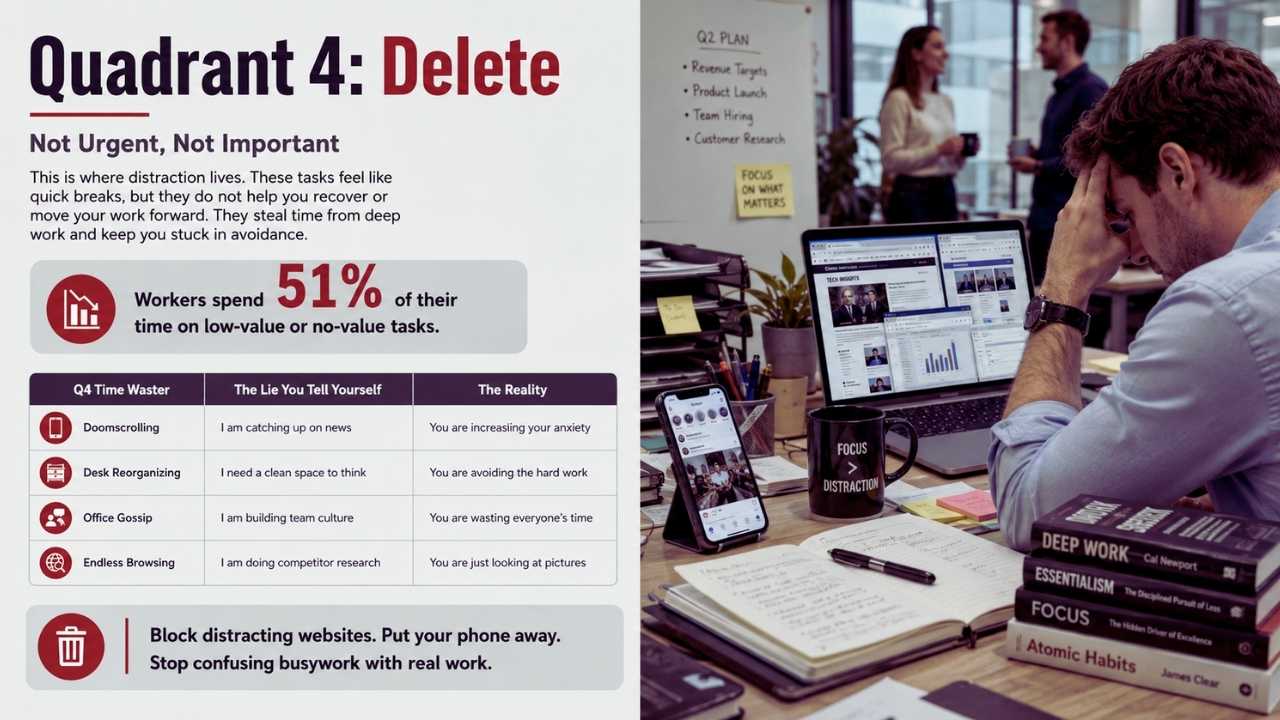
Doomscrolling social media. Watching random videos about agritourism in Germany when you have a massive deadline looming. Rearranging your desk for the fourth time this morning. We hide in Q4 when the chaos of Q1 exhausts us. You convince yourself you are taking a quick mental break. You are not. It doesn’t actually relax you; it just steals the precious time you desperately need for Q2 deep work.
Workers currently spend 51 percent of their time on low-value or no-value tasks. You have to ruthlessly delete these habits from your workday. Block the distracting websites. Leave your phone in another room. Stop pretending that organizing your desktop folders equals actual work.
|
Q4 Time Waster |
The Lie You Tell Yourself |
The Reality |
|
Doomscrolling |
“I am catching up on news” |
You are increasing your anxiety |
|
Desk Reorganizing |
“I need a clean space to think” |
You are avoiding the hard work |
|
Office Gossip |
“I am building team culture” |
You are wasting everyone’s time |
|
Endless Browsing |
“I am doing competitor research” |
You are just looking at pictures |
Why Your Brain Loves Cheap Dopamine?
Why do incredibly smart founders fail at prioritizing their day? Blame human biology. In 2018, researchers published a massive study in the Journal of Consumer Research highlighting a cognitive flaw called the “Mere Urgency Effect.” Basically, your brain prefers to do objectively useless tasks simply because they have a tight deadline. Knocking out five quick, pointless emails gives you a fast hit of cheap dopamine. You feel incredibly productive in the moment.
But sitting down to write a comprehensive guide on digital nomad hubs requires serious mental energy and offers absolutely zero immediate reward. When you get the eisenhower matrix explained to your staff, you hand them a weapon against this fake urgency. It forces you to pause, look at the task, and ask: “Is this actually making us money, or does it just feel busy?” You stop chasing the quick win and start playing the long game.
|
Brain Reaction |
Urgent Tasks (The Trap) |
Important Tasks (The Goal) |
|
Chemical Hit |
Fast dopamine release |
Slow, delayed gratification |
|
Focus Area |
Short-term stress relief |
Long-term business scaling |
|
Typical Emotion |
Anxiety, rush, reactivity |
Calm, strategic, purposeful |
|
Result of Ignoring |
Minor daily failure |
Massive career stagnation |
How to Actually Do This Every Day?
Reading the theory is totally useless without brutal execution. Here is exactly how you run this playbook tomorrow morning. First, do a massive brain dump. Get every single task out of your head and onto a piece of paper. The broken API endpoints, the angry client calls, the grocery list—write it all down. Next, filter that list. Ask yourself: “Will something catch fire if I don’t do this today?” If yes, it is urgent. Then ask: “Does this move the needle on my big quarterly goals?” If yes, it is important.
Now, cap your list tightly. Do not shove 20 things into Quadrant 1. If everything is an emergency, absolutely nothing is. Limit yourself to a maximum of five tasks per quadrant. Finally, pair this system with the 3-3-3 method. Block out three hours of uninterrupted Q2 deep work. Pick three urgent tasks to knock out immediately. Then, do three maintenance tasks like clearing your inbox or hitting the gym. It keeps your grid lean and hyper-aggressive.
|
Daily Execution Step |
The Action Required |
Why It Actually Works |
|
1. Brain Dump |
Write absolutely everything down |
Kills anxiety and mental clutter instantly |
|
2. Filter Hard |
Sort by urgency and real importance |
Strips away all emotional reactions |
|
3. Cap the List |
Limit to 5 tasks per specific box |
Forces you to make hard trade-offs |
|
4. Time Block |
Protect Q2 hours on your calendar |
Guarantees the deep work gets done |
The Data Really Does Not Lie
Trying to keep your task list in your head guarantees absolute failure. Recent 2026 data from Acuity Training shows that 25 percent of professionals just “deal with whatever comes up.” This reactive strategy is a disaster. Over 28 percent of those people feel completely out of control at work. They live in a perpetual state of panic and drop balls constantly.
Furthermore, bad communication costs U.S. businesses a staggering $1.2 trillion annually. That equates to over $9,200 lost per employee every single year because people spend half their workweek trapped in a communication swirl instead of doing deep work. Conversely, the exact same research shows that 100 percent of people who actively use the four-quadrant priority grid feel in control of their workload at least four days a week. Half of them feel in control every single day. It destroys simple to-do lists. It just flat-out works better than anything else you can try.
|
Time Strategy |
User Success Rate |
Burnout Risk |
|
Eisenhower Matrix |
100% control 4-5 days a week |
Exceptionally Low |
|
Pomodoro Method |
60% control 4-5 days a week |
Moderate |
|
Basic To-Do Lists |
Highly variable success |
Medium |
|
Reacting to Chaos |
28% feel totally out of control |
Extremely High |
Final Thoughts
We work in an era literally designed by engineers to distract us constantly. You cannot magically create a 25-hour day. Your only real leverage in business is your raw focus. Once you get the Eisenhower Matrix explained and actually start applying it, you stop rewarding yourself for merely being busy.
You start holding yourself accountable for being highly effective. Handle the daily crises quickly, schedule the deep strategic work, hand off the annoying noise, and absolutely trash the distractions. Stop surviving your crazy week and start owning it completely.
Frequently Asked Questions (FAQs) About Eisenhower Matrix Explained
My boss thinks every task is a Q1 emergency. What do I do?
You have to make the trade-offs completely visible. When they hand you a new “urgent” project, show them your current grid. Say, “I can jump on this right now, but I have to pause the SEO strategy you asked for yesterday. Which one do you want me to prioritize?” Make them choose. Never say no directly; just present the reality of your limited capacity.
Do tasks move around between the boxes?
Yes, they constantly shift. If you ignore a Q2 task—like filing your quarterly taxes—for six months, it violently becomes a Q1 crisis in April. Good planning keeps tasks firmly in Q2 so you never have to panic.
Does this framework apply to my personal life?
Absolutely. Family time, mental health, and heavy exercise are the ultimate Q2 activities. They matter deeply, but they rarely scream for your attention until it is too late. Treat a dinner date with your spouse or an hour at the gym with the exact same respect you give a board meeting.