


Have you ever tried sending a large amount of money to a friend overseas or even just across state lines? If so, you probably hit a frustrating wall of high wire fees, terrible exchange rates, and days of waiting just for the funds to clear. Or maybe you keep hearing wild stories about people making or losing absolute fortunes overnight on obscure internet coins, leaving you entirely confused about what the fuss is all about.
The world of digital money looks incredibly intimidating from the outside, full of technical jargon that sounds like science fiction. But if you strip away the complicated vocabulary, the underlying concepts actually make a whole lot of sense.
So, how does cryptocurrency work? In this plain English guide, I will break down the entire ecosystem from the ground up so you can finally grasp what is going on behind the screens. You will learn exactly what gives these digital coins their value, how the underlying technology keeps your money secure without needing a traditional bank, and the exact steps you need to take if you decide you want to buy some yourself. We are going to skip the confusing tech speak entirely, and whenever we absolutely have to use a fancy industry term, I will explain exactly what it means using real-world analogies. Let’s dive in.
The Problem With Traditional Money
Before we can really grasp why digital currency needs to exist in the first place, we have to look critically at the paper money currently sitting in your wallet. Traditional money—often referred to in the financial world as fiat currency—relies entirely on your unwavering trust in a central authority. When you swipe your debit card to buy a cup of coffee, you aren’t actually handing over physical cash. Instead, you are simply trusting your bank to update a private, closed-off database, electronically moving three dollars from your account over to the coffee shop’s account.
|
Feature |
Traditional Money (Fiat) |
Cryptocurrency |
|
Control System |
Centralized (Controlled by Banks and Governments) |
Decentralized (Maintained by a global network of users) |
|
Ledger Transparency |
Private databases hidden from the public |
Public blockchain ledgers anyone can verify |
|
Money Supply |
Unlimited (Can be printed at will by central banks) |
Usually mathematically capped or algorithmic |
|
Border Transfers |
Slow, heavily regulated, and expensive |
Incredibly fast, borderless, and typically cheaper |
The Middleman Dilemma
Banks and payment processors act as the ultimate middlemen in almost every financial transaction you make today. They carry the responsibility to verify that you actually have the funds, authorize the transaction to go through, and hold the master ledger of everyone’s balances. While this system works relatively well most of the time, it gives these institutions massive, unchecked control over your financial life.
Because they sit in the middle, they can charge arbitrary fees for moving your own money, they can freeze your accounts without warning if they deem your activity suspicious, and they dictate the operating hours. Plus, if their centralized servers go down for maintenance or get hacked, your money is essentially stuck in limbo until they fix the problem.
The Threat of Inflation
Furthermore, central banks control the total supply of the money circulating in the economy. If a government decides it needs to pay off massive national debts or stimulate a failing economy, they can simply fire up the proverbial money printer and create more cash out of thin air. While this might solve short-term economic crises, it heavily dilutes the value of the dollars already sitting in your savings account.
This hidden tax is known as inflation, and it means the hundred dollars you saved five years ago buys significantly less at the grocery store today. Cryptocurrency was explicitly designed by its creators to bypass these central authorities entirely, creating a system with a fixed supply that gives total financial control back to the individual user.
What Is Cryptocurrency? A Simple Definition
At its absolute core, cryptocurrency is just a purely digital form of money that relies on network consensus rather than a bank manager. It utilizes incredibly advanced mathematics and computer science to secure transactions, verify ownership, and control exactly how and when new units get created.
You can never physically hold a Bitcoin or an Ethereum coin in the palm of your hand because it simply does not exist as a physical coin or a paper bill. Instead, it lives entirely on the internet as complex lines of computer code distributed across thousands of machines.
|
Concept |
Explanation in Plain English |
|
Digital Only |
There are no physical coins to mint; it is entirely software-based. |
|
Cryptography |
Complex, unbreakable math used to keep your funds secure from hackers. |
|
Decentralization |
No single CEO, bank manager, or government agency runs the network. |
|
Peer-to-Peer |
You send money directly to someone else’s wallet, exactly like handing them physical cash. |
No Central Boss
The biggest and most revolutionary deal about cryptocurrency is that it is fundamentally decentralized. There is no corporate headquarters building, no board of directors making backroom decisions, and definitely no customer service hotline you can call if you make a mistake.
Instead, the entire financial system stays alive and operational thanks to thousands of regular people all over the world who choose to run specific, open-source software on their personal computers. These volunteers create a massive, interconnected web that works together to validate everything that happens. Because there is no single point of failure, it is incredibly difficult for any government or malicious actor to shut the network down.
To make this decentralized system work without a boss, these connected computers constantly talk to each other to agree on who owns what and to process incoming new transactions. Because no single bank holds the master copy of the financial ledger, the network has to reach a total consensus before any money actually moves.
If one computer tries to say you have a million dollars, but the other nine thousand computers look at the history and see you only have ten dollars, the network automatically rejects the lie. The system relies on a groundbreaking piece of technology to keep everyone honest, transparent, and perfectly synchronized at all times. That foundational technology is called the blockchain.
The Core Engine: How Does Blockchain Work?
If you really want to answer the question of how does cryptocurrency work, you absolutely must understand the mechanics of the blockchain. You can easily think of the blockchain as a giant, incredibly secure public spreadsheet that records every single transaction ever made. But instead of living on one tech company’s private, hackable server in Silicon Valley, thousands of identical copies of this spreadsheet are shared, updated, and maintained by computers all over the world simultaneously.
|
Blockchain Step |
What Actually Happens Behind the Scenes |
|
1. The Request |
You hit “send” on your app to transfer digital crypto to a friend’s wallet. |
|
2. The Network |
Your transaction request broadcasts to thousands of independent computers worldwide. |
|
3. The Block |
Computers group your transaction alongside hundreds of others into a digital “block.” |
|
4. The Chain |
Once verified mathematically, the block links to the previous one permanently and forever. |
Building the Chain
When you decide to send crypto to a friend, you announce that transaction to the entire network of computers. These computers gather up all the new, pending transactions that have happened over the last few minutes and pack them together into a digital box, which programmers call a “block.” But before they can permanently add this block to the official ledger, the network has to check the math.
They scan the entire history of the spreadsheet to verify that you actually possess the funds you are trying to send and that you aren’t trying to trick the system by spending the exact same digital coin twice. Once the network reaches an agreement that all the transactions in the box are legitimate, the block is approved.
Unbreakable History
Once everyone agrees the block is perfectly legit, it gets mathematically locked using complex cryptography and seamlessly attached to the previously approved block. Hence, a literal chain of blocks. Because every single block is cryptographically linked to the specific data of the one right before it, you cannot go back in time and alter history.
If a hacker wanted to fake a past transaction to give themselves free money, they would have to rewrite that specific block, recalculate the math for every single block that came after it, and convince over half of the computers on the planet to accept their fake version of reality all at the exact same moment. For massive networks like Bitcoin, the computing power required to pull off that kind of attack is practically impossible to achieve, making blockchain one of the most secure data systems ever invented.
How Are New Coins Created? Mining and Staking?
Since there is absolutely no central bank or treasury department to print new paper money, the crypto network needs a built-in, automated way to release new coins into the economy. Furthermore, it needs a way to financially reward the people who are dedicating their expensive computer power to keeping the system secure and verifying all those blocks. Different cryptocurrencies handle this challenge in vastly different ways, but almost all of the major coins rely on one of two primary consensus systems: Proof of Work or Proof of Stake.
|
Consensus Method |
How It Operates |
Environmental Energy Usage |
Example Coin |
|
Proof of Work (Mining) |
Computers aggressively race to solve complex math puzzles to win block rewards. |
Extremely High (Requires warehouse-sized computer farms) |
Bitcoin (BTC) |
|
Proof of Stake (Validators) |
Users lock up their own existing crypto as financial collateral to verify blocks. |
Very Low (Can be run on a standard laptop) |
Ethereum (ETH) |
Proof of Work (Mining)
Bitcoin, the original cryptocurrency, uses the Proof of Work system. In this model, highly specialized, noisy computers race against each other to solve incredibly difficult mathematical equations. We call this computational race “mining.” It is essentially a massive, global guessing game, and the only way to win the game is to own a machine that can make trillions of rapid-fire guesses per second.
The first computer to guess the exact correct answer wins the absolute right to add the next block of transactions to the permanent chain. As a reward for their hard work, the winner receives a payout of brand-new, freshly minted Bitcoin. The massive downside to this highly secure system is that these racing computers consume staggering amounts of electricity, leading to heavy criticism regarding environmental impact.
Proof of Stake (Validators)
To dramatically fix the severe energy consumption problem, many newer cryptocurrencies, including the massive Ethereum network, transitioned to a modern system called Proof of Stake. There are absolutely no electricity-guzzling math puzzles here. Instead, participants who want to help secure the network lock up a portion of their own cryptocurrency in a smart contract—an action known in the industry as “staking.” The network software then randomly selects one of these staked users to verify the upcoming block.
If they do a truthful job, they earn newly created coins as a yield. However, if they attempt to cheat the system or approve a fraudulent transaction, the network automatically punishes them by permanently destroying a large chunk of their staked collateral. This financial threat keeps everyone perfectly honest without burning through the electricity of a small nation.
Types of Cryptocurrency You Should Know
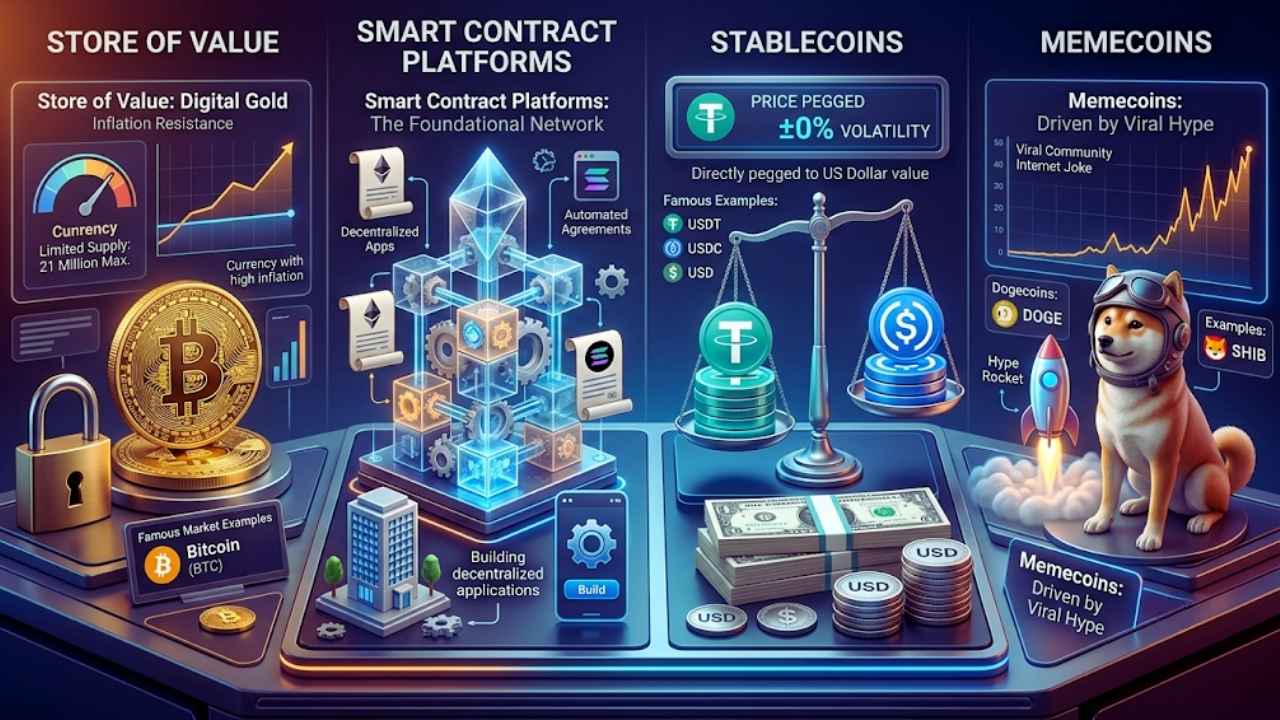
When most everyday people hear the word “crypto,” their brain immediately jumps straight to Bitcoin. But assuming Bitcoin is the only digital currency out there is like assuming Apple is the only company that makes computers. There are actually tens of thousands of entirely different digital coins and tokens actively trading on the market today. They all feature unique codebases, different developers, and they serve vastly different economic and technological purposes.
|
Crypto Category |
Main Purpose and Functionality |
Famous Market Examples |
|
Store of Value |
Acts as digital gold; highly resistant to inflation due to a strictly fixed supply cap. |
Bitcoin (BTC) |
|
Smart Contract Platforms |
Provides a foundational network for building decentralized apps and automated agreements. |
Ethereum (ETH), Solana (SOL) |
|
Stablecoins |
Directly pegged to the value of the US Dollar to completely avoid market price volatility. |
Tether (USDT), USD Coin (USDC) |
|
Memecoins |
Created as internet jokes; their value is driven entirely by viral social media hype and community. |
Dogecoin (DOGE), Shiba Inu (SHIB) |
The Original: Bitcoin
Launched quietly in 2009 by an anonymous, mysterious creator using the fake name Satoshi Nakamoto, Bitcoin was the first truly successful decentralized digital currency. Its primary, unshakeable goal is to be a pure digital alternative to traditional money and a highly secure store of long-term value.
The code strictly dictates that there will only ever be exactly 21 million Bitcoins minted into existence, and not a single fraction more. That mathematically enforced, absolute scarcity is the exact reason why massive Wall Street investors and everyday users alike treat it like digital gold, using it to protect their wealth against the endless printing of traditional government fiat money.
Altcoins and Ethereum
In the crypto dictionary, absolutely any coin that is not Bitcoin is broadly categorized as an “altcoin.” Ethereum is currently the biggest and most important altcoin by a massive margin. While Bitcoin was designed purely to be a reliable digital currency, Ethereum was engineered as a decentralized, global computing platform. It allows software developers to build complex “smart contracts” directly into the blockchain.
A smart contract is simply computer code that automatically executes the terms of a deal without needing a human middleman. For instance, you could use a smart contract to automatically transfer the digital ownership deed of a house the exact second the buyer’s funds hit your wallet, entirely eliminating the need for expensive escrow agents and real estate lawyers.
Stablecoins
One of the most valid criticisms of standard cryptocurrency is that the prices swing far too wildly, making it incredibly difficult to price a cup of coffee using Bitcoin. Stablecoins were specifically invented to solve this exact volatility problem. Their digital value is artificially and directly pegged to a highly stable, real-world asset—almost always the United States dollar.
For every single digital stablecoin that a company issues onto the blockchain, they are supposed to hold one actual, physical US dollar in a traditional, regulated bank reserve. Day traders heavily use stablecoins to quickly move their money out of volatile assets during market crashes, keeping their wealth perfectly safe without having to endure the slow process of withdrawing funds back to a local bank.
Memecoins
Finally, we have the bizarre and highly speculative world of memecoins. These are digital tokens that were originally coded and launched primarily as an internet joke or to poke fun at the intense seriousness of the crypto finance world. Dogecoin is the absolute most famous example, featuring the face of a popular Shiba Inu dog meme as its official logo.
Despite offering virtually zero underlying technological innovation or real-world utility, these joke coins can occasionally skyrocket in value to become worth billions of dollars. Their massive price pumps are driven entirely by viral social media hype, celebrity tweets, and highly passionate online communities, making them incredibly dangerous and wildly unpredictable investments for beginners.
Where Does Cryptocurrency Live? Understanding Wallets?
So, if cryptocurrency is nothing more than complex computer code, where do you actually put it when you buy some? The simple answer involves setting up a digital crypto wallet. However, the term “wallet” is actually a massive misnomer that confuses a lot of beginners. Your crypto wallet does not actually hold your digital coins in the same way your physical leather wallet holds twenty-dollar bills. In reality, the coins themselves never actually leave the global blockchain. Your wallet simply holds the highly secure digital passwords that mathematically prove you own a specific portion of the coins sitting on that public ledger.
|
Wallet Type |
Internet Connection |
Security Level |
Best Used For What Purpose |
|
Hot Wallet |
Always Online (Mobile App or Browser Extension) |
Medium |
Daily trading, interacting with apps, and holding small amounts. |
|
Cold Wallet |
Completely Offline (Physical USB-style Device) |
Maximum |
Long-term secure storage and holding large life-savings amounts. |
|
Exchange Wallet |
Managed fully by a third-party corporate company |
Varies |
Absolute beginners buying their very first coins for convenience. |
Public and Private Keys
To understand wallets, you have to understand keys. Every single crypto wallet on earth consists of two crucial pieces of cryptographic data. Your public key acts exactly like your bank account routing number or your email address; it is perfectly safe to share this long string of letters and numbers with anyone who wants to send you money.
Your private key, on the other hand, is the master password to your vault. It is a complex cryptographic string that gives whoever holds it absolute, total control over the funds associated with your public key. If a hacker gets their hands on your private key, they will instantly drain your account, and there is no bank manager you can cry to for a refund.
Hot vs. Cold Storage
Because keeping that private key safe is your ultimate responsibility, the industry created two main ways to store it. A “hot wallet” is any software wallet that maintains an active connection to the internet—like an app you download on your iPhone or an extension you add to your Chrome browser. They are incredibly convenient for making quick trades, but that constant internet connection makes them slightly vulnerable to clever hackers and malicious spyware.
Conversely, a “cold wallet” is a specialized, physical hardware device that looks very similar to a standard USB thumb drive. It stores your incredibly sensitive private keys completely offline. To actually spend your money, you must physically plug the cold wallet into your laptop and physically press a plastic button to approve the transaction, making it practically immune to remote internet hackers.
How to Buy Your First Cryptocurrency?
If you feel like you finally grasp the basics and you are ready to dip your toes into the market, actually buying crypto is astronomically easier today than it was a decade ago. You no longer need to be a computer science major or navigate sketchy internet forums to get your hands on some digital assets. By following a few standardized steps, anyone with a smartphone can make their very first purchase in under ten minutes.
|
Step Process |
Action Required by the User |
Pro Tip for Beginners |
|
1. Pick an Exchange |
Sign up for a massive, heavily regulated platform (like Coinbase, Kraken). |
Completely avoid unregulated, offshore platforms promising crazy returns. |
|
2. Verify Identity |
Upload your driver’s ID and connect a standard checking account. |
This KYC process is required by federal law to stop global money laundering. |
|
3. Buy Fractions |
Choose a specific coin and execute a simple market buy order. |
You can buy just $10 worth of Bitcoin; you do not need to buy a whole one. |
|
4. Secure It Properly |
Move the purchased crypto off the corporate exchange to your own wallet. |
Live by the golden crypto rule: “Not your keys, not your coins.” |
Choosing a Platform and Verifying
The absolute safest and most logical route for a complete beginner is to use a centralized cryptocurrency exchange. These are massive, publicly traded companies like Coinbase or Kraken that operate very similarly to a traditional stock brokerage app. Because they act as a bridge between the traditional banking world and the crypto world, federal financial laws require them to rigorously verify exactly who you are. This process, known as Know Your Customer (KYC), requires you to upload a clear photograph of your government-issued ID and officially link a funding source, such as your debit card or your local bank account.
Making the Purchase
Once your account is fully verified and your cash has settled, actually buying the crypto is just like adding items to a shopping cart on Amazon. You simply navigate to the trading page for the specific coin you want, enter the exact dollar amount you are willing to spend, and click the big green buy button to execute a market order.
It is crucial to remember that cryptocurrencies are infinitely divisible. You absolutely do not have to shell out sixty thousand dollars to buy one whole Bitcoin. You can simply choose to invest fifty dollars and receive a tiny, fractional percentage of a single coin placed directly into your exchange account.
Taking Custody
When you make that initial purchase on an exchange like Coinbase, the corporate exchange company actually holds the private keys to that crypto on your behalf. While this is incredibly convenient for a beginner who might forget a password, it introduces a massive risk.
If that specific exchange company makes bad bets and goes completely bankrupt, or if their master servers get severely hacked, your money might vanish overnight into thin air. Once you buy your crypto, the absolute smartest move you can make is to pay a small network withdrawal fee and send those digital assets over to your own personal hot or cold wallet where only you control the master keys.
Real-World Uses: Why Do People Use It?
It is incredibly easy for casual observers watching the news to dismiss the entire cryptocurrency industry as just a degenerate digital casino for greedy day traders. While financial speculation is undeniably a massive part of the daily market volume, the underlying blockchain technology is actively solving massive, deeply entrenched real-world problems for millions of people across the globe right now.
|
Real-World Problem |
Traditional Financial Solution |
The Cryptocurrency Solution |
|
Sending money abroad |
Western Union or Bank Wire (Extremely high fees, takes 3-5 business days) |
Crypto transfer (Costs fractions of a cent, settles instantly 24/7) |
|
Hyperinflation |
Helplessly watching local paper currency lose all its purchasing value |
Converting life savings to borderless Bitcoin or stablecoins to preserve wealth |
|
Getting a quick loan |
Requires strict credit checks, paperwork, and subjective bank approval |
Decentralized Finance (DeFi) allows instant loans via code with no credit check |
Cross-Border Remittances
Consider the plight of migrant workers who travel abroad to earn a living and need to send a portion of their paycheck back home to their families in developing nations. Traditionally, they are forced to use massive wire services that brutally scalp up to ten percent of their hard-earned cash in arbitrary fees, and the physical transfer can take nearly a week to clear across borders.
By utilizing crypto networks, that exact same worker can beam digital stablecoins directly to their family’s smartphone in a matter of seconds, 24 hours a day, practically for free. It completely cuts the slow, greedy corporate middlemen out of the financial loop.
Escaping Hyperinflation
If you are fortunate enough to live in a country with a relatively stable economy, it can be hard to grasp the absolute panic of hyperinflation. In developing nations where corrupt or incompetent governments mismanage the economy, the local paper currency can literally lose half of its purchasing power in a single month.
Desperate citizens in these collapsing economies heavily rely on converting their rapidly dying cash into Bitcoin or US dollar-backed stablecoins. It acts as an unbreakable financial lifeboat because the corrupt local government absolutely cannot freeze the blockchain, confiscate the funds, or arbitrarily devalue the digital assets to pay off government debts.
Decentralized Finance (DeFi)
Beyond just sending money, developers have built an entirely parallel financial universe known as Decentralized Finance, or DeFi. Using the smart contracts we discussed earlier, DeFi platforms allow anyone with an internet connection to lend out their crypto to earn high interest rates, or borrow money instantly against their digital assets without ever talking to a human loan officer.
There are absolutely no credit scores, no background checks, and no racial or geographic biases. If you have the required digital collateral sitting in your crypto wallet, the immutable computer code automatically approves your loan in seconds, creating a truly fair and open global financial system.
The Risks and Downsides of Crypto
I would be entirely irresponsible and lying by omission if I tried to tell you that jumping into crypto was a perfectly safe bet. Getting involved in this highly experimental, unregulated market carries incredibly serious, life-altering risks that every single beginner needs to fully understand before putting a single dollar of their hard-earned paycheck on the line.
|
Major Crypto Risk |
Why It Consistently Happens |
How to Properly Protect Yourself |
|
Price Volatility |
The global market trades 24/7 purely based on extreme hype, fear, and news cycles. |
Only ever invest money that you can comfortably afford to lose entirely. |
|
Scams and Hacks |
Irreversible blockchain transactions attract highly sophisticated cybercriminals. |
Never type your private keys into a website; double-check all wallet addresses. |
|
Lost Passwords |
True decentralization means there is absolutely no “reset password” tech support button. |
Write your backup recovery phrase on physical paper and store it in a fireproof safe. |
The Rollercoaster Ride
Cryptocurrency prices swing with a level of extreme violence that makes the traditional stock market look like a boring savings account. Because the market never closes, a single panicked tweet from a prominent billionaire or a vague rumor about a government crackdown can easily tank the entire market by twenty percent in a single afternoon.
You might excitedly invest a thousand dollars on a Tuesday and wake up on Friday to see your portfolio sitting at four hundred dollars. Because of these brutal boom-and-bust market cycles, you should never, under any circumstances, put your vital rent money, grocery budget, or emergency savings into highly volatile digital assets.
You Are Your Own Bank
The greatest strength of crypto—total individual control—is also its most terrifying weakness. With great financial power comes massive personal responsibility. If you accidentally copy and paste the wrong wallet address and send your life savings to a stranger, or if a clever scammer tricks you into approving a malicious smart contract, your money is gone forever.
There is no fraud department you can call to reverse the agonizing mistake. Furthermore, if you decide to use a cold wallet but accidentally lose the physical device and forget where you hid your master backup phrase, your digital wealth will remain locked tightly on the blockchain forever, totally unspendable by anyone until the end of time.
The Future of Digital Money
In a timeframe of little more than a decade, cryptocurrency aggressively grew from a weird, obscure internet experiment discussed on nerdy cryptography forums into a multi-trillion-dollar global asset class. Major Wall Street institutions that openly laughed at Bitcoin five years ago are now frantically rushing to offer digital asset investment products to their wealthiest clients.
|
Future Industry Trend |
Plain English Description |
Potential Impact on the Global World |
|
Institutional Adoption |
Massive Wall Street funds and corporations actively buying crypto. |
Brings much-needed price stability and massive capital legitimacy to the wild market. |
|
CBDCs (Gov Crypto) |
Central Bank Digital Currencies issued directly by nations. |
Modernizes old banking plumbing, but heavily severely reduces personal financial privacy. |
|
The Rise of Web3 |
A totally decentralized version of the internet powered by blockchain. |
Everyday users actually own their online data instead of renting it from big tech monopolies. |
Mainstream Integration
We are currently witnessing massive, traditional payment giants like Visa, Mastercard, and PayPal actively integrating cryptocurrency networks deep behind the scenes of their apps to make their own legacy settlement systems dramatically faster and cheaper. Recently, the US government even approved official Bitcoin Exchange Traded Funds (ETFs), allowing standard retirement accounts to legally invest in digital assets. This massive influx of institutional Wall Street money is slowly transforming the chaotic crypto landscape into a recognized, legitimate pillar of the global financial architecture.
CBDCs and Web3
Meanwhile, powerful world governments are furiously taking notes on blockchain efficiency. Many major nations are actively developing Central Bank Digital Currencies (CBDCs). These are basically government-controlled, centralized versions of crypto designed to completely modernize their aging financial plumbing, though they strip away the anonymity and freedom of true crypto.
At the same time, brilliant developers are aggressively pushing toward “Web3″—a vision for a completely decentralized internet where blockchain tech allows everyday users to truly own their digital identities, in-game assets, and personal data, entirely cutting out the monopolistic control of massive tech corporations.
Final Thoughts
So, at the end of the day, how does cryptocurrency work? It fundamentally works by completely replacing our forced, centralized trust in greedy banks and politicians with a beautifully decentralized trust in unbreakable mathematics and a global network of independent computers. It represents a massive, undeniable paradigm shift in exactly how humanity thinks about digital ownership, privacy, and the transfer of value across borders.
While the current market undoubtedly remains wildly volatile, heavily speculative, and filled with significant risks for the uneducated, the underlying blockchain technology is undeniably here to stay. Whether you ultimately decide to invest a portion of your savings or you just prefer to watch the chaos unfold from the sidelines, taking the time to truly understand the mechanics of decentralized digital money is absolutely crucial as our society moves relentlessly further into a fully digitized, interconnected global economy.
Frequently Asked Questions (FAQs) About How Cryptocurrency Works
Can the government completely shut down cryptocurrency?
A specific government can definitely pass harsh laws to ban the trading, mining, or spending of crypto within its own physical borders (exactly like China has attempted multiple times). However, because the actual network software is distributed across tens of thousands of independent computers globally, no single government has the technical ability to reach out and turn off the blockchain itself.
What actually happens to the network if the internet goes down globally?
If the entire planet loses internet connectivity simultaneously, all cryptocurrency networks would temporarily halt because the computers could no longer communicate to verify blocks. However, the exact history of the blockchain ledger would survive perfectly intact on millions of physical hard drives. The exact second the internet was restored, the network would sync back up and pick up exactly where it left off.
Are my crypto profits actually taxed by the government?
Yes, absolutely. In the vast majority of countries, including the United States, federal tax agencies legally treat cryptocurrency as property rather than standard currency. This means every single time you sell a coin for a profit, or even trade one digital coin for another coin, you owe capital gains taxes on the exact difference in value.
Can a supercomputer or a hacker guess my wallet’s private key?
Mathematically speaking, a hacker guessing your specific private key is about as likely as a blindfolded person picking one specific grain of sand out of all the beaches on Planet Earth on their very first try. The advanced cryptography used to automatically generate these wallets makes brute-force computer guessing practically impossible with our current technological capabilities.
Why do the network transaction fees fluctuate so wildly sometimes?
Blockchains are technologically limited and can only process a certain number of transactions per second. When a massive amount of people suddenly try to send money at the exact same time (usually during a market crash or rally), the digital network gets severely congested. To skip the line, users can voluntarily choose to pay a much higher fee to financially bribe the miners into prioritizing their specific transaction, which violently drives the average cost up for everyone else during those busy times.