
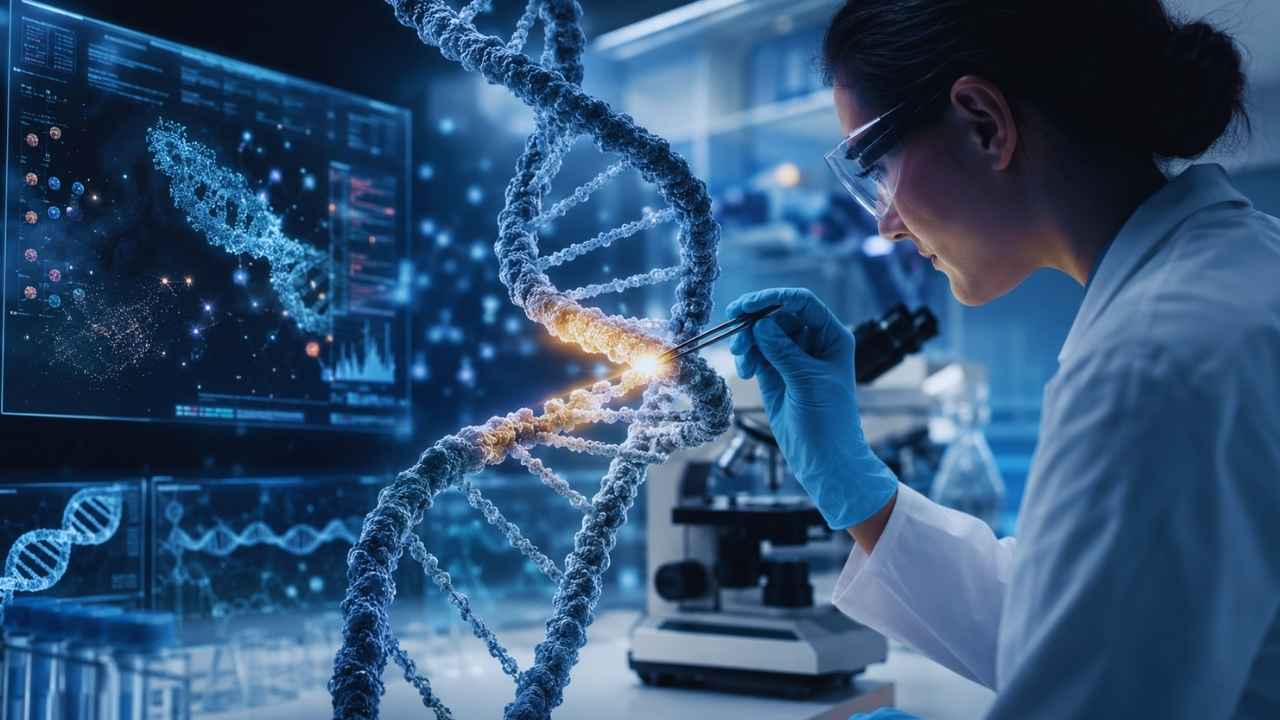
Imagine finding a single wrong letter on page 300 of a giant encyclopedia. To fix it, you used to have to reprint the entire volume. Now, picture having a microscopic eraser and pen that lets you walk right up to page 300, erase that single bad letter, and write in the correct one.
That is what molecular biologists do today. Instead of just reading human DNA, we can edit it directly in living cells. If you have been wondering how CRISPR gene editing works, the real story is surprisingly simple. Scientists borrowed a defense system from wild bacteria and turned it into the world’s most precise genetic tool. It is already curing deadly blood diseases, protecting food supplies, and making us rethink what it means to heal a human body.
The Biology: How CRISPR Gene Editing Works?
CRISPR stands for “Clustered Regularly Interspaced Short Palindromic Repeats.” Bacteria invented it billions of years ago to fight off viruses. When a virus attacks a bacterium, the bacterium cuts off a tiny piece of the virus’s DNA and tucks it into its own genome as a biological mugshot. If that same virus ever shows up again, the bacterium uses that stored DNA sample to find the invader and chop its genome to pieces.
In 2012, researchers figured out how to hijack this biological defense system and reprogram it for human use. To understand how CRISPR gene editing works at the molecular level, you only need to look at three main parts. First, scientists print a custom guide RNA in the lab that acts like a GPS tracker, perfectly matching the 20-letter sequence of DNA they want to change.
Second, the Cas9 protein acts as a pair of molecular scissors, traveling along the DNA strand guided by the RNA. Third, a built-in safety mechanism called the PAM sequence ensures the scissors only cut when they lock onto a specific short pattern next to the target site. Once everything aligns, Cas9 unzips the double helix and slices cleanly across both strands of DNA.
|
CRISPR Component |
Role in Nature (Bacteria) |
Role in Gene Editing Labs |
|
Guide RNA |
Remembers old viral attacks |
Guides scissors to the exact DNA target |
|
Cas9 Protein |
Cuts up invading viruses |
Slices target DNA at the chosen location |
|
PAM Sequence |
Protects bacteria from cutting itself |
Acts as a mandatory dock for Cas9 |
How Cells Patch Up the Break?
Making the cut is only step one. The actual edit happens when the cell tries to fix itself. Cells hate broken DNA and immediately try to repair the gap using one of two primary methods, which scientists actively exploit in the lab.
The first method is sloppy patching, known as Non-Homologous End Joining (NHEJ). The cell quickly glues the loose ends back together but often drops or adds a couple of random genetic letters in its hurry, which breaks the gene and turns it off completely. The second method is precise editing, or Homology-Directed Repair (HDR). If scientists inject a fresh strip of correct DNA alongside the CRISPR tool, the cell uses that new strip as a pattern to repair the break, allowing researchers to seamlessly replace a damaged gene with a healthy version.
|
Repair Pathway |
What the Cell Does |
Resulting Outcome |
|
NHEJ |
Glues ends together quickly and carelessly |
Turns off a harmful gene |
|
HDR |
Uses a provided template to patch the gap |
Rewrites or fixes a broken gene |
Getting the Scissors Into Human Cells
Having microscopic scissors is great, but getting them inside a living cell isn’t easy. You can’t just take a pill full of Cas9 proteins and expect them to find your bone marrow. When studying how CRISPR gene editing works in living tissue, delivery remains one of the biggest hurdles scientists face. Today, doctors rely on three main methods to get the job done safely and efficiently.
First, researchers use electroporation for cells extracted from the body. They zap the cells with a tiny pulse of electricity to temporarily open pores in the membrane so CRISPR can slip inside. Second, for treatments delivered inside the body, scientists wrap the CRISPR tools in microscopic fat bubbles called lipid nanoparticles, which melt right into human cell membranes and drop their payload inside.
Finally, researchers increasingly use direct protein delivery (RNP complexes). Instead of sending DNA instructions for the cell to build Cas9, they inject the pre-built protein, which makes the cut quickly and breaks down before causing accidental damage.
|
Delivery Method |
How It Works |
Main Benefit |
|
Electroporation |
Zaps cell walls open with electricity |
High success rate with lab-grown stem cells |
|
Lipid Nanoparticles |
Fuses fat bubbles directly into cell membranes |
Works well for delivering tools directly inside the body |
|
Protein Delivery |
Injects finished protein tools into cells |
Cleans up fast to avoid unintended DNA cuts |
Real Medical Wins: Sickle Cell and Recent FDA Actions
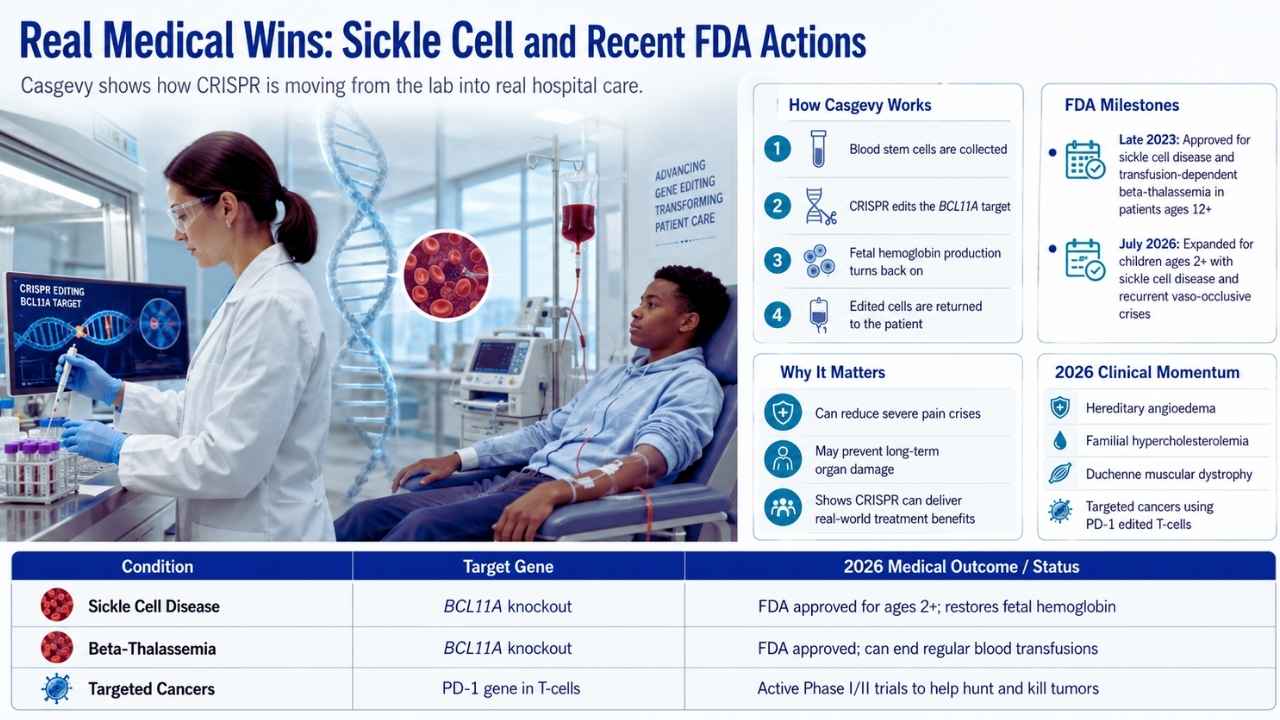 We aren’t just testing CRISPR on Petri dishes anymore. Real people are walking around today completely cured of genetic conditions that used to ruin lives. The biggest story right now is Casgevy (exagamglogene autotemcel), a treatment developed by Vertex Pharmaceuticals and CRISPR Therapeutics. It is a practical, life-changing example of how CRISPR gene editing works in hospital wards.
In late 2023, regulators approved Casgevy to treat sickle cell disease (SCD) and transfusion-dependent beta-thalassemia for patients 12 and older. The treatment extracts blood stem cells, uses CRISPR to cut the BCL11A gene, and turns back on the body’s production of healthy fetal hemoglobin. Recent data is even more promising. In July 2026, the FDA expanded Casgevy’s approval to include children as young as 2 years old with SCD and recurrent vaso-occlusive crises. This is a massive milestone because it allows doctors to cure the disease before irreversible organ damage accumulates during childhood.
Beyond blood disorders, clinical trials in 2026 are aggressively expanding. Late-stage trials are currently testing CRISPR-based therapies for conditions like hereditary angioedema, familial hypercholesterolemia, and Duchenne muscular dystrophy. We are also seeing significant movement in oncology, where CRISPR is used to knock out the PD-1 gene in T-cells to create highly aggressive CAR-T cancer treatments.
|
Condition |
Target Gene |
2026 Medical Outcome / Status |
|
Sickle Cell Disease |
BCL11A knockout |
FDA approved for ages 2+; restores fetal hemoglobin |
|
Beta-Thalassemia |
BCL11A knockout |
FDA approved; stops the need for blood transfusions |
|
Targeted Cancers |
PD-1 gene in T-cells |
Active Phase I/II trials to hunt and kill tumors |
Exploding Market Growth for Gene Editing
Gene editing is growing into a massive global industry. Governments and biotech firms are putting billions of dollars into clinical trials, manufacturing facilities, and AI-driven genomic research. Understanding the financial trajectory is crucial for anyone following biotech trends.
In 2025, the global CRISPR gene editing market was valued at $4.76 billion. As new treatments clear FDA hurdles and agricultural applications expand, projections show the market surging to $18.89 billion by 2035, growing at a steady compound annual growth rate (CAGR) of 14.77%. Currently, North America dominates the space, holding over 41% of the global market share, largely driven by pharmaceutical hubs and government backing.
However, the Asia-Pacific region is catching up at lightning speed and is expected to grow at an even faster rate (over 15% CAGR) in the coming years. When looking at how the technology is applied, the vast majority of current commercial value lies in ex vivo therapeutics (editing cells outside the body), though in vivo therapies (injecting CRISPR directly into the patient) are predicted to be the fastest-growing segment through 2030.
|
Market Metric |
2025/2026 Data |
2035 Outlook |
|
Global Market Value |
$4.76 Billion (2025) |
$18.89 Billion |
|
Top Region |
North America (41%+) |
Asia-Pacific (Fastest Growth) |
|
Main Modality |
Ex Vivo (53% of total) |
In Vivo (Fastest Growth) |
Agricultural and Environmental Breakthroughs in 2026
While medicine steals the headlines, agriculture is where CRISPR will impact the most people on a day-to-day basis. The global CRISPR in agriculture market is projected to reach $3.26 billion by 2030, driven by the urgent need to feed a population of 10 billion by mid-century amidst severe climate change.
Traditional plant breeding takes decades, but CRISPR allows scientists to adjust a crop’s native DNA in a single generation without splicing in foreign bacterial genes. In 2026, we are seeing the rise of “CRISPR 2.0” or Prime Editing, which enables precise search-and-replace edits without cutting the DNA strand. This is being used to engineer crops that can survive 45°C heatwaves without losing nutritional value.
Biotech is also tackling climate change directly. Researchers are using CRISPR to redesign root systems in soy and corn, promoting deeper roots and increased carbon storage to turn farmland into carbon sinks. Additionally, AI-driven precision breeding is accelerating the domestication of wild plants, turning previously unfarmable, pest-resistant wild groundcherries into viable, large-fruit crops suited for mechanical harvesting.
|
Agricultural Focus |
2026 Breakthrough |
Direct Benefit |
|
Climate Resilience |
Prime edited heat-tolerant crops |
Survives extreme heatwaves while maintaining nutrition |
|
Carbon Sequestration |
Deep-root soy and corn |
Turns farmland into a carbon sink via increased suberin |
|
Wild Domestication |
Optimizing wild groundcherry |
Creates new, naturally pest-resistant staple crops |
The Ethical Red Lines We Can’t Ignore
Rewriting the genetic code comes with heavy responsibilities. The medical world divides gene editing into two very different categories: somatic editing and germline editing, and the distinction between the two forms the foundation of modern bioethics.
Somatic editing changes the non-reproductive cells of an adult or child. The changes stay inside that single patient’s body and disappear when they die. FDA-approved treatments like Casgevy are somatic edits, and they are generally celebrated as medical miracles.
Germline editing, however, changes the DNA inside eggs, sperm, or early embryos. These edits are permanent and will be passed down to children, grandchildren, and every generation that follows. In 2018, a researcher in China used CRISPR on human embryos that grew into twin girls, trying to make them immune to HIV. The global scientific community universally condemned the move. The risk of “off-target cuts”—where the CRISPR tools make unintended edits elsewhere in the genome—is still far too high to risk permanently altering the human gene pool.
Read Also: How Does the Human Immune System Work?
|
Editing Type |
Cells Targeted |
Inherited by Children? |
|
Somatic Editing |
Adult tissue (bone marrow, liver, muscle) |
No |
|
Germline Editing |
Eggs, sperm, or early embryos |
Yes (Permanent line change) |
Final Thoughts
We have entered a brand-new era in human history. We no longer have to live with every genetic error we inherit at birth. Understanding how CRISPR gene editing works gives us a front-row seat to one of the biggest scientific jumps since the discovery of antibiotics.
We have functional cures for blood disorders in hospital clinics for patients as young as two and climate-resilient crops growing in stressed fields today. As therapies become cheaper, delivery systems improve, and the market pushes toward $18 billion, our biggest challenge won’t be figuring out how to edit DNA—it will be deciding where to draw the ethical lines.
Frequently Asked Questions (FAQs) About How CRISPR Gene Editing Works
What is Prime Editing and how does it upgrade standard CRISPR?
Standard CRISPR acts like scissors, cutting through both strands of DNA and relying on the cell to patch the gap. Prime editing (often called CRISPR 2.0) uses a modified version of Cas9 that only nicks one strand of DNA, paired with an enzyme that writes new genetic letters directly into the target spot. It is gentler on cells, highly precise, and heavily utilized in new agricultural advancements for 2026.
Can CRISPR accidentally cut the wrong part of my DNA?
It can happen, and scientists call it an “off-target cut.” It occurs when the guide RNA lands on a sequence that looks almost identical to its target. Scientists now use heavily modified versions of Cas9 and RNA structures that require a 100% exact match before making a cut, vastly reducing these mistakes in modern clinical trials.
Does a CRISPR treatment stay in your blood forever?
No. The guide RNA and Cas9 protein degrade and disappear within a few days after entering your cells. Only the structural change made to your DNA remains behind.
Is gene editing the same thing as a GMO?
Not always. Traditional GMOs often combine DNA from completely different species (like putting a bacterial gene into corn). CRISPR usually edits or turns off genes that are already naturally present inside the plant’s own genome, making it much closer to accelerated natural breeding.
Are there FDA-approved CRISPR treatments for young children?
Yes. As of July 2026, the FDA expanded the approval of Casgevy (exagamglogene autotemcel) to include children as young as 2 years old suffering from sickle cell disease and recurrent vaso-occlusive crises.