


Ever wonder why some people seem to pick up a new language in a few months while others struggle for years? It usually has nothing to do with raw intelligence or natural talent. Instead, the difference lies entirely in their approach to processing information. Many of us still rely on outdated study habits we picked up in grade school.
We reread textbooks, highlight text endlessly, and try to force information into our brains through sheer willpower. But science tells us these methods barely scratch the surface of our true cognitive potential. If you want to keep pace with a rapidly changing job market or just pick up a new hobby over the weekend, you need to rethink your approach. That is exactly where accelerated learning techniques come into play.
By aligning your study habits with the way your brain naturally wires itself, you can shave months off your learning curve. This guide walks you through exactly how to bypass the frustration of being a beginner and master new skills faster than you ever thought possible.
The Science of Neuroplasticity and Skill Acquisition
Understanding what happens inside your head when you learn something new is the first step toward getting better at it. Your brain is essentially a massive network of interconnected pathways that constantly change shape based on your daily actions. When you grasp how these physical changes happen, you stop fighting against your natural biology and start working with it.
How Your Brain Builds Neural Pathways?
Understanding how your brain builds neural pathways is the absolute foundation of mastering anything quickly. When you first attempt a novel activity, like playing a new sport, speaking a foreign language, or writing code, your brain relies on a massive amount of conscious effort. Your neurons fire wildly as you try to coordinate your movements or remember fresh vocabulary words.
However, as you repeat the correct actions with deep focus, your brain begins to insulate these specific neural pathways with a fatty substance called myelin. This myelin coating acts exactly like the rubber insulation on an electrical wire, preventing signal loss and speeding up the transmission of information between your brain cells. Over time, this physical change transforms a clumsy, difficult action into a smooth, automatic habit. The secret to speeding up this process is intense focus. Mindless repetition does not trigger myelin production. You have to stay completely engaged with the material to force your nervous system to adapt and upgrade its physical structure.
|
Biological Component |
Function During Skill Acquisition |
How to Optimize It |
|
Neurons |
Fire to transmit information and coordinate new actions |
Introduce novel challenges to force new firing patterns |
|
Myelin Sheath |
Insulates neural pathways to speed up signal transmission |
Engage in highly focused, deliberate practice sessions |
|
Synapses |
Connect neurons to form functional memory networks |
Use active recall testing to strengthen connections |
|
Prefrontal Cortex |
Manages conscious effort during the beginner phase |
Minimize external distractions to reduce cognitive load |
The Reconsolidation Process
Learning is never a one-and-done event where you simply deposit information into a mental bank account for safe keeping. Modern cognitive science shows that memories and physical skills are actually highly unstable. Every time you recall a piece of information or practice a physical movement, your brain temporarily brings that memory out of deep storage. While it is out, the memory becomes moldable and open to editing. This biological mechanism is known as the reconsolidation process.
If you practice a bad habit, you will accidentally reinforce that mistake during reconsolidation, cementing it further into your brain. However, if you actively look for ways to improve the movement while the memory is moldable, you can rewrite the neural code to be far more efficient. Researchers studying motor skills have found that slightly tweaking how you perform a task during a second practice session forces the brain to adapt faster than if you just did the exact same thing again. Embrace this malleability by constantly introducing small variations into your daily practice routine.
|
Memory Phase |
Brain State |
Practical Application |
|
Encoding |
Processing new information for the first time |
Connect new facts to things you already understand |
|
Storage |
Maintaining the information over time |
Rely on healthy sleep cycles to move data into long-term storage |
|
Retrieval |
Bringing the memory back into conscious thought |
Test yourself frequently without looking at your notes |
|
Reconsolidation |
Updating the memory before it goes back to storage |
Intentionally fix minor mistakes while reviewing older material |
Core Accelerated Learning Techniques
To cut your practice time in half, you need specific strategies that force your brain to work harder during the time you actually spend studying. The best accelerated learning techniques completely abandon the idea of passive reading or mindless drilling, focusing instead on efficiency and active engagement.
The Divide and Conquer Approach
Most beginners get completely overwhelmed because they look at the massive end goal instead of the individual steps required to get there. You cannot sit down and just learn a new language in a weekend. You have to learn basic vocabulary, sentence structure, pronunciation, and listening comprehension separately. The divide and conquer approach, often called microlearning, involves breaking a massive skill down into its absolute smallest components.
Once you chop the skill into tiny pieces, you isolate the most important ones and practice them strictly one at a time. By isolating these micro-skills, you prevent cognitive overload and give your brain a chance to digest one small cue without panicking. For instance, if you want to learn tennis, do not just go out and hit balls randomly on the court. Spend your first session exclusively mastering the grip, and spend the next session only looking at your footwork. You build a rock-solid foundation incredibly fast by mastering the small pieces before stringing them all together.
|
Macro Skill |
Micro-Skill Breakdown |
Practice Strategy |
|
Learning Spanish |
Top 100 most common verbs |
Flashcards focusing only on present tense conjugation |
|
Playing Guitar |
Basic open chords (G, C, D) |
Practice transitioning between just two chords for ten minutes |
|
Writing Code |
Basic syntax and variables |
Build a simple calculator without worrying about advanced logic |
|
Public Speaking |
Controlling hand gestures |
Record a video of yourself speaking and focus solely on your hands |
Interleaving and Spaced Repetition
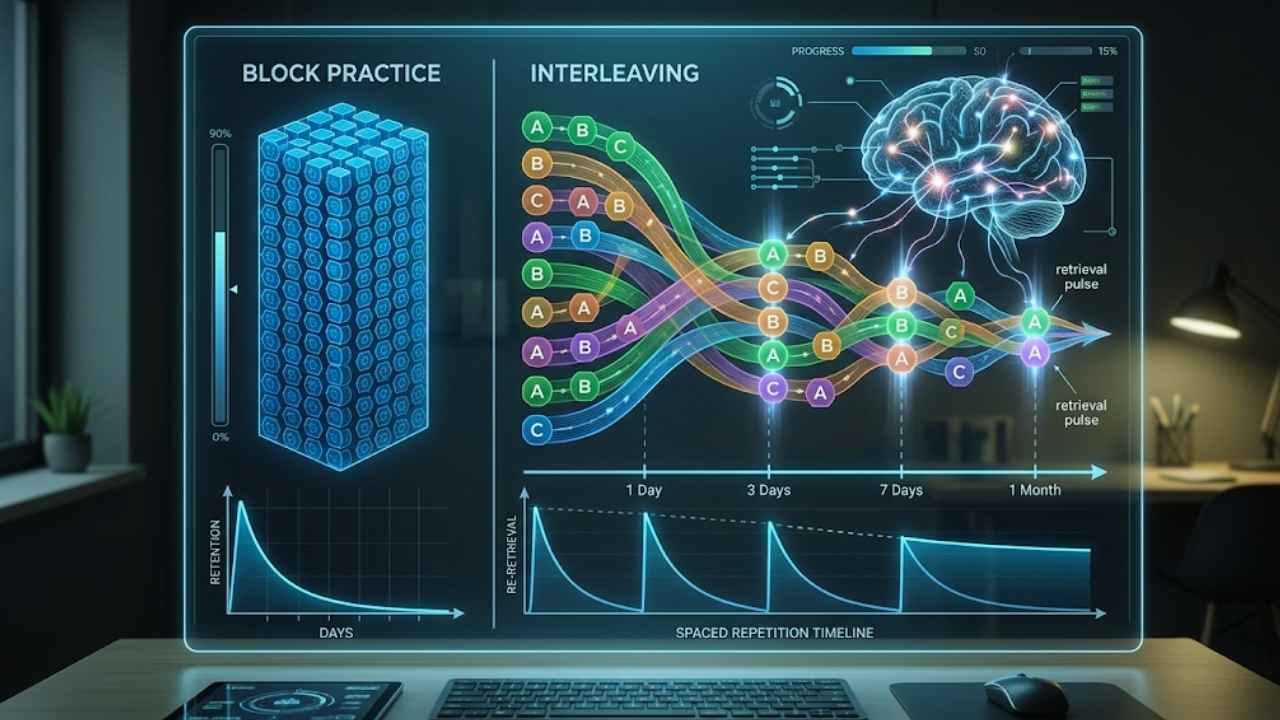
Once you have broken your skill down into small chunks, you have to schedule your practice effectively. Most people use block practice, which means they spend three straight hours studying a single concept until they feel they have mastered it. Science shows this is actually terribly inefficient because you will likely forget most of it by the next day. Instead, you should use interleaving, which means mixing multiple related subjects together in a single, dynamic session.
If you are studying math, do not just solve twenty addition problems and then twenty subtraction problems. Mix them up randomly so your brain has to constantly identify which strategy to use. Combine this with spaced repetition for maximum impact. Spaced repetition involves reviewing material at gradually increasing intervals over time. You might review a new concept after one day, then three days, then a week. Just as you are about to forget the information, you force your brain to retrieve it, sending a massive signal to your nervous system that this data is permanent.
|
Study Method |
Description |
Best Use Case |
|
Block Practice |
Focusing heavily on one single topic |
Initial introduction to a completely brand new concept |
|
Interleaving |
Mixing multiple related topics in one session |
Preparing for comprehensive exams or real-world problem solving |
|
Spaced Repetition |
Reviewing material at increasing time intervals |
Memorizing vast amounts of vocabulary, medical terms, or facts |
|
Cramming |
Massed practice right before a deadline |
Should be avoided entirely as it prevents long-term retention |
The Feynman Technique Explained
Richard Feynman was a Nobel Prize-winning physicist famous for his ability to explain incredibly complex scientific theories in plain, understandable English. The learning method named after him is arguably the most powerful way to test if you actually understand something or if you just memorized the words on the page. “The first principle is that you must not fool yourself, and you are the easiest person to fool.” Richard Feynman. The process is remarkably simple.
Take a blank sheet of paper and write the name of the concept at the top. Then, write out an explanation of the concept as if you were teaching it to a sixth grader. You are not allowed to use any industry jargon or complex vocabulary. If you stumble, hesitate, or realize your explanation makes no sense, you have just found a hole in your knowledge. Go back to your source material, figure out what you missed, and try to write the explanation again. Teaching the material forces your brain to reorganize the information logically, cementing it into your memory forever.
|
Feynman Step |
Action Required |
Why It Works |
|
Step 1: Choose a Topic |
Write the concept name on a blank page |
Sets a clear, specific intention for your study session |
|
Step 2: Teach It to a Child |
Explain the idea using simple, everyday language |
Prevents you from hiding behind complicated jargon |
|
Step 3: Identify Knowledge Gaps |
Note exactly where your explanation breaks down |
Pinpoints the exact areas where you need more review |
|
Step 4: Review and Simplify |
Revisit source material and refine your explanation |
Solidifies your understanding and improves your recall speed |
Optimizing Your Environment for Deep Work
All the study hacks in the world will fail if your physical environment and daily habits destroy your focus. The human brain consumes a massive amount of caloric energy when it is building new neural pathways. You have to protect your attention from distractions to succeed.
Sleep, Rest, and Memory Consolidation
Hustle culture often glorifies staying up all night to grind and study, but from a biological standpoint, this is the absolute worst thing you can do when trying to acquire a new skill. You do not actually learn when you are sitting at your desk or sweating in the gym. You only acquire the raw data during those waking hours. The actual learning happens when you close your eyes and go to sleep. During deep sleep, your brain replays the events of the day, strengthens the new neural connections, and sweeps away metabolic waste.
If you cut your sleep short, you literally interrupt the physical process of learning and ensure you will forget most of what you studied. Taking short naps immediately after an intense study session has also been shown to dramatically boost retention. Even while you are awake, taking frequent breaks is completely non-negotiable. Your brain runs on a cycle called the ultradian rhythm, meaning you can only maintain peak focus for about ninety minutes at most before your attention plummets.
|
Rest Strategy |
Duration |
Cognitive Benefit |
|
Ultradian Breaks |
15–20 minutes |
Resets your attention span after a 90-minute focus block |
|
Power Naps |
20–30 minutes |
Clears mental fatigue and boosts afternoon memory retention |
|
Deep Sleep (Slow Wave) |
Part of an 8-hour cycle |
Physically consolidates facts and data into long-term storage |
|
REM Sleep |
Part of an 8-hour cycle |
Connects unrelated ideas, boosting creativity and problem-solving |
Handwriting over Typing for Better Retention
Laptops and tablets make it incredibly easy to take notes quickly, but typing speed does not equal deep comprehension. Several major university studies have compared students who type their notes to those who write them out by hand. The results consistently show that handwriting wins by a landslide when it comes to understanding and remembering the material. When you type on a keyboard, you can easily transcribe what a speaker is saying word for word. You essentially turn into a human printer, typing blindly without actually processing the meaning of the sentences.
Writing by hand is physically slower, which turns out to be a massive advantage. Because you cannot possibly write down every single word, your brain is forced to actively listen, digest the information, and summarize it on the fly. This active summarization is a powerful form of learning that forces you to engage with the material immediately. Ditch the keyboard when you are trying to grasp difficult concepts, use a cheap notebook, and draw diagrams to connect your ideas.
|
Note-Taking Method |
Cognitive Processing Level |
Long-Term Retention Rate |
|
Verbatim Typing |
Very Low (Mindless transcription) |
Poor |
|
Highlighting Text |
Low (Provides a false sense of security) |
Poor |
|
Summarized Typing |
Medium (Requires some active thought) |
Average |
|
Handwriting Notes |
High (Forces active synthesis and summarization) |
Excellent |
Breaking Through Learning Plateaus
When you first start out, progress happens rapidly and feels amazing. But eventually, the beginner gains disappear, and you hit a plateau where you practice for weeks without seeing any noticeable improvement. Science provides clear strategies to jumpstart your progress and keep moving forward.
Gap Seeking and Deliberate Practice
Human beings naturally gravitate toward doing things that make them feel highly competent and successful. If you know how to play three songs on the piano perfectly, you will probably sit down and play those exact three songs every time you practice because it feels good to succeed. But playing what you already know does absolutely nothing to improve your skills. To push through a stubborn plateau, you have to adopt a mindset called gap seeking.
This means you actively hunt for the specific things that make you feel clumsy, stupid, or incredibly slow. You isolate the exact moment your performance drops and focus all your mental energy right there. This uncomfortable process is known as deliberate practice. It requires stepping slightly outside your comfort zone so that your brain is forced to adapt to the stress. If practice feels easy and relaxing, you are not learning; you are simply performing. Embrace the friction, make mistakes intentionally, and use those errors as raw data to correct your future course.
|
Practice Zone |
How It Feels |
Effect on Skill Growth |
|
Comfort Zone |
Easy, relaxed, highly confident |
Zero growth; simply maintains current skill level |
|
Learning Zone |
Uncomfortable, challenging, focused |
Maximum growth; triggers neuroplasticity and adaptation |
|
Panic Zone |
Overwhelming, highly frustrating, stressful |
Negative growth; shuts down learning due to extreme stress |
|
Deliberate Practice |
Mentally exhausting, specific, targeted |
Rapid growth; breaks through plateaus efficiently |
Modifying Your Approach
If you hit a brick wall and gap seeking is not working, your routine might simply be too rigid. Studies from top cognitive research centers revealed something fascinating about how humans acquire skills. When subjects practiced a task, took a break, and then practiced the exact same task again, they learned at a standard rate. However, when they practiced the task with a very slight modification during the second session, they learned the skill twice as fast. This happens because the brain stops paying attention when a routine becomes completely predictable.
If you want to utilize accelerated learning techniques effectively, you have to change your environment, swap out your tools, or alter your physical stance frequently. If you always study Spanish by reading a textbook at your desk, switch to listening to a Spanish podcast while walking outside. If you always practice coding on a specific software platform, try writing the code out by hand on a whiteboard. These small changes wake your nervous system back up and force it to rebuild the skill from a totally fresh angle.
|
Modification Type |
Example Action |
Why It Breaks the Plateau |
|
Environmental |
Move from a desk to a coffee shop |
Forces the brain to tune out new distractions |
|
Tool Swap |
Use a heavier tennis racket during practice |
Changes muscle recruitment patterns and builds strength |
|
Pacing |
Practice a song at half speed, then double speed |
Exposes sloppy technique hidden by standard pacing |
|
Sensory |
Try tying a complex knot with your eyes closed |
Removes visual reliance and builds intense muscle memory |
Final Thoughts
Mastering a new ability does not have to be a lifelong, frustrating grind. By stepping away from the brute force methods of rote memorization and endless drilling, you can fundamentally change how quickly you grow. The secret lies in working with your biology rather than fighting against it. When you break complex problems down into tiny pieces, test yourself constantly with the Feynman technique, and protect your sleep schedule, your brain adapts rapidly.
Implementing these accelerated learning techniques transforms the difficult beginner phase into a quick, manageable stepping stone. Whether you are pivoting to a new career, picking up a hobby, or trying to stay competitive, these science-backed strategies give you the ultimate advantage. Stop relying on the myth of natural talent, build a smarter practice routine, and watch your skills skyrocket.
Frequently Asked Questions (FAQs) About Learn New Skill Fast
Does age permanently damage my ability to acquire new skills quickly?
Not at all. While children have highly plastic brains that soak up languages and movements effortlessly, adults are perfectly capable of rapid skill acquisition. Adults actually have a massive advantage called crystallized intelligence. You already have a vast library of past experiences, mental models, and cross-disciplinary knowledge. When you learn something new, you can anchor it to things you already understand, which often makes grasping complex theories much faster for an adult than for a child.
How do I know if I am breaking a skill down into small enough chunks?
If a specific step still feels overwhelming or causes you to hesitate, it is not small enough. A chunk should be a single, manageable action that you can perform without losing your focus or feeling stressed. For example, if you are learning to drive a manual car, practicing shifting from first to second gear is a good chunk. Trying to learn how to shift, steer, and watch for traffic all at the exact same time is way too big of a chunk. Keep dividing the task until the immediate step feels incredibly simple.
Is it possible to learn multiple new skills at the exact same time?
Yes, but you have to manage your cognitive load carefully. You can absolutely learn a language and a physical sport during the same month because they draw on completely different physical and mental resources. However, trying to learn Spanish and Italian at the exact same time will likely cause massive mental interference because the languages share too many similarities. If you tackle multiple goals, ensure they are wildly different from one another to prevent your brain from crossing the wires.
How exactly do I track my progress when using these methods?
Do not track the hours you spend practicing; track the specific bottlenecks you overcome. Keep a logbook where you write down the exact mistakes you made during a session and the specific steps you took to fix them. Measuring your success by the number of problems you actively solved rather than the minutes you sat at a desk ensures you are actually making forward progress instead of just putting in time.
Does listening to music help or hurt the accelerated learning process?
It depends entirely on the type of task and the type of music. For highly analytical tasks like reading comprehension or writing complex code, music with lyrics creates a severe cognitive bottleneck because your brain tries to process the words while you work. However, for repetitive physical tasks or light data entry, instrumental music can boost dopamine and keep you engaged. Generally, silence or low-level white noise is best when using accelerated learning techniques on brand new material.