


Cue the happy dance. But right after the relief washes over you, a familiar knot forms in your stomach. You look at the number. It’s decent, sure. But you know you deserve more. Now you face the hardest five minutes of the entire job hunt: asking for that money.
Most people freeze right here. For decades, we’ve been conditioned to take the first number handed to us. We worry the company will yank the offer or label us “difficult” before our first day. Let me be blunt: staying quiet is an incredibly expensive mistake. When you skip the counteroffer, you leave thousands of dollars on the table. Over a twenty-year career, missing out on higher baseline salaries costs you serious wealth.
The good news? The culture is shifting. Recruiters report a massive 75% increase in candidates initiating salary talks this year. You don’t have to guess what to say or stumble through an awkward phone call. Having the right salary negotiation scripts 2026 ready completely removes the panic. You just need facts, good timing, and a polite tone. Let’s break down exactly how to handle your next job offer so you get the paycheck you actually earned.
Why the 2026 Job Market Demands a Counteroffer
Hiring rules have changed, and the shift heavily favors you. We now live in an era of pay transparency. Thanks to sweeping laws across the US and the European Union, companies have to show their cards.
You might think that because a company posted a salary band, the offer they hand you is a rigid, take-it-or-leave-it deal. It’s not. Hiring managers fully expect you to push back. Right now, nearly 73% of employers anticipate a counteroffer. They don’t start with their max budget. They usually pitch a number in the lower-middle of the band, leaving plenty of wiggle room for the people brave enough to ask for it.
The labor market data backs up this strategy. According to the May 2026 ADP National Employment Report, workers who stay put get a standard 4.4% yearly bump. But job-changers? They score an average increase of 6.5%. If you want to beat inflation, your highest earning potential happens right at the initial job offer stage.
Companies are also legally forced to post accurate “good faith” salary ranges. The EU Pay Transparency Directive, which goes into full effect in June 2026, demands companies report pay gaps and disclose starting pay levels up front. You have more visibility into corporate budgets today than ever before. Use it.
|
Market Factor |
How It Hits Your Offer |
Why You Should Care |
|
New Pay Laws |
The EU and US states demand accurate pay scales. |
You know their exact baseline budget before you even speak. |
|
Employer Expectations |
73% of managers expect you to negotiate. |
They bake a 10-15% buffer into their first offer. |
|
The Job-Switcher Bump |
Switchers out-earn stayers by over 2% yearly. |
Your best chance to grow your wealth is right now. |
|
High Success Rates |
78% of new hires who negotiate get a better offer. |
The odds are overwhelmingly in your favor. |
How to Find Your True Market Value Before You Talk
You can’t negotiate based on your rent, your car payment, or your upcoming wedding. Employers don’t care about your expenses. They only care about market value. If you want your salary negotiation scripts 2026 to actually work, you need hard data.
Start by digging up the numbers. Check out aggregate sites like Glassdoor, Payscale, or Levels.fyi. Filter by your exact job title and city. Then, look at active job postings in states with pay transparency laws (like New York or California) to see what competitors explicitly offer for your role.
Next, figure out your leverage. If you don’t have other offers and your skills are pretty standard, your leverage is low. Aim for a 5-8% bump. If you check every single box on their wish list, you sit at medium leverage. Push for 10-15%. But if you hold a competing written offer or work in a highly specialized field? You hold the cards. Comfortably ask for 15-20% above their initial number.
And don’t let age or experience stop you. The data shows 55% of Gen Z candidates are currently negotiating their offers, proving that even early-career workers are claiming their worth.
|
Step |
What You Do |
The Result |
|
1. Pull the Data |
Check Levels.fyi and competitor job ads. |
You get a baseline median for your exact role. |
|
2. Add Your Multipliers |
Factor in your niche skills or certifications. |
Refines the number to fit your specific resume. |
|
3. Check Your Leverage |
Assess if you have competing offers. |
Tells you if you should ask for 5%, 10%, or 20% more. |
|
4. Build the Proof |
List 3 measurable wins from your last job. |
Gives you the business justification to ask for more cash. |
Proven Salary Negotiation Scripts 2026 for Every Scenario
Knowing your target number is half the battle. Delivering the message is where most folks trip up. You want to sound like a collaborator, not a combatant.
Use these specific salary negotiation scripts 2026 to guide your chat. You can shoot these over via email, but following up with a quick phone call usually seals the deal much faster. The average negotiator walks away with an 18.8% pay raise, so these words are highly profitable.
The “Below Market” Script
Use this when the company lowballs you based on your research. It anchors your request in data, taking the pressure off you and putting it squarely on the market.
“Hi [Name], thanks so much for this offer. I’m thrilled about joining the team and tackling [Specific Project].
Before I sign, I’d love to discuss the base salary. Based on my research for this role in [City], and factoring in my background with [Specific Skill], I expected a base closer to the $[Target Number] range.
Is there flexibility to bring the base pay up to that level? I’m incredibly excited about this role and would love to lock this in today.”
The “Competing Offer” Script
Another offer is your ultimate trump card. You don’t have to name-drop the other company, but make it obvious you want this job if the math works. It creates urgency without sounding like a jerk.
“Hi [Name], thanks again for the offer. I’m super excited about the prospect of working with you all.
I want to be totally transparent: I currently have another offer on the table for $[Competing Number]. However, based on the culture and the scope of the work here, your team is my absolute first choice.
If we can match that $[Competing Number] base, I’m ready to accept and sign the paperwork immediately.”
The “Range Anchor” Script
If you lack a competing offer but want to max out their published pay band, pitch a range instead of a flat number. This works like a charm in transparency states.
“Hi [Name], I really appreciate the offer and I’m eager to dive in.
Looking at the expectations for this role, the publicly posted salary band, and the [Specific Skill] I bring, I was looking for a range between $[Lower Number] and $[Higher Number].
Can we explore options to get closer to that range? I’m fully committed to making a massive impact here.”
The “Internal Promotion” Script
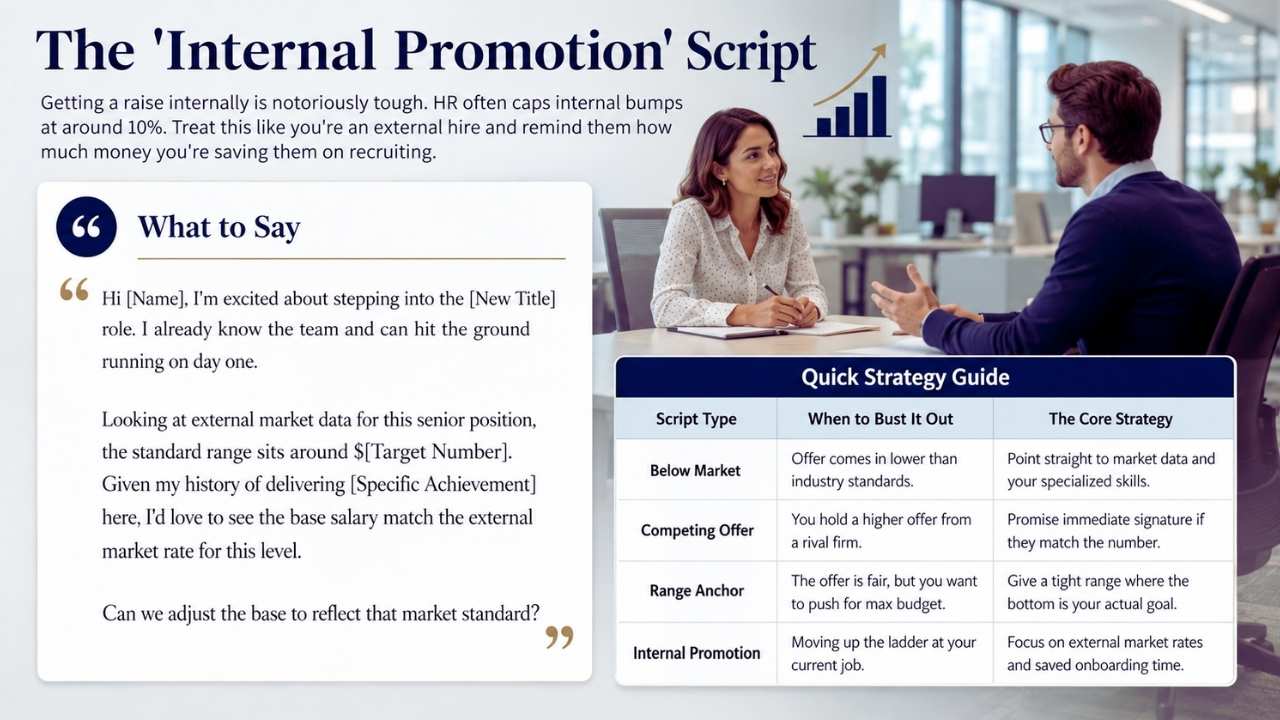
Getting a raise internally is notoriously tough. HR loves to cap internal bumps at around 10%. Treat this like you’re an external hire and remind them how much money you’re saving them on recruiting.
“Hi [Name], I’m excited about stepping into the [New Title] role. I already know the team and can hit the ground running on day one.
Looking at external market data for this senior position, the standard range sits around $[Target Number]. Given my history of delivering [Specific Achievement] here, I’d love to see the base salary match the external market rate for this level.
Can we adjust the base to reflect that market standard?”
|
Script Type |
When to Bust It Out |
The Core Strategy |
|
Below Market |
Offer comes in lower than industry standards. |
Point straight to market data and your specialized skills. |
|
Competing Offer |
You hold a higher offer from a rival firm. |
Promise immediate signature if they match the number. |
|
Range Anchor |
The offer is fair, but you want to push for max budget. |
Give a tight range where the bottom is your actual goal. |
|
Internal Promotion |
Moving up the ladder at your current job. |
Focus on external market rates and saved onboarding time. |
What to Ask For When the Base Budget is Locked
Sometimes the base salary honestly can’t budge. Maybe you applied for a government gig, a strict corporate tier, or a startup running lean on cash. Don’t just fold your hand. You still need to use your salary negotiation scripts 2026 by pivoting your focus to total compensation. Your base pay is just one piece of the pie.
If they say their hands are tied on the base, immediately ask about a signing bonus to bridge the gap for your first year. If cash is totally frozen, pivot to equity or restricted stock units (RSUs).
You can also negotiate your time. If they want you at a desk four days a week, ask for two. Another killer tactic? Ask for an accelerated performance review. Instead of waiting a full year for a standard raise, ask them to write into your contract that they will review your salary in six months if you hit specific KPIs.
Read More: How to Get Into AI and Machine Learning Careers in 2026
|
Perk |
How to Pitch It |
Why It’s Worth It |
|
Signing Bonus |
“Since base is fixed, could we do a $5k signing bonus?” |
Puts immediate cash in your pocket to bridge the gap. |
|
Equity / RSUs |
“Can we offset the base gap with some extra equity?” |
Huge upside if the company scales up. |
|
Accelerated Review |
“Let’s review base pay in 6 months tied to KPIs.” |
Gets you to your target salary faster than the annual cycle. |
|
Extra PTO |
“Could we add an extra week of paid leave?” |
Boosts your work-life balance and your actual hourly rate. |
How to Handle Employer Pushback Like a Pro
Even great communicators hit a wall sometimes. When you ask for more money, the employer will probably toss out a standard corporate deflection. Managers literally use “concession tracking” during these talks—they are trained to handle your requests and trade things back and forth.
Stay cool, listen to what they’re actually saying, and pivot.
If they hit you with “This is our best and final offer,” you’ve found the ceiling. Don’t argue. Just say, “I completely understand the budget constraints. Given that, could we look at a signing bonus or an extra remote day to bridge the gap?”
If they say your number is “outside our pay band for this level,” you’ve hit a structural HR rule. The easiest fix? Ask for a title bump. Try: “If the budget for a marketing manager caps at $85k, what do we need to do to reclassify this as a senior marketing manager to align with my $95k target?”
Above all, never apologize for asking. Keep your tone warm but firm. You’re a professional ironing out the details of a business contract. Treat it that way.
|
What They Say |
What It Actually Means |
How You Pivot |
|
“This is our best and final offer.” |
Base salary is officially locked. |
Pivot instantly to signing bonuses, equity, or PTO. |
|
“It’s outside our pay band.” |
HR tier limits dictate the max number. |
Ask to upgrade the job title to unlock a higher pay band. |
|
“We don’t negotiate.” |
They want to scare you into saying yes. |
Test the waters by asking for a 6-month performance review. |
|
“Let me check with finance.” |
You won. They just need to get budget approval. |
Say “Thanks, I look forward to hearing back,” and wait. |
Final Thoughts
Speaking up for yourself at the offer stage is the highest-return activity you will ever do in your career. Sure, it feels uncomfortable for a few minutes. But the financial security you gain lasts for years, and it compounds every time you get a raise.
Don’t let nerves dictate your earning potential. Do your homework, figure out your leverage, and pick your approach. By leaning on these salary negotiation scripts 2026, you strip the emotion out of the process and replace it with pure strategy. You proved you were the right hire during the interview. Now, make sure your paycheck reflects it. Take a breath, stay professional, and never accept the first number without having a conversation.
Frequently Asked Questions (FAQs) About Pay Negotiations
The job market changes fast, and old-school advice doesn’t always hold up. Based on what we’re seeing in 2026, here is the real talk on the weird, specific questions you might face at the offer table.
Can asking for more money make an employer pull the offer?
This is the ultimate candidate fear, but it’s basically a myth. Nearly 46% of job seekers skip negotiations out of fear, yet companies rarely yank offers just because you asked for 10% more. They spent weeks interviewing you; they want you to start. Offers only get pulled if you act incredibly unprofessionally or demand numbers 50% above market rate without any proof.
Do companies really negotiate entry-level jobs?
Yes. In 2026, 53% of employers say they will negotiate entry-level salaries. Too many recent grads assume they have to take whatever they get, leaving thousands behind. Even if the base pay won’t move, you can easily ask for relocation cash or a small signing bonus.
How do remote workers handle global pay transparency laws?
If you live in a cheap city but work for a tech giant in San Francisco, do not let them pay you based purely on your zip code. Argue based on the value of your output. Push for a global base rate or a hybrid scale that respects both their standard pay band and the work you actually do.