

Ever notice how two rival gas stations always price their fuel exactly the same? Or why you constantly second-guess your commute route during rush hour, wondering what every other driver plans to do? You are already thinking like a game theorist.
If you want to know what is game theory, do not worry about dusting off an old calculus textbook. At its core, it is simply the science of strategy. It looks at how people, businesses, and even algorithms make decisions when the outcome depends entirely on the choices others make. You rarely make a choice in a vacuum. Instead, you constantly anticipate the moves of your competitors, partners, or peers.
Mathematician John von Neumann and economist Oskar Morgenstern kicked off this whole field in the 1940s. They mostly used it to figure out Cold War nuclear standoffs. Fast forward to today, and you will find these same principles everywhere. They dictate global climate treaties, how you negotiate a starting salary, and even how bots price those sneakers sitting in your online shopping cart. Let’s strip away the academic jargon. We are going to break down the actual mechanics of strategic thinking, look at some classic puzzles, and see how you can use this framework to make better choices every day.
The Core Elements: Players, Strategies, and Payoffs
Identifying the Players in the Game
Every time your success depends on someone else’s move, you step onto a game board. But to actually use this framework, we need to identify who is playing. The players are simply the decision-makers involved in the scenario. They could be individuals, like you and a car salesman haggling over a price.
They could be massive tech giants like Apple and Samsung fighting over smartphone market share. Today, players aren’t even always human. Pricing algorithms and AI bots now act as players in e-commerce, making thousands of micro-decisions a minute. You have to know exactly who you are up against before you make your first move.
Crafting Winning Strategies and Counter-Moves
A strategy isn’t just a single isolated move. It is your complete, overarching action plan. It covers what you will do in every possible situation that might pop up. Think of it like a massive decision tree. If a rival brand drops its prices, what is your exact counter-move?
Do you match the discount, or do you increase your marketing budget to highlight your premium quality? In the software world, if a competitor releases a new feature, you need a plan to either build something better or pivot your entire marketing message. A true strategy accounts for all the “if-then” scenarios before the game even begins.
Calculating Payoffs and Managing Information
The payoff is your final reward or consequence at the end of the interaction. In business, we usually measure this in profit, customer retention, or market share. In daily life, your payoff might just be getting home ten minutes earlier. The whole model assumes players act rationally, meaning you will always pick the strategy that gives you the biggest payoff based on what you know.
This brings us to the information set. What do you actually know before you act? If you know your competitor’s wholesale costs, you have a massive advantage. The player with the best information usually secures the highest payoff.
|
Core Element |
What It Actually Means |
Real-World Example |
|
Players |
The people or entities making decisions. |
Two competing coffee shops on the same block. |
|
Strategy |
Your complete action plan. |
Running a discount to steal foot traffic. |
|
Payoffs |
The final reward or penalty. |
Boosting your daily revenue or losing cash. |
|
Information Set |
What you know before deciding. |
Finding out your rival’s wholesale bean costs. |
The Famous Prisoner’s Dilemma
The Classic Police Interrogation Setup
If you want to truly understand what is game theory, you have to look at the Prisoner’s Dilemma. It shows exactly why two completely rational people might refuse to cooperate, even when teamwork helps them both. Imagine you and a buddy get arrested for a crime. The cops toss you into separate interrogation rooms where you cannot talk to each other.
The prosecutor walks in and offers you both the exact same deal. If you both keep your mouths shut, you both get just one year in jail. If you rat out your buddy while he stays silent, you walk free and he gets ten years. If you both confess and rat each other out, you both get five years.
The Dominant Strategy of Betrayal
From a team perspective, staying silent is an absolute no-brainer. That is only two total years of jail time between the two of you. But look at it selfishly. If your buddy stays quiet, ratting him out gets you zero years instead of one. If your buddy betrays you, ratting him back gets you five years instead of ten.
No matter what he does, your absolute best move is to confess. We call this a “dominant strategy.” Because you both think this exact same way, you both confess. You both get five years. You end up with a terrible outcome just because you couldn’t trust each other.
Real-World Example: Climate Treaties and EV Adoption
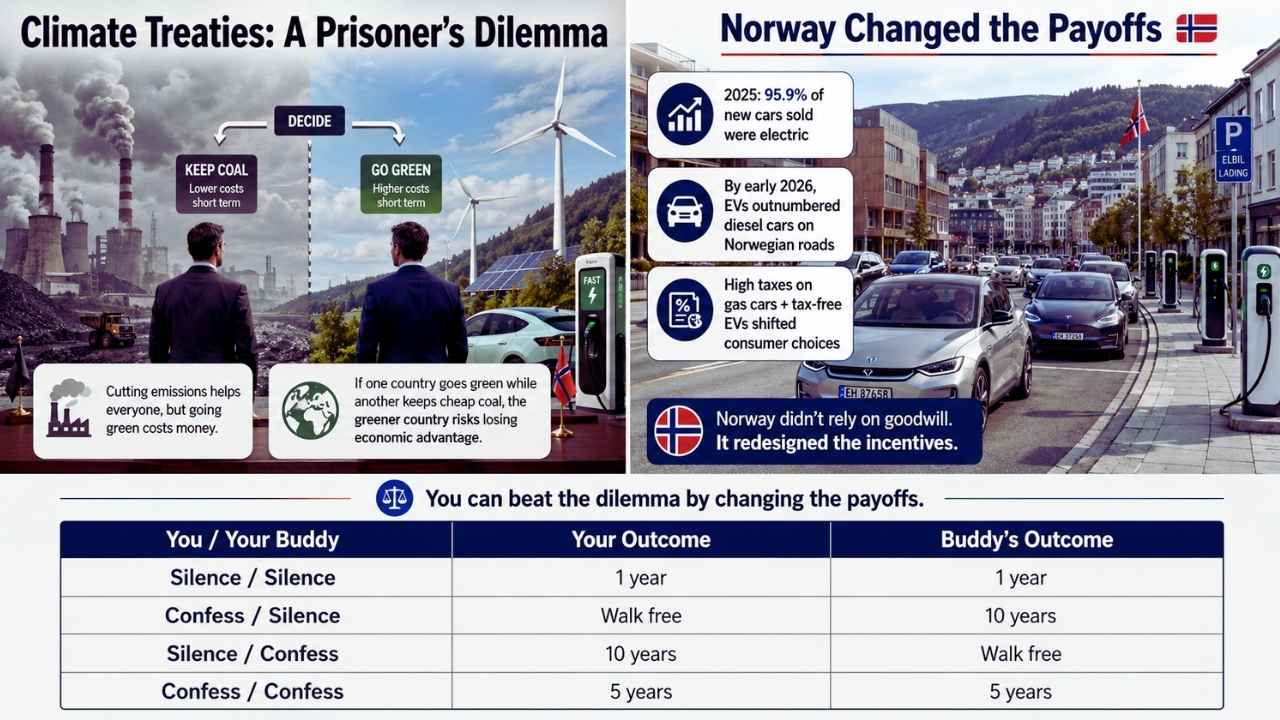
This dilemma perfectly explains global climate treaties. Countries know cutting emissions helps the whole planet, but going green costs money. If one country cuts emissions while the other builds cheap coal plants, the green country loses economic power. So, nobody cooperates. However, you can beat the dilemma by changing the payoffs.
Look at Norway’s electric vehicle market. By late 2025, a massive 96 percent of all new cars sold in Norway were electric, and by early 2026, EVs officially outnumbered diesel cars on the road. Norway didn’t just ask people to be nice to the environment. They changed the payoff matrix by slapping massive taxes on gas cars while making EVs tax-free. They mathematically forced cooperation.
|
The Scenario (You / Your Buddy) |
Your Outcome |
Buddy’s Outcome |
|
Silence / Silence |
1 year |
1 year |
|
Confess / Silence |
Walk free |
10 years |
|
Silence / Confess |
10 years |
Walk free |
|
Confess / Confess |
5 years |
5 years |
Types of Games We Play Daily
Cooperative vs. Non-Cooperative Games
In a cooperative game, you can sit down at a table and sign a binding contract. Think of two tech brands teaming up to share research costs and split the profits. Everyone wins because a legal contract literally forces them to play nice. Non-cooperative games are the exact opposite.
You have no binding contracts, and everyone is strictly out for themselves. When two airlines slash ticket prices to steal your business, they are stuck in a non-cooperative death spiral. They would love to stop discounting tickets, but whoever stops first loses all their passengers.
Zero-Sum vs. Non-Zero-Sum Outcomes
Poker is the ultimate zero-sum game. If I win ten bucks, you lose ten bucks. The total cash on the table never changes; it just moves around. Real life, however, usually plays out as a non-zero-sum game. The total pie can actually grow or shrink based on how people act.
When countries sign free-trade deals, both economies get richer simultaneously. On the flip side, during a massive labor strike, both the workers and the factory lose money together. The outcome isn’t just about winning; it is about maximizing the total value available.
Simultaneous vs. Sequential Decisions
Rock-Paper-Scissors is a simultaneous game. You have to guess what the other person will do without seeing their hand first. Blind real estate auctions work exactly like this, forcing buyers to bid their absolute maximum right out of the gate.
Chess, however, is sequential. You move, I watch, and then I react. Modern business works this way too. Apple drops a new iPhone, Samsung checks out the specific hardware and the price tag, and then they adjust their new Galaxy phone strategy before launching it to the public.
|
Game Type |
The Main Rule |
Everyday Example |
|
Cooperative |
Binding agreements help everyone win. |
Joint business ventures or climate treaties. |
|
Non-Cooperative |
Pure self-interest drives the action. |
Price wars or dirty political campaigns. |
|
Zero-Sum |
My exact gain is your exact loss. |
Poker nights or cutting a single pizza. |
|
Sequential |
Players take turns and watch each other. |
Chess or negotiating a house price. |
Real-World Rules: Traffic, Salaries, and Business Growth
Salary Negotiations and Information Asymmetry
When you sit down to negotiate job pay, you hold completely different cards than the hiring manager. They know their exact budget limit, while you know your absolute walk-away number. Your entire goal is to prove your value without looking desperate for the cash. A smart strategist will tell you to anchor the negotiation.
Let the employer throw out the first number. By doing this, you force them to show a major part of their hidden information set. If they offer a number higher than you expected, you instantly adjust your entire strategy upward.
B2B SaaS Pricing Models and Agentic AI
If you run a software company, you play these games constantly. Software as a Service (SaaS) businesses spent 2025 and 2026 battling over pricing structures. The global SaaS market exploded toward 375 billion dollars, and companies radically shifted how they package their tools. Instead of charging per user, many shifted to usage-based pricing or deployed AI agents to automate tasks directly.
If a rival SaaS platform starts offering an AI-native interface that cuts coding time by 80 percent, you cannot just lower your price. You have to launch a superior feature or risk losing your entire user base. It is a high-stakes sequential game of constant innovation.
Traffic Jams and the Tragedy of the Commons
Traffic jams are a perfect, frustrating example of the “tragedy of the commons.” We all want to get home fast. So, we all check our GPS apps and take that sneaky side-street shortcut through a quiet neighborhood. Because everyone takes the exact same shortcut, the narrow road completely clogs up, and nobody gets home any faster.
The purely selfish choice ruins the collective outcome. Urban planners even study Braess’s Paradox, a mathematical proof showing that building a brand new road can actually make city traffic significantly worse, because drivers flock to it and create a massive new bottleneck.
|
Strategic Field |
How You Actually Use It |
A Real-World Example |
|
Career Moves |
Gaining leverage in an interview. |
Letting the boss name the salary figure first. |
|
Business Strategy |
Predicting competitor reactions. |
Setting B2B SaaS pricing to outsmart rivals. |
|
City Traffic |
Managing public roads. |
Adding a new lane that makes traffic worse. |
|
Retail Wars |
Capturing physical market share. |
Burger King opening across from McDonald’s. |
AI Algorithms and Modern E-Commerce
Dynamic Pricing and Reinforcement Learning
When trying to figure out what is game theory in the modern age, look at artificial intelligence. As we buy more stuff online, human beings aren’t sitting at desks setting prices manually anymore. Artificial intelligence does it. Bots on major platforms constantly monitor consumer demand, stock levels, and competitor prices.
They adjust the price tag on a pair of shoes thousands of times a day. These algorithms use reinforcement learning, constantly testing to see how much you are willing to pay right at this exact moment. This is why you pay triple the normal rate for a rideshare app when it suddenly starts raining. The machine knows your options are limited.
The Rise of Algorithmic Collusion in 2026
Lately, regulators are freaking out about a concept called algorithmic collusion. When two pricing bots compete for a while, they learn that starting a price war destroys profits. Without any human telling them to do it, they learn to keep prices artificially high. If one bot drops a price, the other instantly matches it to punish the first bot.
Studies from early 2026 show that platform recommendation algorithms actually reward these high prices by keeping expensive products visible. The threat got so bad that California passed a groundbreaking law, effective January 2026, officially banning the use of shared pricing algorithms to limit competition.
|
AI Pricing Concept |
What It Actually Does |
Why You Should Care |
|
Dynamic Pricing |
Changes prices based on real-time demand. |
You pay triple for a ride when it rains. |
|
Algorithmic Collusion |
Bots secretly learn to keep prices high. |
You pay more for basic retail items online. |
|
Tit-for-Tat |
Instantly punishing a rival bot for a discount. |
Kills price wars before you get a deal. |
|
The Legal Mess |
Price-fixing without human meetings. |
Governments struggle to regulate AI behavior. |
What Is the Nash Equilibrium?
Finding Stability Without Communication
You cannot talk about what is game theory without mentioning John Nash, the mathematician whose life inspired the movie A Beautiful Mind. He gave us the Nash Equilibrium. Simply put, this happens when nobody wants to change their strategy, assuming everyone else keeps doing what they are doing.
The game finally stabilizes. Think about a four-way stop sign. Two cars pull up at the exact same time. The equilibrium hits when one driver waves the other through. If you both hit the gas, you crash. If you both sit there, you go nowhere. We rely on this equilibrium to keep daily life moving smoothly.
The Ultimatum Game and Human Emotion
But humans aren’t robots. We care deeply about pride and fairness, which completely messes up the pure math. Look at the famous Ultimatum Game. I give you one hundred dollars and tell you to split it with a stranger. If the stranger accepts your split, you both keep the cash. If they say no, nobody gets anything.
Pure math says you should offer them a single dollar. They should logically take it, because one dollar is better than zero dollars. But in real life? People will aggressively reject a 90-10 split just to spite you. They will happily burn free money to punish you for acting greedy.
|
The Concept |
What It Means in Plain English |
How Humans Actually Act |
|
Nash Equilibrium |
The point where nobody changes moves. |
We naturally fall into stable daily routines. |
|
Dominant Strategy |
Your best move, no matter what they do. |
Often causes us to screw each other over. |
|
Ultimatum Game |
Splitting cash with a stranger’s veto power. |
We happily lose money to punish a jerk. |
|
Bounded Rationality |
Our brains can only handle so much math. |
We use gut feelings instead of pure logic. |
Final Thoughts
Figuring out exactly what is game theory gives you a massive cheat code for human behavior. It clearly explains why politicians argue all day, why massive airlines exactly match each other’s prices, and why we deeply struggle to team up even when we know we absolutely should.
Once you spot the players, figure out their specific strategies, and look at their real payoffs, you stop reacting blindly. You start predicting. Whether you are stuck in gridlock traffic, setting up software pricing, or just arguing over where to grab dinner with your friends, realizing you are on a game board is the very first step to winning.
Frequently Asked Questions (FAQs) About What is Game Theory
Does this framework apply to animal behavior?
Yes, absolutely. Biologists use these exact models to figure out why animals do what they do. Why don’t two massive male deer just fight to the death over a mate? Because they naturally play a game of chicken. They lock antlers to show off their size and strength, but they rarely fight until someone dies. The biological payoff of surviving to mate again next year is way better than the risk of dying today. Evolution naturally favors a peaceful equilibrium where posturing replaces fatal violence.
What happens if you play the same game twice?
Everything changes when you add a future to the game. If you only play the Prisoner’s Dilemma once, you usually betray your partner because there are no future consequences. But if you play the exact same game with that person a hundred times in a row, you quickly learn to cooperate. You realize that if you cheat today, they will aggressively punish you tomorrow. This shadow of the future is exactly why your local coffee shop treats you well. They want your repeat business, so they play a cooperative long game.
Do you need advanced math skills to use this?
Not at all. Sure, university academics use crazy algorithms and complex equations to publish research papers. But for you and me? It is just about practicing basic empathy and logic. If you can put yourself in someone else’s shoes, anticipate their goals, and think two steps ahead, you are already using the framework perfectly. You do not need a degree in economics to leverage these strategies during a salary negotiation or a business pitch.
What exactly is expected utility?
Expected utility is just a quick mental formula to weigh risk when you aren’t sure what the final outcome will be. If you have a fifty percent chance of making a hundred bucks, and a fifty percent chance of making zero, your expected utility is exactly fifty dollars. You multiply the potential payoff by the probability of it happening. Decision-makers use this logic all the time when deciding if a new job offer is worth the risk of leaving their comfortable, steady gig.