


Ever check your bank account on the 30th and feel a mild wave of panic? I get it. A few quick coffee runs, a couple of targeted Instagram ads, and one treat-yourself dinner can easily wipe out your extra cash. If you want a genuine financial hard reset, tackling a no spend month challenge is exactly what you need.
It forces you to hit pause, look hard at your daily habits, and stop the financial bleeding. Think of it as a financial detox. For 30 days, you only buy absolute necessities. You cover rent, bills, groceries, and gas. That is it. It sounds brutal, but it’s the fastest way I know to break bad habits, spot your spending leaks, and aggressively pad your savings. Let’s break down how to pull this off without making yourself miserable, the psychology behind why it works, and how to dodge the traps that ruin your progress.
What Actually Makes a No Spend Month Challenge Work?
You can’t win a game if you don’t know the rules. A financial fast falls apart the second your boundaries get blurry. Before day one, you have to define exactly what counts as a need versus a want. Needs keep you alive, healthy, and employed. Your housing, utilities, health insurance, and basic groceries are non-negotiable. You also have to keep paying minimums on your debts so you don’t wreck your credit score. Wants make life comfortable, but you can live without them for a month.
Current 2026 data shows the average consumer carries over $6,500 in credit card debt. A lot of that stems from quick, thoughtless purchases. Write your rules down and stick them on your fridge. If you leave grey areas, you’ll exploit them when your willpower tanks. Be ruthless, but stay realistic. Extreme deprivation just leads to binge spending, so keep basic, healthy food in your budget.
|
Expense Category |
Challenge Status |
Real-World Examples |
|
Housing & Utilities |
Allowed |
Rent, electricity, water, basic internet |
|
Debt Obligations |
Allowed |
Credit card minimums, student loans, car notes |
|
Basic Groceries |
Allowed |
Rice, vegetables, lean proteins, toothpaste |
|
Dining & Takeout |
Banned |
Restaurant meals, food delivery, local coffee shops |
|
Entertainment |
Banned |
Movie tickets, paid concerts, new video games |
|
Apparel & Beauty |
Banned |
Clothes, shoes, accessories, non-essential makeup |
Prep Your Finances Before the Freeze
Jumping into a spending fast blindly guarantees failure. You need a solid, actionable plan before the first of the month hits. Start by auditing your kitchen. You probably have a hundred bucks worth of food sitting in your pantry right now. I usually dig up hidden bags of frozen veggies, pasta, and canned goods tucked in the back of my cupboards. Plan your meals around what you already own. This keeps your allowed grocery budget incredibly low. Next, gut your subscriptions.
Comb through your credit card statements and pause anything that charges you monthly. Freeze the streaming services, the software you barely touch, and the gym classes you never attend. You also need to break your digital habits. Turn off auto-fill for your credit cards on your phone and laptop. Delete saved cards from retail apps. Forcing yourself to get up, find your wallet, and punch in 16 digits gives your brain just enough time to realize you don’t actually need the item.
|
Preparation Step |
Action Required Before Day 1 |
Direct Benefit |
|
The Kitchen Audit |
List current food inventory and draft a meal plan |
Slashes your necessary grocery spending |
|
Subscription Purge |
Pause all non-essential monthly recurring charges |
Frees up immediate cash flow |
|
Digital Declutter |
Delete saved cards from browsers and retail apps |
Creates high friction for online impulse buys |
|
Goal Visualization |
Write down what you’ll do with the saved cash |
Boosts motivation during weak moments |
Crush Your Spending Triggers
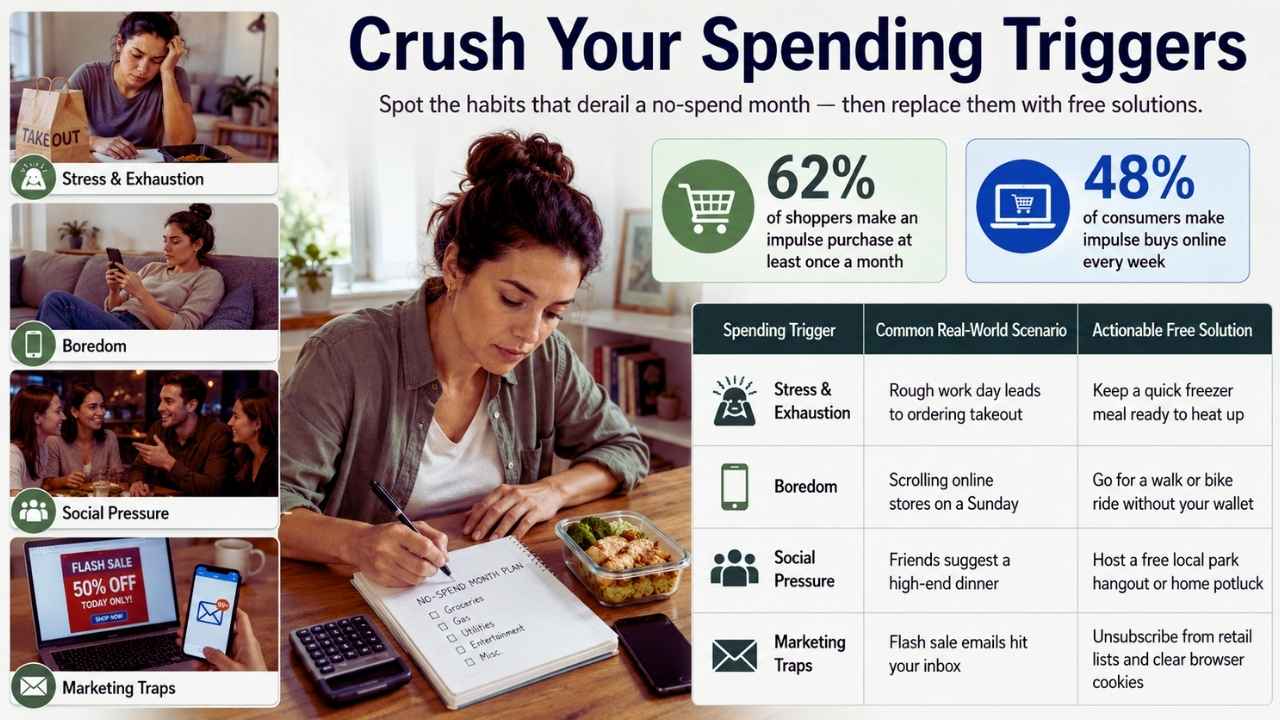
We all have psychological triggers that make us open our wallets. If you don’t spot yours early, the no spend month challenge will feel impossible. Recent 2026 retail statistics show that 62 percent of shoppers make an impulse purchase at least once a month. Furthermore, 48 percent of consumers make impulse buys online every single week. For some, stress is the primary trigger. You have a rough day at work, feel exhausted, and justify a massive takeout order because you feel you deserve it.
For others, weekend boredom leads to endless online window shopping. You need a rock-solid distraction plan. Keep a pre-made freezer meal ready for bad days. The toughest part of a financial fast is usually social pressure. Friends will invite you out for expensive dinners. You don’t have to become a total hermit, but you do need a script. Try hosting a casual potluck where everyone brings a dish made from whatever they already have at home.
|
Spending Trigger |
Common Real-World Scenario |
Actionable Free Solution |
|
Stress & Exhaustion |
Rough work day leads to ordering takeout |
Keep a quick freezer meal ready to heat up |
|
Boredom |
Scrolling online stores on a Sunday |
Go for a walk or bike ride without your wallet |
|
Social Pressure |
Friends suggest a high-end dinner |
Host a free local park hangout or home potluck |
|
Marketing Traps |
Flash sale emails hit your inbox |
Unsubscribe from retail lists and clear browser cookies |
Free Swaps for Paid Habits
Cutting your spending doesn’t mean you stop having fun. It just requires a little creativity. You’ll quickly realize how much you pay for pure convenience. Market surveys highlight that impulse purchases cost consumers about $2,000 a year, and over half of those buys cost less than $50. Your local library is your best asset right now. Beyond physical books, most modern libraries hand out free access to digital audiobooks, streaming movies, and even state park passes.
Swap your paid weekend activities for the outdoors. Hiking, biking, and walking around new neighborhoods cost absolutely zero. If you usually drop cash on boutique fitness classes, switch to free YouTube workouts. A 30-day pause on your gym membership won’t ruin your fitness, but it will save you a solid chunk of cash. Use this time to tackle free DIY projects. Organize your digital photos, clean out the garage, or learn a new language on a free app.
|
Paid Daily Habit |
Completely Free Swap |
Estimated Monthly Savings |
|
Boutique Gym |
Outdoor running and home YouTube workouts |
$50 – $150 |
|
Movie Tickets |
Library DVD rentals or free streaming tiers |
$30 – $60 |
|
Weekend Brunch |
Hosting a morning coffee date at your place |
$40 – $80 |
|
Retail Therapy |
Organizing closets, deep cleaning, or hiking |
$100 – $300 |
Track It or Trash It
You have to track your progress. If you just try to keep it all in your head, you’ll lose motivation by the second week. With the national personal saving rate hovering around a low 3.0 percent in early 2026, proactive tracking is more important than ever. Print a physical calendar and tape it right to your bathroom mirror. Every time you finish a day without spending money on a want, draw a massive red X through the box.
That visual streak gets highly addictive. I also love the wishlist method. Every time you want to buy something, write it down on a piece of paper with the exact price. At the end of the month, tally up the money you didn’t spend. Seeing that you avoided blowing $400 on random gadgets provides a huge confidence boost. Be honest with yourself. If you slip up and buy a coffee, don’t trash the whole challenge. Figure out why it happened, and start fresh tomorrow.
|
Tracking Method |
Setup Difficulty |
Best Suited For |
|
Visual Wall Calendar |
Low |
People motivated by streaks and visual cues |
|
The Wishlist Method |
Low |
Curbing impulse buys by delaying the purchase |
|
Digital Budgeting Apps |
Medium |
Tech fans who want exact real-time numbers |
|
Accountability Partner |
Low |
Extroverts who need positive social pressure |
Make That Saved Cash Work Harder
Does 30 days of sacrifice actually move the needle? Absolutely. Most people save anywhere from $300 to $1,000 during a single sprint. But don’t let that money sit idle in your checking account. Give every single dollar a job before you get tempted to waste it. If you like optimizing your money globally, park it in a high-yield account with a solid neobank. If you’re navigating Indian tax structures, funneling those savings straight into a Public Provident Fund (PPF) is incredibly smart right now.
For the July to September 2026 quarter, the PPF interest rate is holding incredibly steady at 7.1 percent. You lock in guaranteed compound interest while aggressively knocking down your taxable income under Section 80C. Whether you max out an IRA in the US or leverage tax-exempt instruments globally, the rule remains the exact same. Lock the money away where it aggressively grows.
|
Wealth Action |
Priority Level |
Direct Financial Benefit |
|
Fund Emergency Savings |
High |
Creates a cash buffer against high-interest debt |
|
Pay Off Credit Cards |
High |
Kills compounding high-interest wealth drains |
|
Max Tax-Advantaged Accounts |
Medium |
Uses compound interest for massive long-term gains |
|
Save for a Specific Asset |
Medium |
Keeps cash safe for a planned purchase like a car |
Dodge the Post-Challenge Rebound
The biggest threat to your new wealth is the splurge and purge cycle. Many people finish their 30 days feeling totally deprived. On day 31, they hit the mall or book an expensive weekend trip to celebrate. That entirely defeats the point. Financial data shows that 70 percent of consumers regret their impulse buys within a single week. If you treat a spending fast like a crash diet, you just gain all the financial weight right back. Evaluate your lifestyle the minute the challenge ends.
You probably realized you didn’t miss certain things at all. Keep those items cut from your budget permanently. Instead of sliding backward, shift your clean finances into a sustainable system like the 50/30/20 rule. Put 50 percent of your income toward necessities, 30 percent toward fun, and 20 percent into savings and investments. The challenge cleans the slate, but a real budget keeps it clean.
|
Post-Challenge Phase |
Action to Take |
Pitfall to Strictly Avoid |
|
Day 31 Celebration |
Buy one modest, pre-planned reward |
Going on an unrestricted shopping spree |
|
Habit Review |
Cancel the services you didn’t miss |
Turning all old habits back on by default |
|
System Setup |
Automate savings using the 50/30/20 rule |
Leaving excess cash easily accessible |
Final Thoughts
Crushing a no spend month challenge changes how you look at your money. It proves you have total control over your wallet, rather than letting targeted ads and impulse buys control you. By stripping away all the noise, you figure out what actually brings you value.
Whether you use the extra cash to wipe out debt, pad an emergency fund, or invest in tax-saving instruments, the discipline you build here pays off long after the 30 days are up. Take a breath, freeze the cards, and watch your accounts grow.
Frequently Asked Questions (FAQs) About No Spend Month Challenge
Does paying for a necessary repair break the rules?
No. If your car dies, your water heater bursts, or you end up in urgent care, pay the bill. A financial fast targets discretionary spending, not emergencies that keep you safe. Pull this cash from your emergency fund, not your daily checking.
What if I already bought a gift for someone before the month started?
Pre-purchased items don’t count against your active month. But if a birthday pops up that you forgot about, find a free way to celebrate. Bake a cake from scratch or offer to help them with a house project. Don’t go buy a $50 gift card.
Can I use gift cards I already own during the month?
Technically yes, but be careful. Swiping a coffee shop gift card doesn’t drain your bank account, but it keeps the daily coffee habit alive. If you want to break a routine, save the gift cards for next month.
What if I have to travel for work?
Work travel happens. If your company hands you a per diem, stick strictly to that number. If you front the money for reimbursement, buy only what you need to survive the trip. Don’t use business travel as an excuse to eat at five-star steakhouses on your own dime.