


We tap our phones and swipe our plastic for everything these days. From morning coffees to last-minute flights, using credit feels like second nature. But when that monthly statement arrives, things can get confusing fast. You look at the balance, see a random interest charge tacked onto the total, and wonder how the bank came up with that specific number.
I totally get it. The financial jargon hidden in your cardholder agreement is designed to make your eyes glaze over. But understanding the cost of borrowing money is the single best way to keep cash in your pocket. If you carry a balance from month to month, the banking system makes a huge profit off you. Getting your credit card APR explained is the first and most important step to turning the tables. I am going to walk you through exactly what happens behind the scenes when you swipe your card, how your interest is calculated daily, and how you can hack the system to never pay a dime in unnecessary fees again.
What is an APR (Annual Percentage Rate)?
When you apply for a new card, the biggest number plastered on the screen is the APR. This stands for Annual Percentage Rate. It represents the yearly cost of borrowing money from the bank. However, the tricky part is that banks do not charge you interest on an annual basis. They break this yearly number down into tiny daily pieces and charge you every single day you carry debt. You need to look at this number as the baseline for your borrowing behavior. The higher the number, the more painful it will be to leave an unpaid balance on your account. Let us break down how this number differs from other financial terms and why it always looks so intimidating compared to other types of loans you might have.
|
Feature |
Description |
|
Meaning |
Annual Percentage Rate (yearly cost of borrowing) |
|
Application |
Broken down and applied daily to your unpaid balance |
|
Averages |
Usually ranges between 18% and 29% in the current market |
|
Purpose |
Standardized metric required by law so consumers can compare cards |
The Difference Between Interest Rate and APR
People throw around the terms interest rate and APR like they mean the exact same thing. For a mortgage or a car loan, they are totally different. A mortgage APR includes the base interest rate plus closing costs, broker fees, and originations fees. It shows you the true, out-of-pocket cost of the entire loan package. But in the credit card world, the interest rate and the APR are identical. Credit card issuers are not legally required to lump your annual subscription fees or late penalties into that percentage. So when you see a 22% purchase APR on your statement, you are looking directly at the raw interest rate that will be applied to your unpaid shopping trips.
Why Credit Card APRs Seem So High?
If you have a car loan at 6% or a mortgage at 5%, seeing a credit card with a 24% APR feels like highway robbery. There is a very logical reason for this massive gap. Mortgages and auto loans are secured debt. If you stop making payments, the bank sends someone to take your car or foreclose on your house. They have a physical asset they can sell to get their money back. Credit cards are entirely unsecured debt. If you max out your limit buying groceries, dinners, and digital software, the bank cannot repossess those things. Because the bank takes on all the risk of you simply walking away from the debt, they charge a much higher rate across the board to cover their statistical losses.
How Does Credit Card Interest Work?
Credit card interest never sleeps. It is not a flat fee that a person sitting at a desk slaps on your account once a month. It is a living, breathing calculation that shifts based on how much money you owe on any given Tuesday compared to a Thursday. To really understand how credit card interest works, you have to look at the daily mechanics. The bank uses a specific formula to figure out exactly how much of their money you tied up during the month. Once you understand the three moving parts of this formula, the mystery completely disappears.
|
Mechanism |
How It Functions |
|
Daily Periodic Rate |
Your Annual Percentage Rate divided by 365 days |
|
Average Daily Balance |
The average amount of debt you held each day of the billing cycle |
|
Grace Period |
A window (usually 21 days) where no interest accrues on new purchases |
|
Compounding |
Interest gets added to your principal, meaning you pay interest on interest |
The Concept of the Daily Periodic Rate
Because banks charge you interest daily, they have to shrink your annual percentage rate down to a daily size. They do this by taking your APR and dividing it by 365. Some banks use 360 days just to make their accounting easier, but the concept remains the same. If your card has an APR of 20%, your daily periodic rate is roughly 0.054%. That tiny fraction of a percent is what gets multiplied against your balance every single night at midnight. It looks small on paper, but when it hits a large balance day after day, it creates a massive snowball of debt.
Average Daily Balance Explained
You probably do not carry the exact same debt balance every single day of the month. You buy a sandwich on Monday, which raises the balance. You make a payment on Friday, which lowers it. Because your balance bounces around, banks use the average daily balance method. At the end of your billing cycle, the computer looks at exactly what you owed on day one, day two, day three, and so on. It adds all those daily totals together and divides the massive number by the number of days in the month. This gives them a fair, perfectly averaged number to base your interest charges on.
The Grace Period: Your Best Friend
The grace period is the absolute best feature of a modern credit card. Federal consumer laws state that if a bank offers a grace period, it has to give you at least 21 days between the time your billing cycle closes and your payment is due. If you pay your entire statement balance in full before that due date hits, the bank waives all interest charges for the purchases you made that month. You get to borrow their money completely for free. But if you leave even one single dollar unpaid, you instantly lose your grace period. Suddenly, every new purchase you make starts collecting daily interest the second you swipe your card.
Types of Credit Card APRs
Having your credit card APR explained gets a little messy when you realize your card actually has a bunch of different rates hiding in the background. The bank does not just assign you one flat number. They assign different risk levels to different types of transactions. How you use the card dictates which specific interest rate the bank decides to hit you with. Reading the fine print of your card agreement is the only way to know what you are signing up for.
|
Type of APR |
When It Applies |
Typical Rate |
|
Purchase APR |
Standard everyday spending like groceries and gas |
Moderate to High (18% – 25%) |
|
Balance Transfer APR |
Moving debt from an old card to a new card |
Varies (Often 0% for a promo period) |
|
Cash Advance APR |
Withdrawing physical cash from an ATM |
Very High (25% – 29%+) |
|
Penalty APR |
Triggered by late or returned payments |
Maximum allowed by law (up to 29.99%) |
Purchase APR
The purchase APR is your everyday rate. When you buy a pair of shoes online or pay for dinner at a restaurant, this is the interest rate that applies. When you hear people complaining about their credit card interest, they are almost always talking about the purchase APR. Remember, if you keep your grace period active by paying your full statement balance every single month, this specific rate basically does not exist for you. It stays dormant in the background.
Balance Transfer APR
Sometimes you find yourself stuck with high interest debt on one card and you want to move it to a different card with a better rate. This move is called a balance transfer, and it triggers the balance transfer APR. A lot of banks offer sweet promotional deals where they give you a 0% balance transfer APR for 12 to 18 months just to steal your business from a competitor. Just keep in mind that moving the debt usually costs a flat fee of around 3% to 5% of the total amount you are transferring.
Cash Advance APR
Taking your credit card to an ATM and pulling out paper cash is one of the worst money moves you can make. Banks hate when you do this, so they categorize it as a cash advance and punish you accordingly. The cash advance APR is almost always way higher than your regular purchase rate. Even worse, there is absolutely no grace period for cash advances. The massive interest rate starts charging against your account the very same day the cash spits out of the machine.
Penalty APR
If you mess up and miss a payment entirely, or if your bank account does not have enough money and your payment bounces, the credit card company gets nervous. They immediately view you as a massive risk. To protect themselves, they will strip away your normal interest rate and slap you with a penalty APR. This is usually the highest interest rate they are legally allowed to charge, often sitting right around 29.99%. Once you get hit with a penalty rate, it takes at least six months of perfect, on-time payments for the bank to even consider lowering it back down.
Introductory or Promotional APR
Banks want your business, and they use introductory APRs as bait. When you sign up for a new card, they might offer you 0% interest on all new purchases for the first 15 months. This is an incredible tool if you need to buy a new laptop for school or pay for a car repair, because it lets you pay off the expense slowly over a year without losing money to interest. The catch is that the second the promotional period ends, any balance you still have left over immediately gets hit with the standard, high purchase APR.
Fixed vs. Variable APRs
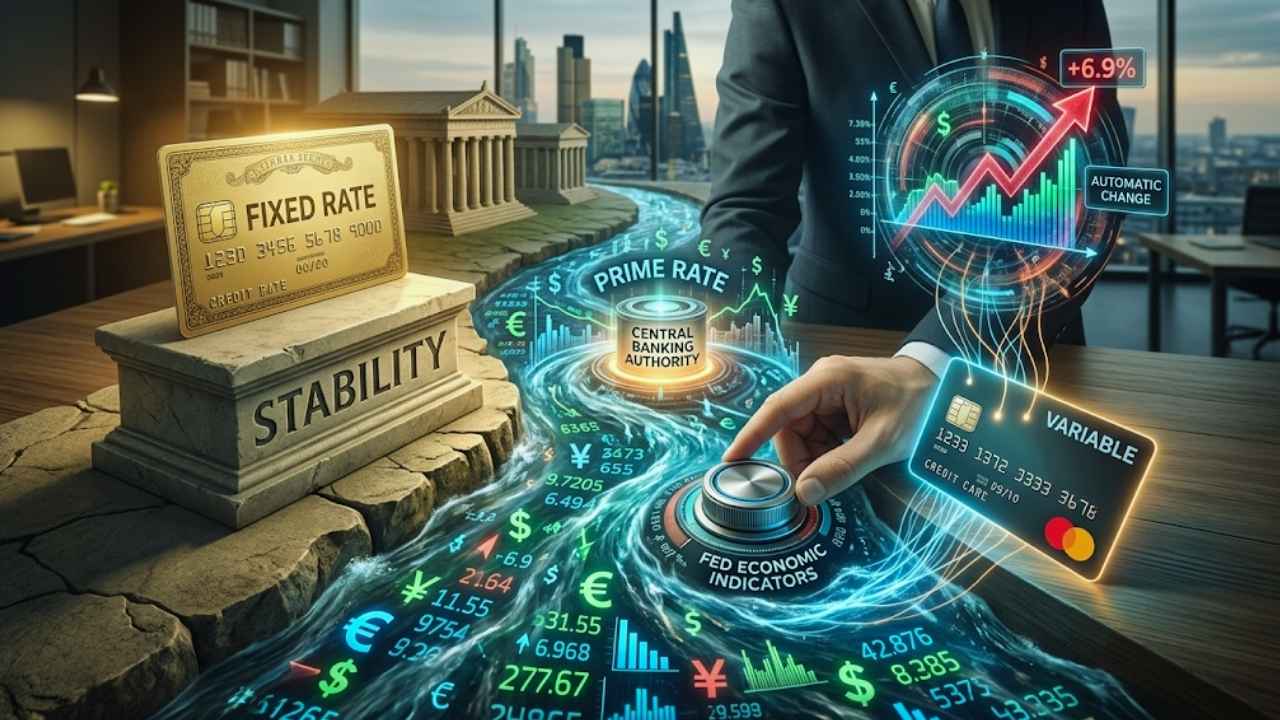
Not all interest rates stay the same forever. In the past, you could find credit cards with fixed interest rates that never changed unless the bank gave you a ton of warning. Today, fixed rate cards are basically extinct. Almost every single credit card on the market operates on a variable rate system. This means the cost of carrying your debt can get more expensive overnight without you even doing anything wrong.
|
Rate Type |
Characteristics |
Stability |
|
Fixed APR |
Stays the same unless the bank gives extensive written notice |
Very rare in today’s credit market |
|
Variable APR |
Changes automatically based on federal economic indicators |
Constantly shifting |
|
Prime Rate |
The underlying rate that drives your variable APR up or down |
Set by central banking authorities |
How Variable Rates are Tied to the Prime Rate?
Variable rates are directly chained to the national economy. Specifically, they are tied to something called the prime rate. The prime rate is the baseline interest rate that giant banks charge their absolute best, wealthiest corporate clients. Your credit card company figures out your personal APR by taking that national prime rate and adding a margin to it based on your credit score. If the prime rate is 8% and your personal risk margin is 12%, your total APR is 20%.
What Triggers a Rate Change?
When the central bank of the country wants to fight inflation, they raise federal interest rates. When they do that, the prime rate goes up. When the prime rate goes up, your variable credit card APR automatically goes up with it. The bank does not have to send you a letter or ask for your permission; they just quietly bump up your interest rate on your next statement. Your rate can also change if your credit score drops significantly, prompting the bank to increase your personal risk margin to protect their money.
Step-by-Step: How to Calculate Your Credit Card Interest?
Most people never bother to check the math on their credit card statements. They just see an interest charge of forty bucks and pay it. But knowing how to run the numbers yourself gives you a massive advantage. I want to show you exactly how the computer calculates your interest down to the penny. It looks like complicated algebra, but once you break it down into three simple steps, it is actually pretty basic middle school math.
|
Calculation Step |
Action Required |
Formula Example |
|
Step 1: Daily Rate |
Divide your APR by 365 |
19.99% / 365 = 0.000547 |
|
Step 2: Average Balance |
Track daily balances, add them, divide by days in cycle |
Sum of all daily balances / 30 days |
|
Step 3: Final Math |
Multiply Average Balance x Daily Rate x Days in cycle |
$1000 x 0.000547 x 30 = $16.41 |
Step 1: Find Your Daily Periodic Rate
Grab your latest statement and find your current APR. Let us pretend your rate is exactly 19.99%. First, turn that percentage into a decimal by dividing it by 100, which gives you 0.1999. Now, divide that number by 365 days in the year. The result is 0.000547. That incredibly small decimal is your daily periodic rate. That is the exact number the bank is using to charge you every single night.
Step 2: Calculate Your Average Daily Balance
This step takes a little bit of tracking. Let us say your billing cycle is exactly 30 days long. On day one, you owe $1,000. You do not buy anything or make any payments for 15 days. On day 16, you make a $500 payment. For the remaining 15 days of the month, your balance is $500. To find the average, you multiply $1,000 by 15 days (which is 15,000). Then you multiply $500 by 15 days (which is 7,500). Add those two chunks together and you get 22,500. Divide that massive number by the 30 days in your cycle. Your average daily balance for the month is exactly $750.
Step 3: Multiply the Variables
Now you have all the puzzle pieces you need. Take your average daily balance of $750 and multiply it by your daily periodic rate of 0.000547. Finally, multiply that result by the 30 days in your billing cycle. The final answer is $12.31. When you get your next statement in the mail, you will see a fresh interest charge of $12.31 added directly to your total debt balance.
The Real Cost of Making Only Minimum Payments
Every credit card statement features a box screaming at you to pay the minimum amount due. It is usually a very small, affordable looking number. Paying just the minimum keeps the bank happy, prevents late fees, and protects your credit score. But it is the biggest financial trap in the modern banking system. The minimum payment is mathematically designed to keep you paying interest for decades.
|
Scenario Details |
The Financial Reality |
|
Balance Amount |
$5,000 |
|
Interest Rate |
20% APR |
|
Minimum Payment |
Usually calculated at 2% of the balance ($100 to start) |
|
Payoff Timeline |
Over 27 years if you never swipe the card again |
|
Total Interest Paid |
Over $7,700 (More than the original balance itself) |
The Snowball Effect of Compounding Interest
When you send in that minimum payment, the bank applies the cash to your new interest charges first. Only a tiny fraction of your money actually goes toward knocking down the principal debt you owe. Because your main balance barely shrinks, you get hit with almost the exact same massive interest charge the very next month. Worse, if your interest charge is higher than your minimum payment, the leftover interest gets added to your principal. Next month, you are literally paying interest on your interest. This compounding effect causes balances to explode out of nowhere.
Long-Term Financial Impact
Let us put real numbers to this trap. Say you have $5,000 sitting on a card with a 20% APR. The bank asks for a 2% minimum payment, which is $100 the first month. If you lock that card in a drawer and only ever pay the minimum amount they ask for, it will take you over 27 years to reach a zero balance. You will end up paying the bank more than $7,700 in pure interest. That original $5,000 shopping spree will ultimately cost you over $12,700. Always pay as much as you can possibly afford above the minimum.
Proven Strategies to Avoid Paying Credit Card Interest
Now that we have the credit card APR explained, we need to talk about beating the system. The banking industry relies on consumer confusion to generate billions in revenue. You do not have to participate in their profit model. You can carry top-tier credit cards, rack up massive travel rewards, get cash back on your groceries, and still never pay a single penny in interest charges. You just need to follow a few hard rules.
|
Strategy |
How to Execute It |
The Result |
|
Pay in Full |
Setup autopay for the full statement balance every month |
You keep your grace period and pay zero interest |
|
Balance Transfer |
Move high-interest debt to a 0% promo card |
Pauses interest so all payments hit the principal |
|
Timing Purchases |
Buy big items the day after your statement closes |
Gives you nearly 50 days before the bill is due |
Paying Your Statement Balance in Full
This is the golden rule of credit cards. If you only remember one thing from this entire guide, make it this: pay your statement balance in full every single month. When you do this, you protect your grace period. The bank essentially gives you a free, short-term loan for a few weeks. To make sure you never mess this up, log into your banking app and set your credit card to autopay the statement balance. It takes the human error out of the equation and guarantees you never pay interest.
Strategic Use of Balance Transfers
If you are already drowning in interest charges, you need a rescue plan. Look for a credit card offering a 0% introductory APR on balance transfers. Apply for the card, and shift your expensive debt over to it. This completely freezes your interest charges for a set amount of time, usually 15 months or so. Without the daily interest dragging you down, every dollar you pay goes straight toward killing the actual debt. Just make sure you calculate exactly how much you need to pay each month to clear the balance before the 0% promo period expires.
Timing Your Purchases
Sometimes life happens and you have to put a massive expense on a credit card knowing you cannot pay it off right away. If your air conditioner dies and you need to finance a new one, timing is everything. Wait to run the charge until the exact day after your billing cycle closes. This places the huge purchase at the very beginning of a brand new 30 day cycle. Add in the 21 day grace period at the end of that cycle, and you just bought yourself roughly 50 days to round up the cash before the bank starts charging you interest on it.
How Your Credit Score Influences Your APR?
Your credit score is your financial reputation boiled down to a three-digit number. When you apply for a credit card, a computer system instantly pulls your score and uses it to judge your character. The APR they assign you is not a random guess; it is a direct reflection of how trustworthy they think you are. If you want access to the cheapest money on the market, you have to build a profile the banks want to do business with.
|
Credit Score Range |
Bank’s View of You |
Resulting APR |
|
Excellent (750+) |
Highly responsible, low risk |
The lowest advertised rates (e.g., 18%) |
|
Fair (650 – 699) |
Moderate risk, occasional issues |
Average to high rates (e.g., 24%) |
|
Poor (Below 600) |
High risk of default |
Penalty rates or subprime rates (29%+) |
The Risk-Based Pricing Model
Every major lender uses risk-based pricing. They look at millions of data points to figure out who is likely to pay them back and who is likely to default. If your credit score is in the 800s, you have proven over a long period of time that you pay your bills. The bank views you as zero risk, so they offer you their lowest possible interest rate to earn your loyalty. If your score is hovering in the 600s because you carry high balances and missed a few payments back in the day, the bank gets nervous. They pad their risk by assigning you a much higher APR.
Steps to Improve Your Score for Better Rates
If your interest rate is currently sky-high, you can actively fix it. The fastest way to boost your credit score is to lower your credit utilization. This means paying down your current balances so that you are using less than 30% of your total available credit limit. The second step is to never, ever miss a payment again. Once you spend six months practicing perfect credit habits and your score jumps up, call the number on the back of your card. Get a human on the phone and politely demand a rate reduction based on your improved credit profile. If they say no, hang up, call back the next day, and try a different representative.
Final Thoughts
The banking industry profits massively when consumers ignore the math. Having your credit card APR explained puts the power back in your hands. You now know exactly how the banks chop your annual rate into tiny daily pieces to aggressively charge you based on your average balances. You understand why minimum payments are a designed trap meant to keep you paying on the same debt for decades.
Credit cards are an incredible tool for travel perks, cash back, and purchase protection, but only if you follow the golden rule of paying your statement balance in full every single month. Keep a close eye on your variable rates, protect your grace period at all costs, and never hesitate to call your bank and negotiate better terms. Once you master how interest really works, you stop being a profit center for the credit card companies and start making the system work strictly for you.
Frequently Asked Questions (FAQs) About Credit Card APR Explained
When breaking down such a heavy financial topic, specific questions always pop up. Here are a few common and highly specific questions people run into when dealing with credit card billing.
Is APR applied daily or monthly?
Even though it has the word annual in the name, your interest is calculated every single day. The bank uses a daily periodic rate to figure out exactly what you owe them for that specific 24-hour period. They tally all those daily charges up in the background and hit you with one lump sum on your monthly statement.
Does a 0% APR mean no fees at all?
Absolutely not. A 0% APR promotion only means the bank is temporarily pausing your interest charges. You are still fully responsible for paying any annual fees attached to the card, foreign transaction fees if you travel, and steep late fees if you miss your minimum payment due date.
Can I negotiate my credit card APR?
Yes, you completely have the right to negotiate. If you have been a loyal customer, always pay on time, and your credit score has gone up since you got the card, call customer service. Tell them you have gotten offers from other banks with lower rates and ask if they can match them to keep your business.
What is residual interest or trailing interest?
This is a massive trap. Say you carry a balance and decide to pay it entirely off on the 15th of the month. You think you are debt-free. But between the 1st of the month and the 15th when your payment cleared, your account was still generating daily interest. That leftover interest will randomly show up on your next month’s statement. This is called residual or trailing interest. You have to pay that final bill to truly wipe the account clean.
Do I pay interest if I pay my card off early?
If you make a purchase and pay it off completely before your statement billing cycle even closes, you will not pay a dime in interest. Furthermore, as long as you pay the statement balance in full before the actual due date, the grace period protects you from all interest charges.