


Credit card debt creeps up on you. One month you are covering an unexpected car repair, the next you are paying for a flight to a wedding, and suddenly you are staring at a massive balance with a crushing annual percentage rate (APR). You feel stuck paying only the minimum, watching most of your money vanish into interest charges.
As of July 2026, the average credit card interest rate sits at a painful 19.57 percent, heavily influenced by a current prime rate of 6.75 percent. With total U.S. credit card debt surging past $1.25 trillion and the average American carrying a balance of $6,659, interest charges are draining wealth nationwide.
Then, a shiny piece of mail arrives offering a “0 percent intro APR on balance transfers.” It sounds like a lifeline. But before you jump at the offer, you need to know the rules of the game. If you want to get out of the red and actually save money, understanding exactly how balance transfers work is your first step. Let’s break down the mechanics, the hidden fees, and whether moving your debt is a smart financial move.
The Mechanics: How Balance Transfers Work Behind the Scenes
A balance transfer is simply moving high-interest debt from one or more credit cards to a new credit card with a lower interest rate. Ideally, this new card offers a 0 percent introductory APR for a set period, usually spanning anywhere from 12 to 21 months. Think of it like refinancing a house, but for your plastic. You are essentially asking a new bank to pay off your old bank. Once the new bank sends the funds to clear your old debt, that original account hits zero.
You now owe the new bank the identical amount of money. The massive difference is that you aren’t being crushed by monthly interest compounding daily. Every single dollar you send to the new bank goes straight to the principal, helping you aggressively chip away at what you actually spent.
Most people use this tool exclusively for credit card debt, but some issuers allow you to transfer other types of debt, like personal loans or auto loans, depending on your approved credit limit. Understanding the exact timeline and flow of funds is critical because missing the promotional window changes the entire financial outcome. You have to treat this promotional window as a strict deadline to reach a zero balance.
|
Transfer Feature |
How It Operates |
Real-World Application |
|
Basic Concept |
Moving debt from a high-interest account to a promotional low-interest account. |
Transferring a 25 percent APR balance to a new 0 percent APR credit card. |
|
Introductory Period |
The strict time frame you receive the promotional 0 percent interest rate. |
Typically ranges from 12 to 21 months depending on your credit score. |
|
Primary Goal |
Stop paying monthly interest so all payments hit the principal debt directly. |
Saving hundreds or thousands in interest charges over a year and a half. |
|
Eligible Debt Types |
Mostly standard credit cards, but sometimes personal loans or auto loans. |
Moving two retail store credit cards onto one major national bank card. |
The Real Cost: Balance Transfer Fees
To really grasp how balance transfers work, you have to look closely at the fine print because banks do not offer zero percent interest out of the goodness of their hearts. They make their money on these transactions right out of the gate through mandatory balance transfer fees. Almost every single credit card on the market charges a fee to move your money, usually ranging from 3 percent to 5 percent of the total amount transferred. The bank adds this fee directly to your new starting balance.
Let’s look at the basic math. If you want to transfer $10,000 to a new 0 percent APR card that charges a 3 percent fee, you will pay exactly $300 just to move the money, making your new starting balance $10,300. While a $300 upfront fee sounds like a lot of money, you absolutely have to compare it to what you would pay in interest if you stayed put. If you left that $10,000 on your old card at a 24 percent APR and tried to pay it off over 15 months, you would easily pay over $1,800 in interest alone.
In this exact scenario, paying a $300 one-time fee to save $1,500 is a massive financial win. You just have to run the numbers first to ensure the transfer fee does not outweigh the actual interest savings, especially on smaller balances. Also, remember that you generally cannot transfer a balance between two cards issued by the identical bank, such as from one Chase card to another Chase card.
|
Cost Element |
The Important Details |
Example on a $5,000 Transfer |
|
Transfer Fee |
Usually 3 percent to 5 percent of the total debt moved to the new card. |
A 3 percent fee adds exactly $150 to your new balance. |
|
New Total Debt |
The original debt amount plus the newly applied transfer fee. |
You start with a $5,150 balance on your brand new card. |
|
Interest Savings |
The money saved by avoiding your old high APR over the entire period. |
You avoid paying over $1,000 in interest over 12 months. |
|
Net Benefit |
The total interest saved minus the initial balance transfer fee. |
$1,000 in savings minus the $150 fee leaves you $850 ahead. |
When Doing a Balance Transfer Makes Perfect Sense
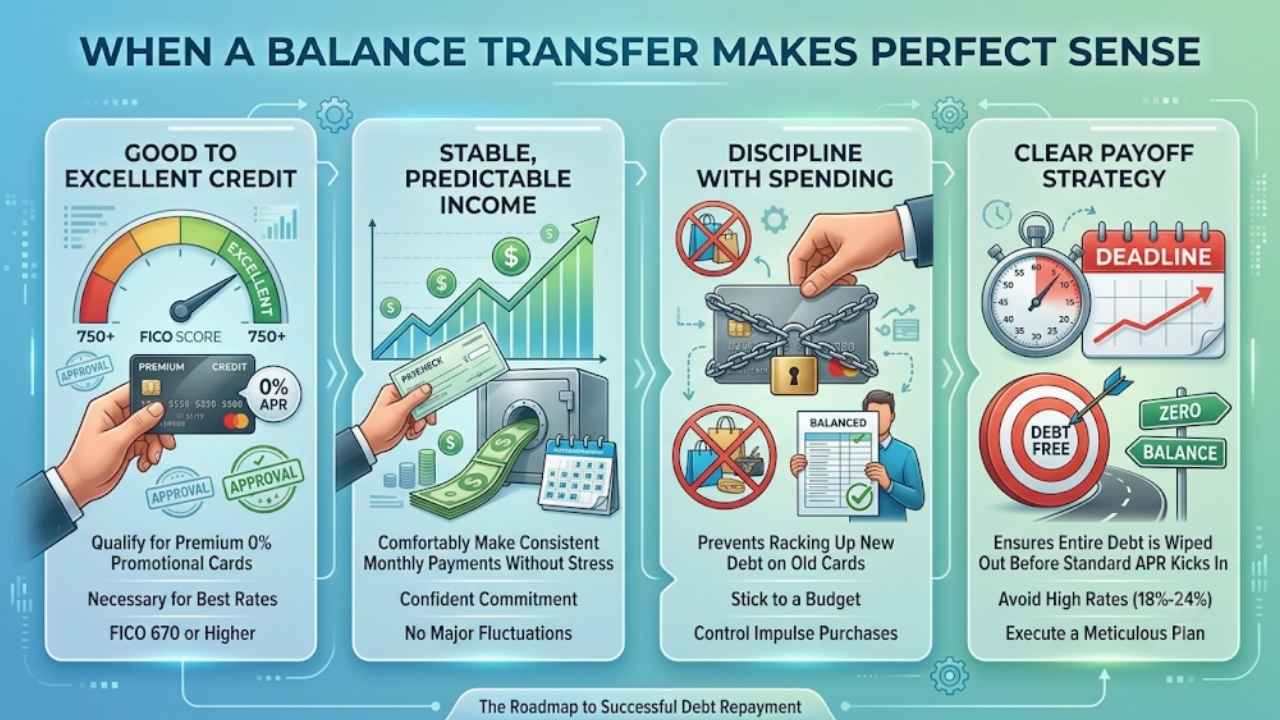
A balance transfer is an incredible financial tool if you use it correctly and execute a meticulous payoff plan. It works best for people who have a clear strategy and the financial discipline to see it through to the end. You should seriously consider this route if you have a strong, established credit score. The very best zero percent APR offers are strictly reserved for consumers with good to excellent credit, which usually means a FICO score of 670 or significantly higher.
It also makes the most sense if you have a highly stable, predictable income stream. The zero percent window is a ticking clock, and if you have 15 months to pay off $5,000, you need to confidently commit to paying roughly $333 every single month without fail. If your income fluctuates wildly from month to month, you might reach the end of the promotional period with a large chunk of debt still sitting there, instantly triggering a massive interest rate hike.
Recent market data shows that the standard APR applied to these cards after the promotional period ends usually ranges from 18 percent to 24 percent. You want to guarantee your balance is entirely gone before that standard rate kicks in and ruins your progress.
|
Ideal Candidate Traits |
Why This Specific Trait Matters |
|
Good to Excellent Credit |
Absolutely necessary to qualify for the premium 0 percent promotional cards. |
|
Stable, Predictable Income |
Allows you to comfortably make consistent, large monthly payments without stress. |
|
Discipline with Spending |
Prevents you from racking up brand new debt on the old, now empty credit card. |
|
Clear Payoff Strategy |
Ensures the entire debt is wiped out before the standard double-digit APR kicks in. |
When You Should Run the Other Way
Balance transfers can backfire spectacularly if you aren’t careful, turning a well-intentioned financial move into an absolute disaster. Moving your debt around feels a lot like progress, but it actually isn’t; you haven’t paid off a single dime yet, you just completely changed who you owe. If you haven’t fixed the core spending habits that got you into debt in the first place, a balance transfer is extremely dangerous. Once the transfer officially goes through, your old credit card will display a beautiful zero balance.
The temptation to start using that old card again for daily purchases is huge, and thousands of people fall into this exact trap every single year. They transfer their debt, start swiping the old card again, fail to pay off the new card in time, and suddenly they find themselves trapped with double the debt they started with. Interestingly, while credit card delinquency rates dipped slightly to 2.92 percent in early 2026, many consumers still struggle to meet their payment obligations promptly.
You should also skip a transfer if you can easily pay off your entire debt in just two or three months. If you owe a relatively small amount of money, the standard 3 percent to 5 percent transfer fee might actually cost you more cash than the couple months of interest you would pay by just aggressively crushing the debt where it currently sits.
|
Risk Factors |
The Immediate Financial Danger |
|
Unchanged Spending Habits |
You will likely run up brand new lifestyle charges on the newly cleared credit card. |
|
Small Debt Amounts |
The upfront transfer fee could cost more than the actual interest you intend to save. |
|
Low Credit Score |
You might only get approved for a high standard APR, entirely defeating the purpose. |
|
Missing Minimum Payments |
Just one late payment can completely void the zero percent promotional rate forever. |
Step-by-Step Guide: Executing the Transfer Correctly
If you have carefully weighed the pros and cons and decided this is definitely the right move for your situation, you need to execute the entire process systematically. First, you must assess your credit score by pulling your free report and ensuring your FICO score sits above 670 for the best approval odds. Next, thoroughly compare different offers by analyzing the length of the zero percent APR period versus the upfront transfer fee. Some cards offer an impressive 21 months with a 5 percent fee, while others offer 15 months with a lower 3 percent fee.
Pick the exact mathematical combination that aligns perfectly with your specific payoff timeline. Submit your application to a completely different bank, keeping in mind that the credit limit you receive might be lower than the total debt you actually want to transfer. You can usually initiate the transfer during the initial application process or online right after your approval comes through.
You will need your old card’s exact account number and the precise dollar amount you want to move. Keep making the minimum payments on your old card until you physically see a zero balance, because transfers can take anywhere from a few days to three long weeks to fully process. Finally, take your total newly transferred debt, add the transfer fee, divide it by the number of months in your introductory period, and set up automatic payments for that exact amount.
|
Process Step |
Action Required from the Consumer |
Expert Pro Tip |
|
1. Assess Credit |
Check your official FICO score through a reputable platform. |
Aim for a score of 670 or higher to secure the best approval odds. |
|
2. Shop Rates |
Compare the promotional term lengths against the transfer fees. |
A shorter term with a lower fee saves money if you pay incredibly fast. |
|
3. Apply Wisely |
Submit the application to a completely different banking institution. |
Do not apply for multiple cards at once because it damages your score. |
|
4. Transfer Funds |
Provide your old account information to the brand new issuer. |
Request the balance transfer immediately upon your final approval. |
|
5. Monitor Progress |
Continue paying the old card until the balance hits absolute zero. |
Bank transfers can take up to twenty-one days to clear completely. |
The Impact on Your Credit Score
Another incredibly tricky part of how balance transfers work involves your personal credit score, as the overall process impacts your credit profile in a few conflicting ways. First, you need to understand the bad news associated with applying for fresh credit. Applying for any new credit card results in a hard inquiry on your official credit report, which will usually knock your score down by about five to ten points temporarily. Also, opening a brand new account directly lowers the average age of your overall credit history, which can cause another small, temporary dip in your score.
Now, you need to understand the good news. Thirty percent of your credit score is dictated by your credit utilization ratio, which calculates exactly how much debt you carry compared to your total available credit limits across all accounts. When you open a new card, you instantly increase your total available credit limits. If your total debt stays exactly the same but your total credit limit goes way up, your utilization ratio drops significantly.
This often gives your overall credit score a highly healthy boost that easily outshines the small initial hit from the hard inquiry. Whatever you do, absolutely do not close your old credit card once it is completely paid off. Closing the old account wipes out that available credit, drives your utilization ratio right back up, and unnecessarily hurts your average age of accounts.
|
Credit Factor |
Immediate Score Impact |
Long-Term Score Impact |
|
Hard Inquiry |
Drops your overall score by approximately five to ten points. |
Fades from your official credit report entirely after twenty-four months. |
|
Average Age of Accounts |
Lowers your average age slightly, causing a minor negative impact. |
Neutralizes over time as the brand new credit account ages normally. |
|
Credit Utilization |
Lowers your ratio, providing a strong and immediate positive boost. |
Heavily boosts your score as you steadily pay down the transferred debt. |
|
Closing the Old Card |
Spikes your utilization ratio, causing a severe negative impact. |
Keep it open with a zero balance to strictly anchor your credit score. |
Smart Alternatives if a Transfer Isn’t for You
If you fundamentally don’t like how balance transfers work, or if your current credit score is unfortunately too low to qualify for a zero percent offer, you have several other excellent options to tackle your debt. You are never completely out of choices when it comes to managing your personal finances. Personal debt consolidation loans are a fantastic option where you take out a fixed-rate personal loan to entirely pay off your high-interest credit cards.
While you won’t get a zero percent interest rate, you will likely get a fixed rate much lower than 24 percent, heavily depending on your credit profile. The major benefit here is having a highly predictable fixed monthly payment and a hard end date for the debt, usually spanning three to five years, which forces strict financial discipline. The debt avalanche method is an aggressive do-it-yourself strategy where you make minimum payments on all your cards except the one holding the absolute highest interest rate.
You aggressively throw every extra dollar you have at that high-interest card until it is totally gone, ultimately saving you the most money on interest mathematically. Alternatively, the debt snowball method focuses heavily on human psychology by attacking the smallest balances first to generate quick, highly motivating financial wins.
|
Alternative Strategy |
Exactly How It Works |
Best Candidate For This Method |
|
Personal Loan |
Getting a single lump sum loan to instantly pay off all your credit cards. |
People who desperately want a fixed monthly payment and a strict timeline. |
|
Debt Avalanche |
Aggressively paying off the highest APR debt first while maintaining minimums. |
The mathematically minded who want to save maximum money on interest. |
|
Debt Snowball |
Aggressively paying off the smallest balances first to gain momentum. |
People who desperately need quick psychological wins to stay motivated. |
|
Credit Counseling |
Working closely with a non-profit agency to officially negotiate interest rates. |
People severely overwhelmed who need immediate professional intervention. |
Final Thoughts
A balance transfer isn’t magic, and it certainly doesn’t erase the actual money you legally owe. It simply buys you incredibly valuable time to get your financial house in complete order. With total U.S. credit card balances reaching historic heights in 2026, finding aggressive strategies to aggressively manage consumer debt is more critically important than ever before.
Once you thoroughly master how balance transfers work, you rapidly take back control of your financial life from the massive banks and their brutal interest rates. The core strategy is remarkably simple but requires relentless, unwavering daily discipline: get a good zero percent offer, pay the one-time transfer fee, set up a strict monthly automatic payment plan, and do not put any new charges on your old, empty cards.
If you entirely commit to the basic math and aggressively pay down the core principal before the promotional window slams shut permanently, a balance transfer is undoubtedly one of the most powerful tools available to finally break free and get completely out of debt.
Frequently Asked Questions (FAQs) About How Balance Transfers Work
Can I transfer a balance higher than my new credit limit?
No. If you get approved for a $4,000 limit, you cannot transfer $6,000. Actually, most banks cap balance transfers at around 75% to 95% of your total credit limit to leave room for the transfer fee.
Do balance transfers count toward credit card rewards or sign-up bonuses?
Almost never. You will not earn cash back, airline miles, or points on a balance transfer. Furthermore, the amount you transfer does not count toward the “spend $3,000 in the first three months” requirement for large sign-up bonuses.
What happens if I make a late payment during the 0% period?
This is a fatal error. If you are 60 days late on a payment, the bank will cancel your promotional 0% rate immediately. They will slap you with a “penalty APR,” which can be as high as 29.99%. Set up autopay and never miss a date.
Should I use the new card for everyday purchases?
Absolutely not. Even if the card offers 0% on new purchases too, mixing old debt with new spending makes it much harder to track your payoff progress. Keep this new card strictly as a holding tank for your old debt until it is completely paid off.