


Tech hiring looks completely different today than it did just a few years ago. You cannot rely on memorizing old algorithms anymore. Companies want engineers who understand AI tools, complex systems, and clean code. If you want to secure a top engineering offer, you need a solid Software Engineer Interview Prep 2026 strategy.
This roadmap walks you through exactly what hiring managers expect right now, from AI-assisted coding to agentic system design. I will break down everything you need to study, step by step, so you stop wasting time and start practicing what actually matters. Let us dive right in.
Why the 2026 Tech Interview Landscape is Different
The rules of tech interviews changed massively over the last couple of years. Major companies shifted away from asking tricky puzzles and started testing real engineering work. Hiring managers care more about your problem-solving process and your ability to debug systems than your memory of obscure syntax. You will notice a heavy focus on how you interact with modern developer tools.
The Rise of AI-Assisted Coding Rounds
Artificial intelligence completely flipped the script on how engineers write code, and interviews now reflect this reality. You will likely face human-led, AI-assisted interviews where you must use tools like Gemini or Copilot to read, debug, and optimize existing codebases. Interviewers do not just want to see if you can write a script from scratch; they want to see your AI fluency in action. You need to show them how well you engineer prompts, validate outputs, and spot hidden bugs the AI missed.
If you blindly accept AI-generated code without checking edge cases, you will fail the round instantly. You must treat the AI like a junior developer on your team. Ask it for help, review its work line by line, and fix its logical mistakes manually. Practice talking out loud while you debug the AI output so the interviewer understands your reasoning. Companies track your screen to see if you write secure, optimized prompts or just copy-paste mindlessly. Mastering this dynamic is the biggest secret to passing modern technical screens.
|
AI Tool Skill |
What Interviewers Look For |
How to Practice |
|
Prompt Engineering |
Writing specific, constraint-bound instructions |
Build small apps using only AI prompts |
|
Code Validation |
Spotting edge cases the AI ignored |
Run dry-tests on AI-generated snippets |
|
Debugging AI |
Fixing logical hallucinations quickly |
Give AI complex math/logic and find flaws |
|
Security Awareness |
Not pasting sensitive API keys into prompts |
Use mock data in all interview environments |
Shift from LeetCode Grinding to Pattern Recognition
Grinding hundreds of random coding problems is a massive waste of your time and will just lead to burnout. The industry moved away from testing random brain teasers and now tests your ability to recognize structural patterns. When you see a problem about a contiguous subarray, your brain should immediately think of the sliding window pattern. If you need to find the shortest path in a grid, you should instantly reach for breadth-first search.
Once you learn the core twenty architectural patterns, you can solve almost any problem they throw at you. Stop focusing on the quantity of problems you solve and focus on the quality of your practice sessions. Solve one problem using the two-pointer approach, and then explain it to yourself out loud as if you were teaching a beginner. If you can explain the tradeoff between time and space complexity clearly, you are ready for the interview. Clean, readable code matters far more than writing a clever one-liner that nobody else can understand. You must explicitly tell the interviewer which pattern you are using before you start typing.
|
Coding Pattern |
Identifying Keyword in Prompt |
Typical Use Case |
|
Sliding Window |
“Contiguous subarray”, “Longest substring” |
Finding optimal ranges in arrays/strings |
|
Two Pointers |
“Sorted array”, “Find pairs” |
Searching pairs or reversing arrays |
|
Fast & Slow Pointers |
“Cycle detection”, “Middle element” |
Linked list loops and midpoints |
|
Breadth-First Search |
“Shortest path”, “Level order” |
Tree/Graph level traversal and routing |
Phase 1: Mastering Computer Science Fundamentals
Even with advanced tools available, you still need a strong grip on computer science basics. You cannot optimize a system if you do not understand how data lives in memory. This phase builds your foundation so you can make smart decisions during high-pressure coding rounds.
Core Data Structures You Must Know
You use data structures every day, but interviews strip away the magic of high-level languages and force you to understand the raw mechanics. Arrays give you instant access to items if you know the index, but inserting an item in the middle forces you to shift everything else, slowing things down. Linked lists solve this insertion problem but force you to walk through the whole list just to find one specific item. Hash maps are your absolute best friend in coding interviews because they let you store and find data almost instantly.
You should know how hash functions work and exactly what happens when two items get assigned to the same memory spot, known as a hash collision. Trees show up constantly, especially binary search trees, so you need to feel entirely comfortable writing a quick recursive function to check all the nodes. Graphs represent networks like roads or friendships, and you will often have to build an adjacency list to track how different nodes connect. Stacks and queues manage your data in a specific order, which helps heavily with parsing text or managing background tasks.
|
Data Structure |
Best Used For |
Worst Used For |
Average Search Time |
|
Hash Map |
Instant lookups, frequency counting |
Maintaining sorted order |
O(1) |
|
Linked List |
Fast insertions at the ends |
Random access by index |
O(N) |
|
Binary Search Tree |
Maintaining sorted data dynamically |
Storing completely random, unbalanced data |
O(log N) |
|
Array |
Accessing data by a known index |
Frequent insertions in the middle |
O(N) |
Essential Algorithms and Time Complexity
Writing code that simply works is not enough anymore; your code must run efficiently under heavy loads. You have to analyze your solutions using Big O notation without the interviewer prompting you to do so. If your solution uses nested loops, tell them it takes quadratic time, and immediately suggest a way to speed it up using a hash map. Searching and sorting are the absolute basics, and you should understand why quick sort is generally fast but can sometimes run extremely slow if you pick bad pivots.
Binary search is a massive cheat code for interviews; anytime you have sorted data, you should cut your search space in half instead of looking at every single item. Dynamic programming scares many people, but it is just a fancy term for remembering past answers so you avoid redundant math. Greedy algorithms make the best immediate choice, hoping it leads to the best final result, while backtracking forces you to try every possible option and turn back when you hit a dead end. Practice talking through both time and space complexity, as candidates frequently forget to mention how much extra memory their solution requires.
|
Algorithm Category |
Common Time Complexity |
Example Problem |
|
Binary Search |
O(log N) |
Finding a target in a sorted array |
|
Merge Sort |
O(N log N) |
Sorting a massive dataset efficiently |
|
Dynamic Programming |
O(N) to O(N^2) |
Fibonacci sequence with memoization |
|
Backtracking |
O(2^N) or O(N!) |
Generating all permutations of a string |
Object-Oriented Design Principles
Many candidates completely ignore object-oriented design and end up failing their mid-level interviews because of it. Writing simple functions is easy, but structuring a massive codebase so it does not break when product requirements change is hard. Interviewers will ask you to design a digital parking lot, a movie ticket booking system, or a vending machine on the spot. They want to see how you break a big, messy idea into smaller, manageable classes that interact logically.
You must apply concepts like encapsulation to hide private data so other developers do not accidentally overwrite it. You should use inheritance and interfaces to share common behaviors across different objects without duplicating code. Familiarize yourself with basic design patterns like the factory pattern, which helps you create objects without messy if-else logic, and the observer pattern, which is perfect for building notification systems. Sketching out a clean class diagram and explaining your architecture choices proves you can write production-ready code.
|
Design Principle/Pattern |
Core Concept |
Interview Example |
|
Encapsulation |
Hiding internal object state |
Making user passwords private variables |
|
Factory Pattern |
Creating objects without specifying exact classes |
Generating different types of game enemies |
|
Observer Pattern |
Sending updates to multiple dependent objects |
Sending push notifications to chat members |
|
Single Responsibility |
A class should have only one reason to change |
Separating database saving from data validation |
Phase 2: Cracking the System Design Interview
System design rounds define your actual engineering level and dictate your final compensation package. These interviews are completely open-ended conversations without a single correct answer. You must take a vague business idea and sketch out a technical architecture that scales smoothly.
Designing Scalable and Maintainable Systems
A typical system design prompt sounds incredibly vague, like asking you to build a global chat app or a ride-sharing platform from scratch. Do not start drawing architecture boxes right away; you must spend the first five minutes asking clarifying questions. How many people will use this app daily, do they need real-time updates, and are we focused more on reading data or writing data? These constraints dictate every single technical choice you make on the whiteboard.
Once you know the rules, you draw the big picture from left to right, starting with the client applications. Your users connect to a domain name system, and that traffic hits a load balancer that distributes the weight. The load balancer sends the traffic to several application servers so no single server crashes under pressure. You need to explain why you chose a specific load balancing method, like round-robin versus least active connections. Finally, you have to plan for failure by explaining how your system reroutes traffic if a whole data center goes offline unexpectedly.
|
System Component |
Purpose in Architecture |
Popular Tools |
|
Load Balancer |
Distributes incoming traffic across multiple servers |
Nginx, HAProxy, AWS ALB |
|
API Gateway |
Manages routing, rate limiting, and authentication |
Kong, Amazon API Gateway |
|
Application Server |
Runs the core business logic |
Node.js, Spring Boot, Django |
|
Content Delivery Network |
Serves static assets fast based on location |
Cloudflare, Akamai, AWS CloudFront |
Microservices, Caching, and Database Sharding
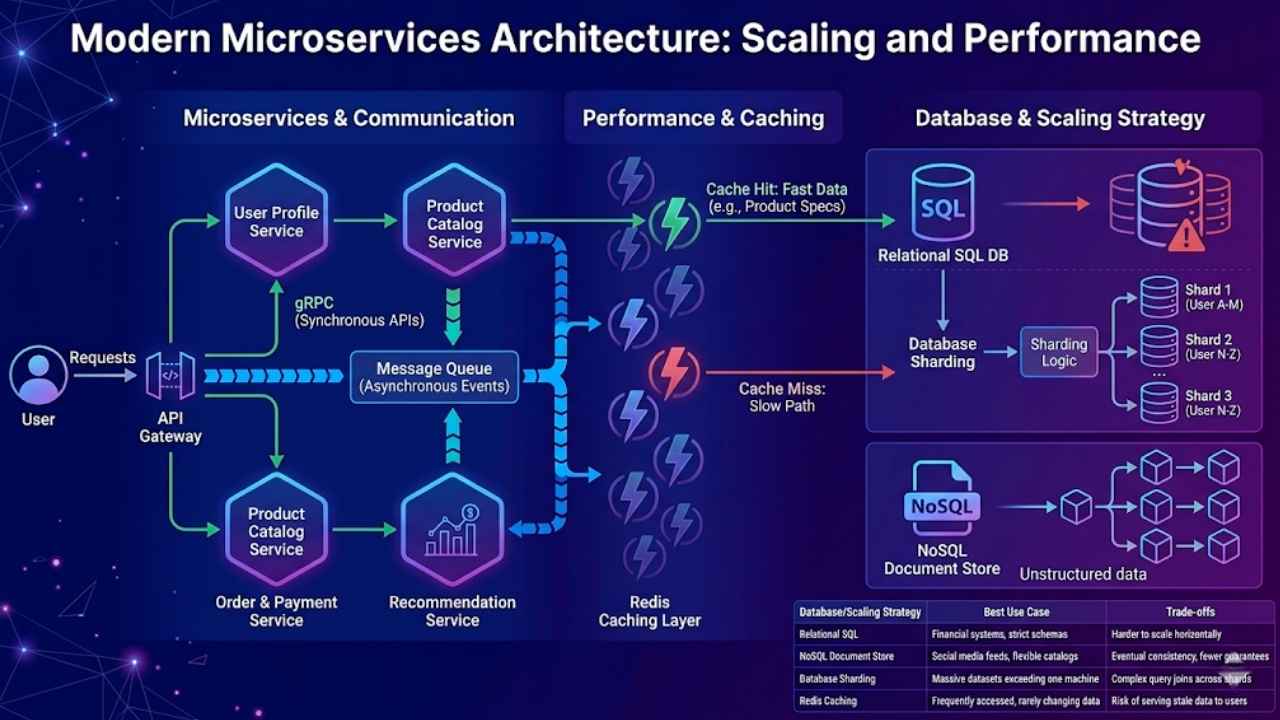
Big tech companies do not run giant, clunky monolithic applications anymore; they break everything apart into microservices. The payment service runs independently from the user profile service, so if the profile service goes down, people can still complete their purchases. You need to talk about how these separate services talk over the network safely using tools like gRPC or message queues. Databases are usually the hardest part of the design, and you must pick between relational databases and non-relational ones based on the data type.
SQL databases keep your data perfectly organized and safe, which you absolutely need for handling financial transactions. NoSQL databases scale up easily if you have chaotic, unpredictable data like social media feeds. When your database gets too big, you have to shard it, meaning you split your data across multiple machines based on a specific key. Caching is your secret weapon to make everything fast; you put a fast memory layer in front of your database to serve popular requests instantly.
|
Database/Scaling Strategy |
Best Use Case |
Trade-offs |
|
Relational SQL |
Financial systems, strict schemas |
Harder to scale horizontally |
|
NoSQL Document Store |
Social media feeds, flexible catalogs |
Eventual consistency, fewer guarantees |
|
Database Sharding |
Massive datasets exceeding one machine |
Complex query joins across shards |
|
Redis Caching |
Frequently accessed, rarely changing data |
Risk of serving stale data to users |
System Design for Distributed AI Applications
We are in a new era of engineering, and designing AI systems is a fresh, highly requested interview topic. You might be asked how to build a recommendation engine, a personalized news feed, or an enterprise document summarization tool. This requires a completely different set of components on your whiteboard compared to a standard web app. You need massive data pipelines to ingest raw information, clean it, and store it securely in data lakes.
You have to decide how to serve your AI models; running inferences takes heavy computing power, so you must choose between real-time processing and overnight batch processing. You also have to watch out for model drift, because AI models get worse over time as real-world trends change. You need to design an automated pipeline that checks model performance and retrains the AI with new data without causing downtime. Discussing vector databases and Retrieval-Augmented Generation (RAG) proves you understand modern AI architectures.
|
AI System Component |
Function in the Architecture |
Example Technologies |
|
Vector Database |
Stores text embeddings for semantic search |
Pinecone, Milvus, Weaviate |
|
Data Pipeline |
Ingests, cleans, and transforms raw data |
Apache Airflow, Kafka, Spark |
|
Inference Server |
Hosts the AI model to generate predictions |
Triton, TensorFlow Serving |
|
RAG Engine |
Retrieves context before asking the LLM |
LangChain, LlamaIndex |
Phase 3: The Behavioral Round and The STAR Method
Technical skills alone will not get you hired if nobody actually wants to work with you day-to-day. The behavioral interview checks your communication, emotional intelligence, and teamwork under pressure. Companies want engineers who handle conflicts smoothly and take absolute ownership of their mistakes.
Understanding the Culture Fit
Every tech company has a distinct personality, and they want to hire people who naturally align with their daily workflow. A fast-moving startup values speed, taking risks, and pushing code quickly, while a large bank values caution, extreme testing, and rigorous documentation. You have to research the company culture deeply before your interview so you know which traits to highlight. Read their engineering blog and figure out their core leadership principles, then select stories from your past that prove you share those values.
If they value transparency, talk about a time you admitted a massive coding mistake early and helped the team fix it before production crashed. Culture fit does not mean having the same hobbies as the hiring manager; it means approaching problems and handling stress in a compatible way. You need to prove you are mature enough to debate a technical decision respectfully without taking it personally when your specific idea gets rejected.
|
Company Archetype |
Core Values Usually Tested |
How to Answer |
|
Hyper-Growth Startup |
Bias for action, wearing multiple hats |
Share stories of moving fast and learning |
|
Big Tech (FAANG) |
Scalability, data-driven decisions |
Focus on metrics, massive impact, and logic |
|
FinTech / Healthcare |
Security, compliance, thoroughness |
Emphasize testing, auditing, and caution |
|
Remote-First Company |
Async communication, self-motivation |
Discuss heavy documentation and clear writing |
Crafting Your Situation, Task, Action, Result Stories
You need a strict system for answering behavioral questions so you do not ramble or lose the interviewer’s attention. The STAR method is the absolute best way to structure your answers, keeping them under three minutes. Always start with the Situation, giving just enough background in two sentences so they understand the specific setting. Next is the Task, where you define the exact problem staring you in the face or the tight deadline you had to hit.
The Action is the main event where you must say “I” instead of “we” to ensure you get credit for your own work. Talk about the specific code you wrote, the difficult meetings you organized, and the technical blockers you personally removed. Finally, share the Result, and always attach hard numbers to your outcome to prove your actual business value. Tell them exactly how much money you saved the company, how many hours you shaved off a process, or how much you reduced server latency.
|
STAR Phase |
Common Mistake |
Pro-Tip for 2026 |
|
Situation |
Giving way too much background history |
Keep it to two sentences maximum |
|
Task |
Being vague about your specific role |
Clearly state what you were hired/asked to do |
|
Action |
Saying “we built” instead of “I built” |
Detail the exact languages and tools you used |
|
Result |
Forgetting to mention the business impact |
Use percentages, dollar amounts, or time saved |
Demonstrating Production-Ready Practices
Behavioral questions are sneakily testing your technical habits, not just your personality. When an interviewer asks about a stressful deadline, they want to know if you skipped writing unit tests just to save a few hours. You must show them you never compromise on system quality, even when the pressure is immense. Talk heavily about your strict adherence to code reviews and how you leave polite, helpful comments instead of just pointing out flaws.
Mention your experience setting up automated CI/CD pipelines that catch errors before any broken code merges into the main branch. Tell them how you added monitoring dashboards and alerting systems so you would know if a feature broke before a customer ever complained on Twitter. When you talk about these production-ready practices naturally, you signal that you are a highly reliable professional who actively protects the codebase.
|
Production Practice |
Why Interviewers Care |
How to Mention It |
|
CI/CD Pipelines |
Proves you automate deployments |
“I set up GitHub Actions to run tests automatically.” |
|
Comprehensive Testing |
Shows you care about stability |
“I enforced a strict 80% test coverage rule.” |
|
Incident Monitoring |
Proves you handle live issues |
“I created Datadog alerts for API latency spikes.” |
|
Code Reviews |
Demonstrates teamwork and standards |
“I mentor juniors by leaving detailed PR feedback.” |
Phase 4: Mock Interviews and Final Polish
Practicing by yourself in a quiet room is completely different from performing live in front of a senior engineer. You must simulate the pressure of the real event to uncover your nervous habits. This final phase gets you completely comfortable with the actual interview environment so you do not panic.
Simulating the Real Interview Environment
Do not just practice in a comfortable chair with unlimited time and your favorite music playing in the background. You have to recreate the exact interview conditions by setting a strict forty-five-minute timer for every problem. Use a plain text editor or a standard browser IDE, and do not let yourself use auto-complete if the interview platform forbids it. Schedule mock interviews with friends or use platforms that pair you with senior engineers who will judge you honestly.
The most important skill to practice is thinking out loud because if you sit in silence, the interviewer thinks you are completely lost. Talk through your logic before you type anything, state your assumptions clearly, and write down a few edge-case test cases first. When you finish, run through your code line by line with a sample input to catch your own typos. Catching your own silly mistake during a dry run looks incredibly impressive and shows great attention to detail.
|
Mock Interview Step |
Goal of the Exercise |
Common Pitfall to Avoid |
|
Timed Constraints |
Mimic actual interview pressure |
Pausing the timer when you get stuck |
|
Thinking Out Loud |
Keep the interviewer engaged |
Mumbling or typing in total silence |
|
Pure Text Editors |
Remove reliance on heavy IDEs |
Relying on syntax highlighting or auto-fill |
|
Dry Running Code |
Catch bugs before the interviewer does |
Skipping edge cases like empty arrays |
Peer Review and Open-Source Contributions
Reading code is just as important as writing it, especially when preparing for collaborative technical rounds. Spend some time reviewing pull requests from other developers to see how they structure their logic and name their variables. Leave detailed, constructive feedback on their work, which builds the exact communication muscle you need for technical discussions.
If you can, push some code to an open-source project, even if it is just a documentation fix or a minor bug patch. Working on a massive codebase with strict contribution rules teaches you how to adapt quickly to new environments. It also gives you fantastic, verifiable stories to share during your behavioral rounds. Navigating the messy reality of a distributed open-source project proves to hiring managers that you can handle the complexities of a real engineering job perfectly.
|
Activity |
Skill Developed |
Interview Benefit |
|
Reviewing PRs |
Code comprehension and auditing |
Helps during code-reading and debugging rounds |
|
Open Source Fixes |
Navigating massive, unknown codebases |
Proves you can onboard to a new job quickly |
|
Writing Documentation |
Clear technical communication |
Shows you care about team knowledge sharing |
|
Public GitHub Profile |
Verifiable proof of your skills |
Gives interviewers concrete projects to ask about |
Final Thoughts
Preparing for a tech job right now requires a highly strategic approach, not just endless, blind grinding. You must build pattern recognition for coding rounds, master scalable system design, and communicate your past successes perfectly using the STAR method. Most importantly, you have to adapt to the new reality of AI-assisted development, proving you can manage these tools securely.
Companies desperately want engineers who write clean, testable code and utilize modern tools to move faster without breaking things. Your Software Engineer Interview Prep 2026 journey will take serious effort and focus. However, if you follow this roadmap step by step, practice consistently, and treat your mock interviews seriously, you will walk into your actual interviews with total confidence and secure the exact offer you want.
Frequently Asked Questions (FAQs) About Software Engineer Interview Prep
Candidates naturally have a lot of questions about the changing interview formats and updated expectations. The shift toward AI tools and remote environments created a lot of confusion across the industry. Here are clear answers to the most common questions regarding the current tech hiring process.
How far in advance should I start preparing for a software engineer interview?
Your timeline depends entirely on your current job and daily experience level. If you are a recent graduate, you should give yourself three full months so you have time to absorb the computer science basics without rushing. If you are a senior engineer, you might only need four to six weeks to dust off your algorithms and practice deep system design questions. Consistency matters more than cramming, so aim for two hours a day.
Can I use AI tools during tech interviews in 2026?
The rules are changing fast, and some progressive companies actually demand that you use AI coding assistants to evaluate your prompt engineering speed. However, traditional banks and older tech companies might still ban all AI tools and force you to write pure syntax from memory. You absolutely must email your recruiter a week before your interview and ask them directly about their tooling policy.
How do remote software engineer interviews differ from in-person ones?
Remote interviews require much more deliberate communication because you do not have a physical whiteboard or hand gestures to rely on. You must explain your mental model clearly through your microphone while typing on a shared digital screen. You are also fully responsible for your own tech setup; test your camera, use a wired internet connection, and find a quiet room.
Do I need a portfolio for a software engineering role?
If you work on the frontend or full-stack, a portfolio helps massively because it proves you can build polished, working user interfaces. If you build backend systems or infrastructure, a portfolio is less critical, but a clean GitHub profile with complex personal projects still looks great. Be ready to defend every single line of code in your portfolio if you submit one.
Will interviewers ask about my AI prompting skills?
Yes, especially for companies fully embracing the modern developer workflow. If they allow AI in the interview, they actively judge how you ask the tool for help, looking for clear context and strict boundaries. If the AI hallucinates a fake function, they watch to see how fast you catch the error and correct it manually.
Do companies still test Object-Oriented Design in 2026?
Object-oriented design actually became more important recently because AI makes writing small, isolated functions far too easy. Interviewers want to test your big-picture architectural thinking to ensure you can design scalable class structures. Practice sketching out clean interfaces and using solid design patterns so your code stays organized.