


Ever planned a chaotic event, kept a distracted team on track, or stretched a tiny budget to get a job done? You already have the foundation of a project manager. You don’t need a fancy business degree or a classic corporate background to switch paths.
I often think about the resilience and focus of cricket legend Sachin Tendulkar. Watching him play offers an absolute masterclass in dealing with high pressure. Leading any major effort takes that exact same patience, strategy, and ability to adapt quickly when things go wrong on the pitch. You keep your eye on the ultimate goal and tune out the noise. That mindset is the core of project management.
People assume they must start at the absolute bottom to change careers. Not here. Whether you work in retail, healthcare, teaching, or digital publishing, you already possess skills that easily translate. If you are ready to move into project management, this guide gives you the exact steps, current market data, and practical strategies to make a highly profitable transition.
Why Make the Shift to a PM Career?
Companies everywhere are abandoning static operations and moving to project-based work. The demand for people who organize chaos and deliver results is massive, and it is only accelerating. According to the Project Management Institute (PMI), the global economy will need to fill 2.3 million new project-oriented roles every year through 2030, with a projected talent gap of 25 to 30 million professionals globally.
This career brings immense stability and great pay. The median annual salary for a project manager in the United States currently ranges from $100,000 to $135,000, depending heavily on experience and specialized industry knowledge. Entry-level project managers with 0 to 3 years of experience are starting between $62,000 and $76,000, while mid-level professionals quickly jump to the $92,000 to $112,000 range.
You also gain incredible flexibility. You can often pivot into PM roles while staying right inside an industry you already know intimately. The highest-paying sectors right now include Pharmaceuticals and Aerospace (median $150,000), Energy and Mining ($160,000+), and Information Technology, where technical project managers easily pull in up to $160,500 annually. Furthermore, remote work is now a standard expectation; employers want leaders who can successfully manage distributed, global teams digitally without needing to be physically present in an office.
|
Career Benefit |
Current 2026 Market Data |
Why It Matters For You |
|
Global Job Growth |
30 million+ talent gap globally. |
High demand means lower barriers to entry for career switchers. |
|
Salary Potential |
Median US PM salary hits $135,000. |
Financial security scales rapidly as you move from entry-level to mid-level. |
|
Industry Flexibility |
Highest demand in finance, tech, and healthcare. |
You can leverage your past industry knowledge to command higher starting pay. |
|
Remote Opportunities |
Remote PM work is a standard in 2026. |
You can apply for lucrative roles outside your immediate geographic area. |
Identifying Your Hidden Transferable Skills
You might think you have zero experience. You are likely wrong. Before you figure out how to move into project management, take a serious inventory of your current abilities. You use these frameworks every single day without realizing it. Successful career transitioners must perform a deep self-evaluation to identify exactly which skills map to a project manager’s job description.
Communication and Leadership
Teachers manage curriculums, handle tight schedules, and deal with difficult stakeholders like parents and students. If you can keep thirty teenagers focused for an hour, you can absolutely run a daily stand-up meeting with software developers. Excellent communication is non-negotiable because project management ultimately comes down to clear, concise, and transparent messaging. You must be able to articulate goals clearly, present updates confidently, and maintain transparency with all stakeholders.
Budgeting and Resource Allocation
Event planners, restaurant managers, or retail supervisors juggle vendors, track daily spending, and adjust on the fly when supplies run out. This is exactly what project managers do during the planning phase to stop an initiative from bleeding money. Mastering resource allocation and task prioritization ensures the team operates efficiently without burning through the approved budget.
Risk Management and Problem Solving
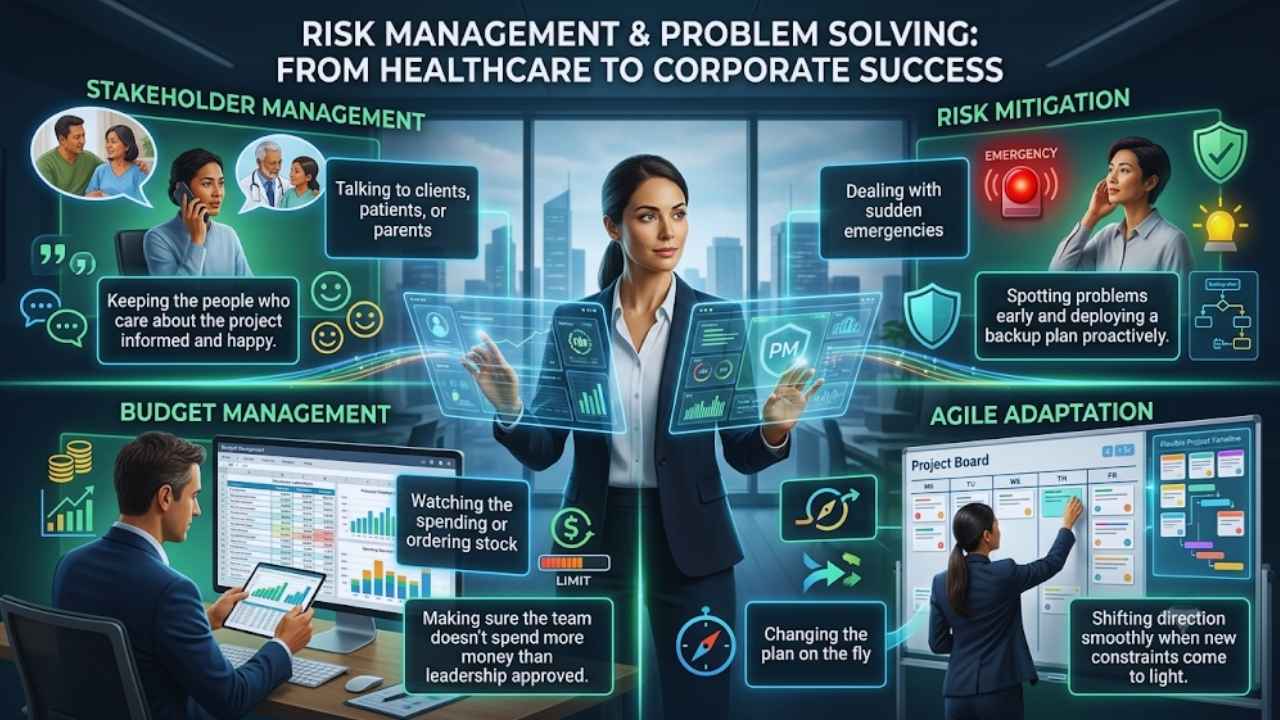
Nurses and healthcare workers constantly assess risks, prioritize patient needs based on raw urgency, and adapt immediately to emergencies. In the corporate business world, this translates perfectly to risk mitigation and agile problem-solving. Anticipating risks before they happen, adapting to sudden changes, and finding practical solutions under intense pressure are the exact traits hiring managers look for today.
|
Your Current Task |
Official PM Term |
What It Actually Means in Business |
|
Talking to clients, patients, or parents |
Stakeholder Management |
Keeping the people who care about the project informed and happy. |
|
Dealing with sudden emergencies |
Risk Mitigation |
Spotting problems early and deploying a backup plan proactively. |
|
Watching the spending or ordering stock |
Budget Management |
Making sure the team doesn’t spend more money than leadership approved. |
|
Changing the plan on the fly |
Agile Adaptation |
Shifting direction smoothly when new constraints come to light. |
Top 2026 Certifications to Help You Transition
You don’t need to go back to college and rack up student debt. Getting certified proves to employers that you understand the formal terminology. In 2026, professionals with a PMP certification earn roughly 17% to 33% more than their uncertified counterparts, proving the massive ROI of formal education.
Certified Associate in Project Management (CAPM)
If you have zero formal hours managing projects on your resume, start right here. The PMI offers this highly respected entry-level certification. The exam covers predictive methodology, Agile, and business analysis. The exam fee is $225 for PMI members and $300 for non-members. It is the absolute best way to prove you possess the foundational knowledge that modern project teams demand.
Google Project Management Certificate
Hosted on Coursera, this highly accessible program costs about $39 per month. It covers the project lifecycle, Agile basics, and stakeholder communication. While it won’t land you a senior executive job, it maps directly to CAPM eligibility, is incredibly affordable, and works perfectly for absolute beginners trying to test the waters.
Certified ScrumMaster (CSM) or Agile Certifications
Tech companies love Agile and Scrum methodologies. A Scrum Master facilitates daily meetings and removes roadblocks specifically for software developers. Companies in 2026 are highly prioritizing certifications that reflect agile thinking and practical execution over pure theory. Professionals with Agile or SAFe® certifications are commanding premium salaries, especially in SaaS and startup environments.
|
Certification Name |
Best Suited For |
Approx. 2026 Cost |
Key Benefit for Career Switchers |
|
Google PM Certificate |
Absolute beginners |
$39/month |
Accessible, cheap, and flexible monthly payment structure. |
|
CAPM (PMI) |
Entry-level professionals |
$225–$300 |
Globally recognized baseline that proves you know the frameworks. |
|
Agile / CSM |
Future tech/software PMs |
Varies by provider |
Gets your foot in the door for fast-paced tech startups and dev teams. |
Steps to Move Into Project Management From Scratch
How do you get the actual job title when you lack the official past experience? You build a bridge between where you sit now and where you want to go. You must prove your competence through visible action. Theory alone will not make you a successful project manager; you need hands-on practice.
Volunteer for Internal Projects
Look around your current job. Is the company rolling out new software? Planning a physical office move? Raise your hand. Look for ways to lead initiatives, coordinate tasks, or manage small internal projects. If you can’t find opportunities at work, volunteer with non-profit organizations or local community groups to gain real, practical experience you can put on your resume.
Start Using the Right Tools
Modern teams run on specialized software. Familiarize yourself with industry-standard tools like Jira, Asana, and ClickUp for sprint management, or Microsoft Project and Smartsheet for traditional planning. Create free personal accounts. Use them to organize a home renovation or a side hustle. You need to confidently navigate these interfaces, along with communication tools like Slack and Microsoft Teams.
Build a Digital Portfolio
Document the projects you have managed, highlighting both your successes and the challenges you overcame. Create a simple website or a digital cloud folder. Include project charters you wrote, timelines you mapped out, and measurable results you achieved. A well-curated portfolio shows hiring managers your strategic thinking and your ability to deliver real outcomes.
|
Career Step |
Immediate Action Item |
Expected Result for Your Pivot |
|
1. Shadowing/Research |
Research PM roles in your specific target industry. |
Gain insider knowledge on required skills and salary expectations. |
|
2. Volunteering |
Take the lead on a small internal initiative or non-profit project. |
Create a tangible, measurable achievement for your resume. |
|
3. Tool Mastery |
Build a mock workflow in Jira, Asana, or ClickUp. |
Pass technical screening questions during early interviews. |
Rewriting Your Resume for a PM Job
Your old resume will fail you here. When you move into project management, your resume acts as your very first project deliverable. The hiring manager is your client. You must tailor your project manager resume to highlight relevant skills, certifications, and project experiences, focusing on what you can contribute immediately.
Ditch the Industry Jargon
If you are leaving healthcare, aggressively remove deep medical terminology that a corporate recruiter won’t understand. If you are leaving education, strip out state testing codes. Translate your past daily duties into universal business language, focusing heavily on leadership, communication, and organizational abilities.
Use Action Verbs and Hard Metrics
Don’t write, “Helped organize a team.” Write, “Directed a cross-functional team of 15 to overhaul patient intake, reducing wait times by 20%.” Numbers grab human attention. Detail the exact budgets you handled, the size of the teams you led, and the actual hours you saved the business. Highlighting measurable results and implemented strategies proves you can deliver.
|
Old Resume Phrase |
Translated PM Resume Phrase |
|
“Handled parent complaints and PTA meetings.” |
“Managed stakeholder expectations, resolved conflicts, and maintained transparency.” |
|
“Ordered weekly supplies for the restaurant.” |
“Handled vendor procurement and successfully managed a monthly operating budget.” |
|
“Trained new nurses on the hospital floor.” |
“Onboarded team members and established standardized operating procedures for new hires.” |
Nailing the Project Manager Interview
Employers fully know you are changing careers. They won’t expect you to know every technical detail of their proprietary software perfectly. In 2026, companies are hiring for capability, adaptability, and real execution ability, not just theoretical knowledge. They want problem-solvers who can align projects with overarching business goals.
Master the STAR Method
Interviewers lean heavily on behavioral questions. They want concise stories. Use the STAR method: Situation, Task, Action, Result. Keep your answers under two minutes. Focus heavily on the “Action” part—what you specifically did to fix a problem, mitigate a risk, or resolve a conflict between team members.
Prepare for the “Failure” Question
Every single PM experiences failure. A deadline slips. A client gets furious. A budget blows up. When asked about a time you failed, don’t dodge the question with a fake weakness like “I work too hard.” Share a real, stinging mistake. Take full accountability, and detail the critical thinking and problem-solving skills you used to adapt to the change and find a practical solution.
|
Common Interview Topic |
What They Actually Want to Know |
How to Answer Effectively |
|
Handling Conflict |
Can you keep a cool head when team members argue? |
Tell a story where you listened to both sides, resolved the conflict, and motivated the team. |
|
Missing Deadlines |
Do you hide problems or face them head-on? |
Explain how you prioritize tasks, allocate resources, and keep projects on schedule. |
|
Business Impact |
Are you just tracking tasks, or driving results? |
Show how you align daily project execution with the company’s strategic goals. |
The Power of Networking in Your Pivot
Applying to jobs through standard online portals is a brutal numbers game. Algorithms heavily disadvantage career changers. Project management is as much about human connections as it is about technical skills. Networking bypasses the software filters entirely and gets your resume directly into human hands.
Join Local PMI Chapters
The Project Management Institute operates local chapters in almost every major city. Attend their monthly meetings, onsite local gatherings, or industry events. These rooms are filled with current project managers, sponsors, and hiring directors. Seek mentorship from experienced professionals who can offer guidance, insights, and direct job referrals.
Optimize Your LinkedIn Profile
Change your LinkedIn headline today. Don’t just list your current job. Write: “Aspiring Project Manager | CAPM Certified.” Communicate with professionals on social media, follow industry leaders, engage in discussions, and participate actively. Many project management roles are filled strictly through professional connections, making your digital footprint a critical part of your strategy.
|
Networking Avenue |
Action to Take This Week |
Real Career Benefit |
|
LinkedIn Strategy |
Connect with professionals and engage in active discussions. |
Builds a digital network and surfaces jobs before they hit public boards. |
|
PMI Chapters / Events |
Join local management groups and attend onsite gatherings. |
Connect with local professionals and find a mentor to guide your transition. |
|
Webinars & Workshops |
Attend virtual events to ask questions and share thoughts. |
Puts you in direct contact with professionals and keeps you at the forefront of the industry. |
Final Thoughts
Pivoting to a completely new career always feels daunting at first. But when you strip away the corporate buzzwords, this job simply comes down to getting things done efficiently. You likely already possess the foundational soft skills—communication, problem-solving, and adaptability. Now, you just need to learn the formal frameworks to package those skills for the market.
By earning a respected entry-level certification, aggressively translating your resume to highlight your transferable skills, and networking to bypass the algorithms, you actively bridge the gap between your past experience and your future role. It takes genuine patience and dedication, but anyone willing to put in the work can successfully move into project management and build an incredibly rewarding career.
Frequently Asked Questions (FAQs) About Move Into Project Management
You probably have a lot of specific questions about the day-to-day realities of this job. Let’s tackle the less obvious queries that pop up for career switchers.
Do I need to be good at math?
No. You need to be good at basic arithmetic and standard logic. You handle budgets and track team hours, but you rely heavily on software like Excel or dedicated PM tools to do the heavy lifting. If you can balance your personal checkbook, you have enough math skills for this job.
Can introverts succeed in project management?
Absolutely, and they often thrive. While the job requires verbal communication, it demands even more active listening. Introverts naturally excel at observing quiet team dynamics, processing information deeply, and creating incredibly thoughtful risk-mitigation plans. You don’t have to be the loudest person in the room to lead a team effectively.
Is AI going to steal project management jobs?
No, but PMs who use AI will replace those who don’t. In 2026, PMs who can utilize AI tools to optimize timelines, predict risks, and interpret data for fast decision-making have a massive, clear advantage in the job market. AI handles the administrative grunt work, freeing you up to focus on strategy and stakeholder relationships.