
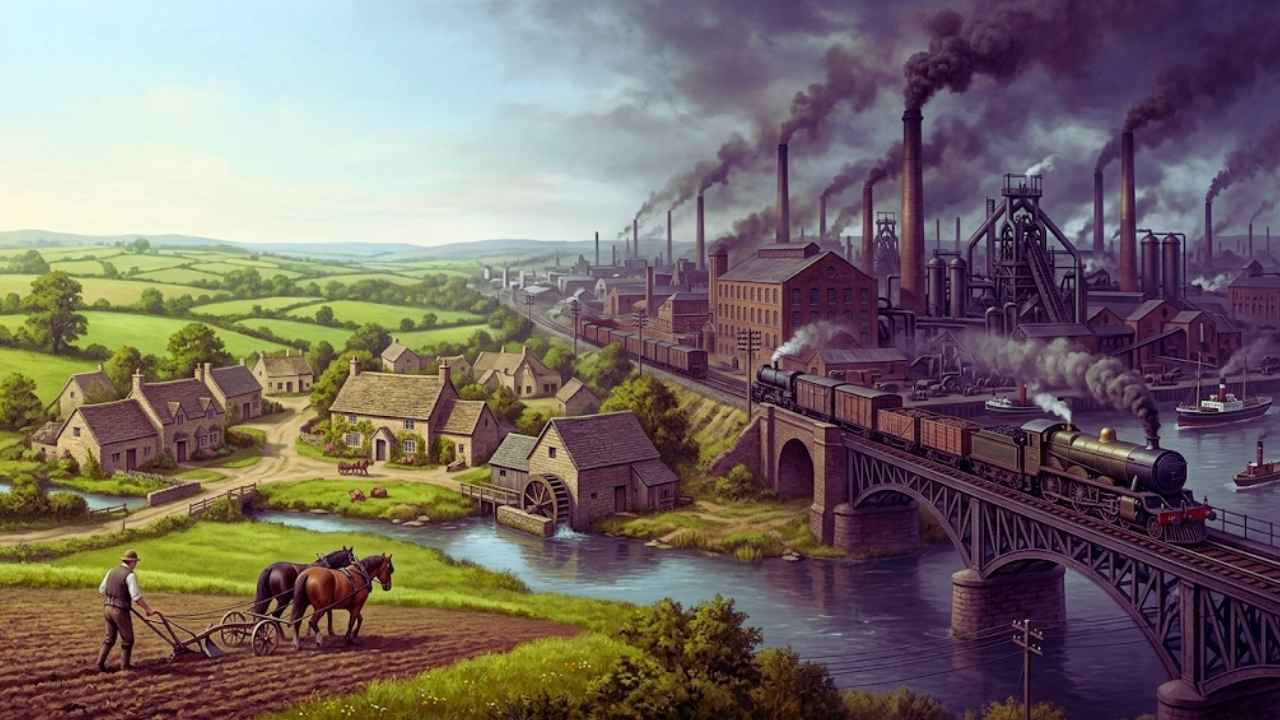
The story of human progress hit a massive acceleration point in the late 18th century. Before this shift, life moved at the slow pace of changing seasons. Most people lived on farms, grew their own food, and made clothes by hand in their living rooms. The sudden shift from farm to factory turned the world upside down.
The impact of the Industrial Revolution rewrote everything from how we work to where we live. It essentially built the modern world we know today, shifting our entire species from muscle power to machine efficiency. You woke up with the sun, worked the fields, and relied on animals or wind for power. Things moved slowly. Then Britain discovered how to mechanize production, completely snapping the timeline of human history in two.
The Dawn of Technological Marvels
The Power of Steam and Coal
For thousands of years, humans used water wheels to power mills. That meant you had to build your factory near a fast-flowing river, which severely limited where a business could operate. James Watt changed that entirely in the 1770s. He took an older, highly inefficient engine design by Thomas Newcomen and added a separate condenser, making it highly adaptable and powerful. His new steam engine could drive heavy machinery anywhere, effectively unchaining factories from riverbanks.
You could now build a massive manufacturing plant right in the middle of a crowded city. But these engines were incredibly hungry for fuel. They ran on coal, and Britain happened to sit on massive, easily accessible coal deposits. Mining became a booming, brutal industry overnight. Men and young boys dug deep underground in terrible, dangerous conditions just to keep the factory fires burning above. Coal became the absolute lifeblood of the new global economy.
|
Innovation |
Primary Function |
Societal Impact |
|
Water Wheels |
Early power source |
Kept factories tied to rivers |
|
Newcomen Engine |
Pumped water from mines |
Allowed deeper coal mining |
|
Watt Steam Engine |
Powered heavy machinery |
Moved factories into urban centers |
|
Coal Mining |
Fueled the steam engines |
Created dangerous new labor classes |
Innovations in Textile Manufacturing
Textiles kicked off the whole factory trend because making cloth at home took forever. A single worker had to spin raw cotton into thread and then weave it on a wooden handloom. It was a slow, tedious process that could not keep up with a growing population. Then, clever inventors stepped in to break the bottleneck. James Hargreaves built the spinning jenny, allowing one person to spin multiple threads at the exact same time.
Soon after, Richard Arkwright developed the water frame, and Edmund Cartwright mechanized cloth weaving with the power loom. Massive brick buildings popped up everywhere just to house these giant machines. Production output skyrocketed, making clothing incredibly cheap to buy for the average person. Across the ocean, Eli Whitney invented the cotton gin to rapidly separate cotton fibers from seeds. This single machine fueled a massive, tragic demand for raw cotton, which directly expanded plantation slavery across the American South.
|
Invention |
Inventor |
Main Effect |
|
Improved Steam Engine |
James Watt |
Powered factories anywhere |
|
Spinning Jenny |
James Hargreaves |
Sped up thread production |
|
Power Loom |
Edmund Cartwright |
Mechanized cloth weaving |
|
Cotton Gin |
Eli Whitney |
Sped up raw cotton processing |
Economic Shifts and the Rise of Capitalism
From Agrarian Societies to Industrial Giants
Before the factories took over, craftsmen worked from home at their own pace in what we call the cottage industry. The factory system wiped that out completely because it was ruthlessly efficient. Factory owners centralized everything, buying massive machines and forcing workers to come to a single location. A single textile mill could churn out more shirts in one day than an entire rural village could produce in a month.
This completely changed how nations built wealth. Governments passed enclosure acts, which fenced off public farming lands and pushed poor farmers into the cities to find work. As production costs plummeted, countries that embraced this new system saw their gross domestic product explode. Goods got cheaper, and people started buying items they previously made themselves. This shift created modern mass consumerism. The wealth gap shifted away from old royalty and straight into the hands of ambitious business owners.
|
Economic Metric |
Agrarian System |
Industrial System |
|
Work Location |
Home workshops and farms |
Centralized urban factories |
|
Pace of Work |
Dictated by seasons and daylight |
Dictated by the clock and managers |
|
Wealth Generation |
Tied to land ownership |
Tied to capital and machine ownership |
|
Output Volume |
Low yield, high manual effort |
High yield, automated efficiency |
The Birth of the Modern Middle Class
We gained a completely new social layer during this chaotic transition. Historically, you were either a very rich aristocrat or a very poor peasant, with almost nothing in between. The industrial boom created thousands of new jobs right in the middle of that spectrum. Society suddenly needed factory managers, bank accountants, railway engineers, and shipping clerks to keep the massive gears turning. This new group made comfortable salaries but did not have royal titles.
They became the modern middle class. They had disposable income and wanted nicer homes, better clothes, and real education for their kids. They stopped haggling at open-air markets and started shopping in fixed-price department stores. Because they held the economic power, they eventually demanded political power too. Their influence heavily pushed governments toward democratic reforms, shaping the modern voting systems and consumer markets we still use today.
|
Social Class |
Traditional Role |
New Industrial Role |
|
Aristocracy |
Land owners, inherited wealth |
Lost economic dominance to factory owners |
|
Middle Class |
Small merchants |
Managers, engineers, accountants |
|
Working Class |
Peasant farmers |
Factory laborers, miners |
|
Consumer Habits |
Subsistence living |
Buying mass-produced retail goods |
Social and Cultural Transformations
Urbanization and the Growth of Cities
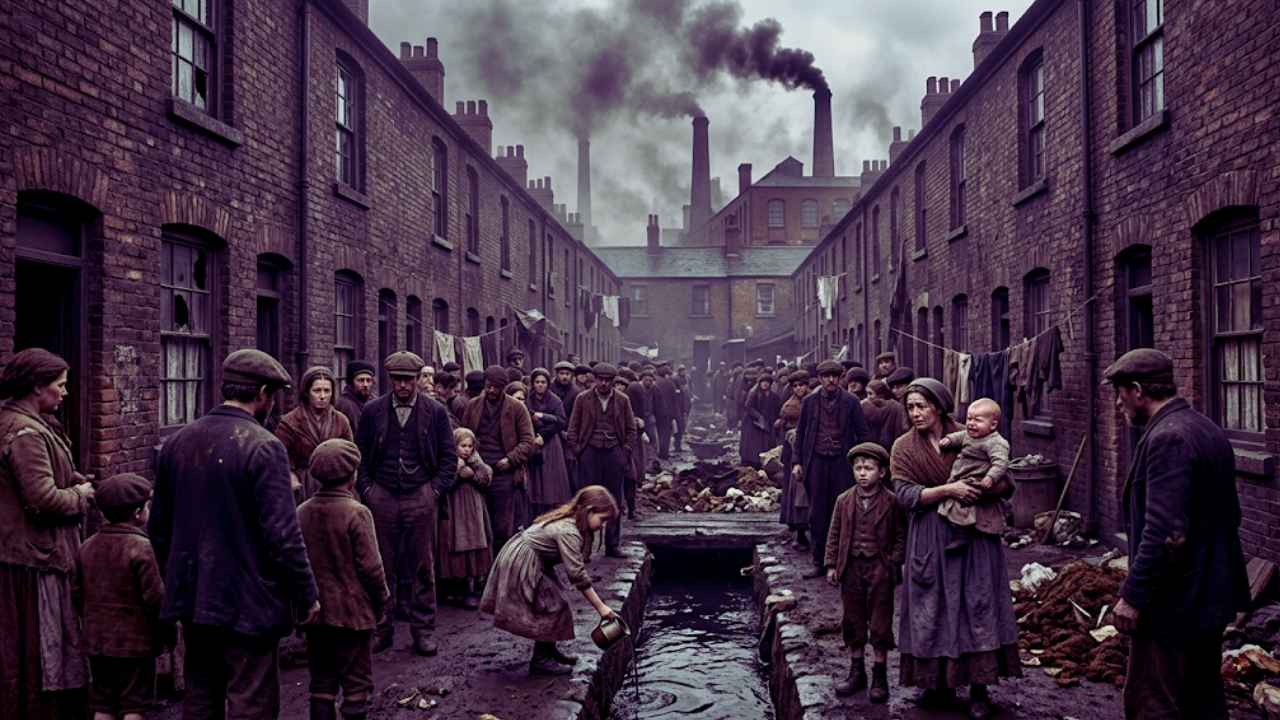
The human cost of this sudden economic boom was incredibly harsh. People flooded out of the countryside looking for factory wages, completely uprooting their traditional ways of life. Cities exploded in size practically overnight, turning quiet towns into sprawling, smog-filled metropolises. Manchester and London swelled with desperate workers seeking a better life. Builders quickly threw up cheap, cramped back-to-back terraced housing to fit everyone in, completely ignoring basic safety and sanitation.
The local infrastructure simply could not handle this massive influx of humans. Clean drinking water was rare, and open sewers literally ran down the middle of residential streets. This created the perfect breeding ground for disease. Epidemics of cholera, tuberculosis, and typhoid killed thousands of people every single year. Life expectancy in these early industrial slums was shockingly low, forcing people to trade the hard life of farming for an incredibly toxic urban environment.
|
Urban Factor |
Condition During Early Industrialization |
|
Population |
Exploded overnight as farmers migrated for work |
|
Housing |
Cramped, poorly built back-to-back tenements |
|
Sanitation |
Open sewers, contaminated drinking water |
|
Public Health |
Rampant outbreaks of cholera and tuberculosis |
Changes in Labor and Working Conditions
Work completely changed from a natural rhythm to a mechanical nightmare. You no longer worked until the sun went down or rested when it rained. You worked until the factory whistle blew, and foremen demanded absolute, unforgiving strictness. The machines never got tired, so the human workers were not allowed to stop either. Factory floors were deafeningly loud, the air was thick with toxic cotton dust, and catastrophic injuries happened almost every day. Owners refused to put safety guards on gears because it slowed down production.
The Role of Women and Children in Factories
To maximize profits, factory bosses actively sought out the absolute cheapest labor they could find. They hired women and small children by the thousands. A child as young as six could crawl under a jammed, moving machine to pull out stuck cotton. Bosses paid them pennies compared to an adult man’s wage. These kids worked up to sixteen hours a day, six days a week, and were entirely deprived of an education.
The Emergence of Labor Unions
Workers eventually realized they had to fight back if they wanted to survive. They understood that one worker complaining would just get fired, but a thousand workers striking could bankrupt a factory. They started forming illegal labor unions to demand basic human rights. Through decades of violent strikes, protests, and immense suffering, these early unions finally won the weekend, ended child labor, and secured the basic workplace safety rules we rely on today.
|
Labor Aspect |
Factory Reality |
Union Demand |
|
Daily Hours |
12 to 16 hours, six days a week |
8-hour workday and weekends off |
|
Child Labor |
Heavy reliance on children under 10 |
Complete ban on early child labor |
|
Safety |
Unguarded machines, toxic air |
Mandatory safety guards and ventilation |
|
Wages |
Bare minimum survival pay |
Fair minimum wages and collective bargaining |
The Environmental Impact of the Industrial Revolution
Resource Extraction and Pollution
We started viewing the planet entirely differently during this era. Nature simply became a giant, disposable warehouse of raw materials to burn and process. The demand for coal and iron tore up the landscape as mining companies ripped open the earth, destroying local forests and wildlife habitats in the process. The factories themselves were monumental sources of pollution.
Massive brick smokestacks pumped thick black soot into the sky day and night. In cities like London, the toxic smog got so bad it literally blocked out the sun at noon, causing severe respiratory diseases for the residents. Waterways suffered just as much as the air. Factories treated rivers as convenient, free dumping grounds for chemical runoff, toxic fabric dyes, and human waste. The River Thames famously caught fire and smelled so awful that it forced the government to suspend their legislative meetings.
|
Environmental Area |
Industrial Action |
Immediate Consequence |
|
Atmosphere |
Massive coal combustion |
Thick toxic smog and blocked sunlight |
|
Waterways |
Dumping dyes and chemicals |
Dead rivers and contaminated drinking water |
|
Landscapes |
Strip mining for coal and iron |
Deforestation and habitat destruction |
|
Wildlife |
Severe habitat disruption |
Species adaptation or localized extinction |
The Long-term Ecological Footprint
We are still paying the massive invoice for these early energy choices. Burning mountains of coal kicked off the heavy, unnatural release of greenhouse gases into our atmosphere. The carbon dioxide pumped out during the 1800s slowly began changing the chemical composition of the sky. The impact of the Industrial Revolution on our climate cannot be overstated.
Today’s severe climate change crisis traces its roots straight back to those very first steam engines running in British mills. We built modern wealth and incredible technological comforts by relentlessly burning fossil fuels. Now, modern society faces the massive, existential task of unwinding that ecological damage. We have to figure out how to keep the high standard of living the factory system gave us without continuing to destroy the biosphere that keeps us all alive.
|
Ecological Factor |
19th Century Origin |
Modern Day Consequence |
|
Carbon Emissions |
First widespread burning of coal |
Rising global temperatures and erratic weather |
|
Resource Dependency |
Shift to fossil fuel reliance |
Geopolitical conflicts over oil and gas |
|
Industrial Waste |
Lack of disposal regulations |
Microplastics and permanent chemical pollution |
|
Ocean Health |
Early chemical runoff |
Ocean acidification and coral reef death |
Global Expansion and Imperialism
The Spread of Industrialization Beyond Britain
Britain tried fiercely to keep its new technological superpowers a strict secret. The government even banned skilled engineers and machine blueprints from leaving the country. But highly profitable ideas always leak out eventually. Industrialization soon crossed the English Channel to Belgium, where British mechanics smuggled in designs to build the first mainland factories. France followed slowly, though political chaos and revolutions delayed their progress.
Germany caught on late but expanded with terrifying speed, heavily focusing on advanced chemistry and steel production. Across the Atlantic, the United States utilized its massive landmass and natural resources to become an absolute industrial titan. They built massive transcontinental railroads that connected coast to coast. Later on, Japan underwent a remarkably rapid modernization period, proving that the factory system worked perfectly in entirely different, non-Western cultural contexts.
|
Nation |
Industrial Timeline |
Key Focus Area |
|
Great Britain |
Late 1700s |
Textiles, coal mining, early steam power |
|
Belgium |
Early 1800s |
First mainland European textile mills |
|
United States |
Mid 1800s |
Railroad expansion, cotton, assembly lines |
|
Germany |
Late 1800s |
Heavy steel production, advanced chemicals |
|
Japan |
Late 1800s |
Rapid military and industrial modernization |
How Industry Fueled Global Empires?
The sprawling factories of Europe and America were incredibly hungry entities. They required a constant, massive influx of raw materials like cotton, rubber, iron, and copper just to keep the machines running. Furthermore, the sheer volume of goods being produced quickly exceeded what the domestic populations could actually purchase. Industrialized nations urgently needed new, captive consumer markets.
This dual need for cheap resources and guaranteed buyers became a primary driver of modern imperialism. Powerful nations used their newly industrialized weapons, like the Maxim machine gun and armored steam-powered gunboats, to conquer vast territories across Africa, Asia, and the Middle East. They forced local populations to mine resources and grow cash crops instead of their own food. This created a massive, persistent wealth gap between the industrialized core nations and the colonized peripheries.
|
Imperial Driver |
Industrial Need |
Resulting Action |
|
Raw Materials |
Factories needed rubber, cotton, and oil |
Colonization of resource-rich nations |
|
Consumer Markets |
Overproduction of domestic goods |
Forcing colonies to buy imported products |
|
Military Tech |
Need to project power globally |
Use of steamships and mass-produced weapons |
|
Global Inequality |
Need to keep manufacturing costs low |
Exploitation of indigenous labor forces |
The Legacy of the Industrial Revolution Today
Shaping Modern Technology and Infrastructure
You cannot look at our modern comforts without acknowledging exactly where they came from. The early, dangerous steam railways eventually evolved into the massive global logistics networks that deliver packages to our doors today. The concept of using interchangeable parts led straight to Henry Ford’s famous assembly line, which made automobiles affordable for the average family instead of just the wealthy elite.
Furthermore, the immense wealth generated by factory industrialization eventually trickled down to fund massive advancements in scientific research. We got modern medicine, clean urban drinking water systems, and reliable electricity grids. Thanks to the agricultural and scientific advances funded by the industrial economy, global life expectancy literally doubled. We live much longer, significantly more comfortable lives today directly because of the mass production systems invented over two centuries ago.
|
19th Century Innovation |
Modern Day Equivalent |
Societal Benefit |
|
Steam Locomotives |
High-speed rail and global shipping |
Rapid movement of goods and people |
|
Interchangeable Parts |
Robotics and automated assembly lines |
Cheaper consumer electronics and cars |
|
Telegraph Systems |
The Internet and smartphones |
Instant global communication |
|
Urban Sanitation Pipes |
Modern water treatment facilities |
Eradication of waterborne diseases |
Lessons for the Fourth Industrial Revolution
Right now, economists and historians suggest we are living right in the middle of another massive shift. They call it the Fourth Industrial Revolution. Driven by artificial intelligence, advanced robotics, and biotechnology, this current wave promises to change our world just as drastically as the steam engine did. By looking closely at the impact of the Industrial Revolution from the 1800s, we can find crucial survival lessons.
We clearly see that rapid technological advancement brings incredible prosperity and longer lives. But if we leave it completely unregulated, it creates severe social inequality, exploits the most vulnerable workers, and severely damages the natural environment. As we navigate a future where software and robots do our daily tasks, we must protect workers and the planet much better than our Victorian ancestors did.
|
Industrial Phase |
Primary Technology |
Key Challenge |
|
First Revolution |
Steam power, mechanization |
Child labor, extreme urban pollution |
|
Second Revolution |
Electricity, mass production |
Monopolies, labor union suppression |
|
Third Revolution |
Computers, early internet |
Outsourcing, digital divide |
|
Fourth Revolution |
Artificial Intelligence, robotics |
Job displacement, data privacy, climate |
Final Thoughts
We simply cannot look at our modern comforts without acknowledging exactly where they came from. The impact of the Industrial Revolution gave us unprecedented wealth, longer lives, and incredible technological leaps that put humanity on the moon. It also gave us modern climate change, massive global wealth gaps, and a dark history of severe worker exploitation. We left the quiet farm for the loud factory and permanently changed the trajectory of human existence.
The steam engine was the prime mover of the industrial age, historians often note, and it set a pace we are still trying to keep up with today. As we face new, terrifying shifts with artificial intelligence and digital automation, we have to look closely at the 1800s. We have to take the good parts of rapid innovation while actively preventing the terrible social and environmental costs. The choices we make today regarding our technology will echo just as loudly in the centuries to come.
Frequently Asked Questions (FAQs) About Industrial Revolution Explained
What were the main causes of the Industrial Revolution?
It started with a massive surplus of capital from better farming methods that yielded more food with less labor. Britain specifically had a ton of easily accessible coal and iron just waiting to be mined. Add in a stable government that protected private property and patents, and you had the perfect environment for inventors to take massive financial risks with new mechanical machines.
How did the Industrial Revolution affect daily life?
It aggressively moved people off generational farms and dumped them into noisy, crowded cities. You stopped working at your own natural pace and started working to the relentless ticking of a factory clock. It made buying clothes, tools, and household goods much cheaper for everyone, but early factory life was brutal, highly dangerous, and physically exhausting.
What were the negative effects of the Industrial Revolution?
It caused terrible, unchecked suffering for the working class at first. We saw rampant child labor, horrible workplace injuries, and the rapid spread of deadly diseases in slums. It also kicked off massive environmental pollution that permanently changed our atmosphere. Plus, the desperate need for cheap resources drove powerful European nations to colonize and brutally exploit weaker countries around the globe.
Why did the Industrial Revolution start in Britain?
Britain hit the geographic and political jackpot. They had fast-flowing rivers for early water power and massive coal deposits for later steam power. Their sophisticated banking system gladly loaned money to daring entrepreneurs. They also had a massive navy and global colonies to supply raw materials and buy back the finished goods.
How did the factory system change the role of the family?
Before factories, families worked together as a single unit on farms or in home-based workshops. The factory system violently split families up. Fathers, mothers, and young children all went to work in different, dangerous mills for incredibly long hours, which completely destroyed the traditional family dynamic and removed children from parental supervision.
Did the Industrial Revolution invent capitalism?
It did not invent basic trading, merchants, or profits, but it absolutely created modern industrial capitalism. The sheer scale of factory production required massive financial investments and centralized, strict control by wealthy business owners. This fundamentally changed how wealth was created, distributed, and protected by national governments.