

Choosing where to upskill has become a serious career decision in the modern professional world. A few years ago taking an online course was just a fun way to pass the time on a weekend. Today it represents a recognized pathway to landing high-paying tech jobs or earning formal university credits from your living room.
Recruiters no longer just look at where you went to college when they review your application. They want to see a layered narrative of practical skills and verified digital certifications on your resume. This shift is happening incredibly fast and you need the right tools to keep up with the competition. If you want to upgrade your skills you have probably narrowed your options down to the big three. Finding the best online learning platform 2026 for your specific needs requires looking past the marketing hype and understanding how they actually work.
Overview of the Big Three in 2026
Before we dive into the tiny details we need to understand the core philosophy behind each platform. They all sell video lessons but they serve totally different markets and learning styles. Knowing their foundational differences helps you figure out which ecosystem fits your personal career goals.
The Coursera Ecosystem
Coursera started as an experiment by two Stanford professors who wanted to make higher education accessible to everyone with an internet connection. Fast forward to today and it has morphed into a massive career training engine built for the modern workforce. The platform operates on a highly structured model that heavily features professional certificates created by industry giants like Google, IBM, Microsoft, and Meta. When you sign up for a class here you actually commit to a syllabus with specific weekly milestones.
You have to pass graded quizzes and submit peer-reviewed assignments to move forward in the curriculum. This format perfectly mimics a traditional college class but it is tailored specifically for immediate job readiness in tech and business sectors. They partner directly with over three hundred universities and top-tier corporations to ensure the material strictly meets current industry standards. If you manage a remote team and need to upskill your employees quickly this ecosystem provides a reliable and standardized training ground.
|
Feature |
Coursera Details |
|
Founding Origin |
Stanford University professors |
|
Primary Focus |
Job readiness and professional certificates |
|
Key Partners |
Google, Meta, IBM, University of Illinois |
|
Course Structure |
Weekly milestones and graded assignments |
|
Ideal Student |
Career switchers and corporate teams |
The Udemy Marketplace
Udemy operates like a completely open market without the restrictions of traditional academia. It is not tied to any traditional university or massive corporate partner dictating what gets published. Anyone with a microphone and expertise in a subject can record a class and sell it directly to students here. Because of this open door policy their catalog is absolutely gigantic and grows by the minute.
They host over two hundred thousand different courses covering everything from advanced Python programming to starting a local bakery. The focus on Udemy is immediate skill acquisition rather than deep academic theory or formal grading. You come here to learn exactly how to use a specific software tool or learn a very specific framework for a side project. The instructors are usually industry practitioners who teach you the exact methods they use at work every single day.
|
Feature |
Udemy Details |
|
Founding Origin |
Independent startup |
|
Primary Focus |
Practical skills and niche software tutorials |
|
Key Partners |
Independent creators and industry professionals |
|
Course Structure |
Self-paced video lectures with lifetime access |
|
Ideal Student |
Self-directed learners on a budget |
The edX Academic Approach
Harvard and MIT built edX to provide serious academic content to students all around the world. Even after its recent acquisition by a private company it maintains its prestigious university partnerships and strict quality control. The catalog is much smaller than the others but the content is extremely demanding and academically rigorous. This platform is famous for its MicroMasters programs which are highly respected in traditional academic circles.
These are graduate-level series that can actually count as university credit if you decide to pursue a full degree later on. The classes focus heavily on the underlying theories, mathematics, and philosophies of a given field rather than just quick software tutorials. It is reading-heavy and deeply intellectual, requiring a massive time commitment from students. If you want to study quantum mechanics or supply chain management at a master level this is your destination.
|
Feature |
edX Details |
|
Founding Origin |
Harvard and MIT |
|
Primary Focus |
Academic rigor and graduate-level depth |
|
Key Partners |
Ivy League schools and top global universities |
|
Course Structure |
Traditional semester pacing with heavy reading |
|
Ideal Student |
Serious academics and senior leadership professionals |
Course Catalog and Subject Variety
The topic you want to study will likely make the choice for you before you even look at the price tags. Each website specializes in completely different fields of study and caters to different industries. You need to pick the platform that actually hosts high-quality content in your target career path.
What to Learn on Coursera?
Coursera rules the tech and business world with an iron fist. If you want to become a data analyst, project manager, UX designer, or cybersecurity specialist you will find a dedicated path here. Their professional certificate programs are legendary for taking absolute beginners and making them job-ready in about six months.
You will find incredible depth in subjects like machine learning, artificial intelligence, and cloud computing infrastructure. The platform also offers fully accredited online bachelor and master degrees from schools like the University of London. They focus strictly on skills that translate directly into higher salaries and corporate promotions. However if you want to learn how to play the guitar or edit photos for fun you will find their selection very limited.
|
Subject Area |
Coursera Strength Level |
Example Programs |
|
Technology and IT |
Very High |
Google IT Support, Meta Front-End Developer |
|
Business and Finance |
High |
IBM Data Science, Corporate Strategy |
|
Arts and Hobbies |
Low |
Very few creative or lifestyle courses |
|
Academic Degrees |
Very High |
Online Master of Computer Science |
|
Language Learning |
Medium |
Basic university-level language intro classes |
What to Learn on Udemy?
Udemy is the absolute king of variety and speed to market. Because independent creators constantly upload new material Udemy is always the first to have tutorials on brand-new technology. If a new artificial intelligence tool launches on a Monday you will find a Udemy guide for it by Thursday afternoon. They excel in massive coding bootcamps that cover multiple languages in one package.
A single web development course might pack sixty hours of video into one purchase covering HTML, CSS, JavaScript, and Node. Beyond technology Udemy is fantastic for personal development, music, fitness, and language learning. If you need to learn a highly specific skill like how to use a particular plugin for WordPress Udemy is the only place that will have a dedicated course for it.
|
Subject Area |
Udemy Strength Level |
Example Programs |
|
Web Development |
Very High |
Complete Web Developer Bootcamp |
|
Niche Software |
Very High |
Specific Excel macros, Final Cut Pro editing |
|
Personal Development |
High |
Public speaking, time management hacks |
|
Traditional Science |
Low |
Lacks formal biology or chemistry labs |
|
Music and Arts |
High |
Digital drawing, piano mastery |
What to Learn on edX?
This is the home of the hard sciences and deep humanities for serious students. You go to edX to study the history of global architecture or the foundational math behind artificial intelligence. Their catalog includes executive education programs designed specifically for senior professionals who want to understand global market trends. You will not find quick tutorials on how to use a basic spreadsheet program here.
Instead you will find deep explorations of corporate finance, global economics, and constitutional law. The material is rigorous and often requires reading peer-reviewed academic papers alongside the video lectures. It is less about pressing buttons on a screen and more about expanding your intellectual capacity for higher-level problem solving.
|
Subject Area |
edX Strength Level |
Example Programs |
|
Hard Sciences |
Very High |
Quantum Mechanics, Advanced Physics |
|
Humanities |
Very High |
Global History, Literature and Philosophy |
|
Executive Leadership |
High |
Corporate Finance, Supply Chain Management |
|
Quick Software Skills |
Low |
Very few software-specific tutorials |
|
Academic Credits |
Very High |
MIT MicroMasters in Data Economics |
Pricing and Subscription Models in 2026
When looking for the best online learning platform 2026 cost is usually the biggest deciding factor for most people. The pricing structures across these websites range from totally free to several thousand dollars. You need to understand their billing models so you do not accidentally overpay for content you could get cheaper elsewhere.
Coursera Pricing and Coursera Plus
Coursera relies heavily on a monthly subscription model for the vast majority of its premium content. You can audit many classes for free just to watch the videos but you have to pay if you want access to graded assignments and the final certificate. Individual class subscriptions usually run around forty to eighty dollars per month depending on the specific subject. The smartest move for dedicated students is getting Coursera Plus which offers incredible value.
For about sixty dollars a month or roughly four hundred dollars a year you get unlimited access to almost everything on the site. This unlimited tier includes the highly coveted professional certificates from Google and Meta. If you learn fast you can finish a full credential in a month and only pay for that single month of access. They also frequently run sales during holidays dropping the annual price significantly for new users.
|
Pricing Tier |
Cost Estimate |
Access Level |
|
Free Audit |
Zero dollars |
Video lectures and reading materials only |
|
Individual Course |
Forty to eighty dollars monthly |
Full access to one specific course and certificate |
|
Coursera Plus Monthly |
Sixty dollars |
Unlimited access to most courses and certificates |
|
Coursera Plus Annual |
Four hundred dollars |
Year-long unlimited access to the entire catalog |
|
Degree Programs |
Varies widely |
Full university tuition rates apply |
Udemy Pricing and Flash Sales
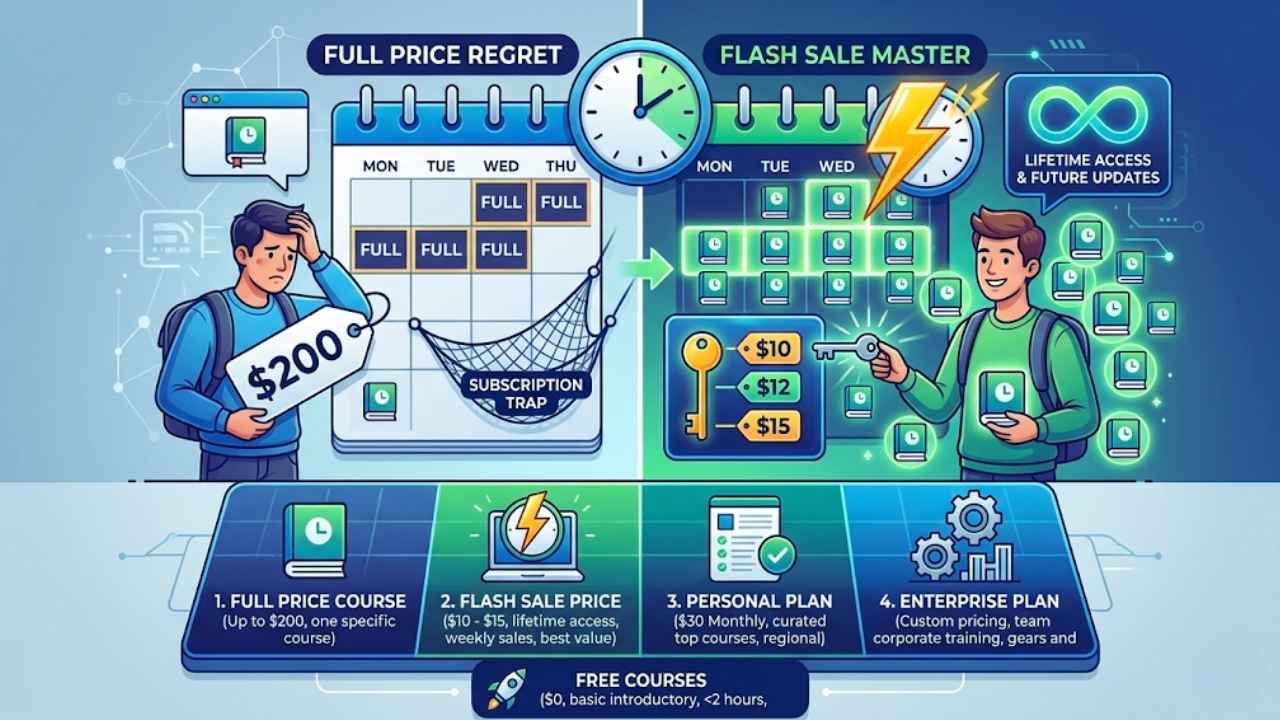
Udemy prices everything individually rather than locking you into a subscription trap. The instructors set their own prices which technically range up to two hundred dollars per course. But the golden rule of this website is that you never ever pay full price for anything. They run massive site-wide sales almost every single week to drive volume.
During these sales nearly every class drops to between ten and fifteen dollars. When you buy something you get lifetime access to it including all future updates the instructor adds later. They do offer a personal monthly subscription in some regions but buying individual topics on sale remains the cheapest and most popular method for students.
|
Pricing Tier |
Cost Estimate |
Access Level |
|
Full Price Course |
Up to two hundred dollars |
Lifetime access to one specific course |
|
Flash Sale Price |
Ten to fifteen dollars |
Lifetime access to one specific course |
|
Personal Plan |
Thirty dollars monthly |
Access to a curated list of top courses |
|
Enterprise Plan |
Custom pricing |
Team access for corporate training |
|
Free Courses |
Zero dollars |
Basic introductory courses mostly under two hours |
edX Pricing and Free Auditing
edX offers a very generous free tier for people who just want to learn without needing paper proof. You can audit almost any individual class completely free of charge for the duration of the course schedule. You get full access to the reading materials, video lectures, and discussion boards to learn at your own pace.
If you want a verified certificate though edX gets expensive very quickly. A single verified certificate usually costs between fifty and three hundred dollars depending on the school. Their larger professional programs can easily exceed one thousand dollars. You are paying a massive premium for the Harvard, MIT, or Oxford logos on your digital paper. It is an investment in academic prestige rather than just a simple purchase.
|
Pricing Tier |
Cost Estimate |
Access Level |
|
Free Audit |
Zero dollars |
Temporary access to course materials |
|
Verified Certificate |
Fifty to three hundred dollars |
Graded exams and official university badge |
|
Professional Certificate |
Three hundred to nine hundred dollars |
Series of courses for career advancement |
|
MicroMasters Program |
One thousand dollars or more |
Graduate-level series eligible for credit |
|
Full Master Degree |
Ten thousand dollars or more |
Completely online accredited university degree |
Accreditation and Certificates
Earning a certificate to post on your professional profile is a primary goal for many people. But you have to know how hiring managers actually view these digital credentials before you spend your time and money. Not all certificates are created equal and some hold absolutely zero weight in the corporate world.
Are Coursera Certificates Worth It?
Right now these certificates hold serious weight in the modern job market. The credentials sponsored by major tech companies are highly respected by recruiters everywhere. Google publicly states that they treat their own Coursera professional certificates as equivalent to a four-year degree for relevant entry-level roles within their company.
Hiring managers recognize these badges because they prove you went through a standardized, rigorous curriculum. While a digital badge alone will not magically get you hired it is a fantastic addition to your resume. It shows you have practical skills, the discipline to finish a long-term project, and the drive to stay updated. They act as a massive trust signal for remote agencies looking to hire self-starters.
|
Certificate Type |
Employer Recognition |
Best Use Case |
|
Tech Company Professional |
Very High |
Landing entry-level IT and Data jobs |
|
University Specialization |
High |
Showing deep knowledge in a niche subject |
|
Single Course Badge |
Low |
Adding keywords to a LinkedIn profile |
|
MasterTrack Certificate |
Very High |
Preparing for a full graduate degree |
|
Free Audit Badge |
None |
Personal satisfaction |
Udemy Certificates of Completion
Every time you finish a paid video series on Udemy you get an automated certificate of completion. Sadly these hold almost zero professional weight in any serious industry. Because anyone can publish a class and there is no strict grading system to prove you actually did the work employers do not view them as formal credentials. You use this site for the raw knowledge rather than the paper.
You take the class to learn how to build a portfolio project that you can actually show off. During a job interview you show the hiring manager the actual website or app you built rather than handing them the printed certificate. The true value is in the skill itself not the digital badge they email you at the end.
|
Certificate Type |
Employer Recognition |
Best Use Case |
|
Standard Paid Course |
None |
Proof of personal continuing education |
|
IT Certification Prep |
None |
Preparing for actual CompTIA or AWS exams |
|
Bootcamp Completion |
Very Low |
Showing initiative on a junior resume |
|
Free Course Badge |
None |
Does not exist |
|
Enterprise Training Badge |
Low |
Internal company compliance tracking |
edX Verified Certificates and MicroMasters
These are the most academically prestigious credentials you can get outside of traditional campus enrollment. Having a verified certificate from MIT on your resume certainly catches the eye of any recruiter looking for top-tier analytical talent. The MicroMasters programs are especially valuable for people playing the long game with their careers.
If you finish one and later get accepted into that specific university for a real-world master degree the MicroMasters counts as actual college credit. This saves you a massive amount of tuition money and shaves months off your study time. These are serious credentials strictly for people looking to climb the corporate ladder into executive positions or enter academia.
|
Certificate Type |
Employer Recognition |
Best Use Case |
|
Verified Single Course |
High |
Proving academic rigor on a resume |
|
Professional Certificate |
High |
Corporate upskilling and promotions |
|
MicroMasters |
Very High |
Converting into actual university graduate credit |
|
Executive Education |
Very High |
Senior leadership and board level resumes |
|
XSeries Program |
Medium |
Deep dive into a specific academic subject |
Instructor Quality and Teaching Style
The person teaching you completely defines your entire experience on these platforms. A boring teacher can easily ruin a fascinating subject and make you quit halfway through. The instructor profiles vary wildly between these three websites and you need to know who is going to be talking to you through the screen.
University Professors vs Industry Professionals
On Coursera you learn strictly from tenured college professors or senior engineers at major tech firms. The video production is incredibly high and the teaching style is calm, deliberate, and highly polished. Every single piece of information is thoroughly vetted by educational departments before it ever reaches your screen. On edX the instructors are almost exclusively traditional university faculty members.
The teaching style strictly mirrors a traditional lecture hall where professors speak behind podiums or walk you through complex slide decks. Udemy is a total wildcard where your teacher might be a self-taught software developer or an enthusiastic hobbyist recording from their living room. The best instructors on Udemy are engaging and highly focused on keeping you entertained but you have to read student reviews carefully to avoid the bad ones.
|
Platform |
Typical Instructor Background |
Teaching Style Focus |
|
Coursera |
Corporate leaders and professors |
Structured, calm, and highly professional |
|
Udemy |
Everyday industry practitioners |
Conversational, fast-paced, and highly practical |
|
edX |
Ivy League university faculty |
Academic, traditional, and deeply theoretical |
User Interface and Learning Experience
A clunky website kills your motivation to study faster than anything else. Navigating the best online learning platform 2026 should feel completely frictionless from the moment you log in. All three websites have matured significantly over the years but they organize their digital classrooms very differently.
Coursera has a highly structured layout that keeps you on track by breaking everything down into manageable weekly chunks. It tells you exactly how many hours of video and reading you have left for your current module so you can plan your day. The video player includes amazing interactive transcripts that highlight the text as the instructor speaks which makes taking notes incredibly easy.
Udemy focuses entirely on the video player making it feel very much like a premium YouTube experience. It is fast and responsive with a brilliant Q&A section attached to every single video for instant help. edX has historically had a rigid interface because their material often relies heavily on text and embedded PDFs. It feels a bit like a traditional college portal which gets the job done but lacks the sleek modern polish you get from the other two.
|
Platform |
Desktop Interface Strengths |
Desktop Interface Weaknesses |
|
Coursera |
Excellent weekly progress tracking |
Can feel overly rigid if you want to skip ahead |
|
Udemy |
Lightning fast video player and great Q&A |
Lacks structured syllabus views |
|
edX |
Handles complex academic PDFs well |
Feels outdated and occasionally clunky to navigate |
Mobile App Experience
All three offer very solid mobile applications for both iOS and Android platforms to help you learn on the go. You can download videos for offline viewing on all of them which is absolutely perfect for commuting on a train or plane. Coursera and Udemy have completely adapted their quizzes to work perfectly on small mobile touch screens without frustration.
You can easily complete a whole module while sitting in a waiting room or riding the bus. edX has a good app for watching the video lectures but completing their complex academic assignments almost always requires switching back to a full desktop computer. Their assignments are simply too complex to type out on a small phone keyboard effectively.
|
Platform |
Mobile Video Playback |
Mobile Quiz Usability |
|
Coursera |
Excellent with offline downloads |
Fully optimized for touch screens |
|
Udemy |
Excellent background audio options |
Very easy to use on small screens |
|
edX |
Good for watching lectures |
Poor for completing complex written assignments |
Pros and Cons
To make this decision as simple as possible we need to look at the harsh realities of each website. Every option has incredible strengths and deeply frustrating weaknesses that you need to consider. Seeing them lined up makes it much easier to pick the right path for your specific situation.
Coursera Pros and Cons
The biggest advantage here is the massive career impact you get from their corporate partnerships. The professional certificates from major tech companies act as real resume builders that recruiters actively search for. The structured weekly paths force you to actually finish the work instead of abandoning it halfway through like most people do.
Coursera Plus offers immense value for aggressive learners who want to stack multiple credentials in a single year. The downside is the subscription trap because if you get busy with work and stop studying you are still paying that monthly fee. It can get very expensive if you learn slowly over several months. Also they offer very little variety outside of the tech and business sectors making it useless for creative hobbies.
|
Coursera Pros |
Coursera Cons |
|
Elite corporate partnerships for hiring |
Monthly subscriptions drain money if you pause |
|
High production value and vetted facts |
Very limited creative or lifestyle subjects |
|
Coursera Plus offers massive yearly value |
Rigid weekly schedules can feel stressful |
Udemy Pros and Cons
The pricing model is completely unbeatable if you know how to work the system. For the cost of a fast food lunch you can buy a fifty hour comprehensive masterclass on almost any software tool in existence. You get lifetime access to the videos so you never feel rushed to finish before a subscription renews.
It is highly practical and focuses purely on getting things done rather than writing essays about theory. The major drawback is the total lack of formal recognition from the corporate world. You will never get a job just by showing a Udemy certificate to a hiring manager. The quality control is also entirely up to you because you have to actively filter out bad teachers by reading the reviews before you buy.
|
Udemy Pros |
Udemy Cons |
|
Extremely cheap during weekly flash sales |
Certificates hold absolutely zero weight |
|
Unmatched variety of niche technical topics |
Quality control relies entirely on student reviews |
|
Lifetime access removes all time pressure |
No structured paths for complete beginners |
edX Pros and Cons
The academic prestige is the main selling point that draws people to this platform. Getting to study material directly from Harvard and MIT for free is an incredible resource for anyone in the world. The MicroMasters tracks offer a legitimate backdoor into a real college degree program which is completely unique in this space. The reading material is unmatched in its depth and historical context.
The negative side is the massive cost of verified completion for the certificates. Paying hundreds of dollars for a single digital badge is steep for most standard learners. They also have the smallest catalog of the three and the pacing can be frustrating with strict start and end dates.
|
edX Pros |
edX Cons |
|
Ivy League academic prestige on your resume |
Paid certificate tracks are extremely expensive |
|
MicroMasters convert to real college credits |
Smallest overall course catalog of the three |
|
Deeply intellectual and rigorous material |
Strict semester pacing limits flexibility |
Coursera vs Udemy vs edX: Which Should You Choose?
There is no single winner that takes all in the digital education space. The best online learning platform 2026 depends completely on what you are trying to achieve this year. You have to match your current career situation with the correct teaching model to get the highest return on your time.
Best for Career Advancement
If your goal is to get a brand new job or switch industries entirely then Coursera is the absolute best choice. The credentials they offer are specifically designed by hiring companies to bypass traditional degree requirements for entry-level roles. The rigid structure ensures you stay disciplined and the final badge actually means something to modern recruiters.
The hiring landscape now prioritizes specific skills over generic degrees, making Coursera the safest bet for corporate climbers. They bridge the exact gap between knowing a skill and proving to a company that you know it. If you want to increase your salary quickly stick to the professional tracks here.
|
Career Goal |
Recommended Platform |
Suggested Action |
|
Land an entry-level IT job |
Coursera |
Google IT Support Professional Certificate |
|
Switch to Data Analytics |
Coursera |
IBM Data Science Professional Certificate |
|
Become a UX Designer |
Coursera |
Meta Front-End Developer Certificate |
Best for Budget Learners
If you simply want to learn a practical skill without draining your bank account Udemy wins easily every single time. It is perfect for self-starters who just want raw knowledge to apply to their own side projects. Whether you need to learn advanced Excel formulas for work or want to learn how to edit videos for a YouTube channel Udemy provides massive value.
You pay once and own the knowledge forever without any recurring monthly fees stressing you out. It is the ultimate tool for scrappy entrepreneurs who need to learn how to fix a specific problem today.
|
Budget Goal |
Recommended Platform |
Suggested Action |
|
Learn Python for under twenty dollars |
Udemy |
Wait for a flash sale and buy a bootcamp |
|
Master Adobe Premiere quickly |
Udemy |
Find the highest rated practical tutorial |
|
Learn basic Spanish for travel |
Udemy |
Buy a conversational language course |
Best for Academic Depth
If you are an intellectual who loves deep theoretical challenges or you are preparing for graduate school edX is your home. It allows you to test the waters of elite university material without taking out massive student loans just to see if you like the subject.
It is built strictly for serious academics who want to understand the foundational why behind a subject rather than just the how. The reading requirements will push you to your limits and force you to think critically about global issues. If you want to sit in a virtual Ivy League classroom this is the only platform that truly delivers that exact experience.
|
Academic Goal |
Recommended Platform |
Suggested Action |
|
Prepare for an MBA program |
edX |
Audit a corporate finance module |
|
Earn credit toward a Master degree |
edX |
Enroll in a full MicroMasters program |
|
Study high-level humanities |
edX |
Take a Harvard history or literature class |
Final Thoughts
The digital education space gives you unprecedented access to world-class knowledge right from your laptop. You no longer have to quit your job and take out massive loans to gain valuable skills that employers actually want. Coursera will build your modern corporate credentials and get your resume past the automated screening software.
Udemy will give you highly practical everyday skills on a tight budget so you can build real projects. edX will deeply challenge your raw intellect with university-level rigor and prestigious partnerships. Take a moment to define your exact goal for the year and be totally honest about your daily study habits. Once you align your personal goals with these ecosystems you will confidently choose the best online learning platform 2026 for your future.
Frequently Asked Questions (FAQs) About Coursera vs Udemy vs edX
What happens if I miss a deadline on a Coursera weekly module?
Coursera is actually quite forgiving with its deadlines despite the structured layout. If you fall behind you can simply click a button to reset your deadlines to the next available session without losing any of your previous progress. You just keep paying the monthly subscription fee until you finally finish the work.
Technically Udemy terms of service prohibit sharing a single personal account across multiple users. If you manage a remote team and need everyone to learn a specific software you should look into Udemy Business. It provides a customized dashboard where you can assign specific tutorials to your team and track their completion rates.
Do edX verified certificates expire after a certain number of years?
No, the verified certificates you earn on edX do not have an expiration date attached to them. Once you pass the rigorous grading process and pay the fee that digital credential belongs to you forever. You can permanently link it to your professional profiles to showcase your academic achievements.
Is it possible to download the actual video files from these platforms to my computer?
Most of these platforms strictly protect their video files using digital rights management software to prevent piracy. While you can download the videos inside their official mobile apps for offline viewing you cannot easily download the raw MP4 files directly to your hard drive. You are purchasing access to the content within their enclosed ecosystem.
How do employers verify that my digital certificate is actually real?
When you finish a certified track on Coursera or edX you receive a unique digital URL associated with your specific badge. You place this URL on your resume or professional profile. When a recruiter clicks the link it takes them to a secure verification page hosted by the platform that confirms your identity and the exact date you passed the final exam.