

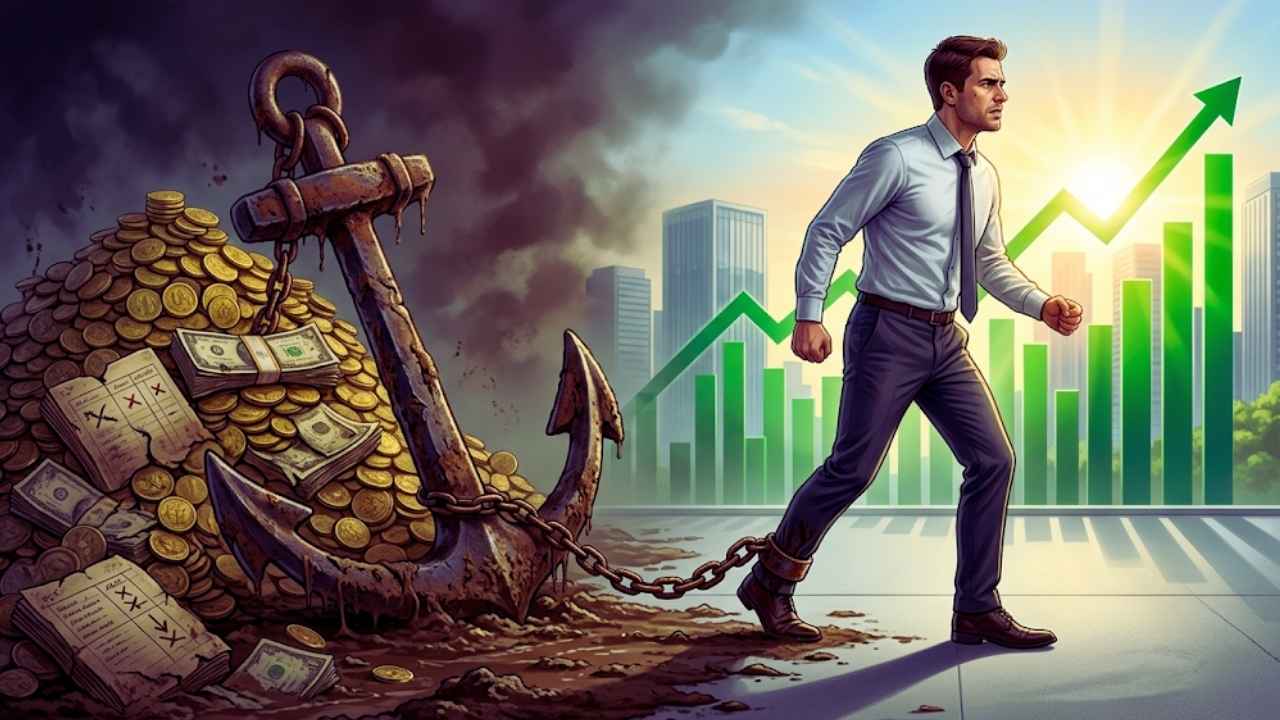
Have you ever sat through a terrible movie just because you paid twenty bucks for the ticket? You knew the movie was bad ten minutes in. But you stayed anyway. You didn’t want to waste your money. Ironically, by staying, you wasted both your money and two hours of your life. That right there is the sunk cost fallacy in action.
When it comes to managing your money, the sunk cost fallacy in personal finance is one of the most dangerous psychological traps you will face. It convinces you to throw good money after bad. It makes you hold onto losing investments, broken cars, and bad business ideas simply because you already paid for them. If you want to build actual wealth, you have to learn how to spot this trap and walk away from it.
What is the Sunk Cost Fallacy?
The sunk cost fallacy happens when you continue spending time, money, or energy on something just because you already invested in it. Instead of looking at what is best for your future, you let past expenses dictate your current choices. Allowing these unrecoverable costs to drive your financial decisions always leads to irrational behavior. You end up draining your bank account to protect your ego rather than protecting your future wealth.
Defining Sunk Costs in Simple Terms
A sunk cost is any resource you have spent that is gone forever and cannot be recovered under any circumstances. Think of it like dropping a twenty dollar bill into a storm drain. Once it slips through the grate, you cannot salvage it. You can stand there and cry about it, or you can walk away and get on with your day, but you are not getting that money back. In the financial world, sunk costs look like non-refundable deposits, money spent on failed business marketing, or the cash you paid for a college class you ended up failing.
A perfectly rational person completely ignores these costs when deciding what to do next. But we are humans, and we hate feeling like we wasted something valuable, so we let these invisible anchors weigh down our future choices. Any financially savvy person knows that identifying these unrecoverable expenses is the first step toward better money management.
|
Financial Scenario |
Sunk Cost Example |
Why It Cannot Be Recovered |
|
Stock Trading |
Trading fees and commissions |
The broker keeps the fee regardless of stock performance |
|
Real Estate |
Initial property appraisal fee |
The appraiser already provided the service and took payment |
|
Education |
Non-refundable tuition deposit |
The university policy explicitly forbids returning the funds |
|
Business Startups |
Money spent on custom logos |
The designer completed the work and cannot undo the labor |
How This Mental Trap Operates in Daily Life?
This mental trap sneaks into our daily routines and quietly drains our wallets without us even noticing. You buy an expensive dress for a wedding, realize it doesn’t fit right, but refuse to sell it or give it away. You just leave it in your closet for years because it cost two hundred dollars. You are letting a sunk cost dictate your closet space and peace of mind. Or maybe you pay for an expensive software subscription for your side hustle.
You realize the software is clunky, hard to navigate, and slows you down, but you force yourself to use it anyway because you paid for the whole year upfront. You are sacrificing daily efficiency and potential profit just to justify the money you already spent months ago. The trap operates by blinding you to current reality, forcing you to constantly look backward at what you spent instead of looking forward at what you actually need.
|
Daily Life Area |
The Irrational Action |
The Logical Alternative |
|
Clothing |
Keeping expensive clothes that do not fit |
Donating or selling them to clear out closet space |
|
Entertainment |
Finishing a terribly boring book |
Putting the book down and starting a better one |
|
Technology |
Using slow software because it was pricey |
Switching to a cheaper, faster alternative |
|
Food |
Eating a bad meal at a restaurant |
Sending it back or leaving it unfinished to avoid feeling sick |
The Psychology Behind the Sunk Cost Fallacy
Understanding why we do this requires a quick look at human psychology. We do not make bad choices on purpose. Our brains are hardwired to protect us from pain, and losing money hurts a lot. When you acknowledge a sunk cost and walk away, you force your brain to process the pain of a loss. To avoid that pain, your brain tricks you into believing that if you just hold on a little longer, you can turn a loss into a win.
Loss Aversion and the Pain of Losing Money
Loss aversion is the main engine behind this fallacy and it controls much of our financial behavior. Behavioral economists have proven that the psychological pain of losing fifty bucks is twice as intense as the joy of finding fifty bucks. We are biologically wired to avoid losses at all costs. When you sell a plummeting stock, you make the loss real on paper and finalize the pain.
As long as you hold the stock, you can tell yourself it is just a temporary dip and hope for a rebound. Your brain desperately wants to avoid finalizing that loss, so you hold onto a terrible investment for years. You hope it will bounce back so you can break even and avoid the emotional distress, entirely missing out on other great opportunities while you wait.
|
Psychological Feeling |
Triggering Event |
Financial Consequence |
|
Extreme Disappointment |
Checking a portfolio and seeing a massive drop |
Refusing to look at bank accounts out of fear |
|
False Hope |
A bad stock goes up by one percent |
Deciding to hold the stock for another five years |
|
Emotional Paralysis |
Realizing a business idea is failing |
Doing nothing while the business burns through savings |
|
Defensive Anger |
Someone suggests selling the losing asset |
Doubling down and buying more to prove them wrong |
Commitment Bias and Justifying Past Effort
Commitment bias happens because we all want to look smart and consistent to ourselves and the people around us. When you announce to your friends that you are starting a business, you put your ego and reputation on the line. If the business model fails a few months later, shutting it down feels like a public humiliation. So, you keep pouring your savings into the failing business just to keep up appearances.
You want to prove to yourself and everyone else that your original decision was correct and that you are not a quitter. You try to justify your past effort by working longer hours and spending more cash, which only digs the financial hole deeper and makes the eventual collapse much more painful.
|
Type of Commitment |
How It Manifests |
Why It Traps You |
|
Public Commitment |
Telling everyone on social media about a project |
You fear the embarrassment of admitting it failed |
|
Time Commitment |
Spending three years building a prototype |
You feel you owe it to your past self to finish |
|
Financial Commitment |
Draining your 401k to fund a startup |
You cannot stomach the thought of the money being gone |
|
Identity Commitment |
Calling yourself an entrepreneur |
Quitting feels like losing a core part of who you are |
The Framing Effect and the Fear of Failure
How you frame a situation changes exactly how you react to it and the decisions you make. Most of us frame giving up as a massive personal failure. We grow up hearing that winners never quit and quitters never win, which is terrible advice for investing. But in finance, quitting is often the smartest and most lucrative thing you can do.
If you frame selling a money-pit property as a failure, you will keep dumping money into endless renovations. If you frame it as a strategic move to free up cash for a much better investment, selling becomes an incredibly easy choice. The sunk cost fallacy feeds on our fear of being labeled a quitter, forcing us to stay in bad situations just to save face.
|
How You Frame It (The Trap) |
How to Reframe It (The Solution) |
|
I am giving up on my dream house. |
I am protecting my cash from a bad real estate deal. |
|
I wasted three years on this project. |
I learned valuable skills to use on my next project. |
|
I am locking in a huge loss on this stock. |
I am freeing up capital to invest in a winning company. |
|
Admitting defeat means I am a failure. |
Pivoting quickly makes me an intelligent investor. |
Unrealistic Optimism in Investing

We all like to think we have a special touch when it comes to picking investments. When we put our own money into something, we suffer from severe unrealistic optimism. We genuinely believe we are immune to market crashes, recessions, or business failures. This blind optimism makes us ignore terrible financial data that is right in front of our faces.
Even when a company’s revenue is tanking and the CEO gets fired, we convince ourselves that our investment will somehow survive and thrive. This optimism keeps us financially tied to sinking ships long after everyone else has jumped overboard, turning what should have been a minor loss into a complete financial disaster.
|
Optimistic Belief |
The Harsh Reality |
The Financial Result |
|
The market always bounces back quickly. |
Recoveries can take decades to materialize. |
Your money sits dead in the market for years. |
|
I know something the experts do not know. |
The market has priced in all available information. |
You lose money betting against the overall trend. |
|
This crypto coin is going to the moon. |
The project has zero utility and is losing users. |
Your entire investment drops to zero overnight. |
|
My struggling business will boom next month. |
Sales have declined for six straight months. |
You take on massive credit card debt to stay open. |
Real-World Examples of the Sunk Cost Fallacy in Personal Finance
Now that we know the psychology, let us look at how this plays out in the real world. The sunk cost fallacy in personal finance is not just a theoretical concept taught in textbooks. It happens to regular people every single day. Recognizing these everyday examples can help you identify where your own money might be leaking out.
Holding Onto Losing Stocks and Investments
This is the classic scenario that ruins amateur investors and keeps them from building true wealth. You buy shares of a tech company at eighty dollars apiece. Six months later, the company misses its earnings report, the competition releases a better product, and the stock drops to thirty dollars. A rational investor looks at the terrible company fundamentals, realizes the growth story is over, and sells.
But you look at the fifty dollars you lost per share and decide to hold. You might even buy more at thirty dollars to lower your average cost, convinced it has to go back up eventually. You completely ignore that the company is failing, choosing instead to let your past purchase price dictate your current portfolio strategy.
|
Investment Mistake |
The Emotional Driver |
The Smarter Move |
|
Averaging down on a failing company |
Desperation to lower the break-even price |
Selling and buying into a profitable index fund |
|
Holding a dead stock for ten years |
Refusal to admit the initial research was wrong |
Taking the tax write-off for capital losses |
|
Checking the stock price every hour |
High anxiety and inability to let go |
Setting a stop-loss order and walking away |
|
Buying more crypto after a rug pull |
Blind faith that the community will return |
Accepting the scam and protecting remaining capital |
The Endless Car Repair Trap
We have all known someone with a broken-down car they refuse to sell, and it drains their wallet constantly. Let us say you buy an older sedan for a cheap commute. Two months in, the transmission dies completely. You spend two thousand dollars replacing it. A few weeks later, the alternator goes out. You think you cannot sell it now because you just paid for a brand new transmission.
So you fix the alternator. Then the radiator cracks and leaks everywhere. Because you already sunk three thousand dollars into repairs, you feel totally trapped. You keep throwing cash at a dying vehicle instead of cutting your losses, selling it for scrap, and getting a reliable car.
|
Car Part Repaired |
Cost of Repair |
The Sunk Cost Justification |
|
Transmission |
Two thousand dollars |
I just fixed it, I cannot sell the car now. |
|
Alternator |
Five hundred dollars |
It is cheaper than buying a whole new car today. |
|
Radiator |
Four hundred dollars |
I have to protect the money I spent on the transmission. |
|
Suspension |
Eight hundred dollars |
If I fix this, the car will finally be perfect. |
Real Estate and the Money Pit Home
Buying a fixer-upper often sounds like a fast track to building wealth and securing a great family home. But older homes hide incredibly expensive secrets behind the drywall. You buy a house planning to spend twenty thousand on a simple cosmetic flip. You rip up the floor and find massive termite damage.
You pay ten thousand to fix the structural rot. Then you find outdated electrical wiring that completely fails the city code. Because you already spent your entire renovation budget on invisible repairs, you feel you have to keep going to finish the job. You take out high-interest personal loans to finish the kitchen just so the previous money does not feel wasted, ultimately losing thousands of dollars when you finally sell it.
|
Hidden House Issue |
Cost to Fix |
Why It Triggers the Fallacy |
|
Termite Damage |
Ten thousand dollars |
It is structural, so you cannot skip it if you want to sell. |
|
Outdated Plumbing |
Fifteen thousand dollars |
You already ripped open the walls to fix other things. |
|
Bad Roof |
Twelve thousand dollars |
The new kitchen will get ruined if the roof leaks. |
|
Foundation Cracks |
Twenty thousand dollars |
You are too far into the project to just walk away. |
Sticking with the Wrong College Degree
College is wildly expensive, and young students fall for this fallacy all the time without realizing it. Imagine a student three years into a rigorous pre-medical degree. They have taken out a hundred thousand dollars in student loans and spent thousands of hours in the library. Suddenly, they realize they despise hospitals, hate the sight of blood, and actually have a deep passion for graphic design.
But they already spent three years and a fortune on science classes. They feel they have to finish what they started. They spend another fifty thousand dollars and suffer through a career they hate for thirty years, all to validate a decision they made when they were teenagers.
|
Year in College |
Sunk Cost Accumulated |
The Internal Monologue |
|
Freshman Year |
Thirty thousand dollars |
I just started, I have to give it a fair chance. |
|
Sophomore Year |
Sixty thousand dollars |
I am halfway done, changing majors is too expensive. |
|
Junior Year |
Ninety thousand dollars |
I cannot throw away three years of intense studying now. |
|
Senior Year |
One hundred twenty thousand dollars |
I have to finish and get a job to pay off this massive debt. |
Unused Subscriptions and Memberships
It is not always huge purchases that trigger this trap; it often drains your monthly cash flow through tiny cuts. You sign up for an expensive annual gym membership in January, feeling highly motivated. By March, you completely stop working out. But because you cannot get a refund on the yearly fee, you refuse to cancel the auto-renewal for next year, hoping you will eventually go back and get in shape.
Or you buy a massive bulk order of a strange health food supplement you saw online. It tastes awful and hurts your stomach, but you force yourself to drink it every single morning because it cost eighty dollars. You are trading your daily happiness and comfort just to justify a sunk cost.
|
Subscription Type |
Monthly Cost |
Why You Refuse to Cancel It |
|
Gym Membership |
Eighty dollars |
You feel guilty about being out of shape and want to go back. |
|
Streaming Service |
Twenty dollars |
You plan to watch that one specific show eventually. |
|
Software Tool |
Fifty dollars |
You spent hours setting it up and do not want to migrate data. |
|
Meal Kit Delivery |
One hundred dollars |
You tell yourself it saves time, even though you throw the food away. |
The Hidden Danger: Understanding Opportunity Cost
To truly grasp the damage this fallacy causes, you have to understand the other side of the coin. Every time you fall for the sunk cost trap, you are actively paying an opportunity cost. Opportunity cost is the hidden price tag of the choices you do not make. You only have a limited amount of time, energy, and money. When you lock those resources up in a bad situation, you cannot use them for a good situation.
Why Your Money Matters More Elsewhere?
Let us say you have five thousand dollars tied up in a plummeting cryptocurrency. You refuse to sell because you originally put in ten thousand and you want your money back. While you sit there hoping for a miracle bounce, that five thousand dollars is completely stagnant. If you took the loss and moved that money into a solid index fund, it would start growing immediately.
The opportunity cost of waiting for the crypto to bounce back is the guaranteed compound growth you are actively missing out on in the stock market. Your money has much better places to be, but you have to let go of the past to put it there. You are paying a heavy price in lost growth every single day you refuse to sell.
|
Asset Held |
Current Value |
The Missed Opportunity |
|
Dead Tech Stock |
Two thousand dollars |
Investing that cash in a high-yield savings account |
|
Broken Used Car |
One thousand dollars |
Using the cash as a down payment on a reliable lease |
|
Empty Land |
Fifty thousand dollars |
Putting the money into a cash-flowing rental property |
|
Failing Side Hustle |
Five thousand dollars |
Spending that money on a certification to get a promotion |
How the Sunk Cost Fallacy Destroys Your Wealth?
The sunk cost fallacy in personal finance is not just a quirky mental glitch that makes you look silly. It is a massive wealth destroyer that ruins futures. It methodically drains your resources and ruins your ability to build long-term financial security for your family. When you refuse to cut your losses, you do more than just lose a little cash right now. You trigger a dangerous downward spiral that affects every aspect of your life.
The Cycle of Financial Drain and Emotional Exhaustion
Financially, this trap forces you to use terrible debt to cover your past mistakes. When the money-pit house needs another repair, you put it on a high-interest credit card because your cash is gone. You tell yourself it is just a temporary bridge until you sell the house, but the debt keeps piling up and the interest eats you alive.
Emotionally, dealing with this every day is absolutely exhausting. Waking up every morning worrying about a failing investment drains your energy and focus. You spend all your mental bandwidth trying to fix a broken situation instead of looking for new, profitable opportunities. You end up financially broke and emotionally burnt out with nothing to show for your hard work.
|
Stage of the Cycle |
What Happens Financially |
What Happens Emotionally |
|
The Initial Investment |
You spend a large chunk of savings |
You feel hopeful and excited about the future |
|
The First Sign of Trouble |
The asset loses value or breaks down |
You feel a twinge of panic but remain optimistic |
|
The Doubling Down |
You borrow money to fix the problem |
You feel trapped, stressed, and highly defensive |
|
The Exhaustion Phase |
You run out of cash and credit lines |
You feel completely burned out and financially ruined |
Actionable Strategies to Avoid the Sunk Cost Fallacy
You cannot change human nature, but you can absolutely build systems to protect yourself from it. Breaking free from this mindset requires you to actively challenge your own thoughts and habits. You need to strip the emotion out of your money and treat your finances like a cold, calculating business spreadsheet. Once you learn how to separate the past from the present, making rational choices becomes second nature.
Shift Your Focus from Past Costs to Future Gains
Whenever you face a tough money choice, draw a thick black line in your mind right now. Everything you spent before today is completely gone. You cannot get it back, no matter who you complain to. So stop factoring it into your decision making process. Look only at what you have right now and ask yourself what the absolute best move is for tomorrow.
If you buy a stock and it crashes, pretend you just inherited the current cash value of that stock today. Would you use that fresh cash to buy that specific failing stock? If the answer is a hard no, sell it immediately and move on.
|
Focus on the Past (Wrong Way) |
Focus on the Future (Right Way) |
|
I cannot believe I lost five grand on this. |
I have two grand left, where can it grow the fastest? |
|
I spent three weeks building this website. |
What is the fastest way to get customers today? |
|
I paid way too much for this broken car. |
How much will a reliable car cost me next month? |
|
I studied this subject for four whole years. |
What career will actually make me happy next year? |
Set Strict Boundaries Before You Invest
The absolute worst time to make a decision is when you are actively losing money and panicking. Your brain shuts down logic and operates purely on fear. You need to make your exit plan before you ever spend a single dollar. If you invest in a volatile asset, set a hard stop-loss order with your broker. Decide that if the investment drops by fifteen percent, you sell automatically without thinking about it.
No questions asked and no second guessing. If you start a side hustle, agree with your partner that you will only invest two thousand dollars. If the business is not profitable after that cash is gone, you shut it down immediately. Pre-planned boundaries eliminate the need for emotional decisions.
|
Boundary Type |
How to Implement It |
Why It Protects You |
|
Stop-Loss Order |
Set it through your brokerage app automatically |
Takes the emotion out of selling a dropping stock |
|
Budget Limit |
Put project money in a separate checking account |
Prevents you from dipping into your emergency fund |
|
Time Limit |
Give a side hustle exactly six months to profit |
Stops you from wasting years on a bad idea |
|
Consultation Rule |
Agree to ask a mentor before spending more cash |
Adds a layer of objective outside logic to your choice |
Detach Emotion from Your Financial Decisions
You have to stop tying your personal self-worth to your purchases and investments. Making a bad investment does not make you a bad person or a failure. It just means you made a mistake, which everyone does. When you evaluate a failing project, pretend you are a ruthless auditor looking at someone else’s spreadsheet.
Look strictly at the cold hard numbers. Does this asset generate positive cash flow right now? Does this car cost more to repair than it is actually worth on the open market? Let the math make the decision for you. The numbers do not care about your ego or your hurt feelings.
|
Emotional Reaction |
The Objective Reality |
The Math-Based Decision |
|
I feel stupid for buying this house. |
The repair costs exceed the potential selling price. |
List the house for sale as-is and take the loss. |
|
I love this old car so much. |
The monthly repair bills are higher than a new car payment. |
Sell the car for parts and buy a reliable vehicle. |
|
I cannot admit I was wrong about this stock. |
The company is losing market share every quarter. |
Sell the stock and buy an index fund immediately. |
|
I want to be a successful business owner. |
The business has lost money for twelve straight months. |
Close the LLC and go back to a stable job. |
Redefine What It Means to Quit
We need to completely kill the idea that quitting is always a bad thing. In the world of wealth building, quitting quickly is an absolute superpower. The best investors in the world take losses all the time on bad bets. They are wildly successful because they take small losses quickly instead of holding on until the loss becomes catastrophic.
Walking away from a bad financial situation is an act of extreme intelligence and bravery. It shows you have the strict discipline to protect your future rather than fiercely protecting your fragile pride. Quitting a bad strategy opens the door for a winning strategy.
|
Society’s View of Quitting |
The Wealth Builder’s View of Quitting |
|
Quitting shows a lack of dedication and grit. |
Quitting shows the intelligence to pivot quickly. |
|
Winners never quit and quitters never win. |
Winners quit bad ideas all the time to find good ones. |
|
You have to stick it out to the bitter end. |
Sticking it out just burns through your valuable capital. |
|
Quitting is deeply embarrassing. |
Going bankrupt is much worse than quitting early. |
Pretend You Are Giving Advice to a Friend
When you are stuck deep in the mud, you cannot see the whole field clearly. A great psychological hack to regain your vision is to pretend your best friend came to you with your exact financial problem. Imagine they tell you they dumped five grand into a dying stock and ask what they should do next.
Because it is not your money, you do not feel the crippling loss aversion. The logical answer is incredibly obvious to you instantly. You would tell them to sell it immediately and move on with their life. Take your own advice. Treat your money with the same objective, clear-headed logic you offer your friends.
|
Your Situation |
Advice You Would Give a Friend |
Action You Need to Take |
|
You are stuck in a dead-end job you hate. |
Quit and find a company that values you. |
Update your resume and start applying today. |
|
You keep pouring money into a broken car. |
Stop wasting cash and buy a Honda. |
Tow the car to the scrapyard and buy a reliable car. |
|
You are holding a stock that dropped fifty percent. |
Sell it before it drops another fifty percent. |
Log into your brokerage and hit the sell button. |
|
You are forcing yourself to eat terrible food. |
Throw it away, it is not worth getting sick. |
Toss the food in the trash and buy something fresh. |
Recognizing the Warning Signs of Bad Financial Decisions
You can stop this fallacy in its tracks if you know exactly what to listen for. Your brain will try to justify a bad choice using very specific, repeatable phrases. If you ever catch yourself saying you have already put too much into this to quit now, red alert sirens should go off in your head. That is the fallacy talking loudly. Another huge warning sign is aggressively defending a bad investment to your spouse or friends by talking about how much it used to be worth, rather than what it is actually doing right now.
Asking the Right Questions
When you feel totally stuck, force yourself to answer two questions out loud. First, if I had not already invested a single dime in this, would I buy it today at its current price? Second, what else could I be doing with this tied up money right now?
These questions rip you right out of the past and force you to look at the present reality and the massive opportunity costs. They break the heavy spell of the sunk cost trap and give you the absolute clarity you need to pull the plug on a bad choice before it ruins you.
|
Question to Ask Yourself |
What the Question Achieves |
The Desired Outcome |
|
Would I buy this today? |
Removes the emotional weight of past purchases |
A clear yes or no based on current value |
|
What else could this money do? |
Highlights the massive opportunity cost |
Finding a better place to park your capital |
|
Am I trying to prove I was right? |
Exposes your commitment bias and ego |
Letting go of the need to look smart |
|
Does holding this cause me anxiety? |
Highlights the emotional toll of the trap |
Selling the asset to regain your peace of mind |
Final Thoughts
Beating the sunk cost fallacy in personal finance is not about being a perfect, emotionless investor. We all buy bad stocks, pay for useless yearly subscriptions, and sink hard earned money into cars that belong in a junkyard. The goal is to simply recognize the mistake fast and stop the financial bleeding. Do not let your past financial errors bully your future wealth and dictate your life.
Acknowledge the painful loss, learn the hard lesson, and reallocate your remaining money into something that actually serves you. Your bank account cares about where you are going, not where you have been. Cut your losses quickly, drop your ego entirely, and take back complete control of your money.
Frequently Asked Questions (FAQs) About Sunk Cost Fallacy Money
What is the Concorde fallacy and how does it relate to sunk costs?
The Concorde fallacy is just another name for the exact same trap. It comes from the famous supersonic passenger jet, the Concorde. The British and French governments realized early on that the plane would never be profitable, but because they had already invested billions of dollars into development, they kept funding the failing project for decades. It is the ultimate historical example of throwing good money after bad simply to save face.
Is the sunk cost fallacy only about money?
Not at all. While the sunk cost trap heavily affects your wallet, it applies to your time and emotional energy as well. Staying in a toxic relationship because you have been together for five years, or finishing a terrible book just because you read the first half, are both prime examples. You are letting past investments of time dictate your current happiness.
How does mental accounting affect the sunk cost trap?
Mental accounting is a behavioral bias where people treat money differently depending on where it came from or what it is intended for. When we mentally assign money to a specific goal, like a new business venture, we struggle to pull that money out even when the venture fails. We feel like reallocating that cash violates our internal rules, which makes us highly susceptible to the sunk cost trap.
Can the sunk cost fallacy ever be a good thing?
In very rare cases, the psychological pressure of a sunk cost can actually motivate you to finish a difficult but worthwhile task. For example, paying a hefty, non-refundable fee for a marathon registration might force you to train on days you want to quit. However, in pure financial investing, relying on sunk costs is virtually always a destructive habit that ruins your portfolio.
Why do large businesses struggle with sunk costs as much as individuals?
Businesses are run by humans, and humans have egos that get bruised easily. Managers often heavily champion a specific software or marketing campaign. If the campaign fails, admitting defeat reflects poorly on the manager’s yearly performance review. To save face, corporate leaders will often funnel more company money into a dead project to justify their original decision, falling for the exact same commitment bias that plagues individual retail investors.