


The way companies hire and people work has completely transformed over the past few years, moving away from old traditional models. Businesses now heavily prefer to keep their permanent, full-time staff incredibly lean while hiring specialized, independent experts for specific, short-term projects. At the exact same time, modern professionals want much more control over their weekly schedules, their location, and their income limits.
This massive shift means you have more viable career options than anyone in previous generations ever had. You are no longer stuck picking between a rigid, boring office job and risky, low-paying gig work. The digital economy has matured, offering high-paying independent contracts alongside highly flexible corporate roles. Understanding this new landscape is the very first step in deciding which working style actually fits your personal life and your long-term financial goals.
The Current State of the Global Workforce
The traditional office environment is practically unrecognizable compared to a decade ago. Global economies are adapting to a workforce that demands flexibility, and technology has made it easier than ever to collaborate across time zones.
Market Growth and 2026 Statistics
Let us look at the actual numbers driving this massive career change. Independent work is experiencing unprecedented growth across the globe right now. Recent data from early 2026 shows that roughly 1.57 billion people worldwide are participating in some form of independent work, making up nearly half of the global workforce. The United States alone boasts over 76 million independent professionals. Businesses are pouring billions of dollars into digital talent platforms to source exactly who they need, exactly when they need them.
They have realized it is drastically cheaper and far more efficient to hire an expert for a tight three-month project than to pay for a full-time employee’s onboarding, benefits, and downtime. We are also seeing a massive generational shift taking place in real time. Gen Z and Millennials are actively choosing to work independently at much higher rates than older generations because they prioritize lifestyle flexibility over blind corporate loyalty. The global freelance platform market is expected to hit nearly ten billion dollars this year alone. This proves beyond a doubt that self-employment is a permanent, structural fixture in the modern economy, forcing companies to rebuild their entire business models around external talent.
AI Integration and the Hybrid Shift
Artificial intelligence is completely rewriting the rules for everyone, regardless of how they earn their living. If you work for yourself, AI tools act like your personal assistant, helping you automate boring administrative tasks so you can focus entirely on high-value, billable work. You can draft emails, generate basic code, and outline research topics in a fraction of the time it used to take. However, this also means clients expect a much higher level of strategic thinking from you. Basic, repetitive tasks like simple data entry or generic writing are mostly automated now, so you must offer creative insights that a machine simply cannot replicate. Full-time employees are feeling this exact same pressure.
Corporate offices now expect their permanent staff to master AI tools to boost their daily productivity and juggle much larger workloads. At the same time, the hybrid work model has settled in as the permanent new normal for most major companies. You might spend three days collaborating in a downtown office and two days working quietly from your kitchen table. This hybrid approach gives full-time workers a much-needed taste of flexibility while allowing them to keep the ultimate safety net of a regular paycheck and company benefits.
What It Actually Means to Freelance Today
Working for yourself means you are running a one-person business from the ground up. You are the boss, the marketing department, the finance team, and the actual worker all rolled into one. It is a parallel economy where your reputation and portfolio matter far more than your resume.
|
Daily Reality |
What It Means For You |
Impact on Lifestyle |
|
Schedule Control |
You dictate your own working hours |
Total freedom, but requires intense self-discipline |
|
Earning Potential |
Uncapped and tied directly to results |
Income fluctuates wildly from month to month |
|
Business Admin |
You handle all the boring background tasks |
Takes valuable time away from actual billable client work |
|
Work Environment |
You choose your home, cafe, or coworking space |
Can lead to deep isolation without a built-in community |
The Upside of Independence and Flexibility
The absolute biggest perk of working for yourself is the sheer, unmatched control you have over your daily life and schedule. You get to decide exactly when your alarm goes off in the morning, and if you work best at two in the morning, you can build your life around that. If you need to take a random Wednesday off to run errands or visit family, you simply take it without having to ask a manager for permission or log your paid time off. You are paid entirely for the results you deliver to your clients, rather than being paid just to sit at a desk for eight continuous hours.
This outcome-based approach is incredibly liberating for people who work quickly and efficiently. Your income potential has absolutely no artificial ceiling holding you back. As you get faster and significantly better at your specific craft, you can comfortably charge much higher rates for the same amount of time. You can also actively target international clients in different countries, allowing you to earn money in stronger foreign currencies while living in a more affordable location. Furthermore, you get to pick the specific projects that genuinely interest you, and if a client becomes toxic or difficult, you have the total power to walk away.
The Hidden Administrative Challenges
The amazing freedom of self-employment comes with a surprisingly heavy price tag of non-stop administrative headaches. You will spend a massive amount of your week doing crucial things that you simply cannot bill a client for. You have to constantly hunt for new leads, write custom proposals, and negotiate complex contracts just to keep your pipeline full. Managing your money becomes a stressful, weekly chore because you constantly have to chase down late payments from clients who conveniently ignore your invoices. You also have to act as your own IT department and technical support.
If your internet connection drops during a major client call or your primary laptop crashes, you have to fix it yourself and pay for the repairs entirely out of pocket. The emotional toll of this lifestyle is another very real factor that you have to prepare for before making the leap. Working completely alone from your living room or a quiet coffee shop can quickly become incredibly lonely and isolating. You miss out on the casual brainstorming sessions by the coffee machine and the instant, helpful feedback you usually get from an experienced manager.
The Reality of Full-Time Employment
The corporate path is still the most popular choice for a very good reason. It offers a highly structured environment where you can show up, do your specific job, and leave your work completely behind when you clock out.
|
Corporate Reality |
What It Means For You |
Impact on Lifestyle |
|
Financial Security |
Guaranteed monthly paycheck |
Extremely easy to budget, pay off debt, and plan ahead |
|
Hidden Benefits |
Health insurance, retirement matches, paid time off |
Adds massive financial value beyond your base salary |
|
Career Growth |
Tied strictly to company hierarchy and reviews |
Promotions can be very slow, bureaucratic, and highly political |
|
Personal Autonomy |
Manager dictates your daily workload and focus |
Much less freedom to choose your tasks or pivot your skills |
Stability, Security, and Traditional Benefits
There is an undeniable, massive amount of peace of mind that comes attached to a regular, guaranteed salary. You know exactly how much money is hitting your bank account on the very last day of every single month, no matter what happens in the market. This intense predictability makes it incredibly easy to pay your rent on time, secure a favorable mortgage, and plan your family vacations months in advance. You can safely build a long-term financial life without waking up in a cold sweat stressing over where your next check is coming from.
If the broader economy takes a sudden dip, your employer absorbs the initial financial shock, keeping your daily life entirely unaffected. Companies also quietly handle a massive array of expensive background details that you would otherwise have to pay for yourself. They give you weeks of paid time off, meaning you still make your full salary while lying on a beach or recovering from an illness. They almost always provide comprehensive health insurance, lucrative retirement fund contributions, and annual performance bonuses. You also get a dedicated, ergonomic workspace and access to all the premium software subscriptions you need to do your job perfectly without paying a single dime.
Commutes, Hierarchies, and Time Limitations
The major trade-off for all of that corporate security is a severe loss of your personal time and daily autonomy. You operate strictly on the company’s predefined schedule, and your time is no longer truly your own. Even with modern hybrid work models, you still have to show up to mandatory, often unproductive meetings and respond to messages rapidly during standard business hours. If you still have to commute to a physical office, you lose hours of your precious week sitting in gridlocked traffic or standing on crowded trains.
You often arrive at your desk already physically tired and mentally drained from the stressful journey. Your career growth and earning potential are also largely taken out of your hands. You usually have to wait patiently for an annual review cycle just to ask for a basic cost-of-living raise. Even if you are objectively the most productive and valuable worker on your entire team, your salary bump is strictly capped by a rigid corporate budget dictated by people you have never met. You have to constantly navigate complex office politics, deal with difficult managers, and perform tasks exactly how the company wants them done.
Freelance vs Full-Time 2026: Financial Comparison
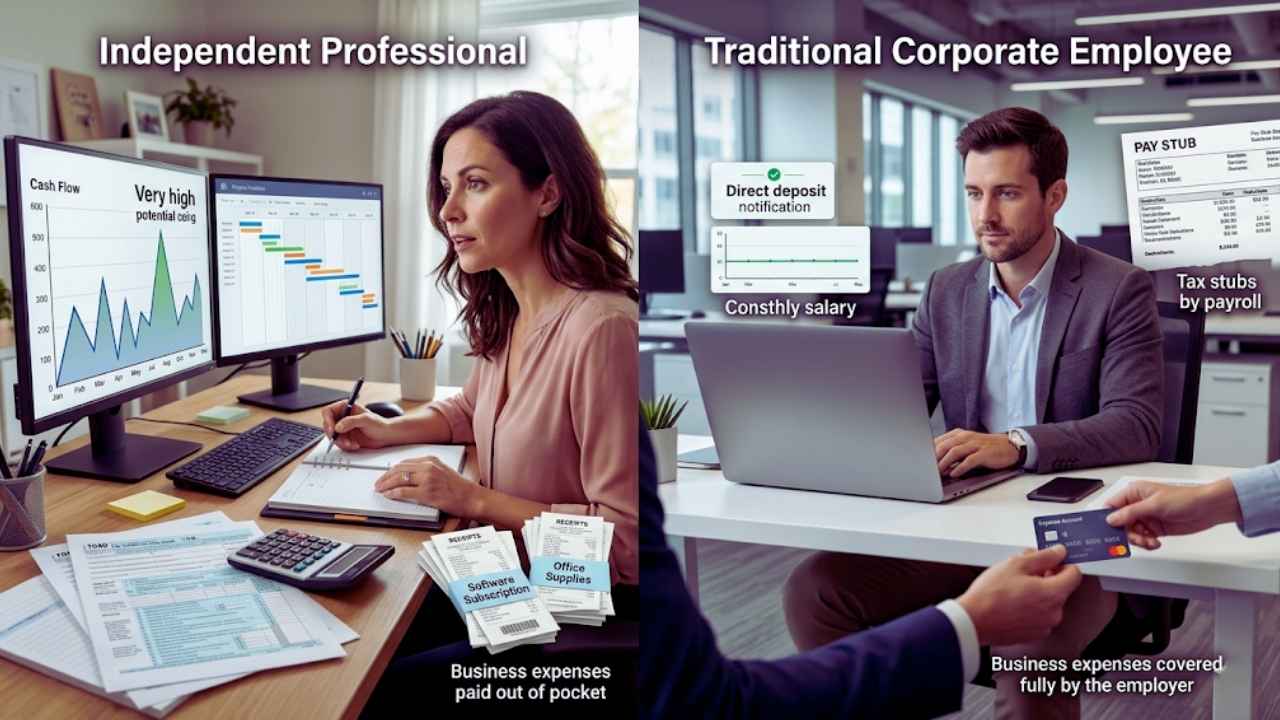
When you compare the money side of both paths, you have to look far past the simple hourly rate. The financial debate is really about managing your cash flow properly and understanding how much risk you are willing to take on your own shoulders.
|
Financial Factor |
Independent Professional |
Traditional Corporate Employee |
|
Income Ceiling |
Very high; scales with skills and fast execution |
Capped heavily by rigid salary bands and annual budgets |
|
Cash Flow Pattern |
Unpredictable, cyclical, requires heavy savings |
Steady, guaranteed, completely predictable every month |
|
Tax Responsibilities |
Self-managed quarterly payments and deductions |
Handled entirely by the company payroll department |
|
Business Expenses |
Paid entirely out of pocket from your profits |
Covered fully by the company expense account |
Setting Your Own Rates vs. Guaranteed Salary
When you work entirely for yourself, your hourly rate might look absolutely amazing on paper compared to a normal job. You might comfortably charge fifty, a hundred, or even two hundred dollars an hour for specialized work. But you have to constantly remember that you only actually get paid for the specific hours you actively bill to a client. You do not get paid a single cent for the hours you spend updating your portfolio website, pitching new business ideas, or replying to endless emails.
However, you do have the ultimate power to increase your rates whenever you feel like it. If you spend a weekend learning a new high-demand software skill, you can instantly charge your next client significantly more money. With a traditional full-time job, your salary is a fixed, rigid number that rarely changes outside of a promotion. It provides a solid, comforting floor that keeps you safe from poverty, but it also creates a hard, frustrating ceiling on your wealth. You get the exact same amount of money whether you have a slow, relaxing week or a frantic, high-stress week where you work late every single night.
Corporate employees have it incredibly easy when it comes to dealing with the government, taxes, and daily overhead. The human resources and payroll departments calculate everything for you, deduct the exact right amount of taxes automatically, and hand you a neat, finalized document at the end of the year. If your work laptop gets too old and slow to use, you just put in a quick ticket with the IT department, and they hand you a brand new one for free. The company also pays for your ongoing training, certifications, and professional development courses. When you are self-employed, you practically become your own part-time accountant.
You have to aggressively track every single business expense, save a very large portion of every client payment for the tax season, and figure out highly complicated, ever-changing tax rules. You also have to buy your own equipment to stay competitive. If you need a high-end computer, a specialized camera, or expensive industry software, that massive cost comes straight out of your own business profit. Most importantly, you have to build and protect your own safety net. Financial advisors strongly recommend that independent workers keep at least six months of living expenses sitting untouched in a high-yield savings account.
Skillsets Needed to Succeed on Each Path
Succeeding in either career path takes much more than just being technically good at your specific job. The soft skills and secondary abilities are what actually keep you afloat in the highly competitive modern market.
|
Core Skill Area |
Why Freelancers Need It |
Why Corporate Employees Need It |
|
Deep Self-Discipline |
Critical for daily survival without a boss watching |
Helpful, but heavily guided by managers and set hours |
|
Direct Communication |
Pitching clients, defending rates, closing sales |
Team alignment, office diplomacy, cross-department goals |
|
Rapid Adaptability |
Fast pivots to changing market demands and tools |
Following sudden company restructuring and leadership shifts |
|
High Resilience |
Handling constant rejection and dry spells |
Dealing with slow promotions, bureaucracy, and red tape |
Essential Skills for the Self-Employed Professional
Working entirely independently requires a truly massive amount of internal self-management and drive. You are the only person on earth responsible for making sure you meet your strict client deadlines. You must develop the fierce discipline to sit down and do the hard work even when you are exhausted, distracted, and absolutely no one is watching over your shoulder. You also deeply need strong, foundational business skills to survive. You have to learn how to market yourself effectively online, negotiate tough contracts with confidence, and concisely explain your exact value to complete strangers.
You cannot afford to be shy about asking for the money you know you deserve, or clients will constantly take advantage of you. Emotional resilience is probably the single most important personal trait you can develop on this path. You will inevitably face a massive amount of rejection during your career. You might spend a whole week sending out twenty customized proposals and only hear back from one single person. Clients will sometimes give you overly harsh feedback or suddenly cancel major projects out of nowhere due to their own budget cuts. You have to be able to instantly brush that off, not take it personally, and keep moving forward aggressively.
Key Traits for Corporate Success
Thriving long-term in a modern corporate office environment takes a completely different set of social and organizational skills. You absolutely have to be a highly cooperative, easy-going team player. You will very often be forced to work on high-stakes projects with people you might not personally like, and you have to find mature ways to collaborate effectively anyway. Communication inside a large company is all about achieving broad team alignment. You need to present your ideas clearly in crowded meetings, document your processes, and keep your managers constantly updated on your progress without ever overstepping your boundaries.
Deep patience is a huge requirement in the corporate world. Major projects move very slowly, basic approvals take weeks of emails, and your career growth is a marathon rather than a fast sprint. You also desperately need strong political awareness to understand exactly how decisions are actually made behind closed doors in your company. Building solid, friendly relationships with key people in totally different departments can help you bypass red tape and get things done much faster when you need a critical favor. Being a highly reliable, consistent person is prized by employers above almost everything else.
Making the Decision: Which Path is Right for You?
There is no magic answer that works perfectly for every single person. The right choice depends entirely on where you are in your life right now, your financial obligations, and your long-term mental health.
|
Core Decision Factor |
Choose Independent Work If… |
Choose Traditional Full-Time If… |
|
Financial Situation |
You have a solid cash buffer and low monthly debt |
You have strict monthly debts and dependents |
|
Personality Type |
You love building systems and creating your own rules |
You prefer clear boundaries and leaving work at the door |
|
Daily Work Style |
You genuinely enjoy wearing many different hats |
You want to focus deeply on one specific craft |
|
Risk Tolerance |
You fully embrace uncertainty and thrill |
You heavily prioritize peace of mind and routine |
Assessing Your Financial Runway
Before you dramatically quit a highly stable job to work completely for yourself, you have to sit down and do the brutal math. Look deeply and honestly at your current financial runway. Do you have a family or children that rely completely on your steady monthly income? Do you have heavy, unavoidable student loans or a massive mortgage payment due on the first of every month? If your monthly living expenses are high and totally rigid, jumping straight into full-time self-employment is incredibly risky and dangerous. You will be completely stressed out trying to find paying clients immediately, which leads to taking on bad projects just to pay the bills.
The absolute smartest approach is usually to start building a loyal client base on the side while you still have the safety of your regular day job. Once your side income consistently starts matching your corporate salary, you can make the leap much more safely. However, if you are young, single, and have very few living expenses, you might be in the absolute perfect position to take the massive risk right now. You have the total flexibility to comfortably survive a few very lean months while you figure out your personal business model and find your niche.
Evaluating Your Personality and Daily Work Style
You have to be completely, brutally honest about how you naturally operate as a human being. Do you actually like having a strictly set routine every single day? Do you genuinely enjoy the social energy of a bustling office and chatting with your coworkers during your lunch break? Do you strongly prefer to shut your laptop down exactly at five o’clock and not think about work again until the next morning? If that sounds exactly like your ideal life, the corporate path is definitely the much better fit for you. It gives you very clear, healthy boundaries and lets you completely separate your professional life from your personal life.
But if you get bored incredibly easily by repetitive daily routines and absolutely hate slow corporate bureaucracy, you might truly thrive working on your own. If you are a natural self-starter who genuinely enjoys solving completely different types of problems every single day, independent work will keep you highly engaged. You have to be totally okay with deep ambiguity, constant change, and shifting priorities. If the exciting idea of hunting down your own work and building your own tiny empire excites you rather than scares you, you have the exact right mindset to succeed on your own terms.
Final Thoughts
Making the massive choice regarding freelance vs full-time 2026 ultimately comes down to knowing yourself deeply and understanding your current life priorities. The entire professional world has changed entirely, giving you the real, tangible power to design a career path that actually fits your personal lifestyle. If you desperately want maximum control over your precious time and totally uncapped earning potential, independent work is absolutely calling your name.
But if you deeply value long-term stability, warm team collaboration, and having clear, healthy boundaries between your work and your home life, the traditional corporate path is exactly where you belong. Take the time to slowly weigh these daily realities, calculate your personal financial runway, and make the bold choice that actually moves you closer to your ultimate life goals.
Frequently Asked Questions (FAQs) About Freelance vs Full Time 2026
The absolute most proven, stress-free strategy is the slow hybrid transition. Keep your safe day job and start taking on small, manageable projects during your evenings or weekends. Save every single penny from your side projects to build a solid six-month emergency fund. Once you have that massive financial safety net and a few steady clients who trust you deeply, you can safely hand in your resignation letter.
Does independent work look bad on a resume today?
Not at all. In fact, it is viewed as a massive asset by most modern hiring managers. Running your own solo business shows that you are highly self-motivated, fully capable of managing tough clients directly, and highly adaptable to new tools. The old, outdated stigma of self-employment being just a cover for an employment gap is completely gone in 2026.
What happens if I get sick when I work for myself?
This is one of the biggest risks you take. If you get seriously ill, you stop earning money immediately. This is exactly why you must heavily price paid time off and sick days into your hourly rate. You also need to purchase your own comprehensive health insurance and consider short-term disability insurance to protect your income during emergencies.
Can I easily switch between these two career paths?
Yes, the modern job market is incredibly fluid and forgiving. Many top-tier professionals jump back and forth depending entirely on their current life stage and financial goals. Companies actually highly value former independent workers because they bring a strong sense of ownership and deep business awareness to the team. Just make sure you accurately frame your independent years as running a successful business when you update your resume.
Is independent work truly sustainable for an entire 30-year career?
Absolutely. With the massive, continued rise of global digital platforms, highly secure payment systems, and retained client models, you can easily build a highly stable solo business that lasts for decades. Many people eventually decide to gently scale up by hiring other people, officially turning their solo operation into a highly profitable, sustainable small agency.