


You just scored a great new client. The kickoff call felt amazing. You are ready to dive right in. Pause. Step away from the keyboard. Handshake deals and verbal agreements are a fast track to working for free. I have watched too many talented beginners lose weeks of time and thousands of dollars because they ignored the paperwork.
Running an independent business demands grit. If you want to survive your first year, mastering freelance contract basics is not optional. A solid agreement sets hard boundaries, outlines exactly what you will deliver, and guarantees you actually get paid. Let’s break down exactly what you need in your first client agreement so you never have to chase a check again.
Why You Can’t Afford to Skip the Paperwork
It feels awkward asking a new client to sign things. You worry they will think you are difficult or untrusting. Drop that mindset right now because it directly costs you money. Operating without a legal safety net leaves your rent money up to the client’s mood and their accounting department’s speed. According to recent data from the Freelancers Union, 74% of independent workers experience delayed payments, often due to unclear or missing documentation.
Worse, financial reports indicate that 82% of small businesses ultimately fail due to poor cash flow management. A contract is not a threat; it is a vital communication tool that forces both sides to agree on the rules before the clock starts. In 2026, with digital tools making signature collection frictionless, skipping this step is purely self-sabotage. If a client refuses to sign a simple document, treat that as a massive red flag and walk away immediately to protect your livelihood.
|
Benefit of a Signed Contract |
Risk of Skipping the Paperwork |
Real-World Impact |
|
Guaranteed Payment Terms |
You get paid whenever they feel like it. |
74% of freelancers experience stalled payments without one. |
|
Clear Project Scope |
Endless revisions and extra tasks for free. |
Burnout and working far below your hourly rate. |
|
Professional Reputation |
You look like an amateur hobbyist. |
High-paying corporate clients will refuse to hire you. |
|
Legal Protection |
Zero leverage if the client ghosts you. |
Losing weeks of billable hours with zero compensation. |
Core Freelance Contract Basics You Must Know
Strip away the heavy legal jargon, and a contract is essentially just a written promise between two people. You promise to do the work, and they promise to pay for it. Every single agreement requires standard administrative details to be legally binding. You must include the legal names of both parties, physical business addresses, current contact info, and the effective date of the project. If you run a registered LLC, always use your actual business name rather than your personal name to maintain liability protection.
Beyond basic contact info, you must clearly define your working relationship. Include a specific clause explicitly stating you are an independent contractor, not an employee. This stops controlling clients from trying to dictate your daily working hours or micromanaging your process. It also shields the client from surprise tax bills and legal penalties associated with misclassifying workers. Today, modern invoicing tools can generate these standard clauses automatically, ensuring you never miss a critical detail.
|
Core Contract Element |
What You Must Include |
Why It Matters for Your Business |
|
Parties Involved |
Legal names and physical addresses. |
Defines exactly who is legally bound by the rules. |
|
Effective Date |
The exact day the agreement kicks in. |
Establishes the project timeline and hard deadlines. |
|
Contractor Status |
A clause confirming you manage your own time. |
Prevents the client from treating you like a W-2 employee. |
|
Signatures |
Digital or physical signatures from both sides. |
Confirms mutual agreement and makes the document enforceable. |
Writing a Bulletproof Scope of Work (SOW)
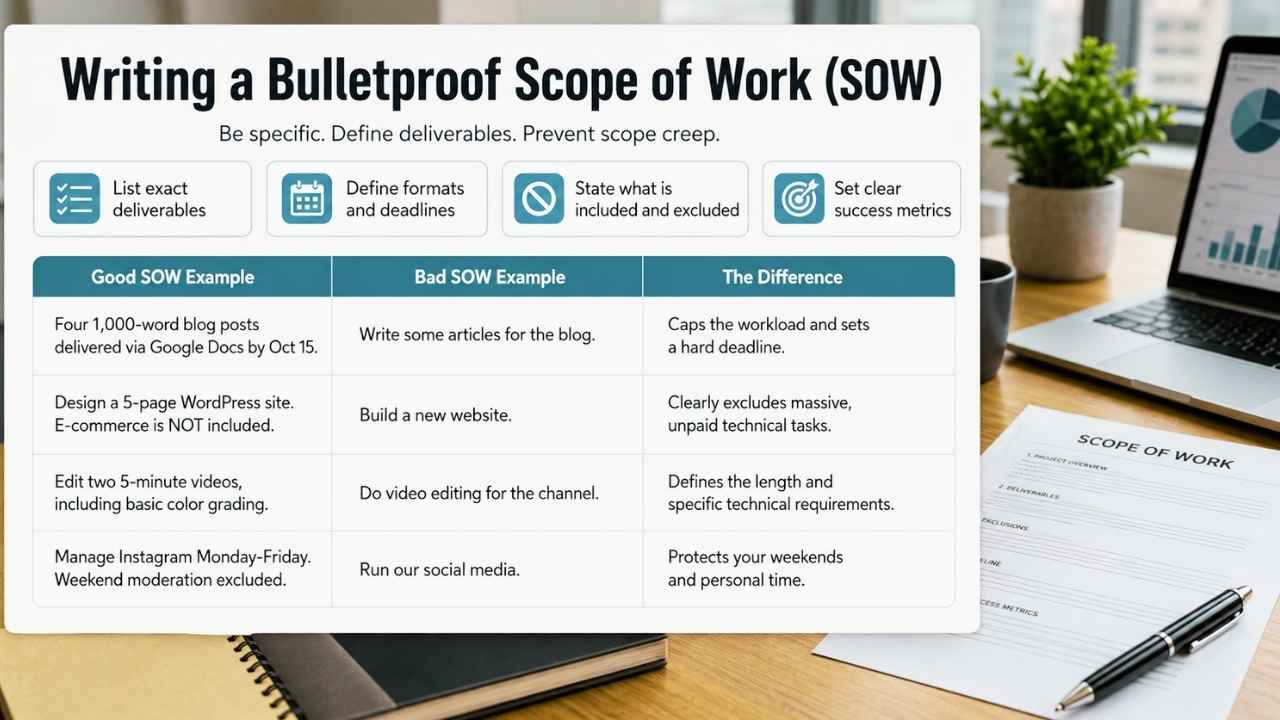
The Scope of Work is the absolute heart of your agreement. This is where beginners mess up the most and lose the most money. If you simply write “social media management for August,” you immediately set yourself up for failure. Does that mean three posts a week or five? Does it include video editing, graphic design, and weekend community management? Your SOW needs to be hyper-specific and leave zero room for assumptions.
List the exact deliverables, the formats you will use, and the specific deadlines for each milestone. If you write copy, specify the maximum word count and the topic. If you design websites, list the exact number of pages and features. State exactly what you will do, and clearly state what you will not do. As clients increasingly expect data-driven results and transparent ROI calculations in 2026, defining exactly what success looks like in your SOW protects you from moving goalposts.
|
Good SOW Example |
Bad SOW Example |
The Difference |
|
“Four 1,000-word blog posts delivered via Google Docs by Oct 15.” |
“Write some articles for the blog.” |
Caps the workload and sets a hard deadline. |
|
“Design a 5-page WordPress site. E-commerce is NOT included.” |
“Build a new website.” |
Clearly excludes massive, unpaid technical tasks. |
|
“Edit two 5-minute videos, including basic color grading.” |
“Do video editing for the channel.” |
Defines the length and specific technical requirements. |
|
“Manage Instagram Monday-Friday. Weekend moderation excluded.” |
“Run our social media.” |
Protects your weekends and personal time. |
Payment Terms That Keep Your Cash Flowing
Do not gamble with your income or hope a client remembers to pay you. You dictate how and when money changes hands from the very start. Understanding freelance contract basics gives you the leverage needed to maintain steady cash flow and pay your own bills on time. First, clearly state your rate and whether it is a flat fee or hourly. Next, ask for a deposit. Never start a project with zero dollars upfront.
Demand 30% to 50% to hold your time in your schedule, and collect the rest upon final delivery. For jobs lasting several months, tie your payments to specific project milestones so you get paid steadily as you work. Set your invoicing timeline clearly in the document. “Net-30” gives the client 30 days to pay the invoice, but you should push for Net-15 or “Due upon receipt” to get cash faster. Always add a late fee clause, such as a 2% interest charge per month on overdue balances, to penalize dragging feet.
|
Payment Term |
Definition & Strategy |
Real-World Application |
|
Upfront Deposit |
Money paid before work starts. |
Demand 30% to 50% upfront so you never work for free. |
|
Milestone Payments |
Payments tied to project phases. |
Use these for jobs lasting longer than 4 weeks to keep cash flowing. |
|
Net Terms |
The days a client has to pay. |
Push for Net-15 to avoid waiting a full month for cash. |
|
Late Fees |
A penalty applied to overdue invoices. |
Having a 2% late fee in writing makes clients pay on time. |
Controlling Revisions and Scope Creep
Scope creep drains your energy and destroys your profit margins. It happens when the client asks for “just one more tiny change,” and suddenly you spend ten extra hours on a project for absolutely free. You can stop this entirely by outlining exactly how many rounds of revisions your flat fee covers. Usually, one or two rounds of minor edits are standard across most creative industries.
State your hourly rate clearly for any work that falls outside that original scope. When a client knows extra edits cost $75 or $100 an hour, they organize their feedback very quickly and stop asking for endless tweaks. Furthermore, implement a strict feedback window. Give the client five business days to review the work and request their changes. If they vanish and fail to respond within that timeframe, your contract should state that the work is automatically approved and the final invoice is due.
|
Revision Element |
How to Phrase It |
Purpose |
|
Included Edits |
“This fee includes two (2) rounds of revisions.” |
Caps the endless cycle of tweaks and minor adjustments. |
|
Feedback Window |
“Client has 5 business days to request revisions.” |
Stops clients from asking for changes three months later. |
|
Extra Work Rate |
“Additional revisions will be billed at $XX/hour.” |
Ensures you get paid for every extra hour you work. |
|
Deemed Approval |
“Failure to respond in 5 days constitutes approval.” |
Prevents projects from stalling due to client ghosting. |
Intellectual Property: Who Actually Owns the Work?
If you design a logo, write a script, or code a custom plugin, who owns it? Beginners often overlook intellectual property (IP) clauses, giving away highly valuable assets by mistake. Clients generally love “Work for Hire” agreements because it means they own the copyright the second you create the work. That works perfectly fine for many corporate gigs, but you still need to protect yourself financially.
Include a specific clause stating that IP rights only transfer to the client after they pay the final invoice in full. If they default on payment, they legally cannot use your work for their business. As advanced workflow tools become deeply integrated into freelance operations, make sure your IP clause covers the software you use and assigns the final output rights correctly. Always reserve the right to display the finished project in your public portfolio, as showcasing past success is how you secure future clients.
|
IP Ownership Type |
What it Means for You |
Recommendation |
|
Work for Hire |
Client owns everything completely. |
Mandate that rights only transfer after full payment clears. |
|
Licensing |
You own the copyright; the client buys usage rights. |
Great for photographers, illustrators, and specialized creators. |
|
Portfolio Rights |
A clause allowing you to showcase the work. |
Always include this to attract and secure future jobs. |
|
Software Disclosure |
Clarifies if automated tools were used to generate assets. |
Protects you against future copyright disputes from third parties. |
The Kill Fee: Getting Paid When Projects Collapse
Projects crash unexpectedly all the time. Corporate budgets dry up, leadership changes directions, or a disorganized client simply ghosts you out of nowhere. If you get halfway through a massive build and they pull the plug, you need guaranteed compensation for the time you blocked out in your schedule. A “Kill Fee” or cancellation clause dictates exactly how much the client owes you if they terminate the project early through no fault of your own.
Often, keeping your non-refundable upfront deposit acts as the standard kill fee. Alternatively, you can require the client to pay a pro-rated amount for all the hours you already worked up until the cancellation date. Mastering freelance contract basics helps you secure your income even when a client bails at the last minute, ensuring you never walk away empty-handed after putting in the hard work.
|
Cancellation Scenario |
How the Kill Fee Protects You |
Real-World Strategy |
|
Client cancels before work starts |
You keep the upfront deposit entirely. |
Covers the income you lost by rejecting other clients. |
|
Client cancels midway through |
Client pays a pro-rated amount based on milestones. |
Ensures you get paid for every hour you already worked. |
|
Freelancer cancels |
You refund the deposit for uncompleted work. |
Maintains professional bridges and avoids nasty legal disputes. |
|
Project Pause |
Client pauses the project for more than 30 days. |
Triggers a final invoice for work completed to date. |
Legal Protections and the “Freelance Isn’t Free” Act
Nobody ever wants to go to court, but you absolutely have to plan for it. If a client in California stiffs you, and you live in Texas, whose laws apply to the dispute? Your contract needs a “Governing Law” clause that explicitly picks your home state as the legal jurisdiction. Add a mandatory mediation clause stating both parties agree to attempt professional negotiation before anyone files a lawsuit. You should also stay heavily informed on local legislation designed to protect independent workers.
For example, New York expanded the “Freelance Isn’t Free Act” across the entire state, requiring mandatory written contracts for any freelance work exceeding $800 within a 120-day period. This law forces clients to pay within 30 days unless specified otherwise, and allows freelancers to sue for double damages if a client refuses to pay. These protections are setting massive trends across the country, giving you more power than ever.
|
Legal Clause |
Real-World Purpose |
Why You Need It |
|
Governing Law |
Determines which state’s legal system applies. |
Ensures you do not have to travel to sue a bad client. |
|
Mediation Clause |
Forces both parties to try resolving issues out of court. |
Saves thousands of dollars in unnecessary legal fees. |
|
Attorney Fees |
Ensures the losing party pays the winner’s legal costs. |
Gives you the financial ability to fight corporate clients. |
|
Payment Timelines |
Aligns with laws like the Freelance Isn’t Free Act. |
Sets a hard 30-day legal deadline for client accounting. |
Final Thoughts
Stepping out on your own takes immense guts. You are not just a creative professional anymore; you run a fully functional business. Protecting your time and ensuring your cash flows properly all comes down to the simple paperwork you sign on day one. Do not let complex legal jargon scare you away from protecting your livelihood.
Grab a solid template, customize it to fit your exact services, and absolutely never work for someone who refuses to put things in writing. Implement these freelance contract basics today. You will weed out the bad clients much faster, command real respect in your industry, and build a highly profitable career that actually lasts. Your future self will thank you every time an invoice gets paid right on time.
Frequently Asked Questions (FAQs) About Freelance Contract Basics
Do I need to notarize my freelance contract for it to hold up in court?
No, you do not need a notary to make your agreement legally binding. A digital signature through platforms like DocuSign, or even a typed name sent via email, works perfectly fine. Just make sure both parties sign the document before you start any billable work.
What happens if a client completely changes the project halfway through?
This is exactly why you include a “Change Order” clause in your paperwork. If the client shifts the goalposts, you pause the work and draft a new mini-agreement outlining the extra costs. Never accept massive structural changes without adjusting your final price first.
Can a client legally force me to work specific hours during the day?
No, dictating your daily schedule crosses the line into employer territory and violates your independent contractor status. You control when, where, and how you complete the work. As long as you hit the agreed-upon deadlines, the client cannot micromanage your daily routine.
What is a severability clause and do beginners actually need one?
Yes, you definitely want to include one in your standard template. A severability clause states that if a judge throws out one specific line in your contract, the rest of the agreement remains entirely valid. It prevents a single typo or legal mistake from voiding your whole safety net.
How do I handle a contract when the exact project scope is unknown?
Never sign a flat-fee contract for an unknown scope, or you will end up working for free. Instead, sign a monthly retainer agreement or an hourly contract that sets a maximum cap on weekly hours. This guarantees you get paid for the discovery phase without getting trapped.