
When you look back at the origins of the Great War, it is wild to think that Europe practically sleepwalked into a catastrophe. For decades, the continent enjoyed unprecedented peace, massive technological leaps, and explosive economic growth. Cities modernized with electricity, public transport expanded, and people genuinely believed that large-scale, brutal warfare was a barbaric relic of the past.
But beneath that polite and peaceful surface, a massive, highly combustible powder keg was growing in the shadows. If you want to understand the true causes of World War 1, you have to look past the single gunshot in the streets of Sarajevo. The explosive materials had been piling up for decades, and European leaders were essentially playing with matches in a room full of dynamite. We are going to break down the exact sequence of events, the widespread paranoia, and the arrogant political blunders that plunged the entire globe into a devastating conflict.
The Core Framework: The M.A.I.N. Causes of World War 1
Historians love to use frameworks to make sense of absolute chaos, and the events of 1914 definitely require one. When trying to untangle the messy, confusing origins of this massive conflict, experts usually point to four long-term structural factors. These underlying pressures turned what should have been a very isolated, local dispute in the Balkans into a global firestorm. You can easily remember these four pillars using the acronym M.A.I.N., which stands for Militarism, Alliances, Imperialism, and Nationalism.
None of these distinct elements operated in a vacuum. They constantly bled into one another, creating a highly toxic political environment where diplomats eventually lost total control of their own massive war machines. By the summer of 1914, these four deeply rooted factors ensured that any diplomatic failure would automatically result in total disaster. Understanding this framework is the absolute best way to figure out how kings and generals felt they had no choice but to fight.
|
Concept |
Simple Definition |
Role in 1914 |
|
Militarism |
Building up armed forces and preparing for war |
Created massive armies and rigid attack schedules |
|
Alliances |
Treaties promising mutual defense |
Turned a local conflict into a continent-wide war |
|
Imperialism |
Expanding empires for resources and power |
Fueled intense economic rivalry and jealousy |
|
Nationalism |
Extreme pride in one’s country or ethnic group |
Triggered the assassination in the Balkans |
Why Historians Rely on This Model?
We use the M.A.I.N. acronym because history is rarely about a single evil villain sitting in a room plotting the end of the world. It helps break down the massive structural flaws of European politics at the turn of the twentieth century. Instead of just memorizing a boring list of dates and battles, this framework shows you the actual psychology of the era.
You start to see the immense pressure these leaders were under to look tough and protect their national pride. It completely removes the confusing clutter and gets straight to the heart of why the entire continent was completely primed for a massive explosion.
The Interconnected Web of Pressures
These four pillars constantly fed off each other in a terrifying feedback loop. For example, imperialism required a massive, modern military to protect highly profitable overseas colonies from rivals. That aggressively growing military scared neighboring countries, practically forcing them to sign secret defensive alliances with other nations.
Those hidden alliances emboldened small, radical nationalist groups, who knew they suddenly had huge superpowers backing up their political demands. It was a perfect storm of political paranoia, where every single move a country made to protect itself was viewed by its neighbors as a direct, aggressive threat to their own survival.
Militarism: The Dangerous European Arms Race
In the late nineteenth century, military strength became the ultimate status symbol for European nations, sparking a dangerous obsession with armed power. Governments pumped massive chunks of their national budgets into standing armies, dreadnought battleships, and heavy artillery, starving other public sectors of funding. They genuinely believed that the only way to guarantee peace was to be too terrifying for anyone else to attack, a strategy of deterrence that completely backfired.
When every country builds up their armies at the exact same time, it creates an atmosphere of deep paranoia and hair-trigger tension. Generals stopped thinking about how to prevent wars through diplomacy and started agonizing entirely over how to win them quickly on the battlefield. This massive, unchecked military buildup stands out as one of the most undeniable causes of World War 1, effectively turning the continent into a giant armed camp.
|
Country |
Standing Army in 1914 |
Primary Military Focus |
Major Vulnerability |
|
Germany |
2.2 million |
Rapid land invasion (Schlieffen Plan) |
Fighting a two-front war |
|
Russia |
1.4 million |
Massive infantry numbers and rail logistics |
Extremely slow mobilization |
|
France |
1.2 million |
Border defense and heavy artillery |
Outdated infantry tactics |
|
Great Britain |
400,000 |
Total dominance of the high seas |
Very small initial land army |
Industrialization Meets Warfare
The industrial revolution completely changed how armies killed each other, making warfare exponentially more lethal and efficient. Factories could now mass-produce high-explosive artillery shells, rapid-fire machine guns, and miles of razor-sharp barbed wire around the clock. Warfare rapidly shifted from the glorious cavalry charges of the past to cold, mechanized, industrialized slaughter on a scale nobody had ever seen.
Unfortunately, the older generals in charge were still stubbornly using nineteenth-century battlefield tactics to fight a brutal twentieth-century war. They simply did not understand the horrifying destructive power they had just purchased until millions of young men were already dead in the muddy trenches.
Great Britain had confidently ruled the oceans for centuries, relying on an absolutely massive fleet to protect its global trade routes and island home. But Germany, driven by the highly erratic and deeply jealous leadership of Kaiser Wilhelm II, decided it suddenly wanted a world-class navy too. The Germans started constructing massive, modern battleships, intentionally trying to intimidate the British and force them to share global power.
The British public completely panicked, demanding their government build even bigger, faster ships called Dreadnoughts to maintain their total dominance. This insanely expensive, tit-for-tat naval arms race completely destroyed any remaining diplomatic trust between London and Berlin, guaranteeing they would be enemies.
War by Timetable and Mobilization
Before the invention of reliable tanks and troop-carrying planes, massive armies moved almost exclusively by railway networks. Moving millions of soldiers, horses, and heavy guns to a hostile border required incredibly complex, rigid railway schedules drafted years in advance. Once a country hit the mobilization button to start loading trains, the process literally could not be stopped without causing absolute logistical chaos and leaving the country defenseless.
This terrifying reality meant that the moment a severe political crisis heated up, the military generals completely took over the decision-making process. Diplomacy died the exact second the train schedules went into effect, trapping politicians in a war they could no longer stop.
Alliances: A Divided and Paranoid Continent
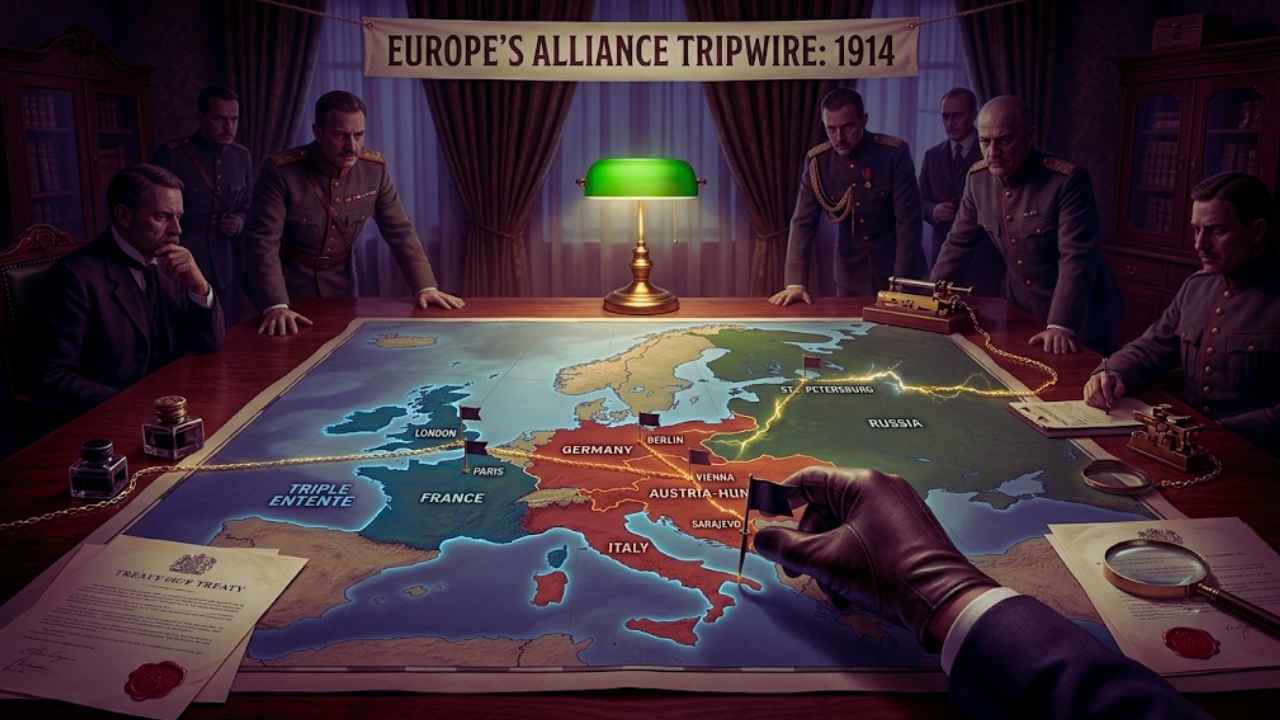
To survive in a crowded continent completely full of heavily armed, aggressive neighbors, countries naturally started looking for loyal friends. The core idea behind this was simple deterrence: if you have incredibly powerful allies obligated to fight for you, no rival will ever dare attack you. But this deeply secretive system was fundamentally flawed and incredibly dangerous for long-term peace.
Instead of preventing wars, these hidden treaties acted like a giant, invisible tripwire stretching across the entire map of Europe. If someone stepped on it, everyone would fall down together, dragging millions of people into a fight they had nothing to do with. By the time the final crisis hit, Europe was chopped into two heavily armed, paranoid camps aggressively staring each other down across the borders.
|
Alliance Name |
Core Members |
Shared Goal |
Potential Weakness |
|
Triple Entente |
Britain, France, Russia |
Contain German expansion |
Not a strict military binding treaty for Britain |
|
Triple Alliance |
Germany, Austria-Hungary, Italy |
Protect central Europe |
Italy’s commitment was highly questionable |
|
Russian-Serbian Bond |
Russia, Serbia |
Protect Slavic interests |
Tied a massive empire to a volatile small state |
|
British-Belgian Treaty |
Britain, Belgium |
Ensure Belgian neutrality |
Forced Britain to act if Germany invaded |
The Triple Entente Explained
France and Russia were deeply afraid of a highly powerful, newly unified, and heavily industrialized Germany sitting squarely between them. To protect themselves from this massive threat, they signed a strict mutual defense pact, promising that if Germany attacked one, the other would immediately invade from the opposite side. Great Britain eventually joined this exclusive club, deciding to finally set aside its incredibly old, bitter colonial arguments with both France and Russia.
They formed the Triple Entente, creating a massive strategic ring around the German Empire that made the German leadership feel completely suffocated. While Britain was not legally bound to send a massive land army at first, the moral obligation to support their new friends was incredibly strong.
The Triple Alliance and Its Flaws
Sitting right in the middle of the continent stood the Triple Alliance, a powerful bloc designed to dominate central European politics. Germany and Austria-Hungary shared a very strong cultural bond, a common language, and a deep, terrifying fear of being entirely encircled by their enemies. Italy originally joined them looking for diplomatic clout and protection against France, but the Italians were never truly dedicated to fighting a bloody offensive war for German interests.
This specific alliance gave the fading Austro-Hungarian empire a completely false sense of absolute security and invincibility. It made the Austrian leaders far more aggressive in the Balkans than they ever should have been, believing Germany would always bail them out of trouble.
The Illusion of Deterrence
The entire secret alliance system relied entirely on a highly dangerous, high-stakes political bluff. European leaders arrogantly assumed no one would ever be crazy enough to actually pull the trigger and start a war with so many powerful countries involved. But when the bluff was finally called in the summer of 1914, the strict treaties completely stripped politicians of their choices and exit strategies.
Because of these rigid, unbreakable agreements, a tiny, localized border dispute in southeastern Europe legally and morally required Paris, London, and Berlin to go to war. The system designed to keep the peace was the exact mechanism that guaranteed a global slaughter.
Imperialism: The Scramble for Global Dominance
You absolutely cannot discuss the causes of World War 1 without pulling back and looking at the entire map of the world. By the early twentieth century, the major European powers were violently and aggressively competing for total control over massive territories in Africa and Asia. They desperately needed incredibly cheap raw materials to feed their booming factories, and they wanted brand new, captive markets to sell their mass-produced goods.
This endless, ruthless race for global dominance made the European powers intensely jealous, suspicious, and hateful of one another. Every single time one country claimed a new colonial port or built a new railway in a foreign land, its neighbors felt directly and economically threatened.
|
European Empire |
Key Colonial Territories |
Primary Motivation |
Impact on Global Tensions |
|
Great Britain |
India, South Africa, Egypt |
Trade monopolies and naval bases |
Fiercely protected its massive head start |
|
France |
West Africa, Indochina |
Resource extraction and prestige |
Clashed heavily with Germany over North Africa |
|
Germany |
Namibia, Cameroon |
A desire for global respect |
Arrived late and aggressively demanded more land |
|
Austria-Hungary |
Bosnia and Herzegovina |
Regional influence |
Sparked fierce local rebellions in the Balkans |
The Brutal Scramble for Africa
In a matter of just a few short decades, European nations aggressively carved up almost the entire African continent among themselves. They arrogantly drew arbitrary border lines on maps without any regard whatsoever for the millions of native people actually living there. Britain and France easily took the lion’s share of the richest territories, becoming ridiculously wealthy and powerful in the process.
This blatant, incredibly greedy land grab created deep, lingering resentments among the imperial powers themselves, as they constantly bumped elbows and fought over resources in the African dirt. Germany felt deeply cheated out of the best lands, fueling a massive national inferiority complex that drove their aggressive foreign policy.
The Agadir and Moroccan Crises
Germany deeply felt entirely left out of the elite imperial club and constantly looked for ways to assert its global dominance. Kaiser Wilhelm II deliberately tried to humiliate France on the world stage by showing up in Morocco and loudly supporting Moroccan independence from French rule. He specifically wanted to test the strength of the new political friendship between France and Britain, hoping to drive a massive wedge between them.
The risky stunt backfired completely and spectacularly, as Britain stood firmly by France and even threatened Germany with war. Germany was forced to back down, leaving the crisis feeling deeply isolated, incredibly angry, and completely convinced that the rest of Europe was plotting their total destruction.
Economic Rivalry and Resource Grabs
At its core, the massive drive for overseas empires was almost entirely about pure corporate cash and national wealth. European factories desperately needed endless supplies of rubber, oil, cotton, and iron to keep their massive economies growing and their populations employed. The capitalist economies of Europe were permanently locked in a completely cutthroat competition to outproduce and outearn each other on the global market.
This intense economic rivalry meant that foreign policy was very often dictated directly by corporate greed and the desperate need for resources. When a nation’s total profit is tied directly to its national security, armed military conflict over distant lands is never very far away.
Nationalism: The Balkan Powder Keg
While massive European empires were trying to violently expand overseas, they were slowly and painfully rotting from the inside out. Nationalism, a deeply intense form of patriotism, was actively tearing massive, multi-ethnic states completely apart at the seams. People who shared a distinct language, history, and culture desperately wanted their own independent countries and were willing to kill for it.
They were completely tired of being heavily taxed and brutally ruled by foreign kings sitting in distant capital cities. Nowhere was this explosive tension more dangerous than in the Balkan Peninsula, a mountainous region diplomats accurately called the powder keg of Europe, just waiting for a single match to blow it sky high.
|
Empire or Nation |
Nationalist Goal |
Target Opponent |
Risk Level |
|
Austria-Hungary |
Suppress minority uprisings to survive |
Serbia and local rebel groups |
Extremely High |
|
Ottoman Empire |
Maintain control over fading territories |
Balkan states seeking independence |
High |
|
Serbia |
Unite all Slavic people into Greater Serbia |
Austro-Hungarian Empire |
Critical |
|
Russia |
Protect all Slavic and Orthodox Christians |
Austria-Hungary and Germany |
Severe |
The Crumbling Austro-Hungarian Empire
Austria-Hungary and the neighboring Ottoman Empire were massive relics of an older, fading age of imperial conquest. They were sprawling, incredibly messy empires trying desperately to govern dozens of completely different ethnic groups who actively hated their rulers.
As the Ottoman Empire slowly lost its military grip on the Balkans, brand new independent nations like Serbia and Bulgaria popped up. Austria-Hungary watched this happen in absolute, paralyzing terror, knowing their own massive minority populations were watching closely and taking notes. The Austrian leaders knew that if they allowed even one nationalist group to break away, their entire empire would shatter into a million little pieces.
Slavic Independence and Greater Serbia
Serbia was a highly ambitious, newly independent nation with a massive chip on its shoulder and a highly capable military. They strongly wanted to unite all the Slavic people living in the region into one massive, powerful country known as Greater Serbia. The massive problem was that millions of those Slavs lived right next door, trapped tightly inside the borders of the Austro-Hungarian Empire.
Secret, highly violent Serbian intelligence groups began illegally funneling massive amounts of guns and bombs to radical separatists living under Austrian rule. They were practically begging for a fight, using terrorism to constantly weaken the Austrian grip on the heavily contested southern provinces.
Russia’s Role as the Big Brother
Serbia was a relatively small country, but it had a massive, incredibly powerful friend willing to back it up. The enormous Russian Empire viewed itself as the protective big brother to all Slavic and Orthodox Christian people in eastern Europe. The Russian Tsar felt a deep religious, cultural, and political duty to protect little Serbia from constant Austrian bullying and threats.
Russia also desperately wanted guaranteed access to warm-water naval ports in the region to expand its own global trade and military reach. This meant any aggressive Austrian military move against Serbia would instantly bring the massive Russian army crashing down on Vienna in defense.
The Spark: The Assassination of Archduke Franz Ferdinand
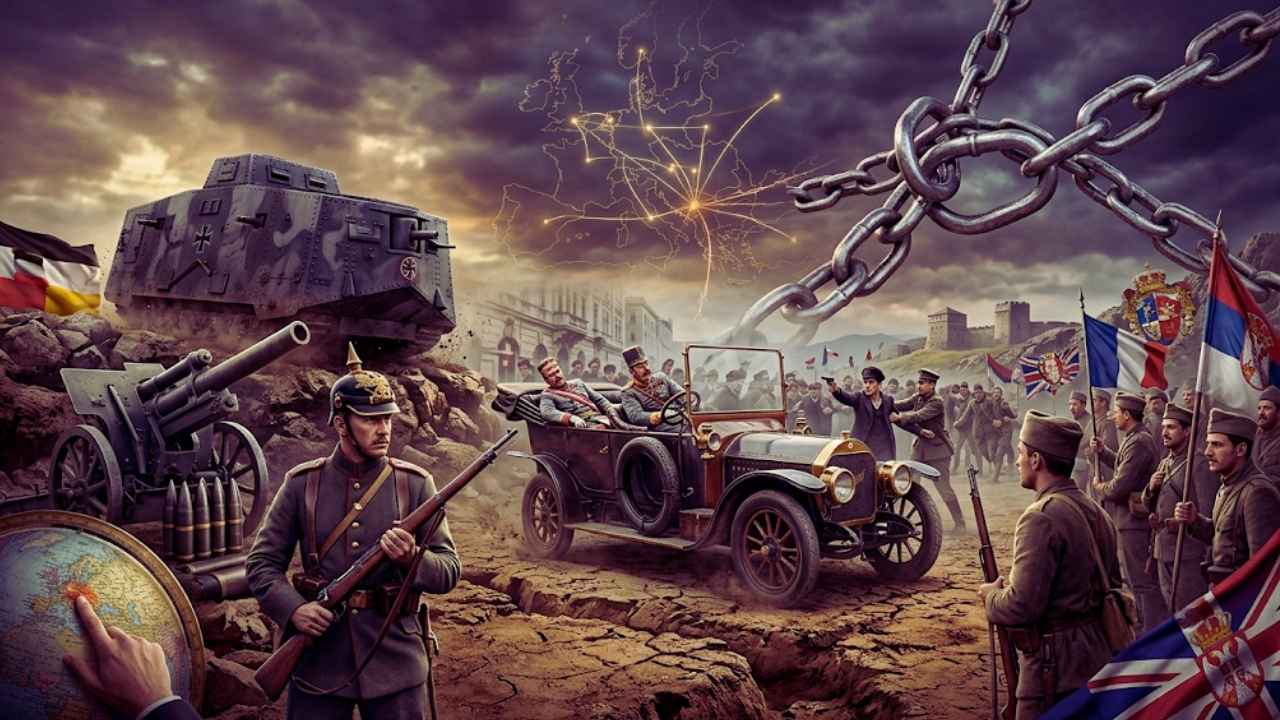
All the long-term causes of World War 1 set the dangerous stage, but it took a brutal, highly public murder to actually start the tragic play. On June 28, 1914, a royal motorcade took a famously wrong turn down a narrow, crowded street in the city of Sarajevo. That single, simple navigational error directly resulted in the bloody deaths of the heir to the Austro-Hungarian throne and his pregnant wife.
It was the absolute single spark that immediately ignited the entire continent and set the complicated alliance tripwires into motion. The assassination was violent, incredibly messy, and entirely preventable if the Archduke had just listened to his security advisors and stayed home.
|
Key Figure |
Role in the Assassination |
Ultimate Fate |
|
Franz Ferdinand |
Heir to the Austro-Hungarian throne |
Shot in the neck, died quickly on the scene |
|
Sophie Chotek |
Ferdinand’s pregnant wife |
Shot in the abdomen, died holding her husband |
|
Gavrilo Princip |
19-year-old nationalist assassin |
Arrested immediately, died in prison of tuberculosis |
|
Dragutin Dimitrijevic |
Serbian intelligence officer (Black Hand) |
Executed later by his own government |
A Highly Provocative Visit to Sarajevo
Archduke Franz Ferdinand was not a widely popular guy in the royal court, but he was next in line for the powerful throne. He arrogantly decided to visit the newly annexed, highly unstable province of Bosnia to officially inspect the military troops stationed there. The timing was absolutely terrible, as he chose to visit on the exact anniversary of a highly sacred Serbian historical tragedy.
It was seen as a massive, deliberate insult to the deeply proud local Serb population who hated Austrian rule. Despite multiple serious warnings of assassination plots from his own police, Ferdinand stubbornly insisted on riding in an open-top car to show off his bravery.
Gavrilo Princip’s Incredibly Fateful Shot
A highly secretive, violent nationalist group called the Black Hand was waiting in the crowds for the royal couple to drive by. Early in the day, they actually threw a bomb at his car, but it bounced off the roof and injured innocent bystanders instead. You would think Ferdinand would completely cancel the rest of the trip and flee the city, but he stubbornly decided to visit the hospital later.
His driver got totally lost, tried to turn around, and accidentally stalled the heavy car right in front of Gavrilo Princip, one of the assassins who had given up. Princip simply stepped up, pulled a pistol from his coat, and fired two fatal shots at point-blank range into the car.
The Immediate and Bloody Shockwaves
The Archduke and his wife bled to death in the back seat before the car could even find a proper doctor or safe location. Gavrilo Princip was immediately tackled by the furious crowd, heavily beaten by the police, and dragged away to a dark prison cell. The shocking news of the royal murder hit the capital city of Vienna like a massive, terrifying earthquake.
The Austrian leadership did not just view this as a tragic murder by a lone madman; they saw it as a massive state-sponsored terrorist attack orchestrated directly by the Serbian government. They finally had the perfect, globally acceptable excuse to wipe the annoying nation of Serbia entirely off the map.
The July Crisis: A Month of Diplomatic Failure
You might reasonably assume the massive global war started the very next day after the brutal assassination. It actually didn’t; instead, Europe endured a frantic, incredibly sweaty month of secret telegrams and failed negotiations known forever as the July Crisis. Ambassadors scrambled frantically to find a peaceful diplomatic solution while their military generals quietly and aggressively prepared for a massive invasion.
It was an absolute masterclass in terrible communication, stubborn national pride, and catastrophic political miscalculations from every single leader involved. The politicians desperately tried to stop the war, but they had already given far too much power to the military timetables.
|
Date |
Event |
Consequence |
|
July 5, 1914 |
Germany issues the infamous Blank Check |
Austria feels completely safe to act aggressively |
|
July 23, 1914 |
Austria sends a harsh ultimatum to Serbia |
Designed specifically to be rejected to justify war |
|
July 25, 1914 |
Serbia accepts almost all terms |
Austria uses the slight refusal to cut ties |
|
July 28, 1914 |
Austria-Hungary declares war on Serbia |
The regional military conflict officially begins |
The Infamous German Blank Check
Before launching a massive attack on Serbia, Austria wanted to make absolutely sure their powerful ally Germany actually had their back. Kaiser Wilhelm II confidently told the Austrian diplomats that Germany would fully support them no matter what extreme actions they decided to take. Historians universally call this reckless promise the Blank Check, and it is largely why Germany gets so much blame for the war.
It was a completely reckless, deeply foolish promise because Germany incorrectly assumed the massive Russian army would simply back down. Armed with this ironclad promise of military support, Austria confidently drafted a plan to completely humiliate and destroy Serbia.
Austria-Hungary’s Impossible Ultimatum
Austria sent a massive, highly detailed list of extreme demands to the Serbian capital, giving them only forty-eight hours to completely comply. The list was deliberately and carefully designed to be completely impossible for any sovereign nation to accept without losing its independence. They aggressively demanded the legal right to send heavily armed Austrian police directly into Serbia to completely run the murder investigation.
Serbia, completely desperate to avoid a war that would destroy them, agreed to almost everything, but politely refused to let foreign cops roam their streets. That tiny refusal was all the diplomatic excuse Austria needed to pack up their embassy and prepare the heavy artillery.
Russia Mobilizes Its Massive Forces
When Austria officially declared war and started relentlessly bombing the Serbian capital of Belgrade, the leadership in Russia completely panicked. The Russian Tsar absolutely could not let his Slavic little brother get brutally destroyed by an arrogant imperial power without stepping in. He nervously ordered the massive Russian army to begin mobilizing its troops along the shared borders of both Austria and Germany.
Remember the rigid train timetables from the militarism phase? Once Russia started officially loading millions of men onto thousands of trains, the diplomatic window slammed permanently shut. The military machine had completely taken over the situation, and there was no turning back for anyone.
The Domino Effect: Declarations of War
In a matter of just a few terrifying days, the entire European continent completely went up in flames and smoke. Because of the highly rigid, deeply secret alliance networks, one single declaration of war automatically triggered the next one down the line. It was a terrifying, almost mechanical process that politicians watched happen with complete horror and absolute powerlessness.
The arrogant leaders who signed those binding treaties decades earlier never imagined they would actually activate so quickly and brutally. The diplomatic dominoes fell exactly as the paper treaties dictated, and the world was plunged into an unprecedented, bloody nightmare.
|
Date |
Action |
Reason |
|
August 1, 1914 |
Germany declares war on Russia |
Reacting aggressively to Russian troop mobilization |
|
August 3, 1914 |
Germany declares war on France |
Knowing France would automatically support Russia |
|
August 4, 1914 |
Germany invades neutral Belgium |
Executing the necessary speed of the Schlieffen Plan |
|
August 4, 1914 |
Great Britain declares war on Germany |
Defending the strict treaty of Belgian neutrality |
The Schlieffen Plan in Brutal Action
Germany was absolutely terrified of fighting a massive, grinding war against Russia in the east and France in the west at the exact same time. Their highly detailed, extremely risky military solution to this problem was a strategy known as the Schlieffen Plan. The core idea was to completely ignore the heavily fortified French border, rapidly invade through the north, capture Paris in a month, and force a quick surrender.
After knocking France out, they would desperately rush all their victorious troops across Germany on trains to fight the slow-moving Russians. But to execute this massive flanking maneuver quickly enough, the massive German army had to march right through the middle of Belgium, a completely neutral country.
The Brutal Violation of Belgian Neutrality
Belgium politely but firmly asked the massive German army to stay out of their peaceful country and respect international law. Germany completely ignored the plea and invaded anyway, aggressively attacking heavy Belgian concrete forts with absolutely massive, modern siege guns. This totally unprovoked, highly brutal attack on a tiny, peaceful country was a massive, catastrophic public relations disaster for the German government.
It completely outraged the global public, generated massive newspaper headlines, and gave the hesitant British government the clear moral high ground they desperately needed to enter the fight. Once Belgium burned, the British army began packing their bags for the continent.
A European Border Conflict Goes Truly Global
When Great Britain finally declared war on Germany, they did not just bring their relatively small island nation into the massive fight. Because of deep imperialism, they brought the endless resources and massive manpower of the entire British Empire with them. Millions of loyal troops from Canada, Australia, India, and South Africa were suddenly pulled into a European border dispute they knew nothing about.
France heavily utilized thousands of brave soldiers recruited directly from its sprawling colonies across North and West Africa to fill the trenches. The deeply interconnected nature of global imperialism completely ensured that the devastating violence violently spilled across the entire planet, from the deep deserts of the Middle East to the open waters of the Pacific Ocean.
Final Thoughts
The ultimate tragedy of the summer of 1914 is that almost nobody actually wanted a massive world war, yet every single leader took selfish steps that made it completely unavoidable. The deeply rigid alliances essentially turned a highly localized, tragic murder into a global death sentence for millions of young men. The rampant, unchecked industrial arms race completely ensured the ensuing violence would be entirely unprecedented in human history.
As we closely look back at the actual causes of World War 1, the most chilling historical takeaway is how incredibly quickly civilized diplomacy collapsed under the heavy weight of national pride and military paranoia. The optimistic, peaceful world changed absolutely forever in a matter of a few short weeks, proving that global peace is often much more fragile than it appears on paper.
Frequently Asked Questions (FAQs) About How WW1 Started
Why didn’t the United States enter the war in 1914 with everyone else?
The United States strongly viewed the entire conflict as a strictly European problem that had absolutely nothing to do with them. The American public and President Woodrow Wilson had zero interest in sending their boys to die in foreign mud over a dead Austrian archduke they had never heard of. They strictly maintained a highly profitable political neutrality for three incredibly bloody years. It wasn’t until Germany aggressively started sinking American civilian merchant ships with untraceable submarines and desperately tried to form a secret military alliance with Mexico that the US public finally had enough and declared war in April 1917.
What exactly was the Blank Check and why does it matter so much?
The famous Blank Check was an incredibly reckless diplomatic promise from the German Emperor directly to the leaders of Austria-Hungary. He was essentially saying, “We will totally back you up with our massive army no matter what extreme punishment you give to Serbia.” It matters historically because it directly made Austria-Hungary incredibly reckless and deeply arrogant. Without that ironclad promise of German military protection, Austria very likely would have carefully negotiated a minor peace deal to avoid fighting Russia. With it, they falsely felt completely invincible and aggressively triggered the massive Russian mobilization that doomed the continent.
Did the press and public opinion play a role in starting the war?
Absolutely, the newspapers of the time played a massive, highly toxic role in hyping up the conflict and pushing leaders toward violence. In the decades leading up to 1914, cheap, mass-produced newspapers constantly published highly aggressive, patriotic articles designed to sell copies by scaring the public. This aggressive journalism, often called jingoism, convinced the average citizen in Britain, France, and Germany that their foreign neighbors were purely evil and plotting their total destruction. When the July Crisis finally hit, politicians felt immense pressure from their completely radicalized, angry citizens to act incredibly tough and never back down from a fight.
How did the industrial revolution actually change the way the war was fought?
Before this massive conflict, military generals entirely relied on glorious cavalry charges and basic, single-shot rifles that took time to reload. Deep industrialization suddenly allowed modern factories to efficiently churn out massive, high-explosive artillery pieces, terrifying poison gas, early airplanes, and endless miles of ammunition belts. The older generals absolutely did not adapt their traditional battlefield tactics to respect these horrifying new weapons. They just kept foolishly sending waves of unprotected infantry directly into rapid-fire machine-gun fire, directly resulting in the absolutely horrifying, unprecedented death tolls of modern static trench warfare.