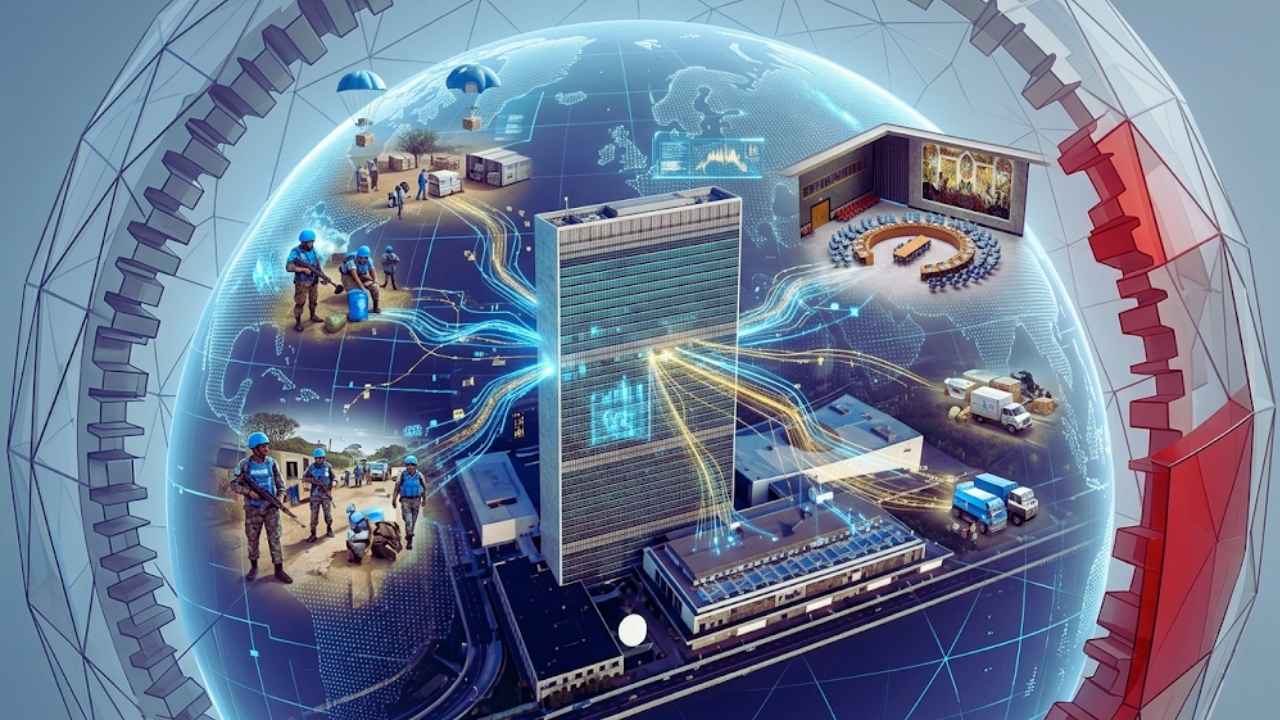
Understanding how the United Nations works requires looking past the diplomatic speeches and diving straight into the actual mechanics of global governance. At its core, the UN is a massive, complex network designed to prevent wars, coordinate international relief, and promote human rights across the globe. You see it in the news almost every day, but the way it operates behind closed doors often feels like a mystery.
The truth is, the organization acts as a bridge between ambitious global goals and the hard reality of national politics. It relies entirely on the voluntary cooperation of its member states. People often think of the UN as a world government that can dictate rules to any country it chooses. That simply is not true. It is a collaborative forum where 193 nations come together to debate, negotiate, and sometimes clash over the future of the planet. Navigating the balance between this global mandate and the strict sovereignty of individual countries explains both its greatest achievements and its most frustrating limitations.
To really grasp how the United Nations works today, you need to understand its structure, the powers it actually wields, and the roadblocks that slow it down. The current landscape in 2026 is pushing the institution to its limits. From massive structural reforms to the upcoming election of a new Secretary-General, the UN is fighting to stay relevant in a highly divided world. Let us break down exactly how this giant machine operates.
A Brief Look Back: Why the UN Was Created?
The United Nations was born out of the ashes of the Second World War. When delegates from 50 nations gathered in San Francisco in 1945 to sign the UN Charter, their primary goal was straightforward but incredibly difficult: to save succeeding generations from the scourge of war. The previous attempt at a global organization, the League of Nations, had failed miserably to prevent the deadliest conflict in human history. The architects of the new UN wanted a system that had real teeth, better representation, and a broader scope covering not just security, but economic stability and human rights.
Today, the organization has grown to include 193 member states, representing almost every recognized sovereign nation on Earth. Its mandate has expanded far beyond stopping armed conflicts between countries. The UN now leads the charge on climate action, sustainable development, global health crises, and even the regulation of emerging technologies like artificial intelligence. It serves as the primary hub where global standards are debated and established.
However, the foundational tension remains exactly the same as it was in 1945. The UN is not an independent authority. It relies on the financial contributions, political will, and military resources of its member states. This means it is only as effective as the countries involved allow it to be.
When major global powers agree, the UN can mobilize massive resources to stop conflicts or deliver aid. When they disagree, the organization often finds its hands tied. This historical context is essential because the original rules written decades ago still govern the complex diplomatic dances we see today.
|
Year |
Milestone Event |
Historical Significance |
|
1945 |
Signing of the UN Charter |
Officially established the UN with 50 original member states. |
|
1948 |
Universal Declaration of Human Rights |
Set the first global standard for fundamental human rights. |
|
1994 |
Trusteeship Council Suspended |
Marked the end of the UN mission to guide trust territories to independence. |
|
2015 |
Sustainable Development Goals |
Launched an ambitious agenda to tackle poverty and climate change by 2030. |
|
2025 |
UN80 Initiative Launched |
Began a massive structural reform program ahead of the UN’s 80th anniversary. |
The Core Structure: Six Principal Organs of the UN
To understand how the United Nations works, you have to break down its architecture. The system is huge and often overwhelming, filled with hundreds of specialized agencies, funds, and programs. But everything traces back to the UN Charter, which established six primary bodies to divide the massive workload of managing international relations.
Think of these six organs as the central nervous system of the organization. Each has a very specific job, ranging from passing budgets to trying war criminals. Some bodies give every country an equal voice, while others concentrate power in the hands of a few wealthy nations. This unequal distribution of power is intentional, designed to keep the most powerful countries engaged in the system.
The way these organs interact determines how quickly the UN can respond to a crisis. Sometimes they work in perfect harmony, passing resolutions and deploying resources within days. Other times, they clash entirely, leading to bureaucratic gridlock. Understanding what each body does is the first step to making sense of global diplomacy.
The General Assembly: The Global Town Hall
The General Assembly is the main deliberative and policymaking organ of the UN. It is the only UN body where all 193 member states have equal representation. Whether you are a global superpower or a tiny island nation, you get exactly one vote. They meet annually in New York, with the most high-profile session occurring every September when world leaders gather for the General Debate.
This body handles a wide range of issues, from admitting new member states to approving the UN budget and electing members to other UN bodies. For standard resolutions, a simple majority is required. For major decisions regarding peace, security, or the budget, a two-thirds majority is necessary. While the resolutions passed here carry immense moral and political weight, reflecting the consensus of the international community, they are generally not legally binding. A country cannot be forced by law to comply with a General Assembly resolution.
The Security Council: The Crisis Managers
While the General Assembly is the town hall, the Security Council is the emergency room. This body has the primary responsibility for maintaining international peace and security. Unlike the General Assembly, the decisions made by the Security Council are legally binding on all UN member states. When this group passes a resolution, the rest of the world has to follow it.
The Security Council consists of just 15 members. Ten of these are non-permanent members elected by the General Assembly for two-year terms, ensuring regional representation. The other five are the permanent members, often referred to as the P5. These are the United States, the United Kingdom, France, Russia, and China. They hold a unique and controversial power: the veto. Any of these five nations can block a substantive Security Council resolution, even if all other 14 members vote in favor of it.
The Economic and Social Council (ECOSOC): The Development Engine
Much of the daily work of the UN system happens under the umbrella of the Economic and Social Council. ECOSOC consists of 54 members elected by the General Assembly for three-year terms. This organ coordinates the economic, social, and environmental initiatives of the UN and its numerous specialized agencies, such as the World Health Organization, the UN Development Programme, and the Food and Agriculture Organization.
ECOSOC is the central platform for fostering debate and innovative thinking on sustainable development. It is the driving force behind the Sustainable Development Goals, which aim to eradicate poverty, ensure quality education, and address climate change globally. By bringing together policymakers, academics, and non-governmental organizations, ECOSOC attempts to build consensus on how to elevate living standards across the globe without ruining the environment.
The International Court of Justice (ICJ): The World Court
Located in The Hague in the Netherlands, the International Court of Justice is the only principal organ not based in New York. The ICJ acts as the main judicial arm of the UN. Its primary role is to settle legal disputes submitted to it by member states and to provide advisory opinions on legal questions referred by authorized UN organs.
The court is composed of 15 judges elected to nine-year terms by both the General Assembly and the Security Council. For a case to be heard, the countries involved generally must agree to submit to the court’s jurisdiction. Once they do, the court’s rulings are final and without appeal. However, enforcing these rulings can be difficult, as the court has no police force of its own.
The Secretariat: The Administrative Backbone
The Secretariat carries out the day-to-day administrative work of the United Nations. It is staffed by tens of thousands of international civil servants working in duty stations around the world. These staff members research human rights abuses, administer peacekeeping operations, organize international conferences, and translate documents into the UN’s six official languages.
At the head of the Secretariat is the Secretary-General, who is appointed by the General Assembly upon the recommendation of the Security Council for a five-year term. The Secretary-General serves as the chief administrative officer and a symbol of the organization’s ideals. This role involves quiet diplomacy, mediating disputes behind closed doors, and publicly bringing attention to global crises that threaten international peace.
The Trusteeship Council: A Completed Mission
The sixth principal organ, the Trusteeship Council, is a relic of the mid-twentieth century. It was originally established to oversee the administration of trust territories, primarily former colonies moving toward independence or self-government. By 1994, all 11 trust territories had achieved self-determination, with Palau being the final territory to gain independence.
Having fulfilled its mandate, the Trusteeship Council suspended its operations. It now exists only on paper and would only meet if circumstances demanded it. It stands as one of the few examples of a UN body successfully completing its original mission and stepping down.
What Powers Does the United Nations Actually Have?
People constantly ask how the United Nations works if it does not have a standing army or the ability to collect taxes. It is a fair question. The UN is often criticized for lacking authority, especially when wars break out and the organization seems unable to stop the violence. But it actually possesses several powerful tools to shape international relations and respond to global crises.
Its power lies in legitimacy, economic pressure, and collective action. When the UN acts, it does so with the backing of international law. This gives its decisions a weight that no single country can achieve on its own. Whether it is deploying troops to a conflict zone or organizing a massive food drop after an earthquake, the UN coordinates resources on a scale that is unmatched by any other entity.
The organization relies heavily on its specialized agencies to execute these powers on the ground. From regulating international postal mail to monitoring nuclear facilities, the UN influences almost every aspect of global society. Below are the primary ways the institution exerts its power and maintains order.
|
Type of UN Power |
Mechanism Used |
Real-World Example |
|
Military Intervention |
Security Council Mandate |
Deploying Blue Helmets to monitor ceasefires in South Sudan. |
|
Economic Leverage |
International Sanctions |
Freezing assets and banning travel for leaders of military coups. |
|
Crisis Management |
Humanitarian Relief |
Supplying food and medicine to refugees through the World Food Programme. |
|
Standard Setting |
Treaty Negotiation |
Establishing global climate targets via the Paris Agreement. |
Deploying Peacekeeping Missions
One of the most visible exercises of UN power is peacekeeping. While the UN does not have a standing army, the Security Council can authorize the deployment of peacekeepers, commonly known as Blue Helmets. These forces are contributed voluntarily by member states. Countries in South Asia and Africa are the backbone of these operations. For instance, nations like Bangladesh, Nepal, India, and Rwanda consistently rank as the top troop contributors. Bangladesh alone frequently deploys over 6,000 military and police personnel to some of the most dangerous missions in places like the Democratic Republic of the Congo, South Sudan, and the Central African Republic.
Peacekeepers are deployed to help countries navigate the difficult path from conflict to peace. They monitor ceasefires, protect civilians, assist in the disarmament of former combatants, and support the organization of democratic elections. Over the decades, UN peacekeeping has evolved from simply observing truce lines to taking on complex mandates in highly volatile environments where there is often no actual peace to keep.
Imposing International Sanctions
When diplomacy fails, the Security Council can mandate sanctions against countries, individuals, or entities that threaten international peace. These are meant to apply intense pressure without resorting to armed conflict. Sanctions can take many forms, including comprehensive economic and trade embargoes, travel bans on specific leaders, and the freezing of financial assets.
The goal of sanctions is usually to force a change in behavior. This could mean halting a nuclear weapons program, stopping the funding of terrorist organizations, or encouraging a return to democratic governance after an illegal takeover. Because these measures are binding, all member states are legally obligated to enforce them, giving the UN massive economic leverage over rogue actors.
Coordinating Global Humanitarian Relief
The UN power to mobilize and coordinate humanitarian aid is perhaps its most universally respected function. Through agencies like the World Food Programme, the UN Refugee Agency, and the UN Children’s Fund, the organization provides life-saving assistance to millions of people caught in the crossfire of war or devastated by natural disasters.
The UN serves as the central hub for assessing needs on the ground, appealing for donor funds, and delivering food, shelter, and medical supplies to the hardest-to-reach areas. In many crisis zones, the UN is the only entity with the logistical capacity and the diplomatic neutrality required to negotiate access to vulnerable populations across enemy lines.
Establishing International Law and Standards
While it cannot pass laws the way a national parliament does, the UN is the primary venue for creating international law. Through the General Assembly and various specialized committees, the UN drafts and negotiates treaties and conventions on everything from the law of the sea to human rights and arms control.
Once a country signs and ratifies a UN treaty, those international standards become part of their domestic legal obligations. Frameworks like the Universal Declaration of Human Rights and various climate agreements originated within the UN system and now serve as the baseline for global norms. It takes time, but these treaties slowly shape how countries govern themselves.
The Limits of UN Power: Where the System Struggles
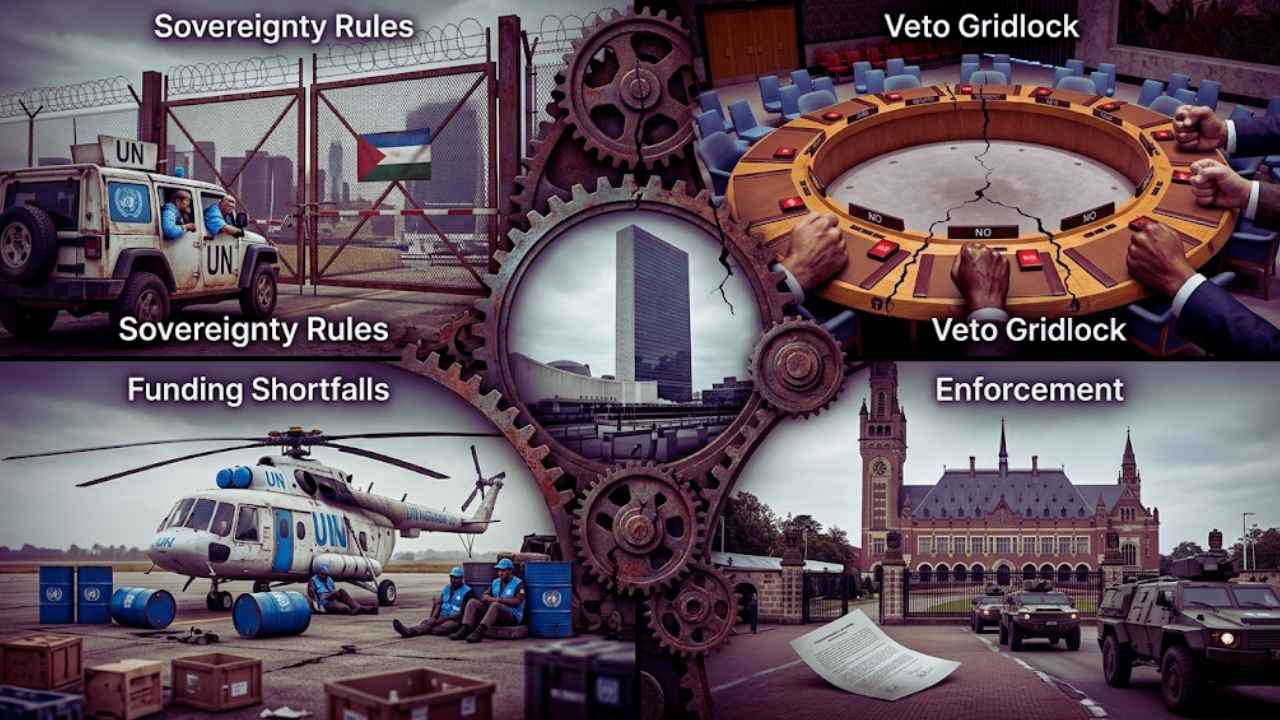
If you really want to know how the United Nations works, you have to look at where it fails. Despite its broad mandate to protect humanity, the organization faces severe structural and political limitations that often prevent it from acting decisively. The system is designed to favor consensus, which means it moves incredibly slowly during emergencies.
The biggest roadblock is political division among the most powerful countries on Earth. When global superpowers disagree, the UN machinery grinds to a halt. You see this most clearly in the Security Council, but it trickles down to budget negotiations and human rights investigations as well. The UN is built on the idea that countries will put global peace ahead of their own interests, a concept that rarely plays out in reality.
Additionally, the UN is completely dependent on money from its members. If countries decide to stop paying their dues, the organization cannot pay its staff, fuel its planes, or run its peacekeeping missions. Let us look closer at the specific limitations that hold the system back.
|
UN Limitation |
Root Cause |
Impact on Global Operations |
|
Veto Gridlock |
Security Council P5 Structure |
Major conflicts go unaddressed if a P5 member is involved or allied. |
|
Sovereignty Rules |
Article 2 of the UN Charter |
Prevents intervention in domestic crises or internal human rights abuses. |
|
Funding Shortfalls |
Voluntary Donations & Arrears |
Forces cuts to humanitarian aid and critical human rights mandates. |
|
Enforcement |
Lack of Independent Police |
Rulings by the World Court can be ignored by aggressive nations. |
The Veto Gridlock in the Security Council
The most glaring limitation of the UN is the veto power held by the P5 in the Security Council. The system was designed in 1945 to ensure that the major military powers remained engaged in the UN, but it frequently results in total paralysis. If a conflict involves a permanent member or one of its close allies, that member will almost certainly use its veto to block any resolution condemning its actions or authorizing intervention.
This structural flaw means that the UN is often sidelined during major geopolitical crises. For years, critics have argued that the Security Council composition reflects the world of 1945 rather than the reality of the modern era, leaving emerging powers like India, Brazil, and major African nations without adequate representation or veto power.
The Challenge of National Sovereignty
The UN Charter explicitly prohibits the organization from intervening in matters that are essentially within the domestic jurisdiction of any state. This principle of national sovereignty is the absolute bedrock of international relations, but it constantly clashes with the UN human rights mandate.
When a government commits atrocities against its own people, the UN often struggles to intervene without violating sovereignty. While the concept of the Responsibility to Protect gained traction in the early 2000s, suggesting that sovereignty is forfeited if a state fails to protect its population, implementing this doctrine requires Security Council approval. That leads right back to the problem of the veto and political gridlock.
Financial Constraints and Funding Struggles
The UN is chronically underfunded. Its regular budget is financed by mandatory assessments on member states, calculated based on their economic capacity. However, countries frequently delay their payments or withhold funds entirely to express political dissatisfaction.
Furthermore, the vast majority of the UN humanitarian and development work relies on voluntary contributions. When donor fatigue sets in or global economic conditions tighten, agencies are forced to slash food rations for refugees and cut essential social programs. The effectiveness of the organization is strictly limited by the willingness of its members to actually open their wallets and pay the bills.
Modern Challenges and the UN in 2026
The world looks very different today than it did a decade ago, and the UN is scrambling to adapt. The year 2026 is proving to be a massive turning point for the institution. The convergence of climate change, technological disruption, and severely fractured geopolitical relations has tested the absolute limits of multilateralism. Member states are demanding that the organization do more with less money.
To survive, the UN is undergoing intense internal restructuring. The focus has shifted toward efficiency, cutting outdated programs, and preparing for future threats like cyber warfare and the unregulated rise of artificial intelligence. At the same time, the organization is gearing up for a massive leadership change that will determine its trajectory for the next decade.
Understanding how the United Nations works right now means understanding these current reforms. The decisions being made in the halls of New York and Geneva this year will reshape global diplomacy for a generation.
|
2026 Challenge |
UN Response Strategy |
Key Details |
|
Bureaucratic Bloat |
The UN80 Initiative |
Slashing vacant posts, restructuring program mandates, merging entities. |
|
Leadership Transition |
Secretary-General Election |
Selecting a new leader for 2027; heavy push for the first female SG. |
|
Budget Crises |
Workstream 1 Budget Cuts |
2026 budget slashed human rights funding due to unpaid member dues. |
|
Technology Threats |
Global Digital Compact |
Establishing new frameworks to govern AI and cybersecurity globally. |
The UN80 Initiative and Institutional Reform
In response to growing criticism about its sluggish bureaucracy, the UN has embarked on significant modernization efforts under the UN80 Initiative. Launched to prepare the organization for its 80th anniversary, this is the most wide-ranging internal reform plan in over a decade. Rather than attempting a massive overhaul of the UN Charter, which would fail due to political division, UN80 aims for practical, structural improvements.
The initiative focuses on identifying efficiencies, reviewing how mandates are implemented, and exploring potential entity mergers across the UN system. However, it is not without controversy. In the 2026 budget negotiations, member states used the UN80 framework to slash funding, cutting over 100 posts at the UN Human Rights Office. While some argue this makes the UN leaner, critics warn that targeting human rights budgets imperils the organization’s ability to investigate grave abuses worldwide.
The year 2026 represents a critical transition period for the United Nations. António Guterres reaches the end of his second term as Secretary-General in December 2026. The selection process for his successor is well underway, serving as a highly political test of multilateral coherence among divided global powers.
There is a massive push to elect the first female Secretary-General in the organization’s history. Candidates like Michelle Bachelet of Chile, Rebeca Grynspan of Costa Rica, and Rafael Grossi of Argentina have entered the race. The incoming leadership will inherit a global landscape where UN authority is frequently contested. The new chief diplomat will need to bridge the widening gap between the Global North and the Global South while managing severe fiscal constraints.
Final Thoughts
Grasping exactly how the United Nations works requires accepting its contradictions. It is an institution capable of feeding millions of starving people and eradicating global diseases, yet it often sits paralyzed while conflicts rage due to political bickering in the Security Council. The 2026 landscape, shaped by the UN80 reforms and intense budget cuts, highlights a system desperately trying to modernize while dealing with major funding shortages.
Despite the deep flaws, the veto gridlocks, and the frustrating bureaucracy, the UN remains the only place on Earth where 193 countries sit in the same room to talk. It provides a safety valve for global tensions and sets the basic rules of international law. As new leaders step up and structural reforms take hold, understanding how the United Nations works is essential for anyone who wants to make sense of international politics today.
Frequently Asked Questions (FAQs) About How United Nations Works
Does the UN have its own military?
No, the United Nations does not possess a standing military force. When the Security Council authorizes a peacekeeping mission, it asks member states to voluntarily contribute troops and police officers. These personnel remain members of their national armed forces but wear the blue UN helmet and operate under the operational control of a UN force commander.
How is the United Nations funded?
The UN is funded through a combination of assessed and voluntary contributions. Assessed contributions are mandatory payments required from all member states to fund the regular budget and peacekeeping operations. Voluntary contributions from governments and corporations fund the humanitarian agencies like UNICEF and the World Food Programme.
Can a country be removed from the United Nations?
Yes. According to Article 6 of the UN Charter, a member state that persistently violates the principles contained in the Charter may be expelled. This must be executed by the General Assembly upon the recommendation of the Security Council. Because any such recommendation requires the agreement of the P5, expulsion has never actually happened.
Do UN ambassadors get diplomatic immunity?
Yes. Representatives of member states and senior UN officials are granted diplomatic immunity while performing their official duties. This ensures they can debate and vote freely without fear of arrest or legal harassment by the host country.
Can the UN tax individuals or corporations?
No. The UN has no authority to levy taxes on citizens or private businesses. It relies entirely on the funds provided by its member governments.