

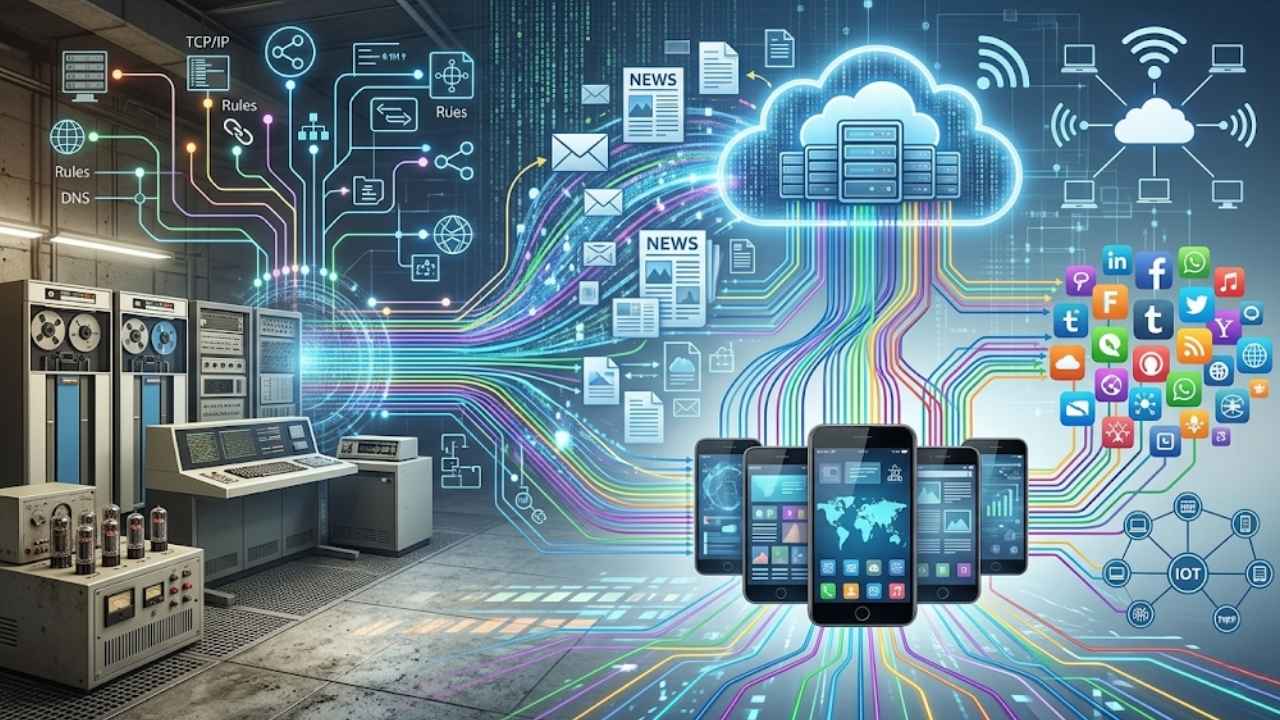
Have you ever stopped to think about the massive, invisible network you rely on every single day? We shop, learn, text our friends, and stream movies using a system that spans the entire globe. But this level of seamless connectivity did not just pop into existence out of nowhere. The history of the internet is a long, weird, and incredible story about curious scientists, government funding, and the human drive to share ideas faster.
When you strip away the heavy technical jargon, you find a highly collaborative human story. Engineers spent decades figuring out how to make giant, clunky computers talk to one another across vast distances. Over time, they built the complex digital world we navigate today. I want to take you through that journey step by step. We will look at how a Cold War military experiment evolved into the absolute lifeblood of modern society, changing how we work, play, and exist.
|
Era |
Major Milestone |
Impact on Society |
|
1960s |
ARPANET Launch |
Proved computers could communicate over distances |
|
1990s |
World Wide Web |
Gave the internet a visual, clickable interface |
|
2010s |
Mobile Revolution |
Put constant internet access in our pockets |
The 1960s: The Cold War and the Birth of ARPANET
To truly understand the history of the internet, you have to look back at the tense political climate of the late 1950s and 1960s. The United States and the Soviet Union were locked in the Cold War, a period defined by paranoia and a desperate race for technological dominance. When the Soviet Union successfully launched the Sputnik satellite into orbit in 1957, the US government panicked. Officials realized they needed to pour massive amounts of money into science and technology to avoid falling behind on the global stage. This widespread fear led directly to the creation of the Advanced Research Projects Agency, commonly known as ARPA, which was housed under the Department of Defense.
The scientists working at ARPA faced a frustrating hardware problem. Their computers were massive, unbelievably expensive machines that took up entire rooms and remained completely isolated from one another. If a researcher in California needed to share data with a team in Massachusetts, they had to copy the data onto magnetic tapes and mail those tapes across the country via the postal service. They desperately needed a way for these giant machines to communicate over long distances. They also required this communication network to be highly resilient, meaning it had to survive a potential nuclear attack without collapsing.
|
Key Figure |
Contribution |
Year |
|
J.C.R. Licklider |
Envisioned the Intergalactic Computer Network |
1962 |
|
Paul Baran |
Developed the theory of packet switching |
1964 |
|
Leonard Kleinrock |
Pioneered the mathematical theory behind data networks |
1969 |
The Concept of Packet Switching
The answer to their long-distance communication problem arrived through a brilliant idea called packet switching. Before this concept existed, telephone networks relied entirely on circuit switching. That meant a dedicated, physical copper wire had to stay open between two people for them to hold a conversation. If that single wire broke or a switch failed, the call dropped immediately. Researchers like Paul Baran in the United States and Donald Davies in the United Kingdom figured out a much smarter way to move digital data.
Instead of sending information in one giant chunk over a single vulnerable line, they decided to chop the data into tiny digital blocks. They called these little blocks packets. These packets could travel independently through dozens of different routes across a scattered network and then glue themselves back together in the correct order at their final destination. If one specific connection broke down or a network node was destroyed, the data simply routed itself through a different path. This highly resilient method of moving data became the absolute core foundation of how modern web traffic functions today.
The First Message Sent Between Computers
Armed with the packet switching theory, ARPA funded an experimental project called ARPANET. In the late fall of 1969, researchers set up the first four nodes of this network at universities across the western United States. The defining moment happened on October 29, 1969. A team of engineers at UCLA tried to send a simple text message to a computer located at the Stanford Research Institute.
Their ambitious plan was to type the word “LOGIN” so they could access the remote machine. They successfully typed the letter “L” and the letter “O”. Then the entire system completely crashed. Despite that somewhat embarrassing start, that fragmented, two-letter message proved that computers could actually talk across a network. It was the humble, clumsy beginning of a system that would one day connect billions of people.
The 1970s: Establishing the Rules of Communication
As ARPANET expanded to include more universities and government research labs in the 1970s, it became obvious that the network was not just for moving cold, hard computing data. People actually wanted to talk to each other. The system started morphing into a genuine digital community. But as independent networks popped up around the world, researchers hit a brick wall.
A computer on ARPANET could not talk to a computer on a satellite network or a radio network. They all spoke entirely different digital languages. It was like trying to have a conversation where one person speaks French and the other speaks Japanese, but neither has a dictionary. To build a true network of networks, the engineers needed to write universal rules that every single machine could understand and follow.
|
Milestone |
Description |
Timeline |
|
Network Email |
First system to send direct messages between users |
1971 |
|
Global Nodes |
Norway and Great Britain connect to ARPANET |
1973 |
|
TCP/IP Design |
The universal language for computer networks is drafted |
1974 |
The Invention of Email
Before they fixed the universal language issue, the 1970s gave us one of the greatest tools in digital history. In 1971, a computer engineer named Ray Tomlinson wrote a clever little program that let ARPANET users send messages to one another. He needed a unique character to separate the user’s name from the computer’s name so the system knew where to route the text.
He looked down at his keyboard, found a key that was rarely used, and picked the “@” symbol. Email was officially born. It exploded in popularity almost overnight. People stopped using the network just to share heavy computing power and started using it to chat, gossip, share recipes, and collaborate on projects. It proved that the future of networking was going to be heavily focused on human interaction.
The Development of TCP/IP
The headache of getting different networks to communicate was finally cured by two brilliant minds named Vint Cerf and Bob Kahn. In 1974, they published a paper that mapped out a universal translator for computers. They called it the Transmission Control Protocol and the Internet Protocol, usually shortened to TCP/IP.
This set of rules told computers exactly how to chop data into packets, address them, and rebuild them upon arrival, regardless of what hardware they were running. It took years of testing, but on January 1, 1983, ARPANET officially switched all its systems over to use TCP/IP exclusively. Many historians consider this specific date the official birthday of the internet because it finally allowed wildly different networks to function together as a single global entity.
The 1980s: Naming the Web and Connecting Networks
By the time the 1980s rolled around, the internet was spreading fast through academic and government circles. The new TCP/IP rules worked perfectly, and more networks joined the party every month. However, there was a massive usability problem preventing everyday people from understanding the system.
If you wanted to visit a specific computer or retrieve a file, you had to type in a ridiculous string of numbers called an IP address. Imagine trying to call your friends, but you have to memorize every single digit of their phone numbers because you do not own a contact book. It was highly frustrating and kept average folks far away from the technology.
|
Event / Technology |
Significance |
Year |
|
MILNET Split |
Separated military data from civilian research data |
1983 |
|
Domain Name System |
Replaced numerical IP addresses with readable words |
1983 |
|
NSFNET Creation |
Built a massive high-speed backbone across America |
1986 |
The Introduction of the Domain Name System
In 1983, a team of researchers fixed this memory problem by inventing the Domain Name System, commonly known as DNS. You can think of DNS as the ultimate digital phone book. Instead of forcing you to type a complicated IP address like 192.168.1.1, DNS let you type a readable word ending in familiar extensions like .edu, .gov, or .com.
The system then quietly translated that readable name back into the ugly numerical address the computers actually needed to make the connection. This simple user-experience upgrade made the internet infinitely more accessible to people who were not hardcore computer scientists. It laid the groundwork for the branding and web addresses we use today.
The Shift from Military to Civilian Use
During this same era, the military side of ARPANET decided they no longer wanted to share server space with college students playing early text-based adventure games. They broke off to form their own isolated network called MILNET. This left the rest of the system entirely to civilian organizations, mainly the National Science Foundation. The NSF built a high-speed network called NSFNET to link massive supercomputing centers across America.
They let regional research networks tap into this fast backbone, creating a sprawling web of connected campuses. Slowly but surely, the strict government rules against using the network for commercial business started to fade away. The digital gates were opening. Regular businesses and consumers were getting ready to step into this new frontier.
The 1990s: The World Wide Web Changes Everything
If the previous decades built the hidden plumbing of the internet, the 1990s built the shiny cities, shopping malls, and libraries right on top of it. The early internet was entirely text-based. You had to memorize obscure keyboard commands just to find a simple text file hidden on a server.
It was a powerful tool, but it was incredibly ugly and highly intimidating to use. Everything shifted thanks to a British computer scientist who worked in a physics lab in Switzerland. He realized information needed to be visually linked, and his wild idea completely changed human history.
|
Technology / Trend |
Impact on the Public |
Era |
|
World Wide Web |
Allowed users to navigate via clickable hypertext links |
1989 to 1993 |
|
Mosaic and Netscape |
Gave users a graphical browser to view images and text |
Mid 1990s |
|
Dot-Com Boom |
Flooded the internet with e-commerce sites and retail stores |
Late 1990s |
Tim Berners-Lee and the Invention of the Web
In 1989, Tim Berners-Lee was working at CERN, the massive particle physics laboratory in Europe. He hated how hard it was for visiting scientists to share research papers across different incompatible computer systems. He pitched a system where digital documents linked directly to one another using something called hypertext. You could just click a highlighted word and instantly jump to another related document.
He built the very first web browser, the first web server, and the first website on a chunky NeXT desktop computer. He named his creation the World Wide Web. The absolute smartest thing he did was convince CERN to make the source code completely free to the public in 1993. That single decision triggered a global explosion of creativity, as anyone could now build a website without paying royalties.
The First Web Browsers
The World Wide Web gave the internet a visual interface, but everyday people still needed easy software to browse it. In 1993, Marc Andreessen and a team of students at the University of Illinois launched Mosaic. It was a revolutionary piece of software that displayed text and pictures side-by-side on the same screen.
It was super easy to install using a floppy disk. Andreessen later helped launch Netscape Navigator, which absolutely ruled the mid-1990s software market. Suddenly, normal families were buying personal computers, plugging dial-up modems into their home phone jacks, enduring the screeching static connection sounds, and waiting patiently for minutes just to load a single webpage.
The Dot-Com Boom
As public access skyrocketed and millions of people rushed online, investors smelled a massive financial opportunity. The late 1990s triggered a wild financial gold rush known as the dot-com boom. Companies like Amazon and eBay launched and fundamentally changed how retail operated. Wall Street threw billions of dollars at literally any startup that had a “.com” attached to its name, regardless of whether they had a solid business plan.
The financial bubble eventually popped in the early 2000s, wiping out thousands of terrible business ideas and bankrupting investors. However, the heavy fiber-optic cables and massive server farms built during that frenzy laid the permanent physical groundwork for today’s digital economy.
The 2000s: Web 2.0 and the Era of Social Media
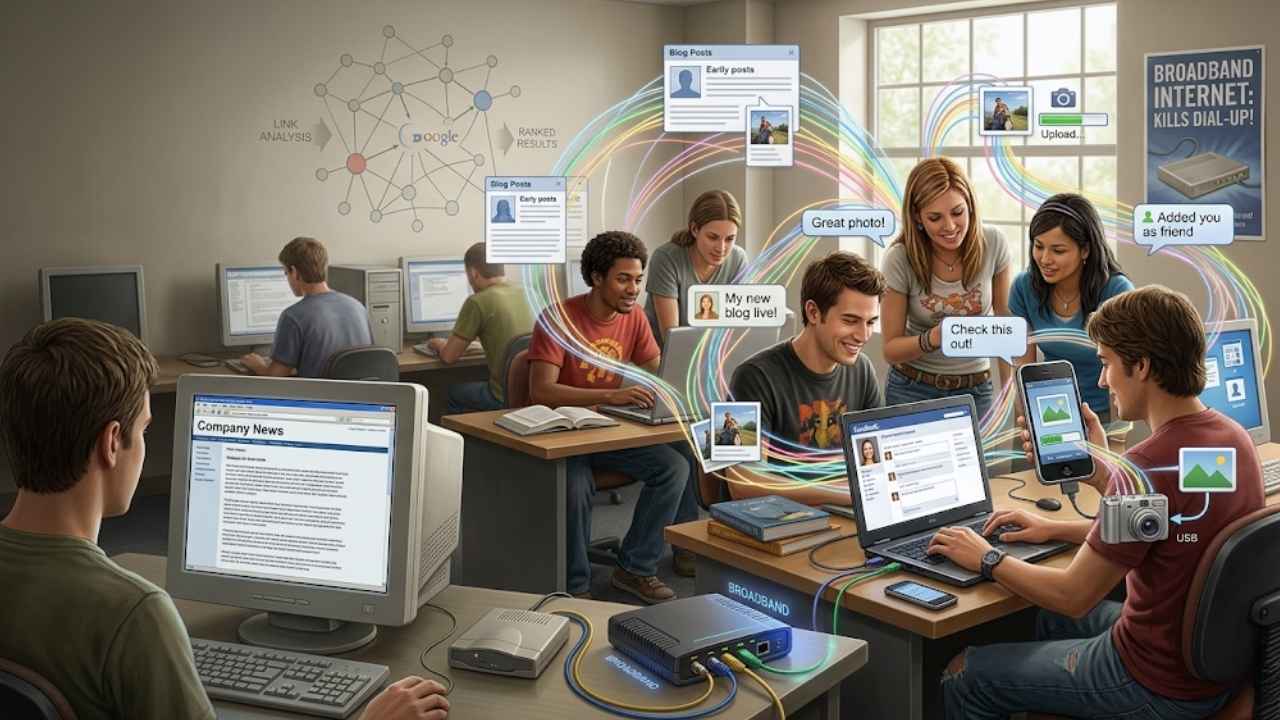
When the calendar flipped over to the new millennium, the history of the internet took a massive pivot toward user participation. Before this era, the web was mostly a read-only experience. You visited a company’s website, read their news article, and closed the window. You were simply a consumer sitting on the sidelines.
The 2000s sparked a massive movement that technology experts called Web 2.0. The internet became a busy two-way street. It was no longer just about reading static pages built by corporations; it was about regular people uploading their own content, voicing their opinions in comment sections, and building massive online communities.
|
Platform / Shift |
Cultural Impact |
Decade Highlight |
|
Broadband Internet |
Killed dial-up and enabled video streaming at home |
Early 2000s |
|
Google Search |
Organized the chaos of the web using link analysis |
2000s |
|
Social Media Launch |
Facebook, YouTube, and Twitter connected the globe |
Mid 2000s |
The Rise of Broadband Internet
This highly interactive era relied entirely on the rapid spread of broadband internet. The agonizing wait times and dropped connections of dial-up modems slowly died out. They were replaced by always-on, high-speed cable and DSL lines installed directly into homes. Broadband meant websites loaded instantly.
It allowed platforms to host high-resolution photos and stream video and audio without constantly pausing to buffer. You no longer had to scream at your family to get off the house phone so you could check your email. This major speed upgrade turned the internet from a fun weekend hobby into a permanent, running utility in our homes.
Google and the Search Engine Revolution
With millions of new websites launching every single month, the web quickly turned into a chaotic, unsearchable mess. Early search engines like Ask Jeeves and AltaVista often fed users terrible spam pages and broken links. Then Google stepped onto the scene and cleaned up the mess. Founders Larry Page and Sergey Brin changed the game completely by analyzing how websites linked to each other.
If fifty highly reputable sites linked to your specific page, Google naturally assumed your page was valuable and bumped it to the top of the search results. This made navigating the massive internet actually useful and turned Google into an absolute global powerhouse.
The Dawn of Social Networking
As broadband sped things up, the internet transformed into the ultimate digital hangout spot. Early sites like Friendster and MySpace showed that teenagers and adults desperately wanted to curate digital profiles, pick background music, and talk to their real-life friends online. In 2004, Facebook launched for college kids before rapidly eating the rest of the world.
YouTube showed up shortly after in 2005, turning anyone with a cheap digital camera into a global broadcaster. Twitter gave us a place to shout short, rapid-fire thoughts into the void. These platforms completely rewired how we consume daily news, interact with celebrities, and maintain our longest friendships.
The 2010s: The Mobile Internet and Cloud Computing
The 2010s violently ripped the internet away from the bulky desktop computer sitting in your home office. The old concept of “going online” completely vanished because we were suddenly online every single second of the day. The internet migrated permanently into our pockets, our cars, and eventually onto our wrists. This specific decade was defined by constant connectivity and the sheer, undeniable convenience of having the entire sum of human knowledge sitting right in the palm of your hand.
|
Tech Advancement |
Core Benefit |
Industry Example |
|
Smartphone Apps |
Replaced web browsers with dedicated mobile software |
App Store ecosystem |
|
The Gig Economy |
Used mobile GPS to connect workers and customers |
Uber, DoorDash |
|
Cloud Streaming |
Eliminated the need to buy physical media |
Netflix, Spotify |
The Smartphone Revolution
While clunky mobile flip phones existed for years, the launch of the original iPhone in 2007 and the rapid spread of Android devices changed the rules entirely. These devices were not just phones making calls. They were powerful, pocket-sized computers packed with cameras, GPS trackers, and permanent internet connections.
This forced every single company on earth to completely rethink their business model. Apps became the primary way we interacted with the digital world. Entire industries flipped upside down almost overnight. Uber changed how we hail rides, Airbnb changed how we book our vacations, and Instagram changed how we take and share photos. The modern gig economy was officially born out of this mobile shift.
Streaming Services and the Cloud
As mobile cellular networks got insanely fast with the global rollout of 4G LTE, another massive change happened quietly in the background. We completely stopped downloading heavy files to our local hard drives. Instead, we moved everything to the cloud. Cloud computing means all your data, photos, and software live on massive servers housed in remote warehouses rather than taking up space on your physical phone.
This major shift allowed streaming services to explode in popularity. Platforms like Netflix, Spotify, and Apple Music could instantly stream thousands of high-definition movies and songs directly to your screen because the heavy data lifting happened miles away in the cloud.
The 2020s and Beyond: Artificial Intelligence and Web3
Right now, we are watching the internet shed its skin and evolve yet again. The hard lines between our physical reality and the digital world are practically gone. We are stepping into an era where the internet is no longer just something you stare at on a glowing rectangular screen. It is actively becoming an invisible layer of intelligence that wraps around everything we do. The sheer speed of modern data transfer and the rapid rise of smart machines are rewriting the rules of the internet daily.
|
Future Trend |
What It Does |
Societal Impact |
|
5G Infrastructure |
Provides near-instant wireless data transfer |
Enables self-driving cars and remote surgery |
|
Internet of Things |
Connects appliances and infrastructure to the web |
Creates smart homes and automated cities |
|
Generative AI |
Uses data to write text, code, and create art |
Shifts how humans work and create media |
The Impact of 5G and the Internet of Things
The ongoing global rollout of 5G cellular networks gives our phones speeds that easily crush traditional home broadband connections, bringing lag down to almost zero. This raw, unadulterated speed powers the Internet of Things. That is a fancy tech term for the billions of physical objects currently connecting to the web.
Your kitchen refrigerator, your living room thermostat, your doorbell camera, and even the traffic lights in your downtown area are constantly collecting and trading data over the network. This hyper-connectivity is meant to automate our boring daily routines and make our massive cities vastly more energy-efficient.
Artificial Intelligence and the Decentralized Web
The biggest plot twist in the history of the internet is the sudden, explosive integration of Artificial Intelligence. Machine learning tools now write computer code, generate stunning artwork, and chat with us exactly like human beings. AI algorithms secretly curate every single video and article you see on your social media feeds.
At the exact same time, a vocal group of developers is pushing hard for Web3. This movement uses blockchain technology to fundamentally decentralize the internet. They want to strip power away from the massive tech monopolies that currently run everything and give everyday users total ownership over their personal data and digital assets.
Final Thoughts
When you zoom all the way out and look at the whole picture, the history of the internet is an ongoing story of humans desperately trying to solve complex problems. What started as a paranoid military experiment to protect data during the Cold War has morphed into the absolute backbone of modern human civilization. From ARPANET sending a broken, two-letter message to the launch of the graphical World Wide Web and the sudden dominance of generative AI, every single breakthrough leaned heavily on the hard work of the previous generation.
As we barrel toward a wild future packed with smart devices, virtual environments, and decentralization, it helps to remember the core purpose of all this technology. The internet, stripped of all its glowing screens, fiber-optic wires, and massive server farms, is just a tool designed to bring human ideas closer together. It will keep evolving and changing shape as long as we keep finding new ways to connect with one another.
Frequently Asked Questions (FAQs) About History of Internet
What was the first physical item ever bought on the internet?
The first legitimate online transaction is heavily debated, but many tech historians point to a CD. In August 1994, a man named Dan Kohn built a secure retail website called NetMarket. He sold a copy of the sting album “Ten Summoner’s Tales” to a friend in Philadelphia for $12.48 plus shipping. The friend used secure data encryption software to safely send his credit card number over the network.
Did the internet exist before the World Wide Web?
Yes, it absolutely did. The internet is the massive physical infrastructure of connected computers and cables that stretches across the globe, and it was up and running by the late 1960s. The World Wide Web, which was invented decades later in 1989, is simply a graphical service that runs on top of that existing physical internet to display clickable pages and images.
How deep is the physical internet cable network?
Most people think the internet floats in the air, but 99 percent of international data traffic travels through physical fiber-optic cables resting directly on the ocean floor. These massive undersea cables can be laid as deep as 25,000 feet below the surface. They are coated in thick layers of steel wire and plastic to protect them from extreme water pressure and shark bites.
What happens if an undersea internet cable breaks?
Undersea cables break all the time due to dragging boat anchors, underwater earthquakes, and routine wear and tear. Because the internet is built on the concept of packet switching, the network simply reroutes your data traffic through other active cables in the region. Repair ships are then dispatched to pull the broken cable up from the ocean floor, splice the glass fibers back together, and drop it back down.
How much of the internet is actually accessible through Google?
Google and other search engines only index a tiny fraction of the internet, known as the Surface Web. Experts estimate the Surface Web makes up less than 10 percent of the total internet. The vast majority of online data lives in the Deep Web, which consists of private databases, password-protected email accounts, banking portals, and academic archives that search engines are not legally allowed to crawl or display.