


We have all been there. You decide it is finally time to get serious about saving for retirement. You open a brokerage website, click on the button to open an account, and immediately hit a brick wall. The screen asks you to pick between a Roth IRA vs Traditional IRA, and suddenly you feel like you are taking a pop quiz you did not study for.
It is a common roadblock, but making the right choice does not have to be stressful. You just need to understand how the government wants to tax your money and decide when you want to pay that bill. You can pay it today, or you can pay it decades from now. That is really the core of the entire debate. We are going to break down the rules, look at the 2026 limits, and figure out which path makes the most mathematical sense for your wallet. Let us dive into the details so you can start investing with total confidence and clarity.
Understanding the Basics of Individual Retirement Accounts
Individual retirement accounts are incredible tools for building long-term wealth, but they can feel overwhelming at first glance. Think of an IRA not as a single investment, but as a protective basket where you keep your money safe from immediate taxes. You get to fill this basket with stocks, bonds, or mutual funds depending on your comfort level with risk. The government created these special accounts to reward people who plan ahead for their later years.
Without this tax protection, your annual investment gains would get eaten away by capital gains taxes, slowing down your overall wealth building. Once you grasp how these accounts function, you gain total control over your financial destiny. You just have to decide whether you want to pay taxes today or defer them until you retire. Getting this foundation right is the first step toward true financial independence.
|
Account Concept |
Description |
Main Benefit |
Best For |
|
Individual Retirement Account |
A tax-advantaged holding container for investments |
Shields investment growth from annual capital gains taxes |
Anyone with earned income looking to build wealth |
|
Traditional IRA Model |
Pre-tax contributions with taxes paid in retirement |
Immediate deduction lowers your current taxable income |
High earners wanting to reduce current tax bills |
|
Roth IRA Model |
Post-tax contributions with tax-free withdrawals later |
Provides completely tax-free income during retirement years |
Young workers and those in lower tax brackets today |
|
Allowable Investments |
Stocks, bonds, mutual funds, and exchange-traded funds |
Offers complete control over how your money is invested |
Self-directed investors who want portfolio control |
What is a Traditional IRA?
The traditional version is the original retirement account model that most people are familiar with. When you put money into this account, you often get to deduct that amount from your income when you file your taxes. If you make sixty thousand dollars a year and contribute five thousand dollars to your traditional account, you tell the IRS to only tax you on fifty-five thousand dollars.
It is a fantastic way to lower your tax bill in the present moment. Your investments then grow inside the account without any tax drag for decades. You do not have to report annual dividends or capital gains on your tax returns. However, the IRS never forgets. When you finally retire and start taking money out to live on, every single dollar you withdraw is taxed as regular income based on whatever tax bracket you fall into at that time.
What is a Roth IRA?
The Roth version flipped the script entirely when it was introduced in the late nineteen nineties. With this account, you do not get any sort of tax deduction today. You pay taxes on your full salary right now, take the leftover money, and deposit it into the account. It sounds like a bad deal upfront, but the payoff at the end is massive. Because you already paid taxes on the seed money, the government promises to never tax the harvest.
All the compound interest and investment growth your money generates over thirty or forty years becomes completely tax-free. When you retire and pull that money out to pay for groceries or vacations, you owe the IRS absolutely nothing. For folks who start investing early, the amount of tax-free growth can easily outpace the amount of money they originally deposited.
Key Differences Between Roth and Traditional IRAs
Choosing between these two accounts comes down to understanding exactly how they treat your hard-earned money over time. You need to look closely at the specific rules for taxes, income limits, and when you can actually touch your cash. The Roth IRA vs Traditional IRA debate usually centers on your current income tax bracket compared to what you expect to pay in the future.
The Internal Revenue Service has distinct rules for both, and knowing these limits helps you avoid massive penalties. The right choice today might actually be the wrong choice five years from now as your career grows and your salary increases. That is why it pays to review these differences every single tax season. We need to break down the key areas where these accounts take entirely different paths so you do not get blindsided by unexpected taxes.
|
Feature Comparison |
Traditional Rules |
Roth Rules |
|
Tax Treatment |
Tax deduction now, pay taxes on withdrawals later |
No deduction now, withdrawals are completely tax-free |
|
2026 Contribution Limit |
$7,500 or $8,600 if age 50 or older |
$7,500 or $8,600 if age 50 or older |
|
2026 Income Limits |
None to contribute, but limits exist for deductions |
Phased out starting at $153,000 for single filers |
|
Early Withdrawals |
10 percent penalty plus income tax on full amount |
Original contributions can be withdrawn penalty-free |
|
Mandatory Withdrawals |
Required minimum distributions start at age 73 |
No required minimum distributions during your lifetime |
Tax Treatment: Now vs. Later
The core difference is timing. You have to decide if your current tax rate is higher than the rate you expect to pay in retirement. If you are currently in a very high tax bracket, taking the deduction today makes mathematical sense.
You avoid paying thirty percent or more to the government right now. If you are young or in a lower tax bracket, paying ten or twelve percent today to lock in a lifetime of tax-free growth is an absolute steal. It is a constant balancing act of paying taxes when the rate hurts your wallet the least.
Income Limits and Eligibility for 2026
The government restricts who can use these accounts based on how much money you make. For the 2026 tax year, anyone with earned income can put money into a traditional account. There are no income barriers to making a deposit, though limits apply to deducting it. The Roth account is much stricter.
If you are a single filer in 2026, your ability to contribute to a Roth begins to shrink once your modified adjusted gross income hits $153,000. If you make $168,000 or more, you are completely banned from making a direct contribution. For married couples filing jointly, the phase-out range starts at $242,000 and cuts off completely at $252,000.
Contribution Limits for 2026
You cannot just dump your entire salary into these protected accounts. The IRS sets strict annual caps to prevent wealthy individuals from sheltering too much money. For 2026, the maximum you can contribute across all your IRA accounts combined is $7,500. If you are fifty years old or older, the government throws you a lifeline called a catch-up contribution.
This allows you to put in an extra $1,100, bringing your maximum total to $8,600 for the year. Remember, this is a shared limit. You cannot put the maximum amount into both a Roth and a traditional account in the same year. You have to split the limit if you want both.
Withdrawal Rules and Penalties
Getting your money out early comes with harsh consequences for the traditional account. Because the money has never been taxed, pulling it out before age 59 and a half triggers regular income taxes plus a brutal ten percent penalty. The Roth account treats you much better if you find yourself in a financial emergency.
Since you already paid taxes on your original contributions, you can withdraw that principal amount at any time, for any reason, without owing a dime in taxes or penalties. You just cannot touch the investment earnings early without facing fees.
Required Minimum Distributions
When you reach your later years, the IRS gets tired of waiting for its tax money. If you have a traditional account, the government forces you to start taking money out when you turn 73. These forced withdrawals are called required minimum distributions.
You have to take them whether you need the money or not, and they will increase your taxable income for the year. Roth accounts are exempt from this rule entirely. You can leave your money alone to grow tax-free until the day you die, making it a fantastic tool for leaving wealth to your children.
Deep Dive: The Traditional IRA Advantage
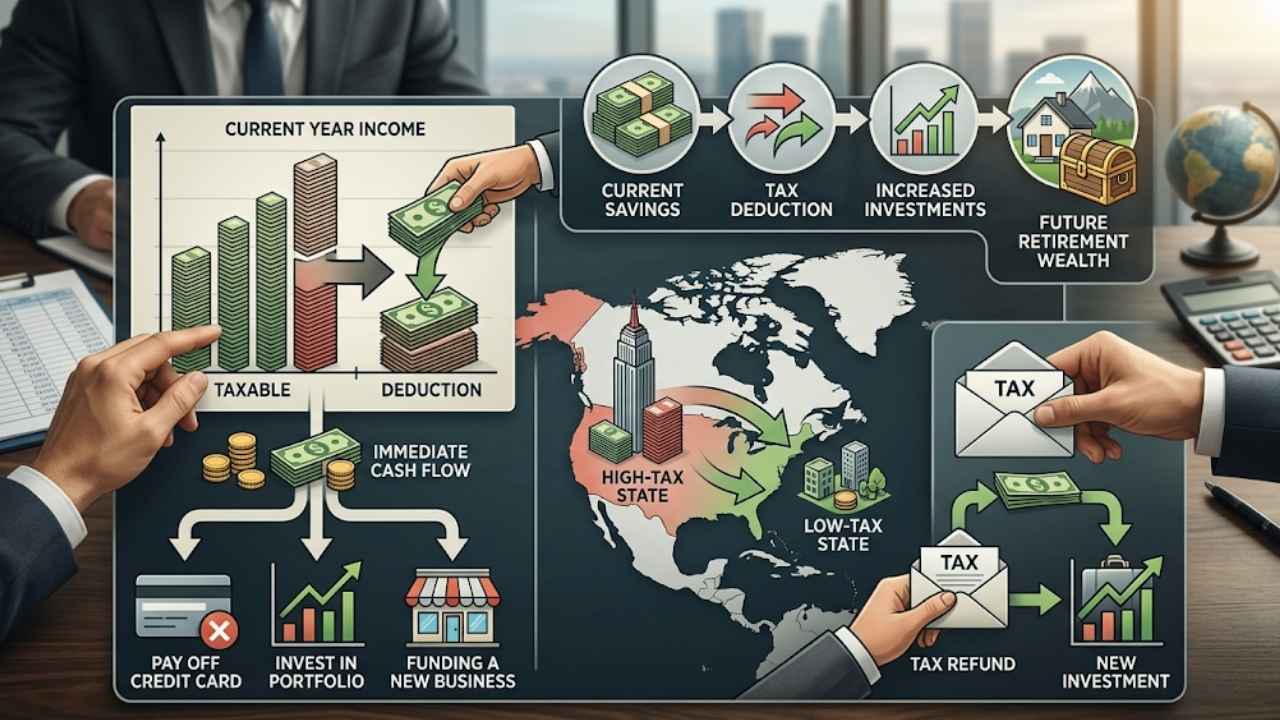
Many modern financial experts push everyone toward tax-free accounts, but the classic pre-tax model remains an absolute powerhouse for high earners. When you use a traditional account, you take a massive chunk of your income and hide it from the IRS right now. If you are sitting in a high tax bracket today, the upfront deduction keeps actual cash in your checking account instead of sending it to the government.
This instant relief frees up money that you can use to pay off credit cards, fund a business, or invest in a separate brokerage account. You do have to pay taxes when you retire, but most people spend less in retirement, putting them in a much lower tax bracket anyway. If you manage the math correctly, you essentially cheat the tax code legally by paying the lowest possible rate. Let us look closely at why taking the immediate tax break is often the smartest move you can make.
|
Traditional Advantage |
How It Works |
Ideal Candidate |
|
Immediate Tax Deduction |
Lowers current taxable income dollar-for-dollar |
High earners currently in their peak tax brackets |
|
State Tax Arbitrage |
Deduct in high-tax state, withdraw in low-tax state |
People planning to relocate for retirement |
|
Increased Cash Flow |
Tax savings can be used to pay off high-interest debt |
Individuals needing extra money in their budget today |
|
Reinvested Refunds |
Taking the tax refund and investing it separately |
Disciplined investors who save their tax windfalls |
Immediate Tax Relief
The biggest selling point of the pre-tax route is the instant gratification on your tax return. Lowering your taxable income by seven thousand dollars can easily save you two thousand dollars in actual taxes if you are in a higher bracket.
That is real money that stays in your checking account right now. You can use that savings to fund a child’s college education, pay down a mortgage faster, or simply build up your cash reserves. Getting a massive tax refund in April is a direct result of utilizing this deduction properly.
Ideal Candidates for a Traditional IRA
This account shines the brightest for doctors, lawyers, executives, and anyone else currently sitting in a top tax bracket. If you are single and making over a hundred thousand dollars, you are paying a hefty premium on your top dollars. By taking the deduction now, you shield that money from high rates.
When you retire, your income will likely drop drastically because you are no longer working. You can then pull the money out in smaller chunks and pay taxes at a much lower, more friendly rate. It is also perfect for workers living in high-tax areas like California or New York who plan to retire in states with zero income tax like Florida or Texas.
Strategies for Maximizing Traditional IRA Benefits
To truly win with this account, you have to be smart with the tax savings you get every spring. If you take the deduction and then spend your tax refund on a new television, you lose the mathematical edge. You need to take the money the government gave back to you and invest it in a standard brokerage account.
When you combine the growth of your retirement account with the growth of your reinvested tax savings, the pre-tax model can actually generate more total wealth than the post-tax alternative over a long enough timeline. It just requires serious financial discipline.
Deep Dive: The Roth IRA Advantage
For millions of younger investors and everyday workers, removing the looming threat of future taxes makes the post-tax model the clear winner. You pay your taxes upfront on the seed money, but the government can never touch the harvest your investments grow into. Compound interest is the greatest wealth-building force on the planet, and protecting decades of that growth from taxes gives you incredible financial freedom. You never have to worry about the government raising tax rates down the road because your money is already cleared.
Furthermore, having a massive pool of tax-free cash in retirement protects your Social Security benefits from triggering extra taxes. It also acts as a flexible safety net, allowing you to access your original deposits in an emergency without getting slammed with penalty fees. Here is why so many people consider this account the holy grail of personal saving.
|
Roth Advantage |
How It Works |
Ideal Candidate |
|
Tax-Free Withdrawals |
Pay zero taxes on investment gains in retirement |
Avoiding stealth taxes on Social Security benefits |
|
Flexible Withdrawals |
Access your original contributions anytime penalty-free |
People who want a backup emergency fund |
|
No Forced Distributions |
Leave money in the account for your entire life |
Building generational wealth for heirs |
|
Locked-In Tax Rates |
Pay taxes at today’s historically low rates |
Young workers anticipating higher future taxes |
Tax-Free Growth and Withdrawals
Compound interest is amazing, and protecting it from taxes is a brilliant move. If you invest diligently for forty years, the amount of money you actually contributed will be tiny compared to the massive gains your investments generated. Getting to keep all of that growth is a staggering benefit.
For example, if you contribute fifty thousand dollars over a decade and it grows to half a million dollars by retirement, you pay exactly zero taxes on that four hundred and fifty thousand dollars of profit. Furthermore, having a source of tax-free income in retirement keeps your official taxable income low, keeping your Medicare premiums from skyrocketing.
Flexibility and Early Access to Contributions
We all try to build emergency funds, but sometimes life throws a disaster at you that drains your cash completely. Having your money locked behind a ten percent penalty wall is terrifying. The post-tax account solves this by letting you withdraw your original deposits whenever you want.
You should try your hardest never to touch your retirement money early, but having that ripcord available helps you sleep better at night. It acts as a shadow emergency fund while still allowing your money to grow aggressively in the stock market. You just have to be sure you are only withdrawing the principal, not the gains.
Ideal Candidates for a Roth IRA
If you are in your twenties or thirties and just starting your career, this is almost always the right choice. Your salary is likely lower than it will be ten years from now, meaning your current tax bracket is low. Pay the cheap tax rate today and let the money ride tax-free for four decades.
It is also the smartest play for anyone who believes the government will raise taxes in the future to pay off national debt. By paying your taxes upfront, you completely insulate yourself from future political decisions regarding tax rates. You lock in a sure thing today.
Advanced Strategies and Financial Considerations
As your income grows and your financial life becomes more complicated, you have to look beyond the basic rules to maximize your wealth. Comparing a Roth IRA vs Traditional IRA is not just a one-time choice for beginners; it requires ongoing strategic planning. High-income earners often find themselves locked out of direct contributions, forcing them to use completely legal loopholes to get their money invested.
You also have to navigate the tricky rules surrounding workplace retirement plans, as having a 401k can completely eliminate your ability to take a traditional tax deduction. Knowing how to leverage both account types at the same time allows you to control exactly how much tax you pay in retirement. You must stay aware of these advanced tactics to keep the IRS out of your pockets. Let us explore the sophisticated moves that wealthy investors use to stay ahead.
|
Advanced Strategy |
Description |
Things to Watch |
|
Tax Rate Comparison |
Evaluating current versus future tax brackets |
The core math behind choosing the right account |
|
Backdoor Conversion |
Bypassing income limits to fund a post-tax account |
Watch out for the pro-rata rule on existing pre-tax money |
|
Tax Diversification |
Splitting money between both account types |
Provides flexibility to manage tax bills in retirement |
|
Workplace Plan Rules |
401k participation changes deduction eligibility |
High earners may lose pre-tax deduction benefits |
Your Current Tax Bracket vs. Future Tax Bracket
The entire decision rests on predicting where your taxes are going. You have to take a hard look at your career path. A medical resident making sixty thousand dollars today but expecting to make four hundred thousand dollars as an attending physician needs to pay taxes now while the rate is low.
A senior engineer making two hundred thousand dollars who plans to retire to a simple cabin in the woods should take the deduction now while their rate is punishingly high. Run the numbers based on your specific life plans, not on general advice you hear on the internet.
The Backdoor Roth IRA Strategy
If you make too much money and the IRS says you cannot contribute to a post-tax account, there is a completely legal workaround. You start by putting your money into a traditional account, making sure you do not claim a tax deduction for it. Once the money settles in the account, you immediately convert it over to your post-tax account.
Because you never took a deduction, you do not owe any taxes on the conversion. This backdoor method lets high earners build tax-free wealth, but it gets complicated if you already have other traditional accounts with pre-tax money in them. The IRS uses a pro-rata rule that will tax a portion of your conversion if you mix pre-tax and post-tax money.
Employer Sponsored Plans and IRA Deductibility
Having a 401k or a 403b at work throws a massive wrench into the pre-tax strategy. The government does not want you double-dipping on tax breaks. For 2026, if you are single, have a retirement plan at work, and your income goes over $81,000, your ability to deduct your traditional contributions starts to disappear.
It vanishes completely at $91,000. For married couples filing jointly where you participate in a workplace plan, the phase-out hits between $129,000 and $149,000. If you cannot take the deduction, putting money into a traditional account is usually a terrible idea, and you should focus entirely on the post-tax or backdoor options.
How to Choose the Right IRA for Your Retirement Goals?
You have absorbed all the facts, rules, and limits, and now you have to make a concrete decision for your own financial future. Making the final call requires you to sit down and visualize exactly what you want your retirement lifestyle to look like. Do you plan to downsize and live simply, or do you want to travel the globe and spend heavily? Your expected spending habits dictate your future tax bracket, which ultimately decides which account saves you the most money.
There is absolutely no shame in hedging your bets and splitting your money between both types of accounts to give yourself options later. Building a customized roadmap ensures you hit your goals without handing over an unnecessary fortune in taxes. Here is a practical framework to help you finally pull the trigger and start investing today.
|
Decision Factor |
What to Analyze |
Action Step |
|
Income Expectations |
Will your income drop or rise in retirement? |
Choose pre-tax if dropping, post-tax if rising |
|
Workplace Coverage |
Do you have a 401k with a match? |
Maximize the employer match before funding outside accounts |
|
Tax Diversification |
Do you only have pre-tax money saved? |
Start building a post-tax balance for future flexibility |
|
Complexity Level |
Are you attempting backdoor conversions? |
Hire a professional to avoid IRS penalty mistakes |
Evaluating Your Financial Roadmap
Grab a pen and paper and map out what you want your golden years to look like. Calculate how much money you will need every month to cover housing, food, healthcare, and travel. If you have a paid-off house and a frugal lifestyle, your tax bracket will be incredibly low in retirement, making the immediate tax deduction very attractive right now.
If you plan to travel the world and buy expensive toys, you will be pulling huge amounts of money from your accounts, which will push you into higher tax brackets. In that scenario, having tax-free money is absolutely vital to surviving without running out of cash.
Splitting Contributions Between Both Accounts
One of the best secrets in personal finance is that you do not have to pick just one side. You can hedge your bets by doing both. Splitting your annual limit between pre-tax and post-tax accounts gives you tax diversification.
When you finally retire, you can look at the tax brackets for that specific year. You can pull money from your pre-tax accounts until you hit the top of the lowest tax bracket, and then switch over to pulling from your tax-free accounts to fund the rest of your lifestyle. It gives you total control over your tax bill year after year.
When to Consult a Financial Advisor
While the concepts are straightforward, the actual implementation can get messy rapidly. The IRS tax code is unforgiving. If you calculate your modified adjusted gross income incorrectly or mess up a backdoor conversion, you could face severe financial penalties.
If your financial life includes small business income, real estate investments, or multiple old 401k rollovers, it is time to call in an expert. A certified financial planner can run advanced projections and ensure you are making the most efficient moves possible based on your specific life situation.
Final Thoughts
Navigating the complexities of retirement planning often feels overwhelming, but taking action is the most important step. When comparing a Roth IRA vs Traditional IRA, remember that both paths lead to the exact same destination of financial security. The post-tax model offers incredible long-term freedom and completely tax-free growth, while the pre-tax model provides immediate relief for high earners looking to lower their current tax bill.
Analyze your current income, project your future tax bracket, and choose the account that gives you the biggest mathematical advantage. The earlier you start investing, the more time compound interest has to work its magic and build the wealth you deserve.
Frequently Asked Questions (FAQs) About Roth vs Traditional IRA
Can a non-working spouse open one of these accounts?
Yes, they absolutely can. This is called a spousal IRA. As long as one spouse has enough earned income to cover the contributions for both people, the non-working spouse can open and fund their own account. This essentially doubles the amount of tax-advantaged space a married couple has available every single year.
Does money in these accounts affect my child’s college financial aid?
The balance of your retirement accounts is generally not counted as an asset on the FAFSA application, meaning it will not hurt your child’s chances of getting financial aid. However, if you withdraw money from these accounts to pay for college, that withdrawal counts as income, which could heavily impact financial aid eligibility for the following year.
Are my retirement accounts protected from creditors and lawsuits?
Yes, federal law provides excellent protection for your retirement assets if you declare bankruptcy. Currently, federal bankruptcy law protects over one million dollars of your IRA assets. If you are sued outside of bankruptcy, your protection depends entirely on the laws of the specific state you live in, as some states offer total protection while others offer very little.
What happens if I make too much money for a Roth but contribute anyway?
If you accidentally contribute directly when your income is over the 2026 limits, the IRS will hit you with a six percent penalty tax on that excess money for every single year it stays in the account. You have to act quickly to fix the mistake. You can either withdraw the excess contribution and its earnings before tax day, or ask your brokerage to recharacterize the contribution into a traditional account.
Can I have a 401k at work and still open my own IRA?
Absolutely. Your workplace plan and your personal retirement accounts are entirely separate things. You can contribute the maximum amount to your 401k and still put $7,500 into your personal accounts for 2026. Just remember that having the workplace plan might prevent you from taking the tax deduction on the traditional side if your income is too high.
Can I transfer money from my traditional account into a Roth?
Yes, this process is known as a Roth conversion. You take money that has never been taxed and move it into the tax-free bucket. The catch is that you have to pay the income taxes on whatever amount you convert right now. This is a brilliant move to make during years when your income temporarily drops, like if you go back to school or take a sabbatical from work.