


Want to turn your channel into an actual paycheck? You need to know what works right now. The platform shifted entirely over the last few years. Chasing a random viral hit simply does not guarantee a sustainable income anymore.
Understanding how to make money on YouTube in 2026 takes a solid business plan, a deep look at your audience, and a firm grasp on the newest payout metrics. We are moving past generic, outdated advice to give you the real data. You will find the current eligibility rules, actual revenue figures, and the most profitable niches you can jump into today. Let’s get straight into the numbers.
Why YouTube Monetization is Different in 2026?
The whole creator landscape looks completely different today. YouTube is no longer just a machine that serves ads. It operates as a massive ecosystem for digital business owners. The platform heavily pushes direct fan funding now, which means smaller creators get paid much earlier than they used to. Short-form video also flipped the script. Shorts act as a massive discovery engine rather than a direct money maker. Advertisers have grown incredibly picky about where they spend their budgets.
You cannot rely on a single revenue stream if you want to survive sudden algorithm updates. If you are learning how to make money on YouTube in 2026, diversifying your income is practically mandatory. The gap between casual uploaders and serious business owners has never been wider. Smart creators focus on building deep connections with a smaller, highly targeted audience rather than trying to appeal to everyone on the internet.
|
Feature |
Past Years |
Reality in 2026 |
|
Main Income Source |
Ad revenue only |
Ad revenue plus fan funding and product sales |
|
Entry Barrier |
1,000 subscribers required |
Early access tier starts at 500 subscribers |
|
Shorts Payout |
Bonus fund model |
Pooled ad revenue sharing model |
|
Advertiser Rules |
Broad targeting |
Highly specific targeting requiring safe content |
The Shift Toward Fan Funding
Years ago, you had to wait months or even years to see a single dollar. You relied entirely on commercial breaks. Today, YouTube wants you earning money from your biggest fans on day one. They rolled out an early access tier specifically designed for direct support. If you build a small but highly engaged community, those viewers can buy channel memberships or send Super Chats during your live streams.
This shift changes everything. A channel with just a few hundred die-hard fans can easily out-earn a channel with thousands of casual viewers who click away after ten seconds. Creators in highly technical spaces, like B2B software development or global financial tech, benefit massively here. You do not need a million views. You just need five hundred professionals willing to pay a few bucks a month for your exclusive community posts.
Shorts Revenue Pooling
Short-form video is a double-edged sword. YouTube Shorts are incredible for getting millions of eyes on your content and driving up your subscriber count at record speed. However, the payout model for Shorts works completely differently than regular videos. Instead of tying a specific ad to your specific video, YouTube dumps all the ad money made between Shorts into a giant pool.
They pay for the music licensing first. Then, they divide the rest among creators based on view share. This is exactly why you cannot rely on Shorts alone to pay your bills. Millions of views on a short clip might only translate to fifty bucks. Savvy creators know Shorts are just marketing billboards. You use them to grab attention and immediately usher viewers toward your long-form videos.
The Core YouTube Monetization Requirements for 2026
Before you see any deposits hit your bank account, you have to get approved. YouTube currently runs a two-tier system for the Partner Program. This setup lets you start making money through audience support long before you unlock the full ad dashboard. Knowing these exact thresholds helps you map out your content schedule. Reviewers manually check your channel, so following the rules matters just as much as hitting the view counts.
You need to treat your channel like a professional broadcast network right out of the gate. Do not cut corners by posting unedited stock footage or robotic voiceovers. The human reviewers will catch it and reject you. Getting approved is your first major hurdle. Doing things by the book saves you months of endless frustration. Prove to the platform that your content is advertiser-friendly, visually polished, and entirely original.
|
Monetization Tier |
Subscriber Requirement |
Viewing Requirement |
Features Unlocked |
|
Early Access |
500 |
3,000 watch hours or 3M Shorts views |
Fan funding, memberships, shopping |
|
Full Access |
1,000 |
4,000 watch hours or 10M Shorts views |
Video ad revenue, Premium revenue |
|
Basic Rules |
None |
None |
2-Step Verification, active AdSense account |
|
Content Rules |
None |
None |
No active Community Guideline strikes |
The Early Access Fan Funding Tier
If one thousand subscribers feels miles away, the early access tier is your first target. You only need 500 subscribers to qualify. You also need to upload at least three valid public videos in the last 90 days. For the watch time, you must hit either 3,000 public watch hours in the past twelve months or 3 million public Shorts views in the last 90 days.
Once approved, you unlock Super Thanks, Super Chats, channel memberships, and YouTube Shopping. You will not get a cut of the ad revenue yet. But you can start monetizing your most loyal fans immediately. Think of this tier as a proving ground. It shows YouTube you are serious about publishing consistently.
The Full Access Ad Revenue Tier
To unlock the full suite of tools, including a cut of the ads that play before your videos, you have to pass the higher threshold. You need a minimum of 1,000 subscribers. You also have to reach either 4,000 valid public watch hours on long-form videos over the past twelve months or 10 million valid public Shorts views within 90 days. Hitting 4,000 watch hours means making content that actively holds attention.
If you upload a ten-minute video, you need viewers to stick around until the end. Educational content and well-structured storytelling hit this mark much faster than random vlogs. Once you reach this milestone, you link your Google AdSense account and start taking home a fifty-five percent split of the display ad revenue.
Avoiding Community Guideline Strikes
The numbers mean nothing if you break the rules. Human reviewers inspect your videos before stamping your approval. You must live in a country where the Partner Program actually operates. You also need 2-Step Verification active on your Google account. Most importantly, your channel cannot carry any active Community Guideline strikes.
If you rely heavily on reused clips, lazy text-to-speech reading, or copyrighted music, YouTube will deny your application. They want original content that brings real value to the viewer. A single policy violation can delay your approval by months. Do a full audit of your past twenty videos before you hit that apply button.
YouTube RPM and CPM Explained: The Real Numbers
If you want to forecast your actual income, you have to understand two specific metrics. Creators confuse CPM and RPM constantly. Knowing the difference is the only way to figure out your real paycheck. Advertisers pay based on the value of the customer they want to reach. This means not all views are worth the same amount of money.
Ten thousand views in the B2B software niche easily out-earns a million views in the prank niche. This harsh reality dictates the type of content you should make if your primary goal is maximizing revenue. You also have to factor in ad blockers and YouTube Premium users. Stop obsessing over your subscriber count. Start obsessing over your average RPM.
|
Metric Type |
Meaning |
Who Cares About It |
Average Range |
|
CPM |
Cost Per Mille (1,000 views) |
Advertisers paying YouTube |
$4 to $50 globally |
|
RPM |
Revenue Per Mille |
Creators getting paid |
$0.50 to $22 depending on niche |
|
US Audience |
Premium ad rates |
Finance and Business creators |
$15 to $40 CPM |
|
Shorts RPM |
Pooled ad share |
Entertainment creators |
$0.03 to $0.10 RPM |
CPM vs RPM Difference
CPM stands for Cost Per Mille. This is the exact amount advertisers pay YouTube to show their ads one thousand times. If your CPM is twenty dollars, brands spend twenty dollars for every one thousand ad impressions on your content. RPM stands for Revenue Per Mille. This is the money that actually lands in your pocket per one thousand video views.
RPM is always lower than CPM. YouTube takes a 45 percent cut of the ad revenue right off the top. Plus, many viewers use ad blockers or just do not get served an ad. RPM reflects your actual take-home pay, including channel memberships and Super Chats. Track your RPM relentlessly. CPM is just a vanity metric.
Top Earning Niches in 2026
A million views on a gaming video makes pocket change compared to a million views on a SaaS review video. Personal finance, investing, and enterprise software remain at the very top of the food chain. Creators breaking down cloud computing trends, global payment standards, or wealth building see CPMs ranging from 15 to 50 dollars. That translates to a personal RPM of 5 to 22 dollars.
Advertisers in these spaces know a single new enterprise customer is worth thousands. Digital marketing and tech reviews also pay incredibly well. On the lower end, mass-appeal entertainment and gaming pull RPMs between fifty cents and four dollars. If you want serious ad money, talk about the topics that high-paying advertisers care about.
How Geography Impacts Your Income?
Where your audience lives dictates how much advertisers will pay for their attention. The ad market ties directly to the purchasing power of the viewer. If your audience lives mostly in the United States, Australia, the United Kingdom, or Germany, you see the highest possible ad rates. Brands spend massive budgets trying to capture these premium markets.
If your videos go viral in developing economies, your RPM drops off a cliff. A million views from tier-three countries might only yield a few hundred dollars. A million views from the US yields tens of thousands. If you are running your channel strictly for profit, targeting English-speaking, high-income countries scales your revenue fastest.
5 Proven Ways on How to Make Money on YouTube in 2026
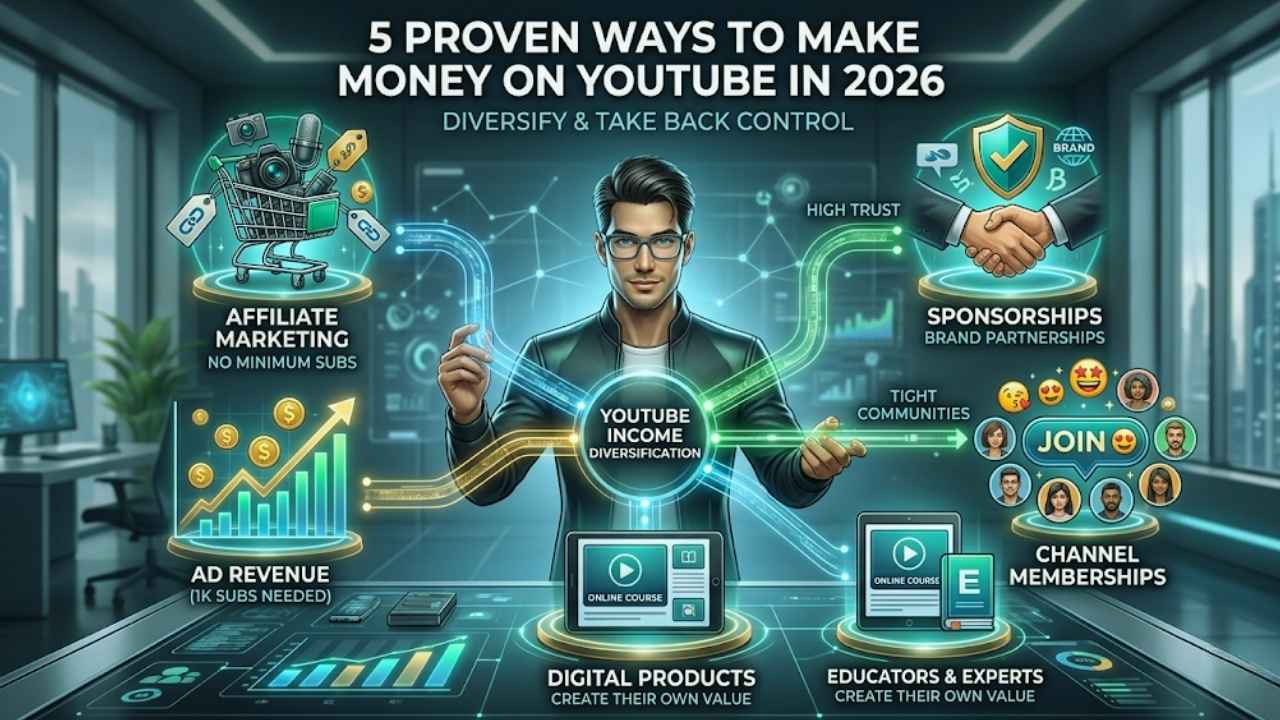
Relying entirely on ad revenue is a rookie mistake. A random algorithm update or a sudden shift in corporate ad budgets can slice your income in half overnight. The most successful creators build multiple income streams to protect themselves from platform volatility. You need a diverse portfolio of revenue sources around your content to survive long term.
It is totally possible to make a full-time living with just a few thousand subscribers if you build the right business model. Treat your channel as a top-of-funnel marketing tool. Direct that attention to your own products, brand sponsorships, and paid memberships. When you learn how to make money on YouTube in 2026 through multiple avenues, you take back control.
|
Income Stream |
Difficulty to Start |
Revenue Potential |
Best For |
|
Ad Revenue |
High (needs 1k subs) |
Medium to High |
Evergreen educational content |
|
Channel Memberships |
Medium (needs 500 subs) |
Medium |
Live streamers and tight communities |
|
Affiliate Marketing |
Low (no sub minimum) |
High |
Tech reviewers and tutorial channels |
|
Sponsorships |
Medium |
Very High |
Established channels with high trust |
|
Digital Products |
High (requires building) |
Very High |
Educators and experts |
YouTube Ad Revenue
This is your baseline income. Once you hit the full program requirements, YouTube places ads before, during, and after your videos. You also earn a fraction of a cent every time a YouTube Premium subscriber watches. Ad revenue provides amazing passive income. This is especially true if you create searchable tutorials that pull in views years after you hit publish.
But since YouTube takes a massive cut, view this as just the starting point of your business. It pays the daily utility bills. The real wealth gets built by leveraging that initial attention into higher-margin products. As your video library grows, this baseline income becomes highly predictable.
Channel Memberships
Direct fan funding changes everything for niche channels. Memberships let viewers pay a monthly fee in exchange for exclusive perks. You offer custom chat badges, private live streams, or behind-the-scenes content. If you run a channel focused on advanced coding or heavy industry trends, your audience is usually hyper-dedicated.
In these interactive spaces, membership money often surpasses standard ad revenue by a mile. It turns casual viewers into actual financial backers. This gives you a predictable monthly baseline that does not rely on going viral every single week. It feels a lot like running your own private subscription service natively on the platform.
Affiliate Marketing
Affiliate marketing remains the best way for small channels to generate cash before hitting any official subscriber requirements. You sign up for programs like Amazon Associates or direct B2B software partnerships. Then, you place tracking links right in your video descriptions. When a viewer clicks your link and buys the product, you earn a commission at no extra cost to them.
A tech channel reviewing new server hardware can make hundreds of dollars from a single video just through affiliate clicks. You completely bypass the need for YouTube partner approval. It works best when you show the viewer exactly how to use a product to solve a specific problem.
Sponsorships
Brand deals bring in the life-changing money. Instead of hoping YouTube serves a random ad, a brand pays you a flat rate to talk about their product directly inside your video. Brands love this because the videos live forever and build deep consumer trust. Depending on your niche and average viewership, sponsorships range from a few hundred bucks to tens of thousands per dedicated video.
You just have to be careful. Only promote products you actually believe in. Once you burn your audience by selling them garbage, no amount of ad revenue brings that trust back. Managing sponsorships requires sharp negotiation skills.
Selling Digital Products
When you own the product, you keep all the profit margins. Selling t-shirts works for entertainment vloggers, but selling digital products is the ultimate endgame for educational creators. You sell online courses, custom software templates, consulting calls, or access to a private Discord community.
If you teach people how to optimize supply chains, selling an advanced masterclass to a tiny fraction of your audience generates way more money than millions of ad-supported views. Digital products have zero shipping costs and infinite scale. You keep one hundred percent of the revenue. This is how the smartest creators double their income without doubling their subscriber count.
How to Maximize Your YouTube Income Today?
Knowing the basic rules is a great start. But optimizing your content specifically for revenue turns a fun hobby into a serious career. You need to pull the right levers to push your earnings higher on every single upload. Small tweaks to your video length, formatting strategy, and content safety can literally double your monthly paycheck. You do not even need extra views to make this happen.
Many creators leave thousands of dollars on the table simply because they format their videos poorly. You must balance keeping your audience engaged with strategic ad placement. A solid workflow ensures every piece of content you produce works incredibly hard for you.
|
Optimization Strategy |
Action Required |
Impact on Revenue |
|
Eight Minute Videos |
Stretch valuable content past 8 mins |
Doubles or triples ad revenue via mid-rolls |
|
Shorts Funnel |
Use Shorts to link to long videos |
Increases high RPM views |
|
Geographic Targeting |
Talk about Western-focused topics |
Attracts high-paying advertisers |
|
Content Safety |
Avoid swearing in the first 30 seconds |
Prevents yellow demonetization icons |
Creating Eight Minute Videos
The absolute biggest lever you can pull to boost your RPM is crossing the eight-minute mark. When a video is shorter than eight minutes, YouTube only shows ads at the very beginning and the very end. Once you cross that eight-minute line, you unlock the ability to place mid-roll ads anywhere throughout the video.
If you drop a mid-roll ad right before you reveal the solution to a complex problem, the viewer stays through the ad to get the payoff. Adding just one strategic mid-roll easily doubles the total money that video earns. Just make sure the video actually warrants being eight minutes long. Stretching thin content kills your retention rate.
Building a Shorts Funnel
Trying to make a full-time living entirely off Shorts is brutal unless you pull hundreds of millions of views every single month. The RPM on Shorts sits around a few pennies per thousand views. Smart creators figure out how to make money on YouTube in 2026 by treating Shorts strictly as free marketing billboards.
You create punchy, fifteen-second clips that introduce new people to your topic. Then, you use the related video feature to point those viewers straight to your ten-minute long-form videos. Those long videos are where you serve mid-roll ads and sell products. Stop chasing Shorts views for the ad payout. Chase them to build a funnel.
Protecting Your Ad-Friendly Status
All your hard work means nothing if your videos get stripped of their ads. YouTube relies on automated systems to flag inappropriate content, and those bots are incredibly sensitive. Avoid using profanity, especially in the first thirty seconds of your video. Stay far away from highly controversial or dangerous topics unless you provide heavy, objective educational context.
Be extremely careful with background music. Even a five-second clip of a trending pop song triggers a copyright claim. That sends all your ad money straight to a massive record label. Use licensed music libraries to stay safe. Getting hit with a yellow monetization icon drops your RPM to near zero instantly.
Final Thoughts
Building a channel that actually pays the bills requires you to look at your content through a strict business lens. Mastering how to make money on YouTube in 2026 means blending standard ad revenue with smart affiliate marketing, direct fan funding, and eventual digital product sales. Monitor your RPM closely, understand which geographic areas pay the highest rates, and aggressively protect your ad-friendly status.
Focus on making high-value, long-form content that solves real problems. Use short-form video strictly as a discovery tool to fuel your main engine. Apply these strategies to your next upload, stay consistent through the inevitable slow months, and watch your platform transform into a highly reliable business.
Frequently Asked Questions (FAQs) About Make Money Youtube 2026
Can you monetize a channel using only AI-generated content?
Yes, but the rules are incredibly strict. If your channel uses original scriptwriting, high-quality visual editing, and adds genuine educational value, you can get monetized. However, channels that mass-produce spam using unedited text-to-speech voices and repetitive stock footage get rejected constantly for reused content violations. You have to prove you are adding a creative human touch.
Do Shorts watch hours count toward the 4,000-hour requirement?
No, they do not. The watch hours generated from videos inside the Shorts feed do not count toward the 4,000 public watch hours needed for the long-form monetization path. You must either hit 4,000 hours exclusively on your long videos or hit 10 million views exclusively on your Shorts to qualify.
What happens to my ad revenue if I get a copyright claim?
If you receive a Content ID claim for using copyrighted music or video clips, YouTube redirects the ad revenue generated from that specific video straight to the copyright owner. You will not lose your channel over a standard claim, but you end up doing all the hard work while a record label collects your paycheck.
Why do my earnings drop drastically in January?
Ad budgets are highly seasonal. Brands spend massive amounts of money in November and December to push holiday sales and exhaust their end-of-year marketing budgets. Once January first rolls around, those corporate budgets completely reset. It is totally normal for your RPM to drop by 30 to 50 percent in January.
Does YouTube pay you when someone skips an ad?
Usually, no. If an ad is skippable and a viewer hits the skip button before watching 30 seconds of it, the advertiser does not pay YouTube. Consequently, you do not get paid for that specific ad impression. You only make money on completed views or direct clicks on the ad itself.