

It’s 2:00 AM. Your exam starts in exactly seven hours. You’re frantically dragging a neon highlighter across a dense textbook and downing your third coffee. You read the exact same paragraph four times, but nothing sticks. You feel productive, but let’s be real—you’re just burning out.
The human brain isn’t a computer hard drive. You can’t just drag and drop files into it and expect perfectly preserved folders you can click open during a final exam. Memory is messy and reconstructive. Every time you recall a fact, you literally rebuild it from scratch. If you want to ditch the late-night panic and build real, durable knowledge, you need to rely on the study techniques cognitive science actually backs up.
Researchers have spent decades figuring out exactly how we encode and store information. Turns out, the stuff we naturally default to—like rereading notes and underlining text—barely works. Real learning requires friction. Let’s look at the exact methods you can use to study smarter, retain data longer, and completely overhaul your academic routine using hard, verified data.
Why Your Go-To Study Habits Usually Fail?
If you rely on rereading your notes, copying textbook chapters word-for-word, or highlighting everything in sight, you’re trapped in the “illusion of competence.”
When you read a chapter for the third time, the text feels super familiar. Your brain recognizes the flow of the words and says, Hey, I know this. But recognizing words on a page isn’t the same as pulling answers out of thin air during a test. Psychologists call this the difference between “storage strength” (how well something is anchored in your brain) and “retrieval strength” (how easily it comes to mind right now).
In a massive, landmark 2013 review published in Psychological Science in the Public Interest, lead researcher John Dunlosky and his team evaluated ten popular study tactics. The results shocked a lot of students. They handed out “low utility” ratings to summarizing, highlighting, keyword mnemonics, and rereading. Dunlosky explicitly noted that relying on a highlighter just gives you a false sense of security. To actually learn, you have to switch from being a passive consumer of information to an active participant.
|
Popular Strategy |
Scientific Utility Rating |
Why It Fails or Succeeds |
|
Practice Testing |
High |
Forces your brain to retrieve facts from scratch |
|
Spaced Review |
High |
Stops the natural process of forgetting in its tracks |
|
Interleaving |
Moderate |
Great for math, builds quick problem-solving skills |
|
Highlighting |
Low |
Creates a false sense of knowing the material |
|
Rereading |
Low |
Feels productive but rarely builds long-term memory |
Desirable Difficulty: The Secret Sauce of Learning
Cognitive psychologist Robert Bjork coined the term “desirable difficulties” back in the 1990s, and it remains the gold standard framework for learning today. The idea is simple but counterintuitive: if learning feels a bit hard and frustrating in the moment, you’ll actually remember the material much longer.
When your brain struggles to pull up a fact, that mental struggle acts like a giant neon sign to your nervous system. It signals that this specific piece of info matters and needs stronger neural pathways. If you want better grades in less time, drop the easy methods.
Many students hate the best study techniques cognitive science offers because they feel like a grueling mental workout. Traditional studying minimizes errors to make you feel good. Bjork-informed studying welcomes mistakes during practice because struggling to find the right answer primes your brain to encode the correction deeply.
|
Traditional Practice |
Brain-Based Practice |
The End Result |
|
Read the chapter twice |
Close the book and guess the main points |
Thickens myelin around neural pathways |
|
Study the same spot every day |
Switch up your physical study environment |
Attaches new contextual cues to the memory |
|
Avoid mistakes while practicing |
Embrace productive failure |
Strengthens the correct answer when revealed |
|
Review notes right before the test |
Test yourself days before the test |
Shifts knowledge from short to long-term storage |
Active Recall: The Ultimate Memory Builder
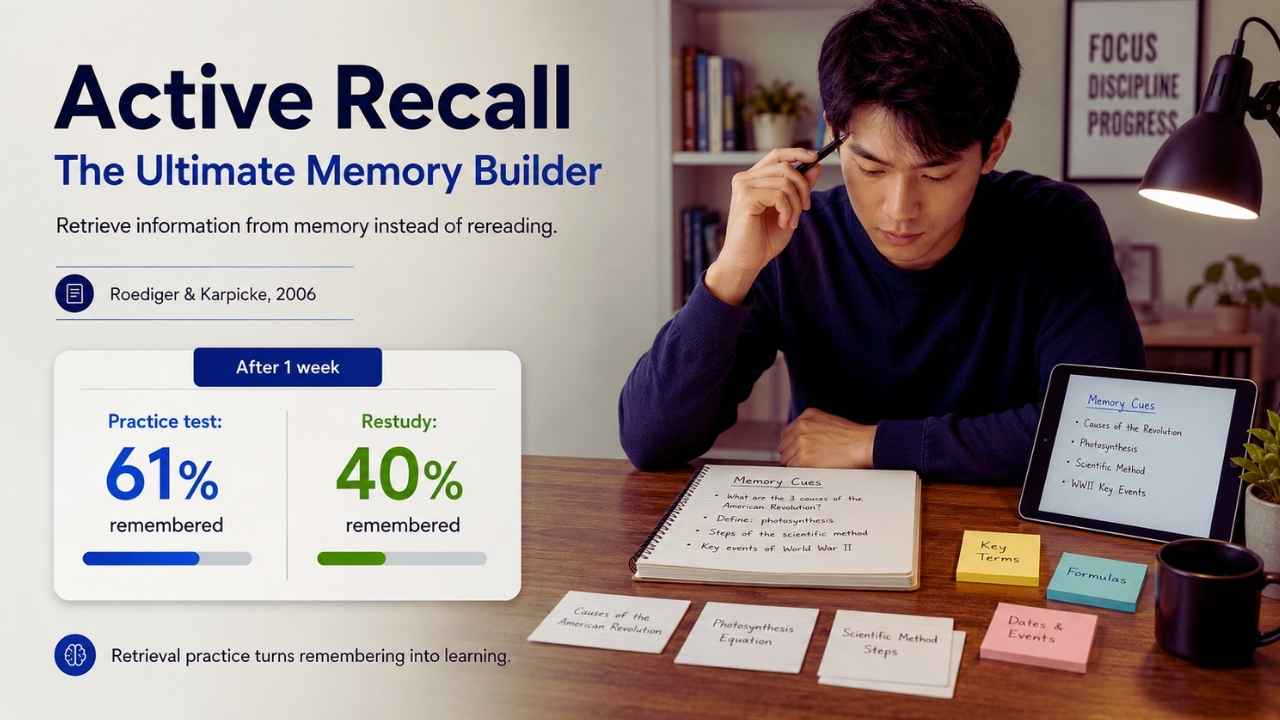
When digging into study techniques cognitive science researchers almost always point to active recall first. It’s the undisputed king of learning hacks. Active recall (also called retrieval practice) involves deliberately pulling information out of your brain rather than trying to shove it in.
Back in 2006, researchers Henry Roediger and Jeffrey Karpicke ran a famous experiment. They had college students read a science passage. One group restudied it. The other group put the text away and took a quick, no-feedback free-recall test. A week later, the group that took the practice test remembered 61% of the material. The restudy group remembered only 40%. Taking a test isn’t just measuring what you know; the act of retrieving the memory is the learning process.
How to Do It Right?
- The Brain Dump: Read a section of your textbook. Close the book completely. Grab a blank sheet of paper and scribble down everything you remember. Open the book, check your facts, and fix your mistakes in red pen.
- Flashcards (The Honest Way): Use physical index cards or apps like Anki. You must say the answer out loud or write it down before flipping the card. Don’t just flip it and whisper, “Yeah, I knew that.”
- Mock Exams: Dig up old tests or make your own. Simulating the real testing environment is the fastest way to expose your blind spots.
|
Active Recall Method |
Execution |
Best Time to Use It |
|
Brain Dump |
Write everything from memory on a blank page |
Tackling broad concepts or chapter summaries |
|
Honest Flashcards |
Test specific facts before checking the back |
Memorizing vocab, dates, medical terms, or formulas |
|
Mock Exams |
Simulate test conditions with a strict timer |
Practicing complex logic and exam time management |
Spaced Repetition: How to Beat the Forgetting Curve
In 1885, German psychologist Hermann Ebbinghaus discovered the “Forgetting Curve.” He proved we naturally lose roughly 70% of newly learned information within 24 hours if we don’t actively try to keep it.
You can’t beat this curve by pulling a ten-hour all-nighter. You beat it by reviewing material right when you’re on the verge of forgetting it. This is called spaced repetition (or distributed practice). Review a concept today, then tomorrow, then in three days, then a week. Each review forces your brain to work hard to recall the info, which reinforces the memory trace and flattens the forgetting curve.
How to Set It Up Today?
- Flashcard Apps: Tools like Anki or SuperMemo use built-in algorithms to track your memory. Get a card right easily, and you won’t see it for a week. Struggle, and it pops back up in ten minutes.
- The Leitner System: Use three physical boxes. Put all your cards in Box 1 (review daily). Get it right? Move it to Box 2 (review every 3 days). Right again? Box 3 (weekly). Miss a card anywhere in the chain? It goes straight back to Box 1.
|
When to Review |
Action Required |
What Happens Neurologically |
|
Day 1 |
Initial learning and testing |
Builds the very first neural pathway |
|
Day 2 |
First quick review |
Stops the initial steep drop of the forgetting curve |
|
Day 7 |
Second spaced review |
Pushes knowledge into medium-term storage |
|
Day 30 |
Third spaced review |
Locks the facts securely into long-term memory |
Interleaving: The Study Technique Cognitive Science Experts Love
Most of us naturally study in blocks. We do two hours of algebra, then two hours of geometry. That’s “blocked practice.” Interleaving is the exact opposite. You intentionally mix different topics or problem types into a single session.
Why You Need to Mix Things Up?
Blocked practice feels easy because the formula you need is already sitting in your short-term memory. By the 15th math problem, you aren’t really thinking; you’re just blindly plugging numbers into a familiar equation.
But real exams don’t group questions by chapter. Interleaving trains your brain to look at a problem and figure out which strategy to use on the fly. It feels incredibly frustrating at first because you are constantly shifting gears. However, studies show that students who use interleaving score significantly higher on cumulative tests.
|
Practice Style |
Session Structure |
The End Result |
|
Blocked Practice |
Math, Math, Math, History, History |
Feels easy today, but you fail the cumulative final |
|
Interleaved Practice |
Math, History, Math, Science, History |
Feels grueling today, but you ace the final exam |
Dual Coding & The Feynman Technique
To round out your strategy, you need to fix how you process heavy, dense textbooks. Two of the most powerful study techniques cognitive science supports for deep comprehension are dual coding and the Feynman technique.
Dual Coding Theory (introduced by Allan Paivio) states that our brains process words and visuals through completely different channels. If you only read text, you use one channel. If you combine that text with a quick sketch, you encode the info in two places. You don’t need to be Picasso. Stick figures, messy timelines, and basic flowcharts work perfectly.
The Feynman Technique is an application of “elaborative interrogation.” It just means explaining things simply. Instead of memorizing a fact, force yourself to explain it out loud as if you were teaching a 12-year-old. If you have to rely on complicated textbook jargon to explain a concept, you don’t actually understand it yet.
|
Processing Hack |
How to Actually Do It |
Why It Works |
|
Verbal Focus |
Reading paragraphs out loud |
Engages the language centers |
|
Visual Focus |
Watching a silent animation |
Engages spatial awareness |
|
Dual Coding |
Drawing a diagram and labeling it |
Combines both channels for max retention |
|
Feynman Technique |
Explaining a topic simply to your dog |
Proves true, deep semantic understanding |
The “Hidden” Cognitive Boosters: Sleep, Exercise, and Environment
You can use all the flashcards in the world, but if your physical hardware is failing, nothing will stick. Recent research into educational neuroscience highlights lifestyle factors as critical study tools, not just health advice.
Sleep is non-negotiable. Your brain literally consolidates newly learned information and moves it into long-term storage during deep sleep cycles. Students who sleep fewer than seven hours show severely impaired problem-solving abilities the next day.
Exercise is another massive hack. Harvard psychiatrist John Ratey calls aerobic exercise “Miracle-Gro for the brain.” Getting your heart rate up before a study session triggers the release of brain-derived neurotrophic factor (BDNF). This protein encourages new neural connections, making your subsequent study session wildly more productive.
Finally, switch up your location. Studying in the exact same spot every day ties your memory to that specific room. Moving from your desk to a coffee shop to a library forces your brain to attach multiple contextual cues to the material.
|
Hidden Booster |
What to Do |
Cognitive Benefit |
|
Sleep |
Get 7-9 hours, especially after studying |
Consolidates memories from short to long-term storage |
|
Exercise |
20 mins of cardio before hitting the books |
Spikes BDNF, priming the brain to learn faster |
|
Environment |
Rotate between 3 different study spots |
Attaches diverse contextual cues to your memories |
|
Focus Blocks |
Use the Pomodoro method (25 mins on, 5 off) |
Prevents cognitive fatigue and maintains attention |
As we push deeper into the digital age, the way we study is shifting. Generative AI tools and agentic systems are everywhere. But using them requires a lot of caution.
AI is fantastic for generating practice questions, summarizing massive documents into flashcards, or explaining complex concepts simply (acting as your personal Feynman tutor). However, educational researchers warn against letting AI do the heavy lifting. If an AI writes your essay outline or solves your math problem step-by-step without you struggling first, you bypass the “desirable difficulty” entirely. You rob yourself of the friction required to build a memory. Use tech as a scaffold to test you, never as a substitute for your own thinking.
|
Tech Tool |
How to Use It Safely |
How NOT to Use It |
|
Generative AI |
“Quiz me on the causes of WWI.” |
“Write a summary of WWI for me.” |
|
Flashcard Apps |
Syncing spaced repetition across devices |
Downloading decks you didn’t create or verify |
|
Website Blockers |
Locking yourself out of social media for 50 mins |
Relying on willpower alone while getting notifications |
Final Thoughts
Ditching your comfy highlighters and passive reading habits isn’t going to be easy. Using active recall and spacing out your reviews will feel pretty exhausting at first. But remember the core rule of desirable difficulty: that mental friction means the methods are actually working.
Don’t try to overhaul your entire academic life tonight. Start small. The next time you finish reading a page, look away and try to jot down three main points from memory. Work with your brain’s natural wiring, not against it. By trusting the study techniques cognitive science researchers swear by, you’ll stop spinning your wheels and start building knowledge that actually lasts.
Frequently Asked Questions (FAQs) About Study Techniques Cognitive Science
When people drop their highlighters and switch to brain-based learning, they usually run into a few specific questions. Here’s what the data actually says.
Does listening to music help or hurt?
It depends entirely on the lyrics. Listening to music with words actively competes for the exact same language-processing centers you need for reading. However, lyric-free music (like classical, video game soundtracks, or lo-fi beats) blocks out background noise and keeps your dopamine up. For intense math or reading, absolute silence wins.
Are visual and auditory learning styles real?
Nope. This is one of the biggest myths in modern education. A massive 2008 review completely debunked the “learning styles” idea. You might prefer watching a YouTube video over reading a book, but catering strictly to that preference doesn’t boost your test scores. We all learn best when we combine formats.
How long should I study before taking a break?
Your brain taps out after 50 to 90 minutes. Use the Pomodoro method: 25 to 50 minutes of intense, phone-free focus, followed by a strict 5- to 10-minute break. Step away from your desk. Let your brain enter “diffuse mode” to process what you just read.