


You wake up, grab your phone, and lose 30 minutes to a social media feed before your feet even hit the floor. You swear you will stop tomorrow. But tomorrow comes, and you do the exact same thing. We all have routines we want to kill. Maybe it is checking emails late at night, stress-eating sugar, procrastinating on major projects, or endless doomscrolling. When we fail to stop, we blame our lack of willpower. We call ourselves lazy.
But laziness has nothing to do with it. Your brain is simply doing its job: saving energy by putting repeated behaviors on autopilot. I know firsthand how quickly bad habits can derail a day. Running the operations and managing the team at Editorialge means my schedule stays packed. If I let bad habits creep in, cognitive fatigue takes over, and productivity tanks. If you actually want to change your daily patterns, you have to stop fighting yourself. It is time to look at the break bad habit science. Behavior change is a mechanical process. Understand the gears, and you can take the machine apart.
The Anatomy of an Automatic Behavior
A habit is just a mental shortcut. Repeat an action enough times in the same context, and your brain stops actively thinking about it. Research from Duke University confirms that roughly 45 percent of everything you do every single day is not an actual decision. It is an automatic habit executed without a second thought. Your brain shifts the control of these repeated actions from the prefrontal cortex—the conscious, decision-making part of your brain—to the basal ganglia.
This ancient neural cluster sits near the center of your skull. It does not judge whether a habit hurts your long-term health or ruins your workflow. It just remembers the pattern and executes it flawlessly. We desperately need this system because of modern cognitive overload. Recent 2025 workplace data shows the average employee faces up to 275 interruptions a day. With that level of mental strain, your brain leans on automatic shortcuts just to survive the sheer volume of daily tasks.
To override the basal ganglia, you have to decode the pattern first. Every single habit follows a specific loop that involves a trigger, a physical or mental action, and a neurochemical payoff. Once you map these three elements out on paper, you take away the subconscious power the habit holds over you.
|
Habit Loop Stage |
What It Actually Does |
Real-World Example |
|
The Cue |
Triggers your brain to start the routine. |
Feeling stressed about a sudden deadline. |
|
The Routine |
The actual behavior you take. |
Opening a new tab to scroll the news. |
|
The Reward |
The feeling that reinforces the loop. |
A quick dopamine hit and a mental escape. |
Understanding the Break Bad Habit Science
When you dive into the break bad habit science, you quickly learn a harsh truth. You cannot just erase a bad habit. Those neural pathways are physically etched into the structure of your brain. Instead of trying to delete a habit completely, behavioral scientists say you have to overwrite it. The golden rule of habit change is simple but profound: keep the old cue, deliver the old reward, but insert a totally new routine in the middle.
Say you want to stop pouring a drink every night immediately after work. The cue is walking through the door after a high-stress day. The reward is relaxation and a mental shift away from work mode. If you just sit on the couch and stare at the wall, your brain will scream for the alcohol. It expects the reward. To win, you must swap the routine. Walk through the door, pour a glass of sparkling water with lime, and sit on the couch to decompress.
Over time, this new routine satisfies the exact same craving. I see this specific mistake all the time when people try to optimize their workdays. They try to cut out their afternoon coffee break without replacing it. Their productivity instantly plummets because they lost the mental transition phase the coffee break provided.
|
Strategy Step |
Action Required |
Why It Works |
|
Identify the Cue |
Find out what triggers you (time, location, mood). |
Pulls the subconscious trigger into the light. |
|
Isolate the Reward |
Experiment to find what you really crave. |
Stops you from picking a useless replacement. |
|
Swap the Routine |
Pick a healthier action that gives the same feeling. |
Uses your existing brain circuitry to your advantage. |
Why Willpower Always Fails You?
Most people try to muscle their way out of bad habits. They rely entirely on willpower. But relying on willpower is a massive trap. It functions exactly like the battery in your smartphone. You wake up with a full charge. But every decision you make drains it. Handling a difficult client, choosing lunch, mapping out a content strategy—it all chips away at your battery. By 8:00 PM, you are tired, stressed, and your willpower is dead. Psychologists call this ego depletion.
The statistics back this up ruthlessly. Data shows that 88 percent of all New Year’s resolutions fail, and nearly a quarter of people quit within the first seven days. You cannot out-think biological fatigue. When your cognitive load is high, your brain defaults to its most ingrained routines. Working memory can only hold about four chunks of information at a time. When that gets maxed out by daily stress, your brain abandons any new habit you are trying to build.
You need a system that holds up even when you are completely exhausted. Stop relying on your internal battery to make the right choice. Willpower is designed for short-term survival, not long-term behavior design. If you expect yourself to just “try harder” tomorrow, you are setting yourself up for guaranteed failure.
|
Willpower Drainers |
How They Sabotage You |
The Easy Fix |
|
Decision Fatigue |
Making too many choices kills self-control. |
Automate daily choices (meals, clothes, schedules). |
|
Stress Responses |
Cortisol shoves the brain into autopilot. |
Use habit reversal training to manage stress triggers. |
|
Late Day Fatigue |
Prefrontal cortex function tanks by evening. |
Schedule your hardest tasks for the morning. |
Environment Design: The Ultimate Hack
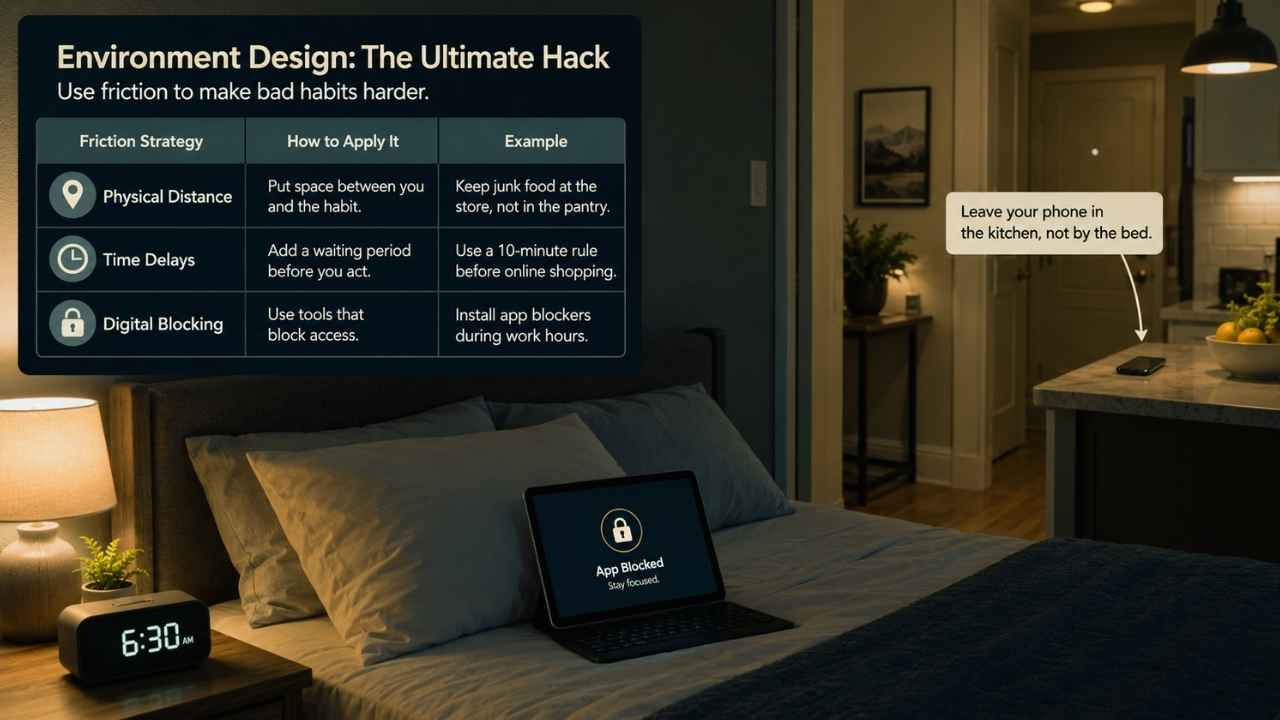
Because willpower is a leaky bucket, you have to rely on your external environment. Psychologists call this concept “friction.” If you want to stop doing something, make it incredibly annoying to do. This concept sits at the very core of the break bad habit science. Want to stop checking your phone in bed? Do not rely on self-control to leave it on the nightstand. Leave it in the kitchen. Buy a cheap digital clock for your bedroom.
You have just built a massive wall of physical friction between you and the bad habit. By the time you think about getting out of bed, walking down the hall, and grabbing the device, your prefrontal cortex has enough time to step in and say no. Today, the average US screen time has surpassed 7 hours daily, with teens hitting nearly 9 hours. To beat those algorithms, you have to build physical and digital walls.
|
Friction Strategy |
How to Apply It Today |
Real-World Example |
|
Physical Distance |
Put actual space between you and the habit. |
Keep junk food at the store, not in the pantry. |
|
Time Delays |
Force a waiting period before you indulge. |
Use a 10-minute rule before online shopping. |
|
Digital Blocking |
Use software to kill access entirely. |
Install app blockers during your peak work hours. |
The Role of Dopamine and Brain Chemistry
Dopamine is your brain’s primary motivation chemical. People usually mistake it for the pleasure chemical, but it actually regulates anticipation. When your phone buzzes, dopamine spikes because you anticipate a message. That spike drives you to physically pick up the phone. Tech companies engineer their platforms to create these artificial dopamine spikes, hooking your basal ganglia into a tight, inescapable loop.
A recent 2025 study from Georgetown University Medical Center showed exactly how this works on a cellular level. Researchers found that shifting levels of a brain protein called KCC2 reshape how our cues link to rewards. When KCC2 levels drop, dopamine neurons fire much faster, locking in new associations with terrifying speed. That is why doomscrolling becomes a hardwired habit in a matter of days, while eating a healthy lunch takes months to stick.
To break out, you have to actively manage your dopamine baseline. When you drop a high-dopamine bad habit, life feels a bit flat for a few weeks. That is normal. Your brain’s dopamine receptors just need time to reset. Do not panic and run back to the bad habit just because you feel a little bored. Push through the dip.
|
Neurochemical Phase |
What You Actually Feel |
How to Handle It |
|
The Craving Peak |
Intense urge driven by a sudden dopamine spike. |
Wait 10 minutes. The chemical spike will pass. |
|
The Dopamine Dip |
Lethargic, bored, or irritable after quitting. |
Engage in low-dopamine activities like a walk. |
|
The Reset |
Cravings drop; normal things feel good again. |
Celebrate the small wins to build momentum. |
The Timeline of Neuroplasticity
Neuroplasticity is your brain’s ability to reorganize itself by forming new neural connections. Every time you deny a bad habit and execute a new routine, you literally alter the physical structure of your brain. But how long does this actually take? Drop the myth that it takes 21 days to break a habit. That number came from a 1960s plastic surgeon who noticed patients took three weeks to adjust to their new faces. It has absolutely nothing to do with human behavior.
A massive 2024 meta-analysis by Singh et al. confirmed a median of 59 to 66 days for behaviors to become fully automatic. Furthermore, the 2026 Harvard Habit Formation for Health study, which tracked over 2,800 participants, found that gradual behavior change improves long-term retention by over 30 percent. You need real patience. You will mess up. You will have a terrible day and fall back into an old routine.
Do not panic when that happens. The data clearly shows that missing one single day does not ruin the habit formation process or erase your neural progress. The trajectory remains perfectly intact as long as you get back on track the very next morning. It is consistency over the long haul, not absolute perfection, that actually rewires the brain.
|
Timeframe |
What Happens in Your Brain |
Your Primary Goal |
|
Days 1 to 10 |
High resistance. Old pathways scream for the routine. |
Survive. Rely heavily on strict environmental friction. |
|
Days 11 to 30 |
The messy middle. The new routine feels slightly easier. |
Stay consistent. Do not trust your willpower yet. |
|
Days 31 to 66+ |
Automaticity sets in. Neural pathways are rewired. |
Maintain the environment. Guard against old triggers. |
Implementation Intentions: The “If-Then” Strategy
To make this science work, use “Implementation Intentions.” That is just the academic term for a simple if/then statement. Instead of setting a vague goal like, “I will stop checking my phone during deep work,” make a hyper-specific plan. Decide in advance exactly how you will react when the craving hits. Making the decision before the craving strikes removes willpower from the equation entirely. You automate the good choice.
Research proves that people who use specific if/then plans succeed at a massively higher rate. Studies show that groups using implementation intentions hit a 91 percent success rate, compared to a dismal 35 percent for those who just rely on feeling motivated. You connect the new habit to a concrete, unavoidable cue in your day. This way, your brain does not have to pause and deliberate; it just follows the script you already wrote.
If you want to stop snapping at your team when stressed, your plan could be: “If I feel my chest tighten during a meeting, then I will take one deep breath before speaking.” It sounds ridiculously simple, but that tiny pause interrupts the automated basal ganglia response. It forces the prefrontal cortex back online so you can act intentionally.
|
Vague Goal |
The If/Then Implementation Plan |
Why It Succeeds |
|
“I will exercise more.” |
“If it is 7 AM on a weekday, then I will do 10 push-ups.” |
Attaches the new habit to a rock-solid time cue. |
|
“I will stop stressing.” |
“If I feel overwhelmed by work, then I will take 5 deep breaths.” |
Gives you a concrete action to replace the panic. |
|
“I will read more.” |
“If my head hits the pillow, then I will read exactly one page.” |
Lowers the barrier to entry so you never fail. |
Final Thoughts
You are not permanently stuck with the routines holding you back today. Your brain is highly malleable, and your daily behaviors are just learned mechanical patterns. Take willpower out of the equation completely. Lean heavily into the break bad habit science, and you take direct control of your mind’s mechanics.
Identify your specific cues, swap your routines, and aggressively design an environment that makes doing the wrong thing incredibly annoying. Give your brain the 66 days it genuinely needs to rewire. Changing your life is not about massive, overnight overhauls fueled by fleeting motivation. It is about understanding the science of your own behavior and making the small, mechanical adjustments that last a lifetime.
Frequently Asked Questions (FAQs) About Break Bad Habit Science
Does a “dopamine detox” actually help break bad habits?
You can’t actually detox from a naturally occurring brain chemical. However, taking a deliberate break from high-stimulation activities—like endless scrolling or gaming—helps downregulate your dopamine receptors. It makes finding satisfaction in healthier, lower-stimulation habits a lot easier.
Can past trauma make bad habits harder to break?
Absolutely. Trauma directly impacts the nervous system, keeping the body in a prolonged state of fight-or-flight. Many bad habits, from overeating to doomscrolling, are deep-rooted coping mechanisms meant to soothe a dysregulated system. In these cases, combine behavioral tactics with nervous system regulation or professional therapy.
Why do old bad habits return instantly when I travel?
Habits anchor themselves to your physical environment. When you travel, those environmental cues vanish. Without structure, your brain reverts to default, comfortable behaviors. Prevent this by anchoring good habits to portable cues, like drinking a glass of water immediately after waking up, no matter what city you’re in.
Does habit reversal training work for severe habits?
Yes. Habit reversal training is a highly effective behavioral intervention. You increase your awareness of the unwanted habit, engage in a competing response (an action incompatible with the bad habit), and use relaxation techniques. It works wonders for stubborn routines.