


Ever wonder why older houses seem indestructible compared to modern builds? Or why tech billionaires who dropped out of college make quitting school look like the ultimate career hack? We stare at the vintage houses still standing and marvel at the old-school craftsmanship.
We obsess over the famous billionaires who beat the system. But we completely ignore the thousands of poorly built shacks that collapsed decades ago, and the millions of dropouts who ended up flat broke.
This massive mental blind spot is a logical trap. We focus heavily on the people, businesses, or things that “survived” a specific filter. Meanwhile, we completely ignore the ones that failed. Because the failures are invisible, our brains just assume they do not exist. This leads to wildly skewed data, terrible business choices, and a totally warped view of reality. Getting survivorship bias explained is your absolute first step to making smarter choices with your startup, your investments, and your daily life.
The Classic WWII Bomber Story
You cannot talk about this topic without looking at the military data problem from World War II. It remains the best historical example of how invisible data tricks brilliant people. During the war, the US military wanted to add heavy armor to their bombers to protect them over Europe. But steel is incredibly heavy. If you cover the entire plane, it will not get off the ground. The generals had to be highly selective about exactly where to put the armor to maximize survival rates.
They gathered data by examining the bombers that returned from combat. They meticulously mapped out all the bullet holes and flak damage. The data was crystal clear: returning planes were heavily shot up in the wings, the tail, and the center fuselage. The military brass made the obvious call. They decided to put the heavy armor exactly where the bullet holes were.
Then, a statistician named Abraham Wald stepped into the room. He told the generals they had it completely backward. Wald pointed out a massive flaw in their logic: the military was only looking at the planes that came back. The bullet holes did not show where the planes were vulnerable. They showed exactly where a plane could take a direct hit and still manage to limp home.
The planes that took hits to the engines or the cockpit never made it back. They crashed in fields across Europe. Wald told the military to put the armor exactly where the returning planes had zero bullet holes. That blank space was where the missing planes took their fatal hits. By looking for the invisible data, Wald saved countless lives.
To truly grasp how Wald’s logic flipped standard military thinking, you can test the variables yourself:
|
Concept |
The Military’s View |
Abraham Wald’s Insight |
|
Data Source |
Bombers returning to base |
Both returning AND missing bombers |
|
Observation |
Wings and tails had the most damage |
Engines and cockpits had zero damage |
|
Assumption |
Reinforce the areas with the most damage |
The damaged areas are actually the strongest parts |
|
The Fix |
Put armor where the holes are |
Put armor where the holes aren’t |
What Is It? Survivorship Bias Explained Simply
Think of this cognitive bias as a filter that automatically hides the losers. It happens when a dataset only looks at existing observations and ignores everything that did not make the cut. Financial writer Nassim Nicholas Taleb calls this missing data “silent evidence.” Silent evidence is incredibly dangerous precisely because it does not make any noise.
It does not pop up in your analytics dashboards, it does not send you angry emails, and it definitely does not make the cover of top business magazines. We only see the champions standing on the podium, completely blind to the thousands of competitors who washed out during the qualifiers.
Our brains are naturally lazy when it comes to processing information. Trusting the data sitting right in front of us requires zero effort. But actively imagining data that was destroyed or hidden? That takes heavy cognitive work. We take the path of least resistance.
Once you have survivorship bias explained to you, you start to realize history is written entirely by the survivors, and the “advice business” is mostly run by people who just got incredibly lucky. We attribute their success to their hard work, completely ignoring the fact that thousands of other people worked just as hard and still failed due to bad timing or market conditions.
|
The Concept |
What We See |
What We Miss |
The Reality |
|
Silent Evidence |
Visible successes and winners |
Quiet failures and bankruptcies |
Winners are often just statistical anomalies |
|
Cognitive Load |
Trusting immediate data is easy |
Hunting for missing data is hard |
Our brains default to the easy answer |
|
Advice Monopoly |
Gurus selling success habits |
People using the same habits who failed |
Success requires timing, not just a routine |
|
The Filter Effect |
Only the strongest test subjects |
The subjects who dropped out |
The test was flawed from the beginning |
How It Ruins Startups and SaaS Decisions?
If you run a B2B SaaS company or manage a high-performance sales team, ignoring silent evidence will destroy your growth metrics overnight. Founders love reading startup success stories. We devour articles about product-led growth tactics from tech giants like Slack, Canva, or Dropbox. We steal their exact playbook.
We copy their freemium pricing tiers, their user onboarding flow, and their viral marketing loops. We blindly paste these strategies into our own startups, assuming it is a guaranteed recipe for scaling a massive software business. Then, the strategy completely crashes and burns.
Why does this happen? Because for every Slack that succeeded with that specific playbook, thousands of dead startups tried the exact same product-led growth strategy and ran out of cash. Tech blogs do not write viral post-mortems about boring companies that failed. If you only study the unicorns, you learn how to take massive risks, but you never learn how to dodge fatal mistakes. Reading the blogs of failed startups is vastly more valuable than reading a billionaire’s memoir.
Furthermore, this bias ruins internal business data. Say you send a customer satisfaction survey to your active users. The results show a 95 percent approval rating. You pop champagne. But you only surveyed your current customers. You completely ignored the hundreds of angry users who canceled last quarter because your software interface was terrible. Your data looks amazing simply because the unhappy people left the room.
|
Business Metric |
The Visible Survivor Data |
The Missing Context |
The Business Risk |
|
Growth Playbooks |
A unicorn company’s strategy |
5,000 failed startups using it |
Adopting a strategy with a high failure rate |
|
Customer Surveys |
95% approval from active users |
Feedback from churned users |
Ignoring core product flaws that cause churn |
|
Hiring Profiles |
Emulating traits of top sales reps |
Fired reps who shared those exact traits |
Hiring for the wrong personality profile |
|
Pricing Models |
Successful freemium SaaS apps |
Apps that went bankrupt offering free tiers |
Burning through cash reserves too quickly |
The Financial Trap: Mutual Funds and Neobanks
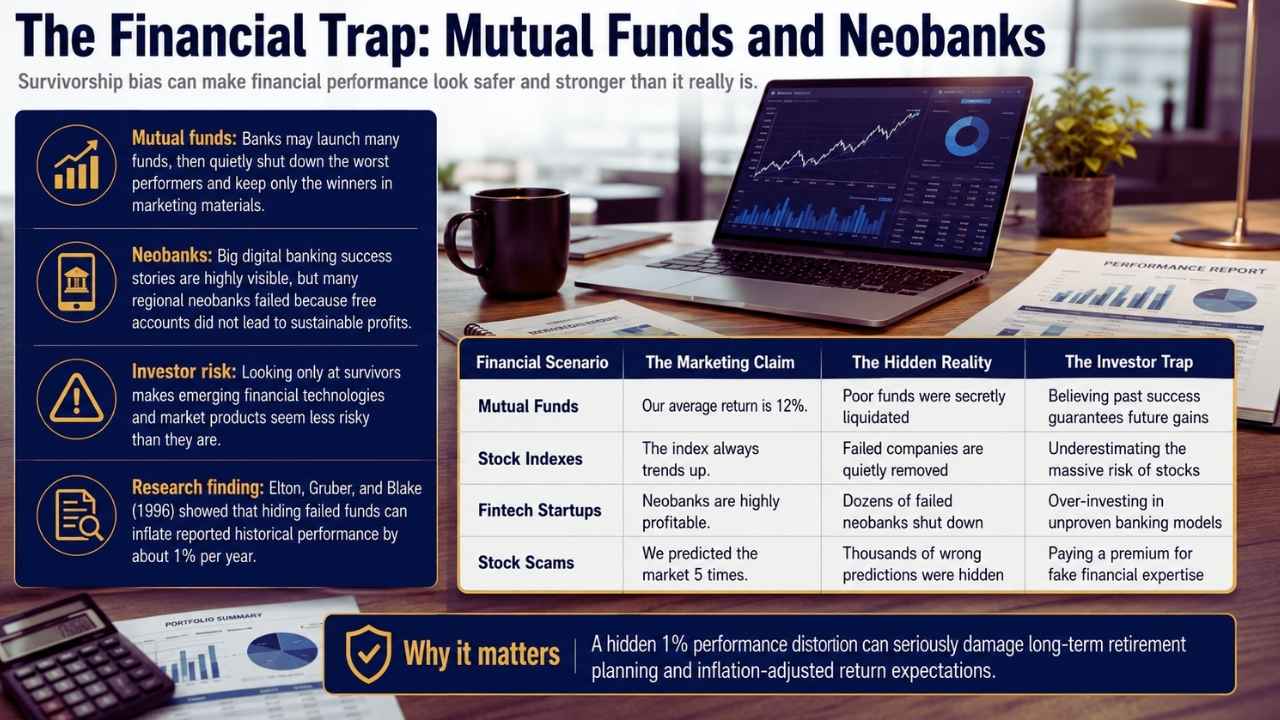
Wall Street loves weaponizing this bias to make their returns look spectacular. If you are handling personal tax planning or looking at market returns to beat inflation, you have to read between the lines. Take the mutual fund industry. A bank launches 50 different funds. Over a decade, 35 of those funds bleed money and perform terribly.
So, the bank quietly shuts down the 35 losers and merges the leftover cash into the 15 successful funds. Next year, their marketing brochure boldly claims that 100 percent of their funds beat the market average over the last ten years. They aren’t technically lying. All the funds they currently offer did beat the market. But they purposely buried the graveyard of losers.
This exact same illusion happens in the modern fintech space. We look at the booming digital banking shift in Scandinavia or the rise of massive US neobanks like Chime. We see their massive valuations and assume building a digital-only bank is a guaranteed path to profitability. What we do not see are the dozens of regional neobanks in Australia and the US that completely collapsed because they could not figure out how to monetize free checking accounts.
When we only look at the survivors, we heavily underestimate the risk of investing in emerging financial technologies. A famous 1996 study by researchers Elton, Gruber, and Blake exposed this exact trick in the stock market. They proved that by hiding the failed funds, the financial industry artificially inflates its historical performance by about 1 percent every single year. Over twenty years, that fake 1 percent completely wrecks your retirement math.
|
Financial Scenario |
The Marketing Claim |
The Hidden Reality |
The Investor Trap |
|
Mutual Funds |
“Our average return is 12%.” |
Poor funds were secretly liquidated |
Believing past success guarantees future gains |
|
Stock Indexes |
“The index always trends up.” |
Failed companies are quietly removed |
Underestimating the massive risk of stocks |
|
Fintech Startups |
“Neobanks are highly profitable.” |
Dozens of failed neobanks shut down |
Over-investing in unproven banking models |
|
Stock Scams |
“We predicted the market 5 times.” |
Thousands of wrong predictions were hidden |
Paying a premium for fake financial expertise |
The Impact on Healthcare and Productivity Data
When this data flaw infects clinical trials, human resources, or personal productivity tracking, the fallout goes way beyond lost money. Look at how founders approach physical fitness and cognitive productivity. We see a highly successful CEO running ultra-marathons and claim that extreme physical endurance is the secret to managing financial stress. Ambitious founders immediately copy the grueling workout routine.
What they miss is the massive sample size of founders who tried running 50 miles a week, completely burned out their nervous systems, and drove their companies into the ground. We only see the biological outliers who survived the extreme stress, not the thousands who broke down trying to emulate them.
You see the exact same trap in medical and psychological studies. During the UK’s 2020 pandemic lockdowns, a massive study tracked the mental health of residents. Early on, the data showed anxiety and depression levels dropping. It looked like people were adapting to the crisis perfectly fine. But a deeper dive caught the silent evidence: nearly 40 percent of the people who took the first survey simply stopped replying.
The people suffering from the worst trauma and financial stress were far too exhausted to keep filling out surveys. The data did not show dropping anxiety; it just showed that only the calmest people survived the survey process. In HR and corporate recruitment, algorithms trained on historic hiring data often just learn to replicate the traits of the “survivors” of a flawed, biased system, automating past discrimination into future hiring practices.
|
Domain |
The Skewed Observation |
The Missing Data |
The Consequence |
|
Founder Health |
Extreme workouts boost success |
Founders who burned out trying it |
Wrecking physical health for a myth |
|
Mental Health |
“Anxiety is dropping over time.” |
Highly anxious people stopped replying |
Ignoring a massive public health crisis |
|
Longevity Data |
“Oscar winners live 4 years longer.” |
Young actors who died before winning |
Publishing severely flawed medical statistics |
|
HR Algorithms |
“This demographic performs best.” |
Historic discrimination skewed the data |
Automating and scaling corporate hiring bias |
Spotting It in Everyday Life: Sports, EdTech, and Nomads
Once you know the trick, you spot it everywhere in our daily culture. Take the world of sports leadership. We study cricket legend Sachin Tendulkar, marvel at his specific mindset, and assume replicating his exact approach will build a champion. We completely ignore the tens of thousands of young athletes who had the exact same dedication, discipline, and mindset but never made it out of their local clubs due to injuries or lack of opportunity. We confuse a requirement for success (hard work) with a guarantee of success, simply because we only stare at the survivor.
You see it heavily in lifestyle trends and educational technology. We scroll through Instagram and see digital nomads working from laptops on the beaches of Bali or exploring agritourism in Germany. It looks like a flawless, stress-free lifestyle. We do not see the thousands of aspiring nomads who ran out of money in three months, faced massive visa tax issues, and flew home in debt. In education, we read case studies about schools successfully using logic games like Minecraft to boost cognitive learning.
We assume the software is magic. We miss the hundreds of school districts that spent thousands of dollars on software licenses that teachers never actually used because the implementation was too complex. The survival of a few great examples tricks us into thinking the execution is easy.
|
Everyday Category |
The Survivor (What We See) |
The Invisible Failure |
The False Conclusion |
|
Sports Leadership |
A legendary athlete’s mindset |
Amateurs with the same mindset who failed |
“Mindset alone creates champions.” |
|
Digital Nomads |
Influencers working from the beach |
Nomads who went broke in three months |
“Working abroad is a flawless lifestyle.” |
|
EdTech Software |
A school thriving with game-based learning |
Districts that wasted money on unused apps |
“Software automatically fixes education.” |
|
Manufacturing |
A 100-year-old brick courthouse |
Collapsed wooden shacks |
“Everything used to be built better.” |
How to Protect Your Decisions?
You cannot stop your brain from noticing the survivors. We are literally wired to look at what is directly in front of us. But you can train yourself to hit the brakes and actively hunt for the missing information before you make a major strategic move. Whether you are migrating cloud AI workflows, optimizing Google Search Console metadata, or launching a new publication, looking for the silent evidence will save you countless hours and dollars.
Here are the best ways to keep this logic trap out of your life: First, always hunt for the graveyard. Anytime you look at a successful group, stop and ask where the failures are. If you cannot see the failures, your data is garbage. Second, run a pre-mortem. Before launching a project, imagine it already failed miserably and work backward to figure out what killed it. This forces you to look at risks instead of just daydreaming about success. Third, talk to the haters. Stop surveying your happy customers.
Spend your budget talking to the people who abandoned their carts, deleted your app after five minutes, or demanded refunds. Finally, look at base rates. Never look at a single winner to figure out your odds. Look at the entire industry average to keep your expectations grounded in reality.
|
Mitigation Strategy |
How to Execute It |
The Real-World Outcome |
|
Hunt for the Graveyard |
Actively research failed competitors |
Avoid repeating fatal industry mistakes |
|
Conduct Pre-Mortems |
Imagine the project failed, find out why |
Shifts focus from blind optimism to risk management |
|
Exit Interviews |
Survey churned users, not active ones |
Uncover UI roadblocks you didn’t know existed |
|
Base-Rate Thinking |
Look at total industry averages |
Set realistic, mathematically sound growth goals |
Final Thoughts
We live in a culture obsessed with winning. We build statues of victors, write endless books about billionaires, and fill our spreadsheets with the metrics of surviving products. But reality is built on a massive, hidden foundation of invisible failures. When you make major business or financial choices based only on the people who crossed the finish line, you are playing a dangerous game. You end up copying reckless behavior, assuming it is genius simply because it worked out for one lucky person.
Now that you have survivorship bias explained, you hold a serious edge over your competitors. You know how to look for the missing planes. You know to ask where the bullet holes are not. By actively hunting for silent evidence and studying the failures, you will make sharper, more grounded, and wildly more profitable decisions in your content strategy, your software builds, and your life.
Frequently Asked Questions (FAQs) About Survivorship Bias Explained
Does this bias mess up software UX testing?
Absolutely. If your design team only reads bug reports from active power users, they miss the fatal interface flaws that caused new users to quit on day one. You end up polishing features for power users while ignoring the massive roadblocks destroying your onboarding flow.
How does it skew life expectancy data?
We totally misinterpret lifespan stats. If the average life expectancy at birth is 75, people think a 70-year-old only has 5 years left. But that average includes infant mortality and early accidents. If you survive to 70, your specific life expectancy pushes well into your 80s. The “survivors” ride a completely different statistical curve.
Is this the same thing as confirmation bias?
No. Confirmation bias is when you actively seek out information that proves you right and ignore facts that prove you wrong. Survivorship bias happens when the selection process physically hides the opposing facts from you, whether you are looking for them or not.
Can this bias affect machine learning and AI models?
Yes. If you train an AI text generator or an image recognition tool exclusively on the most popular, highly upvoted content on the internet, the AI learns to replicate that specific “surviving” style. It completely misses out on niche, highly creative formats that simply did not go viral, leading to generic, homogenized AI outputs.