


You nailed the technical questions. Your resume is spotless. You even made the recruiter laugh. Then the hiring manager leans in, makes direct eye contact, and drops the heavy question: “So, why are you looking for a new opportunity right now?” Panic often sets in for candidates at this exact moment.
Finding the right why are you leaving your job answer feels like walking a tightrope without a net to catch you. Say too little, and you look sketchy. Say too much, and you risk sounding like a walking human resources nightmare. I have seen brilliant, highly qualified candidates lose amazing job offers simply because they completely fumbled this single question. Employers use this behavioral test to filter out people who bring unnecessary drama or quit the second things get hard. You need a response that proves your ambition without trashing your old boss.
The Real Reason They Ask This Question
Hiring managers do not ask this question to make you sweat or to put you on the spot. They ask it to protect their budget, their team culture, and their own jobs. Hiring someone new costs a massive amount of money and time. Recent workforce data from the Society for Human Resource Management highlights that replacing an employee easily costs a company up to double that person’s annual salary. The person sitting across the table just wants to know if you are a safe, reliable investment.
When an interviewer asks this, they are calculating risk. They need to uncover your actual motivations, your professional maturity, and your long-term goals before they hand over an offer letter. They are testing your judgment to see if you will complain or badmouth your current manager. If you throw your current boss under the bus, the hiring manager immediately assumes you will eventually do the exact same thing to them.
|
Their Hidden Fear |
What They Actually Mean |
Your Winning Strategy |
|
Are you running away? |
Did you mess up your last project? |
Prove you are running toward a new goal. |
|
Do you complain? |
Will you ruin our team’s daily vibe? |
Keep a positive, strictly professional tone. |
|
Will you quit soon? |
Do you understand what this job is? |
Show your goals match their job description. |
|
Were you fired? |
Is there a secret performance issue? |
Be honest, but frame the exit strategically. |
The Secret Sauce of a Strong Why Are You Leaving Your Job Answer
Finding the perfect why are you leaving your job answer requires you to focus entirely on the future, rather than getting stuck in the past. The best responses never dwell on what went wrong at your old company. Instead, they use your previous experience as a quick launchpad to explain why taking this new job makes complete, logical sense. You want to make your career switch look like a highly calculated, intelligent move, rather than a desperate escape from a bad situation.
A solid answer always acts like a bridge between your current reality and your future goals. For instance, if you currently work at a massive, slow-moving corporation and want to join a fast-paced startup, your bridge is simply wanting more agility and direct, hands-on impact. Keep your explanation short, stay relentlessly positive, and prove that you have the ambition to succeed in their specific open role.
|
Core Element |
Why It Works So Well |
How to Apply It |
|
Keep it Short |
Stops you from rambling into bad territory. |
Cap your answer at 45 to 60 seconds total. |
|
Stay Positive |
Proves you possess emotional intelligence. |
Say one nice thing about your past role. |
|
Look Forward |
Shifts the spotlight onto their company. |
Connect your move to their open role. |
|
Tell the Truth |
Saves you from failing a background check. |
Never lie. Frame the truth constructively. |
The Past-Present-Future Formula
You should never try to wing this question off the top of your head. Sticking to a proven script like the Past-Present-Future framework keeps your thoughts perfectly organized and stops you from nervous rambling. First, you start with the past by validating your current experience and acknowledging exactly what you learned. Next, you move into the present by stating the specific, professional trigger that made you realize you need a change.
Finally, you spend the majority of your time focusing on the future, connecting your specific hard skills directly to the needs of their company. A great example sounds like this: “I have loved my three years at my current company, and I learned a massive amount about enterprise sales. However, they recently shifted focus to strictly local markets, and I want to keep scaling global accounts. That is exactly why I want this role, as your European expansion fits my background perfectly.”
|
The Formula Stage |
Your Primary Goal |
How Much Time to Spend |
|
1. The Past |
Validate the experience and show gratitude. |
15% of your spoken answer |
|
2. The Present |
Give the exact trigger for needing a change. |
35% of your spoken answer |
|
3. The Future |
Connect your skills directly to their needs. |
50% of your spoken answer |
Totally Valid Reasons to Move On
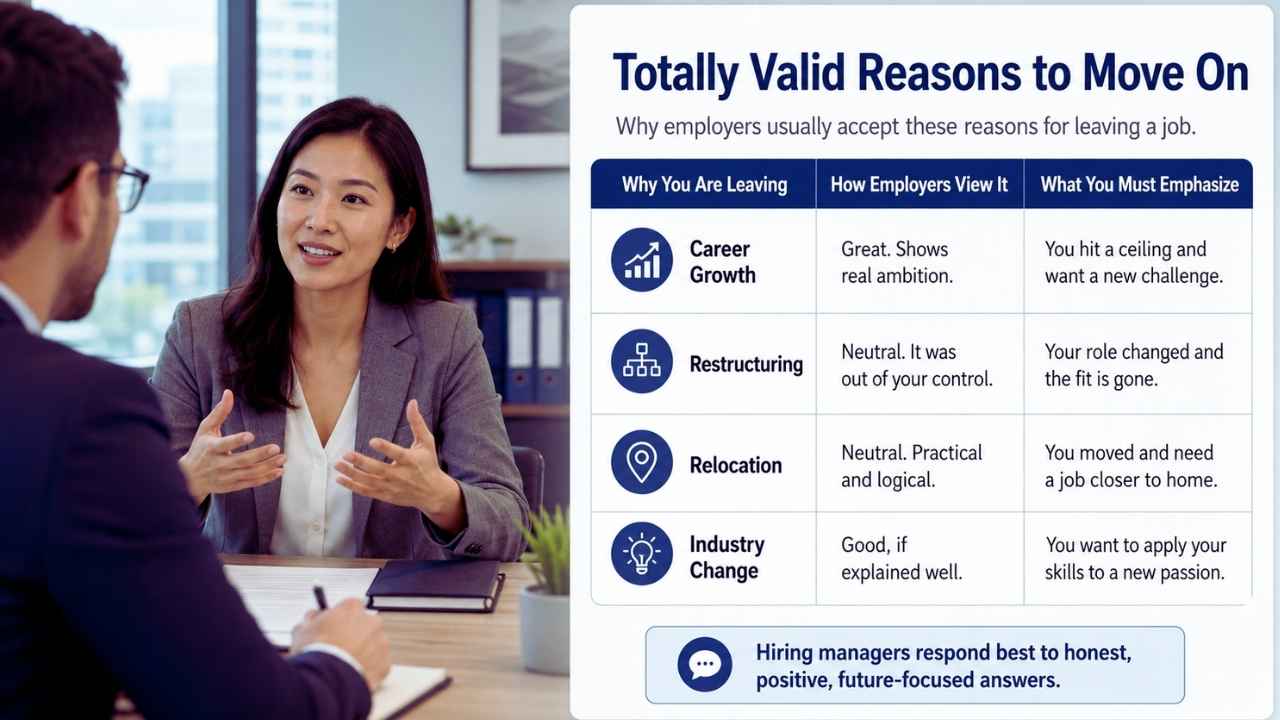
Some reasons for leaving a job get an automatic green light from hiring managers everywhere. If your specific situation falls into one of these standard buckets, you have a distinct advantage. Seeking career growth remains the safest, most reliable answer on the planet. According to the Bureau of Labor Statistics, modern workers change jobs every four years on average, so nobody expects you to stay in a dead-end position forever.
If you learned everything you possibly could at your current job, it is entirely fair play to say you need an environment that pushes you to the next professional level. Layoffs and company restructurings are also incredibly common right now across major industries. With tech and media companies downsizing constantly in the news, hiring managers completely understand. If your department got cut, just say so clearly and confidently, because secrecy just breeds unnecessary suspicion.
|
Why You Are Leaving |
How Employers View It |
What You Must Emphasize |
|
Career Growth |
Great. Shows you have real ambition. |
You hit a ceiling and actively want a challenge. |
|
Restructuring |
Neutral. Things happen out of your control. |
Your role changed, and the fit is simply gone. |
|
Relocation |
Neutral. Highly practical and logical. |
You moved and need a reliable job near home. |
|
Industry Change |
Good, if you justify it properly. |
You want to apply your skills to a new passion. |
Massive Red Flags You Must Avoid
Even if your old boss was an actual monster and the culture was terrible, the interview room is never the place for a therapy session. When you vent or complain about a past employer, the interviewer instantly wonders if you were the actual problem all along. You absolutely must keep your personal frustrations in check. Money is another incredibly tricky subject to navigate.
We all go to work to get paid, and wanting a bump in your salary is a totally normal reason to jump ship. But leading with money as your main motivation makes you look strictly transactional to the employer. You must always frame your desire for cash as a desire for higher responsibility. When you step up to own bigger projects and manage more people, the money naturally follows, and employers respect that ambition much more than a simple demand for a raise.
|
You Want to Say… |
What They Actually Hear… |
Say This Instead… |
|
“My boss is a micromanager.” |
“I refuse to take direction from leaders.” |
“I am looking for a role with more autonomy.” |
|
“I just want more money.” |
“I will quit when someone pays me more.” |
“I want to take on senior responsibilities.” |
|
“The culture is completely toxic.” |
“I thrive on workplace drama and gossip.” |
“I want a highly collaborative, supportive team.” |
|
“I am bored to death at work.” |
“I have absolutely zero personal initiative.” |
“I need a faster-paced, dynamic environment.” |
Scripts for the Tough Stuff: Fired, Laid Off, or Toxic Bosses
Life gets messy, and career paths are rarely a perfectly straight line. Maybe you got fired for performance reasons, or maybe you are desperately trying to escape a nightmare manager. When dealing with difficult exits, your why are you leaving your job answer requires careful finesse. If you got fired, do not ever lie about it. Human resources departments talk to each other, and standard background checks will easily expose a lie.
You need to keep the explanation incredibly brief, take full ownership of the situation, and immediately pivot to what you learned. Talk about how the day-to-day reality of the job shifted away from your core strengths, leading to a mutual parting of ways. If you are escaping a terrible boss, you must focus entirely on different leadership styles rather than attacking their personality. Frame it as seeking an environment that empowers independent problem-solving.
|
The Messy Reality |
Your Interview Strategy |
Try This Script Framework |
|
You were laid off. |
State the cold facts. Never make it personal. |
“My department was cut during a restructuring.” |
|
You got fired. |
Own the mismatch. Pivot to what you learned. |
“The role shifted from my strengths, so we parted ways.” |
|
You hated your boss. |
Talk about leadership styles, not personalities. |
“I do best in environments that empower independence.” |
|
You quit with no job. |
Focus on full-time upskilling or family needs. |
“I took dedicated time off to complete a certification.” |
Mastering Your Tone and Body Language
What you actually say matters, but how you physically deliver the message matters just as much. Interviewers watch your body language like a hawk when they ask this specific question. If you suddenly break eye contact, cross your arms defensively, or shift uncomfortably in your chair, you instantly signal that you are hiding something bad. You need to practice your answer out loud multiple times before you ever step foot in the interview room.
You want the words to flow naturally so you do not sound like a robot reciting a memorized script. Maintain steady, confident eye contact while delivering your explanation. Keep your shoulders relaxed and your posture open to communicate absolute professionalism. A calm, measured speaking tone reassures the hiring manager that you are completely at peace with your decision to leave your last job.
Read Also: How to Prepare for a Panel Interview: Complete Guide
|
Non-Verbal Cue |
What It Communicates to HR |
Best Practice to Follow |
|
Eye Contact |
Supreme confidence and honesty. |
Maintain steady eye contact during your answer. |
|
Body Posture |
Openness and professionalism. |
Keep shoulders relaxed; do not cross your arms. |
|
Voice Pitch |
Emotional stability and calm. |
Speak in a measured tone; do not rush words. |
|
Expressions |
Positivity and enthusiasm. |
Offer a professional smile when discussing the future. |
Final Thoughts
Job hunting is stressful enough on its own. Do not let one standard behavioral question completely derail your confidence during an interview. The hiring manager is not trying to trick you or back you into a corner; they just want to make a safe, smart hire for their team. The perfect why are you leaving your job answer always looks forward instead of looking backward.
Keep your response incredibly tight, drop all the emotional baggage at the door, and tie your career move directly to the exciting projects their open role offers. Stick rigorously to the Past-Present-Future formula, own your unique career story, and show them exactly why handing you a job offer is the best decision they will make all year. Stand tall, speak clearly, and go claim the job you deserve.
Frequently Asked Questions About Why Are You Leaving Your Job Answer
How do I explain leaving a company before my stock options vest?
Leaving money on the table always makes recruiters incredibly curious. If you walk away before your stock options vest, the hiring manager immediately assumes something went terribly wrong behind the scenes. You must frame this aggressive move as a highly calculated career choice rather than a desperate escape plan. Explain that while the financial package was attractive, your desire for long-term career growth heavily outweighed the short-term payout. Tell them that finding the right role with the right team matters much more to you than waiting around for a vesting cliff. This specific approach proves you are highly motivated by actual work and professional development rather than just collecting a passive paycheck.
What if I am leaving because my employer forced a return to the office?
The modern transition back to physical offices remains a massive pain point for thousands of workers. If your company suddenly killed their remote work policy, you can definitely use this as your primary why are you leaving your job answer. However, you must completely avoid sounding entitled or incredibly angry about the new commute. Instead, simply state that you spent the last few years building highly effective remote workflows and you want to continue working in a distributed environment. Emphasize your peak productivity levels while working from home and note that you are actively seeking a company that fully supports a digital-first culture.
Can I say I am leaving because my startup completely ran out of money?
Startup failures happen every single day, and hiring managers totally understand this brutal financial reality. You do not need to hide the fact that your company ran out of funding or abruptly shut down its daily operations. State the cold, hard facts quickly without diving into the messy financial details or blaming the founders for bad management. Tell the interviewer that the startup lost its runway, which unexpectedly eliminated your specific position. Immediately pivot the conversation to how much you learned building products from scratch in a highly chaotic environment. Then, explain how you want to bring that aggressive builder mentality to their highly stable, growing team.