


Let’s be completely honest about this. Walking into a conference room and staring down four or five interviewers at the exact same time is a terrifying experience. You are no longer just trying to impress a single hiring manager with a good conversation.
You have to actively juggle different personalities, hidden departmental agendas, and entirely clashing communication styles all at once. If you go in blind without a solid game plan, a group interview quickly devolves into what feels like a hostile interrogation.
The stakes are incredibly high right now. Look at the verified 2026 hiring data circulating across major recruiting platforms. Getting the interview in the first place is the hardest part of the entire job hunt. Current metrics show the applicant-to-interview ratio sits at a dismal two to three percent. That means out of every hundred resumes a company receives, only two or three people ever get a foot in the door. If you made it to the panel stage, you already beat the massive odds stacked against you. Now, the hiring committee is watching your every single move to see if you crack.
Figuring out how to prepare panel interview starts with a very simple truth: this format is an aggressive test of your soft skills and your endurance. I have sat on the other side of that table plenty of times when hiring writers and digital strategists for my team. We are never trying to break a candidate on purpose. We just want to see exactly how you handle pressure, how well you read a room, and if you can explain complex ideas without having a meltdown. This comprehensive guide breaks down exactly what you need to do before, during, and after the big day so you walk in completely ready to own the room and secure the offer.
The 2026 Hiring Landscape: Why Panels Are Everywhere
Before we get into the specific tactical maneuvers, you need to understand exactly what you are walking into. Companies are intentionally dragging out the hiring process to avoid making extremely expensive hiring mistakes. Recent employment statistics show the total number of interviews required per hire has jumped by thirty-three percent across the board. For technical and specialized roles, it is a complete marathon.
Companies now average over thirty-five interviews spread across their entire candidate pool just to fill one single empty seat. That is exactly why panels exist in the modern workplace. They save companies a massive amount of time. Instead of making you come back to the office for five separate one-on-one calls, they throw all the decision-makers into a single ninety-minute gauntlet to get it over with.
Furthermore, your traditional resume matters a lot less today than it did five years ago. Recent job outlook surveys confirm that seventy percent of modern employers now prioritize skills-based hiring over impressive college degrees or long tenures at past companies. They want actual proof that you can do the job. You should absolutely expect a live test during this meeting.
The panel will likely ask you to solve a problem on a whiteboard, walk through a complicated case study, or defend a technical decision right there on the spot. You cannot hide behind buzzwords anymore; you have to demonstrate total competence in real-time while four people evaluate your every word.
Read Also: How to Answer What Are Your Weaknesses in 2026 Interviews
|
Hiring Trend (2026 Data) |
What the Numbers Mean |
How It Changes Your Game Plan |
|
2-3% Interview Rate |
General competition is fierce. |
Generic answers will fail. Stand out instantly with data. |
|
70% Skills-Based Hiring |
They want proof, not just promises. |
Expect live problem-solving or detailed case studies. |
|
5-8 Interview Rounds |
The overall process is a grind. |
Build your stamina and follow up every single time. |
|
33% Increase in Volume |
Companies are highly risk-averse. |
Every panelist has veto power. Do not ignore anyone. |
Decoding the Panel: Who Are You Actually Talking To?
You probably hate panel interviews, but hiring managers absolutely love them. When you understand exactly why they use them, you can give them exactly what they want to see. First and foremost, panels kill individual hiring bias. If a single manager interviews you, their bad mood or personal preferences dictate your entire fate. In a group setting, they have to defend their vote to the rest of the team.
Top companies now use independent scoring systems. Everyone logs their candidate score into a software platform before they even discuss you out loud. This means you cannot just charm the boss and ignore the junior developer sitting in the corner. Every single vote counts equally.
Think of it like a B2B SaaS sales pitch. You aren’t just selling to the end-user; you have to convince the entire buying committee. You have the economic buyer who cares about the budget, the technical buyer who cares about the implementation, and the end-user who cares about the daily workflow. A panel interview operates on the exact same logic. You have to tailor your communication to satisfy the hiring manager looking for output, the HR representative looking for cultural fit, and the peer looking for a reliable teammate.
It also simulates real workplace stress. Deadlines move constantly. Clients complain loudly. Internal meetings get heated. Having four people fire rapid questions at you is a deliberate stress test designed to see if you lose your cool. Staying calm under cross-examination shows you have the professional discipline to handle the actual job. Much like cricket legend Sachin Tendulkar facing a hostile fast-bowling attack on a crumbling pitch, you have to stay incredibly calm under pressure, block out the noise of the crowd, and play each question on its individual merit without losing your core values.
|
Panelist Role |
What They Actually Want |
How to Win Them Over Completely |
|
Hiring Manager |
A fast problem-solver to ease their workload. |
Focus strictly on direct impact, efficiency, and hard numbers. |
|
Human Resources |
Cultural fit and someone who won’t quit fast. |
Highlight your adaptability, teamwork, and core company values. |
|
Peer / Coworker |
A reliable teammate they can tolerate every day. |
Show great collaboration, active listening, and a very low ego. |
|
Cross-Department Lead |
Smooth collaboration between different silos. |
Emphasize clear, jargon-free communication and alignment. |
Your Master Timeline: How to Prepare Panel Interview
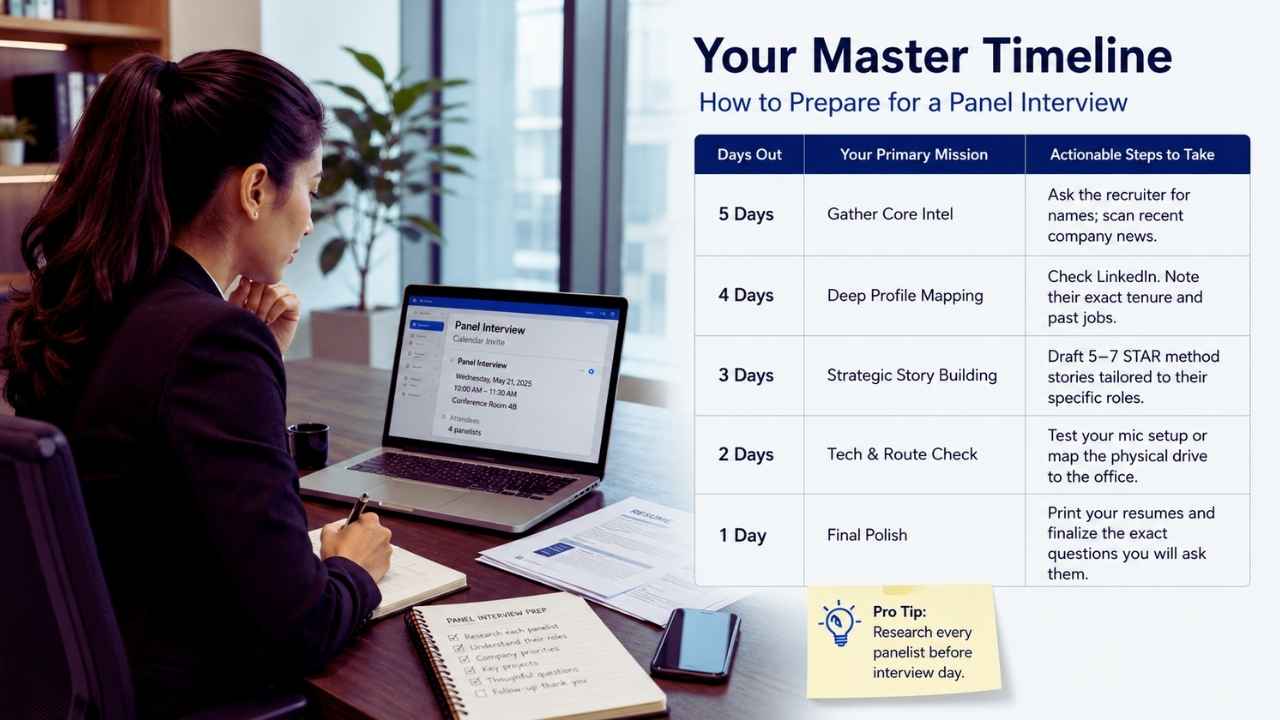
Do not try to wing this process. The real work starts the exact minute you get the calendar invite in your inbox. The single biggest mistake candidates make is showing up entirely blind to who is in the room. You have the absolute right to know who is interviewing you. Reply to the recruiter immediately and ask for the full names and exact job titles of every single panelist. Once you have that list, start digging deep into their professional backgrounds. Treat your preparation like a rigorous five-day sprint so you are not cramming information the night before.
Look up every single person on LinkedIn to map out their specific perspective. A panelist who started three months ago views the company very differently than a ten-year veteran who built the original systems. Look closely at their past roles and past industries. If the current Director of Marketing used to be a data analyst at a major financial firm, you better bring hard metrics and conversion rates when discussing your past creative campaigns.
Find common ground quickly. Did you work in the same obscure industry? Do you share a mutual connection? Finding these small connection points gives you a highly organic way to break the ice during the initial small talk phase before the really tough questions begin.
|
Days Out |
Your Primary Mission |
Actionable Steps to Take |
|
5 Days |
Gather Core Intel |
Ask the recruiter for names; scan recent company news. |
|
4 Days |
Deep Profile Mapping |
Check LinkedIn. Note their exact tenure and past jobs. |
|
3 Days |
Strategic Story Building |
Draft 5-7 STAR method stories tailored to their specific roles. |
|
2 Days |
Tech & Route Check |
Test your mic setup or map the physical drive to the office. |
|
1 Day |
Final Polish |
Print your resumes and finalize the exact questions you will ask them. |
Structuring Your Answers for Maximum Impact
You have to completely nail your verbal delivery. The panel will compare their detailed notes later, so your stories need clear structure. You cannot afford to ramble or use useless fluff. Stick strictly to the STAR method because it keeps you on track. First, outline the Situation by setting the scene in just two short sentences. Second, state the Task you specifically had to achieve. Third, detail the Action steps you took, spending roughly seventy percent of your total time here. Finally, end with a highly measurable Result.
You must bring hard numbers to the table. Group panels will completely zone out if you talk for three straight minutes without landing on a concrete point. Wake them up with data. Do not say you improved the onboarding process. Say you completely redesigned the onboarding flow, which cut training time by two full weeks and saved the department four thousand dollars per new hire. Numbers act as a universal language that everyone in the room instinctively understands, regardless of their specific department.
If they hit you with rapid-fire questions, do not panic. Sometimes Person A asks a detailed question, and Person B jumps in with a secondary thought before you even finish. Finish your thought for Person A quickly, acknowledge Person B, and pivot smoothly. You can say, “To wrap up John’s point on the budget, we stayed five percent under. And to answer your question, Sarah, about the launch timeline…” This proves you can track multiple threads of conversation without losing your composure.
|
Question Type |
The Dangerous Trap |
The Winning Strategic Move |
|
Behavioral |
Rambling endlessly and losing the main point. |
Stick to STAR. Cap all answers at exactly 2 minutes max. |
|
Technical/Skills |
Faking knowledge you obviously do not have. |
Admit what you don’t know, then explain how you’d learn it fast. |
|
Hypothetical |
Giving very generic, overly safe answers. |
Give them a clear, step-by-step framework to solve the issue. |
|
Multi-Part |
Completely forgetting the second question. |
Take notes on a pad. Answer part one, then hit part two. |
Mastering Body Language and Room Management
Staring exclusively at the hiring manager is a remarkably quick way to fail the entire interview. You have to actively work the entire room. Use the sixty-forty eye contact rule. When someone asks a question, start by looking directly at them. Give them sixty percent of your eye contact for that specific answer. Sweep the rest of the room with the other forty percent to pull everyone else into the narrative. Finish your final sentence looking directly back at the person who originally asked the question.
Good posture isn’t just about looking professional; it’s about physical fitness and workplace ergonomics. Maintain a neutral spine, keep your shoulders back, and lean in just slightly to show you are highly engaged. Do not slouch into the chair or cross your arms defensively. When you sit with proper ergonomic alignment, you project confidence and breathe easier, which naturally calms your nervous system down during stressful questions.
Do not check out mentally when you aren’t talking. Nod your head in agreement. Take brief notes on a pad. Pay very close attention to the silent note-taker sitting in the corner. Industry data shows recruiters spend a massive amount of time documenting these chats for compliance reasons. That quiet person typing away on their laptop is grading your competencies in real-time. Bring them into the conversation with deliberate, warm eye contact so they know you respect their presence.
|
Body Language Rule |
Do This |
Don’t Do This |
|
Posture |
Sit up straight with a neutral spine, lean in slightly. |
Slouch heavily or cross your arms in a defensive posture. |
|
Eye Contact |
Sweep the room naturally to include everyone. |
Stare down one single decision-maker the entire time. |
|
Hands |
Keep them clearly visible resting on the table. |
Fidget, pick your nails, or hide your hands in your lap. |
|
Face |
Maintain a relaxed, highly natural smile. |
Frown deeply or look totally blank while others speak. |
Zoom and Teams panels are the absolute standard now, and they are notoriously awkward to navigate. When studying how to prepare panel interview dynamics for video, you have to realize you must manufacture eye contact and actively fight internet lag. Look directly at the camera lens, not the screen below it. I know it feels incredibly unnatural to do this for an hour. But staring at that little glowing dot is the only way to make the panelists feel like you are actually looking them directly in the eye.
When they speak, you can briefly glance at the grid to read their facial expressions. But the exact second you open your mouth to answer, look right back at the lens. You also have to watch the audio delay closely. Pause for one full second after they stop talking before you start your answer. This completely kills that awkward back-and-forth where you accidentally talk over each other and spend ten seconds apologizing for the interruption.
Fix your environment before you log in. Poor lighting casts harsh shadows and makes you look exhausted. Face a natural window or stick a ring light directly behind your screen. Prop your laptop up on a stand so the lens is exactly at eye level. Looking down at the camera makes you look arrogant and dominant. Finally, use a dedicated headset. Laptop microphones pick up every single keyboard click and room echo, which heavily distracts the panel from your actual answers.
|
Tech Fix |
Why You Need It |
The Quick Win Implementation |
|
Lighting |
Shadows make you look highly unprofessional. |
Face a window directly or use a dedicated ring light. |
|
Camera Angle |
Looking down looks arrogant and awkward. |
Prop your laptop up so the lens is exactly at eye level. |
|
Background |
Messes are deeply distracting to the panel. |
Clean your room totally or use a subtle blur effect. |
|
Audio Setup |
Laptop mics pick up everything in the room. |
Use a dedicated headset to kill echoes and keyboard clicks. |
Turning the Tables: Asking Your Own Questions
At the very end of the meeting, they will inevitably ask, “Do you have any questions for us?” Never say no. Saying no makes you look completely bored and wildly unprepared for the role. This is your critical opportunity to show you understand their business model and are evaluating them just as hard as they are evaluating you.
Target your questions specifically. Do not just throw a generic question to the center of the table hoping someone catches it. Ask the HR representative about their specific training programs. Ask the hiring manager about their exact day-one priorities. You might say, “Sarah, you mentioned earlier that the marketing team is expanding rapidly. What is the single biggest hurdle for that expansion right now?” This proves you were actually listening to her earlier.
Ask questions that reveal the harsh reality of the job, not just the polished sales pitch. Ask a peer what a typical Tuesday actually looks like when things get stressful. By directing highly specific questions to specific people, you force the entire panel to engage with you as a respected professional peer rather than just another desperate job seeker.
|
Target Panelist |
High-Impact Question to Ask |
What It Actually Proves |
|
Hiring Manager |
What is the most urgent problem I need to fix in month one? |
You want to take extreme ownership immediately. |
|
HR Rep |
How do you actually measure and reward top performance? |
You care deeply about high standards and growth. |
|
Peer / Coworker |
What does a typical Tuesday actually look like here? |
You want the absolute reality of the daily grind. |
|
The Whole Group |
Is there anything about my background that gives you pause? |
High confidence. It gives you one last chance to clear doubts. |
Post-Interview Protocol: What to Bring and How to Follow Up
If you are doing this in person, you must bring physical materials with you. Bring five to seven clean, unwrinkled copies of your resume. Do not assume they printed it out. Someone always gets dragged into the conference room at the absolute last minute and won’t have a single clue who you are. Handing them a crisp resume instantly establishes your high level of preparation.
Bring a dark portfolio and a notepad to sketch a quick seating chart. Write down their names based on where they sit so you do not forget them mid-sentence. For the follow-up process, completely ditch the generic group email. Send a highly personalized thank-you note to every single person on the panel within twenty-four hours of leaving the building.
Mention a highly specific moment from your chat. You might write, “John, I really loved our quick debate about implementing the new CRM software.” If you do not have their direct emails, ask the recruiter to forward your specific notes to each person. Taking the time to write individual messages shows you sweat the small details, which is exactly what they want in a new hire.
|
What to Bring / Do |
Exact Quantity / Timing |
Why It Actually Matters |
|
Printed Resumes |
5-7 copies |
For the entirely unprepared or last-minute panelists. |
|
Notepad & Pen |
1 set |
To quickly track names and multi-part questions. |
|
Physical Portfolio |
2-3 copies |
Hard, undeniable proof of your past career wins. |
|
Thank-You Emails |
1 per person (within 24 hours) |
Leaves a highly personalized, lasting professional impression. |
Final Thoughts
Group interviews will always spike your adrenaline, no matter how seasoned you are. But once you truly master how to prepare panel interview tactics, you swap that initial panic for sharp, actionable focus. The modern hiring market is brutal, and these companies are testing you incredibly hard to protect their bottom line.
But you must remember this one crucial fact: they actively want you to win. They absolutely do not want to keep interviewing people for another month. They want to hire you today and get back to doing their actual jobs. Research their professional backgrounds deeply, nail your structured STAR stories, maintain your strong posture, manage your eye contact, and own the room completely. You have the exact strategy you need. Now go execute it.
Frequently Asked Questions (FAQs) About How to Prepare Panel Interview
What if they start arguing with each other?
It happens. The tech lead wants one thing, HR wants another, and they debate it right in front of you. Stay out of it. Acknowledge both sides: “I see both points. In my experience, a balanced approach works best by hitting the immediate deadline first.”
What if I totally blank on a name?
Don’t guess. Just smile, make eye contact, and answer naturally. If you need it later, glance at the seating chart you drew on your notepad.
What if they ask something inappropriate?
Sometimes an untrained panelist asks about your age or if you have kids. Deflect politely and pivot back to the work. “I am fully committed to the hours this role requires and have a solid track record of hitting my deadlines.”
How do I handle a hostile interviewer?
Someone might cross their arms, sigh, or check their phone. Keep your tone flat and professional. Sometimes they play “bad cop” just to see if you crack. Don’t take the bait.
What if I have no idea how to answer a technical question?
Don’t lie. They will spot a fake answer instantly. Say, “I haven’t used that specific framework, but I am proficient in a similar stack. Here is exactly how I would learn yours.”