


You have got some cash set aside, and naturally, you want it working hard for you in the stock market. But right away, you hit a massive wall and face the classic investor’s dilemma. Do you dump all your money in today and hope for the best? Do you sit nervously on your hands waiting for a catastrophic market crash so you can buy everything dirt cheap? Or do you slowly trickle your cash into the market to protect your sanity?
When we weigh market timing vs investing systematically, the entire debate usually boils down to two opposing camps: dollar cost averaging (DCA) and trying to perfectly time the market. We all want to buy low and sell high because it sounds incredibly easy on paper. However, if you ask any trader who has survived in the trenches for a decade, they will tell you straight up that predicting short-term market swings is a fool’s game.
If you guess wrong, you leave a life-changing pile of money on the table. So, how do you protect your hard-earned cash while still riding the massive wave of global market growth? Let’s strip away the corporate fluff and dive deep into the math, the psychology, and the hard 2026 data to see what actually builds wealth.
The Basics: What Do These Strategies Actually Mean?
Let us skip the confusing Wall Street jargon and break things down simply. You need to intimately know the rules before you can figure out how to dominate the game.
|
Feature |
Dollar Cost Averaging (DCA) |
Timing the Market |
|
Core Idea |
Consistency heavily beats prediction. |
Buy only at the absolute lowest price. |
|
Action Plan |
Invest set amounts on a strict schedule. |
Hold cash until the perfect moment arrives. |
|
Stress Level |
Incredibly low and highly automated. |
Extremely high and requires daily monitoring. |
|
Risk of Missing Out |
Very low because you always participate. |
Massive because the market might never drop. |
What is Dollar Cost Averaging (DCA)?
Dollar cost averaging sounds like something a guy in a tailored suit pitches you, but you probably already do it without even realizing it. If you have a workplace retirement account and money automatically comes out of every paycheck to buy index funds, congratulations, you are already executing a flawless dollar cost averaging strategy. The core concept works beautifully because it relies entirely on consistency rather than your ability to predict the unpredictable future.
You simply invest a set dollar amount on a rigid, regular schedule, completely ignoring whether the stock market is screaming higher or crashing violently that day. Let us say you decide to buy five hundred dollars of a broad market index fund on the first of every single month. When stock prices are high and everyone feels rich, your five hundred dollars naturally buys fewer shares. When the market tanks, panic sets in, and stocks go on massive discount sales, your exact same five hundred dollars automatically grabs a much larger pile of shares.
Over a long period, this completely smooths out the average price you pay and eliminates the crippling stress of trying to time your entry perfectly. You do not have to guess when the next crash will happen or agonize over the morning financial news. You just put your wealth building on autopilot, step back, and go live your life while the market does the heavy lifting.
What is Market Timing?
Market timing represents the exact opposite approach, functioning as a hands-on, high-stress, and hyper-active strategy where you attempt to outsmart global financial systems. You try to predict exactly where the stock market is heading next by analyzing economic data, inflation reports, interest rate decisions, or just trusting your gut feelings. A market timer might see rising oil prices, panic about inflation, sell all their stocks to hide in cash, and plan to wait for a twenty percent drop before buying back in at a much lower price.
The appeal is incredibly obvious and constantly sold by financial gurus, because if you manage to nail the peaks and buy the absolute bottoms, you can get rich remarkably quickly. You get to skip all the painful portfolio drops and only ride the exhilarating upward swings. The massive catch is that crystal balls simply do not exist, not for you, not for your highly paid broker, and definitely not for the talking heads screaming on financial television networks.
To consistently win at market timing, you have to outsmart millions of other highly motivated traders and sophisticated supercomputers that are all staring at the exact same data as you every single second. Guessing wrong just once can wipe out years of potential gains, leaving you stuck in cash while the market rockets upward without you.
Market Timing vs Investing: Why Prediction Usually Fails
Look closely at market timing vs investing, and the undeniable truth hurts: sitting on the sidelines safely in cash costs you way more money than riding out the bumps.
|
The Cost of Bad Timing |
Devastating Impact on Portfolio Returns |
|
Missing the 10 best days |
Cuts your long-term return by over half. |
|
Missing the 30 best days |
Wipes out almost all your compounding gains. |
|
Panic selling |
Locks in permanent and unrecoverable financial losses. |
|
Waiting for a crash |
The market aggressively hits new highs without you. |
The Allure of Buying the Bottom
Human brains absolutely love finding patterns, and we always want to outsmart the system to feel in control of our money. When you read terrifying headlines about global energy supply shocks or central banks threatening to hike interest rates, blindly buying stocks feels reckless and entirely irresponsible. Your gut screams at you to wait on the sidelines, stash your hard-earned cash in a high-yield savings account, and hold tight until the economic dust finally settles.
Here is the vicious trap that destroys most active traders: the stock market constantly looks months ahead into the future. By the time the economic news officially sounds terrible on television, the market has usually already priced in the damage and dropped significantly. Once the news finally starts sounding positive and optimistic again, stock prices have already surged to completely new record highs.
If you stubbornly wait for the official all-clear signal from economists, you will almost always end up paying way more to get back into the market than what you sold your shares for. The coast only looks truly clear after the biggest and most profitable gains have already taken place, leaving you holding the bag of regret.
The Danger of Missing the Best Days
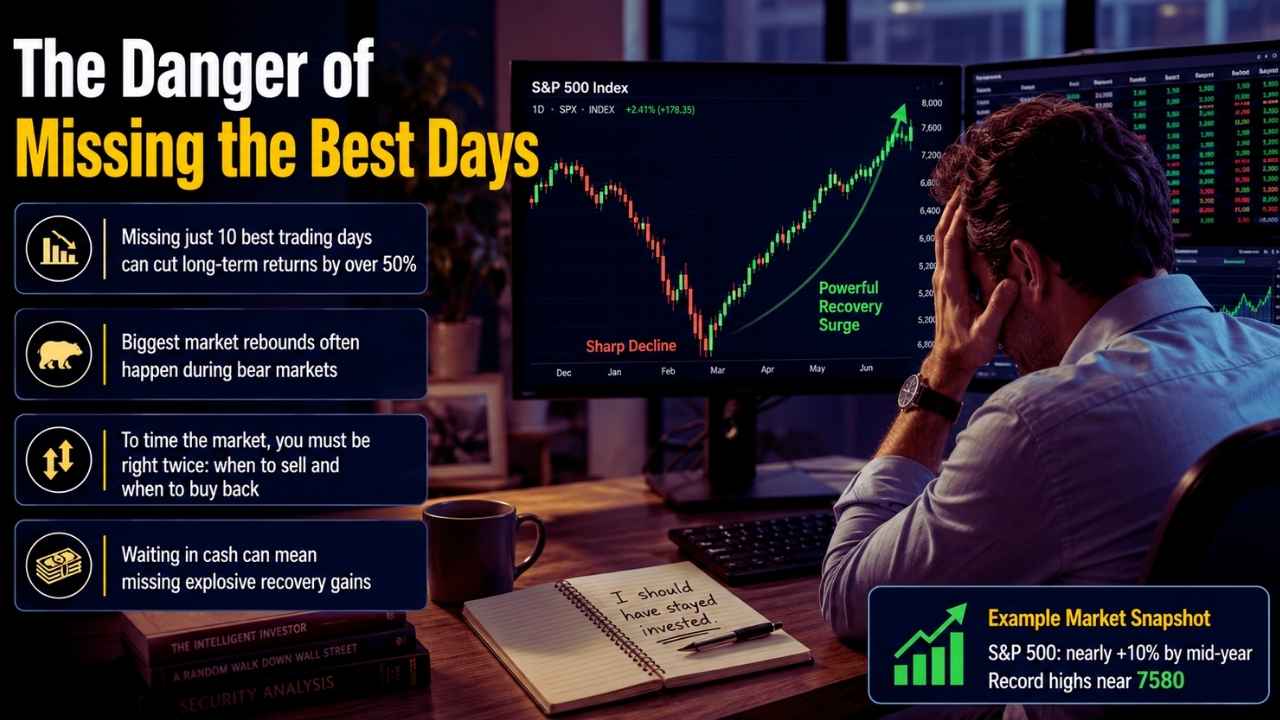
The actual devastating risk of timing the market is not taking a small, temporary loss during a minor correction. The real wealth killer is missing out on the massive, explosive days of market recovery that generate the bulk of historical returns. Look at the comprehensive 2026 market data, where the S&P 500 surged nearly ten percent by the middle of the year, smashing through record closing highs near 7580 points.
Investors who sat in cash waiting for a major geopolitical pullback missed an incredible wealth-building window driven by massive corporate earnings growth. Historical research confirms this brutal reality, showing that missing just the ten best trading days over a twenty-year period can easily cut your total portfolio returns by over fifty percent. The absolute wildest part of this data is that a huge majority of the stock market’s best single-day gains happen right in the middle of terrifying bear markets.
Stocks usually post their biggest upward surges right after the most brutal drops, punishing anyone who got scared and pulled their money out. To win this game, you have to be right twice by knowing exactly when to bail out and exactly when to buy back in, and almost nobody pulls that off consistently over a lifetime.
The Math and Psychology of Dollar Cost Averaging
If timing the market is a guaranteed recipe for failure, why do so many smart folks swear by dollar cost averaging? Let us stack it up against dumping all your money in at once to see the real truth.
|
Strategy Breakdown |
The Main Advantage |
The Biggest Drawback |
|
Dollar Cost Averaging |
Kills investor regret and automates excellent habits. |
Cash sits idle, missing out on some compounding growth. |
|
Lump-Sum Investing |
Maximizes time in the market for higher potential returns. |
Induces massive stress if the market immediately tanks. |
How DCA Protects Your Mindset?
Behavioral economists know deep down that human beings hate losing money vastly more than we love making it. The sharp pain of losing ten thousand dollars psychologically hurts about twice as much as the joy of gaining ten thousand dollars feels good. Imagine you inherit one hundred twenty thousand dollars, bravely decide to go all in, and invest the entire lump sum on a random Tuesday. Wednesday arrives, the global market unexpectedly drops ten percent, and you just watched twelve thousand dollars evaporate into thin air in twenty-four hours.
The severe mental blow from that single event might make you panic, sell everything to lock in your loss, and swear off investing in stocks forever. Dollar cost averaging acts like a heavy-duty shock absorber for your fragile human brain. Instead of risking the entire pile of cash at once, you invest ten thousand dollars a month for a full year. If the market suddenly tanks in month two, you do not panic at all.
You actually feel incredibly smug because next month’s ten thousand dollars will buy quality shares at a phenomenally steep discount. By shifting your perspective, DCA turns terrifying market crashes into exciting bargain-hunting opportunities and ensures you never get scared out of the game.
Lump Sum vs DCA: What the Latest Research Says
We have to be intellectually honest about the raw math behind these popular investing strategies. While dollar cost averaging keeps you completely sane during chaotic times, it mathematically loses out to lump-sum investing if you already hold a massive pile of cash. Stock markets generally trend upward over long periods of time, and historically, the S&P 500 posts positive overall returns in about seventy-four percent of calendar years.
Because the primary trend points aggressively up, sitting on a huge pile of cash means you are voluntarily missing out on compound growth. Research from major firms like Vanguard proves that putting all your money into the global markets immediately beats dollar cost averaging almost seventy percent of the time over a twelve-month period. The underlying logic is completely bulletproof: every single month your cash sits safely in a bank, it earns absolute pennies in interest while missing out on real stock market gains and dividend payouts.
However, you must remember this mathematical edge only matters if you actually have a large lump sum sitting in your checking account right now. For the vast majority of us who are simply investing a small slice of our bi-weekly paycheck, DCA is not a strategic choice but just the reality of how we live and earn. We cannot invest money we have not earned yet, making DCA the perfect default path to riches.
We simply cannot ignore what is actively happening in the world right now when discussing these topics. The 2026 market presents a weird, aggressive tug-of-war that makes market timing look incredibly tempting, yet exceptionally dangerous for your portfolio.
|
2026 Market Drivers |
What It Actually Means For Your Money |
|
Artificial Intelligence Boom |
Massive tech spending pushes 725 billion dollars into data centers. |
|
Infrastructure Explosion |
Power grids and cooling companies are crushing big tech returns. |
|
Global Geopolitical Tension |
Messes with delicate supply chains and triggers sudden market dips. |
|
Sticky Consumer Inflation |
Central banks delay rate cuts, keeping financial markets constantly on edge. |
The 725 Billion Dollar AI Boom
Investors face crazy mixed signals right now, but on one side, we are clearly living through an unprecedented technological spending boom. Analysts tracking the major players estimate that Big Tech companies like Microsoft, Amazon, Alphabet, and Meta will spend between 690 billion and 725 billion dollars this year alone just on artificial intelligence infrastructure. They are aggressively buying highly advanced chips, building massive data centers, and securing massive power grids like there is absolutely no tomorrow.
The real financial winners of this massive spending bonanza are not just the software companies, but the gritty infrastructure guys working behind the scenes. Energy providers, advanced cooling system manufacturers, and heavy industrial suppliers are quietly making an absolute fortune powering this AI revolution.
If you stubbornly sit in cash waiting for a broad macroeconomic dip to finally occur, you risk missing this massive AI infrastructure wave completely. The market continues to roar higher on the back of these historic capital expenditures, punishing anyone who refuses to participate.
The Macro Economic Threat
On the flip side of the coin, the big global picture still looks a bit sketchy and dangerous. Geopolitical fights and regional conflicts constantly cause severe supply shocks that ripple through the global economy. Energy prices randomly spike up without warning, squeezing our wallets at the gas pump and driving up the cost of shipping goods. That ugly dynamic keeps inflation incredibly sticky and prevents central banks from cutting interest rates as aggressively fast as Wall Street traders desperately want.
If you try to actively time this specific market environment, you will absolutely lose your mind and your money. Do you trade based on the unstoppable AI boom, or do you sell everything because of the looming inflation threat? Active market timers inevitably get chopped up trying to play both sides of this volatile coin.
Consistent dollar cost averaging investors just keep blindly buying through all the terrifying noise. They effortlessly catch the massive AI upside while automatically snagging the occasional geopolitical dip, proving once again that simple consistency beats complex prediction every single time.
Which Strategy Fits Your Financial Goals?
Winning at the long game of wealth building heavily requires knowing your own personality. You must pick a strategic path you will not abandon when things inevitably get incredibly ugly.
|
Who Are You? |
Your Best Strategic Move |
Why It Makes Absolute Sense |
|
Working a normal 9-to-5 job |
Dollar Cost Averaging |
Automates your paycheck and builds unshakeable investing discipline. |
|
Got a massive cash inheritance |
Immediate Lump Sum Investing |
Math completely proves this wins over ten years in a rising market. |
|
Terrified of losing a lump sum |
DCA over a six to twelve month period |
Buys you peace of mind so you never panic and sell at the bottom. |
|
Active Daily Stock Trader |
Timing the Market |
Brings high fees, high stress, and bad taxes. Do not do this for retirement. |
When DCA Makes Perfect Sense?
If you know you are prone to panic, dollar cost averaging is undeniably your absolute best friend. Raw math does not matter one bit if a sudden portfolio drop makes you sell everything at a devastating loss. You need a rock-solid strategy that lets you sleep peacefully at night without checking your phone every five minutes. If you just sold a piece of real estate or received a massive inheritance, and putting two hundred thousand dollars into the stock market tomorrow makes you physically nauseous, simply slice it up.
Invest twenty thousand dollars a month for ten consecutive months to ease your way into the financial waters. You willingly sacrifice a tiny bit of mathematical edge in exchange for massive, life-changing peace of mind. You practically guarantee you will not accidentally buy the absolute peak of the market with every single dollar you own.
Furthermore, DCA remains the only logical move for handling your regular, recurring monthly income. Set up a strict automatic transfer to move cash into your brokerage account exactly two days after every payday. You forcefully pay yourself first, and you make yourself buy valuable assets no matter what the scary news headlines say. It is undeniably the single best financial habit you can ever build for your family’s future.
When Lump Sum Beats Timing?
If you possess a remarkably strong stomach and truly understand how wealth is built, push your chips in right away. History aggressively proves that holding onto cash is a terrible long-term strategy for anyone trying to build real wealth.
Holding cash feels incredibly safe and comforting, but silent inflation quietly robs your purchasing power every single day you leave it sitting in a checking account. If you have money that you absolutely do not need to touch for the next ten to twenty years, get it fully invested into a broadly diversified index fund today. You must mentally expect the stock market to drop ten percent next week and fully embrace that temporary volatility as the price of admission.
As long as you absolutely refuse to panic-sell when the numbers turn red, a temporary dip means absolutely nothing on a multi-decade timeline. The market demands patience and rewards those who get their money working early and leave it completely alone to compound over time.
Final Thoughts
The ultimate verdict on market timing vs investing is crystal clear and completely undisputed by the data. For almost everyone walking the earth, getting out of your own way is the only reliable path to building generational wealth. Darting in and out of the stock market means you are actively fighting sophisticated supercomputers and your own worst psychological habits.
It is incredibly stressful, deeply exhausting, and decades of hard market data aggressively prove it fails. Miss just a tiny handful of the market’s best performing days, and you permanently cripple your financial returns forever. Dollar cost averaging powerfully takes your ego and your daily anxiety completely out of the mix.
You start acting like a disciplined owner of massive global businesses, rather than a guy playing roulette at a shady casino. Just buy a little bit every single month, rain or shine, and ignore the noise. Do not let the intense fear of a temporary dip keep you from achieving total financial freedom. Put your money to work, set the entire system on autopilot, and go live your life.
Frequently Asked Questions (FAQs) About Market Timing vs Investing
Does dollar cost averaging actually work during a severe economic recession?
Yes, it absolutely does. In fact, an economic recession is the exact environment where DCA does its absolute best wealth-building work. When the overall market tanks and stock prices crash, your fixed dollar amount automatically buys significantly more shares because everything is suddenly dirt cheap. Once the global economy eventually recovers and prices rise, that massive pile of cheap shares turbocharges your entire portfolio’s growth.
What if I just hold my cash and wait for a massive market crash to buy in?
You will almost certainly miss out on years of incredible financial gains. Market crashes are notoriously impossible to time perfectly, even for seasoned Wall Street professionals. If the stock market climbs forty percent while you wait safely in cash, and then finally drops twenty percent in a recession, you still end up buying at a significantly higher price than if you had just started investing on day one.
Is dollar cost averaging strictly a strategy for rookies and beginners?
Not even close. Massive global pension funds, university endowments, and incredibly wealthy institutional investors use systematic investing all the time to manage their capital. It completely removes dangerous human emotion from the daily equation, making it the smartest and safest way to deploy ongoing cash flow, regardless of whether your net worth is five thousand dollars or five billion dollars.
Should I temporarily pause my DCA contributions when stocks are actively tanking?
Never do this. Pausing your automatic contributions during a market crash completely defeats the entire purpose of the strategy. A terrifying market crash is the exact moment your hard-earned money buys the most shares for the lowest price. If you manually stop the process, you guarantee that you only buy when things are highly expensive and stubbornly refuse to buy when they finally go on sale.
If lump-sum investing mathematically wins, why do financial advisors still pitch DCA?
Smart financial advisors heavily pitch DCA to aggressively manage your fragile human brain, not just your math. It effectively reduces your “regret risk” and prevents you from making catastrophic emotional errors. If you drop a massive lump sum into the market and it violently crashes on Thursday, human nature makes you want to sell everything and run away forever. Spreading that money out over a full year keeps you comfortable enough to actually stay invested for the long haul.