


Nearly 88% of New Year’s resolutions crash and burn by mid-February. According to recent data from Fisher College and Ohio State, roughly 23% of people give up within the first seven days. By the end of January, 43% have completely quit, and only a tiny 9% actually see their goals through.
We constantly beat ourselves up, thinking we just lack discipline. We convince ourselves we need more motivation, a better attitude, or a brutal 5 AM wake-up call. But that massive failure rate has absolutely nothing to do with willpower. It comes down entirely to terrible system design.
James Clear’s bestseller Atomic Habits completely flipped this script. The book spent an insane 260 weeks on the New York Times best-seller list and sold over 25 million copies worldwide. Why? Because it actually works. If you want the core, actionable lessons without reading hundreds of pages, this atomic habits summary cuts straight to the chase. Real change doesn’t happen overnight. By making tiny, 1% adjustments to your daily routine, you build an environment where success happens automatically. Let’s break down the proven behavioral science and the four laws you need to master.
The Core Philosophy: Systems Over Goals
You don’t rise to the level of your goals; you fall to the level of your systems. A goal gives you a direction, but your system drives your actual daily progress. Think about it: both successful and unsuccessful people share the exact same goals. Every startup wants to hit a million in ARR, and every athlete wants a championship ring. The goal isn’t the magic differentiator. The daily system is.
According to 2025 research by behavioral scientist Amanda Rebar, up to 65% of our daily behaviors run entirely on autopilot. You are already running systems; you just haven’t designed them intentionally.
If you improve by just 1% every day, compounding makes you nearly 38 times better by the end of a single year. But the math works against you, too. Decline by 1% daily, and your skills drop to almost zero. The biggest trap we fall into is the “Plateau of Latent Potential.” Small changes feel completely useless at first. You might optimize your workflow for three weeks and see zero extra free time. You haven’t failed; you’re just storing potential. When you finally break through that plateau, everyone else will call you an overnight success.
|
Focus Area |
Outcome-Based Goals |
System-Based Habits |
|
The Target |
Hitting a final destination |
Perfecting the daily process |
|
The Mindset |
“I’ll be happy when I get there.” |
“I’m happy putting in the work today.” |
|
The Timeline |
A short-term finish line |
Lifelong, compounding growth |
|
The Pitfall |
The yo-yo effect after winning |
Consistent, sustained improvement |
Busting the 21-Day Myth: Real Data on Habit Formation
You’ve probably heard that it takes exactly 21 days to form a new habit. Forget it. That’s a total myth based on outdated cosmetic surgery observations from the 1960s. Real psychology tells a very different story.
A landmark study from University College London, backed by a massive 2024 meta-analysis by Singh et al., tracked real people building actual habits. The researchers found that new behaviors take a median of 59 to 66 days to lock into your brain. Depending on how complex the task is, it can take anywhere from 18 to 254 days. Drinking a glass of water every morning? That might take a few weeks. Blocking out all distractions to write 2,000 words a day? That might take eight months of grinding.
The data also revealed two massive advantages you can leverage right now. First, morning habits form significantly faster than afternoon routines because your morning environment is usually much more stable. Second, people who chose their own habits had a 37% higher success rate than those assigned a habit by someone else. Stop stressing over an imaginary three-week deadline and take ownership of your routine.
|
Habit Formation Fact |
The Popular Myth |
The Reality (2024-2026 Data) |
|
Average Time |
21 days |
59 to 66 days |
|
Maximum Time |
30 days |
Up to 254+ days for hard tasks |
|
Best Time of Day |
Doesn’t matter |
Mornings yield faster automaticity |
|
Autonomy Effect |
Doing what you’re told works |
Self-chosen habits succeed 37% more |
Atomic Habits Summary: Breaking Down the 4 Laws
Every habit you have runs on a tight, four-step neurological loop: cue, craving, response, and reward. A cue triggers your brain. The craving provides the drive. The response is the physical action you take. Finally, the reward satisfies your brain and hardwires the sequence for next time.
A truly practical atomic habits summary teaches you how to hack this loop. Clear turns this loop into a dead-simple framework called the Four Laws of Behavior Change. Make a behavior obvious, attractive, easy, and satisfying, and you’ll do it. Miss even one of those, and you’ll struggle.
|
Habit Loop Stage |
The Corresponding Law |
What It Actually Does |
|
Cue |
1. Make It Obvious |
Builds a clear, undeniable trigger |
|
Craving |
2. Make It Attractive |
Creates a strong, immediate desire |
|
Response |
3. Make It Easy |
Kills all physical and mental friction |
|
Reward |
4. Make It Satisfying |
Guarantees you’ll do it again |
Law 1: Make It Obvious (The Cue)
You can’t fix a bad habit if you don’t even realize you’re doing it. Most of us grab our phones the second we wake up without a single conscious thought. To build better routines, you have to wake up to your current reality. Grab a piece of paper and create a “Habits Scorecard.” Write down everything you do in a day. Just look at the raw data—don’t judge yourself.
Once you know your baseline, use “Implementation Intentions.” Vague goals like “I’ll exercise more” die on day two. You need a specific time and place. Researchers ran a test grouping people into those who relied on motivation versus those who wrote down exactly when and where they would work out. The motivation group succeeded only 35% of the time. The group that wrote down their plan succeeded a massive 91% of the time. Write down: “I will exercise for 20 minutes at 6 AM in my living room.”
My personal favorite tactic is “habit stacking.” You tie a new action to an existing, hardwired routine. The formula is: After [CURRENT HABIT], I will [NEW HABIT]. Try this: “After I pour my morning coffee, I will review my SEO rankings for exactly five minutes.”
|
The Tactic |
How It Works |
The Statistical Edge |
|
Habits Scorecard |
Tracking your daily actions |
Creates baseline awareness |
|
Implementation |
Setting a firm time and place |
Boosts success rates from 35% to 91% |
|
Habit Stacking |
Linking an old habit to a new one |
Bypasses the need for new triggers |
Law 2: Make It Attractive (The Craving)
Dopamine runs the show. Your brain actually releases more dopamine when you anticipate a reward than when you get it. If you want a tough habit to stick, you have to make it genuinely appealing.
Enter “Temptation Bundling.” Pair a task you need to do with one you want to do. Let’s say you need to read up on B2B SaaS growth metrics, but you’d rather listen to your favorite podcast. Bundle them: “I only get to listen to this podcast while I read industry reports.”
Culture also drives our cravings. We naturally copy our family, our tribe, and our mentors. Find a community where the habits you want are totally normal. If you want to level up your leadership skills, get in a room with high-performing founders. When everyone around you normalizes success, doing the hard work just feels like fitting in.
|
The Concept |
How It Works |
Everyday Application |
|
Temptation Bundling |
Pair a “want” with a “need” |
Watching Netflix only while on the treadmill |
|
Join a Tribe |
Surround yourself with winners |
Joining a founder mastermind group |
|
Reframing |
Focus on the gain, not the pain |
Viewing a workout as gaining energy |
Law 3: Make It Easy (The Response)
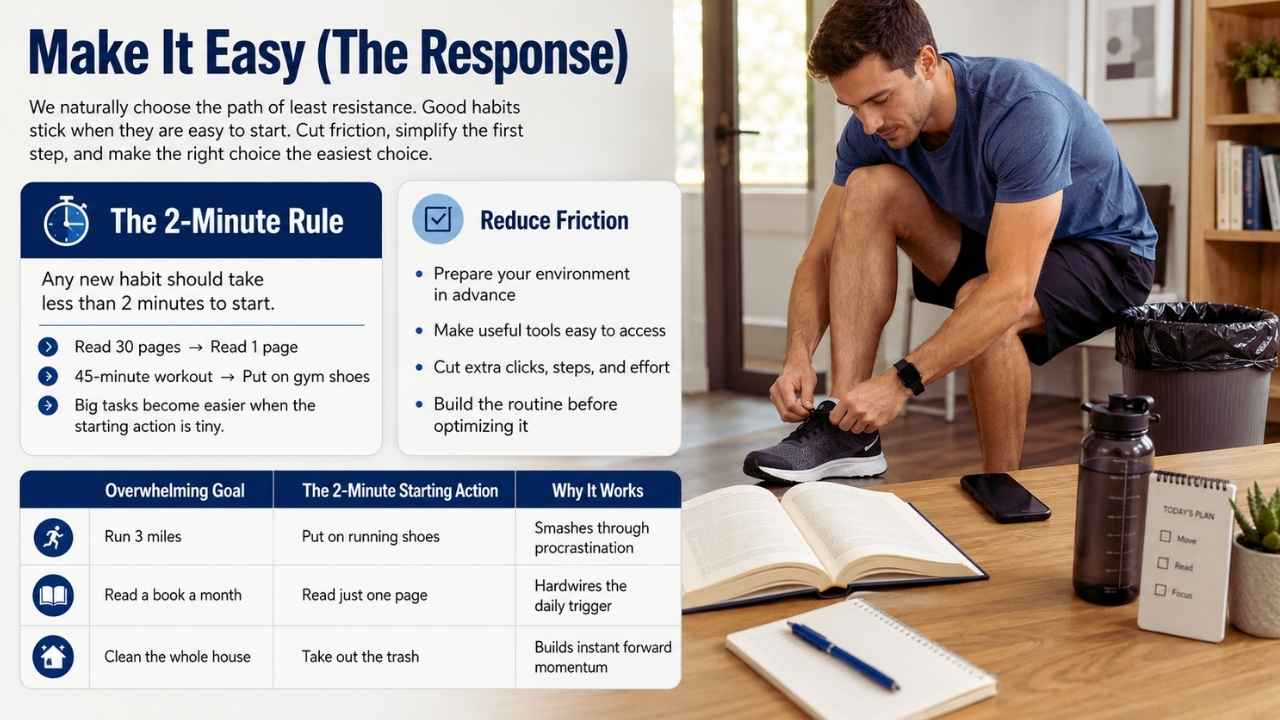
We are wired to be lazy. It’s human nature to pick the path of least resistance. Look at our digital behavior: the global average screen time is approaching seven hours a day, with Gen Z pushing past nine hours. Why? Because picking up a phone requires zero friction. To win, you must aggressively kill the friction standing between you and your good habits.
This is where the Two-Minute Rule completely changes the game. Any new habit must take under two minutes to start. “Read 30 pages” becomes “read one page.” “Do a 45-minute workout” becomes “put on my gym shoes.” You have to establish the routine before you can optimize it. Showing up is half the battle. Procrastination is a brick wall; the Two-Minute Rule is a sledgehammer.
Optimize your physical space. Make the right choice the easiest choice. Want your team to use a new project management tool? Integrate it directly into the Slack channels they already live in. Want to eat better? Chop your vegetables on Sunday. Cut down the clicks and steps required to do the right thing.
|
Overwhelming Goal |
The 2-Minute Starting Action |
Why It Works |
|
Run 3 miles |
Put on running shoes |
Smashes through procrastination |
|
Read a book a month |
Read just one page |
Hardwires the daily trigger |
|
Clean the whole house |
Take out the trash |
Builds instant forward momentum |
Law 4: Make It Satisfying (The Reward)
Good habits usually have a terrible delay on returns. You eat a salad today, but you don’t look fitter tomorrow. Bad habits? They pay out instantly. You eat a donut, and it tastes incredible right now.
To stick with the good stuff, you need to fake that immediate gratification. The habit tracking app market hit $1.7 billion in 2024 for a reason: humans love crossing things off lists. Checking off a day provides visual proof that you’re moving forward, giving your brain a quick dopamine hit.
And when you inevitably slip up, just follow the “Never Miss Twice” rule. University College London data proved that missing one day does zero damage to your long-term progress. It’s just a mistake. But missing two days in a row? That’s the start of a brand new, terrible habit. Reclaim your routine immediately the next day.
|
Reward Strategy |
How to Execute |
The Psychological Payoff |
|
Habit Tracking |
Mark an X on a physical calendar |
Visual proof of your consistency |
|
Instant Rewards |
Move $5 to savings when you skip coffee |
Immediate gratification for good choices |
|
Never Miss Twice |
Bounce back the very next day |
Stops a single mistake from becoming a relapse |
How to Break Bad Habits: Inverting the Rules?
Building good routines is only half the battle. You have to ruthlessly cut the bad habits draining your time. According to 2026 research from behavioral psychologist Wendy Wood, you cannot override bad habits purely with motivation. The only way to kill them is by changing your physical context. You do this by flipping the four laws upside down.
Make it invisible. If you waste hours scrolling on your phone while trying to write, leave the phone in another room. Out of sight genuinely means out of mind. Make it unattractive. Remind yourself how lethargic and awful you feel after binge-eating junk food.
Make it difficult. Crank up the friction. Use a website blocker on your laptop during your deep work hours. Finally, make it unsatisfying. Write up a habit contract. Tell your business partner you owe them $100 every time you miss a deadline. Knowing it will cost you cold, hard cash makes failing instantly painful.
|
The 4 Laws |
The Inversion |
Stopping the Junk Food Habit |
|
1. Make It Obvious |
Make It Invisible |
Get the snacks entirely out of your house |
|
2. Make It Attractive |
Make It Unattractive |
Focus on how bad a sugar crash feels |
|
3. Make It Easy |
Make It Difficult |
Only eat treats if you bake them from scratch |
|
4. Make It Satisfying |
Make It Unsatisfying |
Announce your diet goals publicly |
Advanced Tactics: Redesigning Your Identity
True behavior change goes way deeper than your actions; it shifts who you fundamentally believe you are. Clear talks about three layers of change: outcomes, processes, and identity.
Most people obsess over outcome-based habits (“I want to write a book”). Stop doing that. Focus on identity-based habits (“I am a writer”). When your actions match your identity, you don’t need willpower anymore. You just act like the person you already believe you are.
Every time you execute a habit, you cast a vote for your new identity. Every time you outline a piece of content, you cast a vote for being an editor. You don’t need a unanimous vote. You don’t have to be flawless. You just need the majority of votes to swing in your favor over time. Let your daily actions prove your new identity to yourself.
|
Layer of Change |
Where Your Focus Goes |
A Real-World Example |
|
Outcomes |
The final, physical result |
Losing 10 pounds |
|
Processes |
The daily actions you take |
Hitting the gym 3 days a week |
|
Identity |
Your core internal belief |
Identifying as an athlete |
Final Thoughts
Drop the exhausting overhauls. Forget the dramatic, sweeping life changes that rely on raw motivation. They fail 91% of the time because they rely on you being perfectly disciplined every single day. You don’t need more willpower; you need a smarter environment. Put your energy into making your daily actions obvious, attractive, easy, and satisfying.
This atomic habits summary is your blueprint. Stop stressing about where you’ll be in five years and start mastering the art of showing up today. Build the right systems, cast a vote for your new identity every single morning, and let the quiet power of compounding handle the heavy lifting.
Frequently Asked Questions (FAQs) About Atomic Habits Summary
When people look for a solid Atomic Habits summary, they often hit real-world roadblocks. Here are the straight answers to the trickiest habit questions, backed by recent clinical data.
Does the Two-Minute Rule actually work for hard skills like learning to code?
Absolutely. The point of the Two-Minute Rule isn’t to master Python in 120 seconds. The point is to kill the friction of starting. Once you sit down and write one line of code, momentum takes the wheel. You’ll probably keep going for an hour just because you finally got over the initial hump.
How do trackers work for neurodivergent folks, like those with ADHD?
Digital spreadsheets usually feel like awful homework assignments. High-impact, physical trackers work way better. Grab two jars. Put ten paperclips in one. Every time you finish a task, move a paperclip to the empty jar. The physical, visual movement gives you an instant dopamine rush without any digital friction.
Can I use implementation intentions for five habits at once?
Don’t even try it. Behavioral data shows your success rate plummets if you tackle multiple new routines simultaneously. Pick one habit. Lock it in for two months until it runs on autopilot. Only then should you move to the next one.
How do I handle conflicting cues in a home office?
If you work from home, your laptop means “focus,” but it also means “YouTube.” You have to split them up. Create a specific user profile on your machine strictly for work, and block all distracting sites. Use a completely different profile for messing around. Wendy Wood’s research proves that separating physical context is the only way to kill bad impulses. One context, one use.