

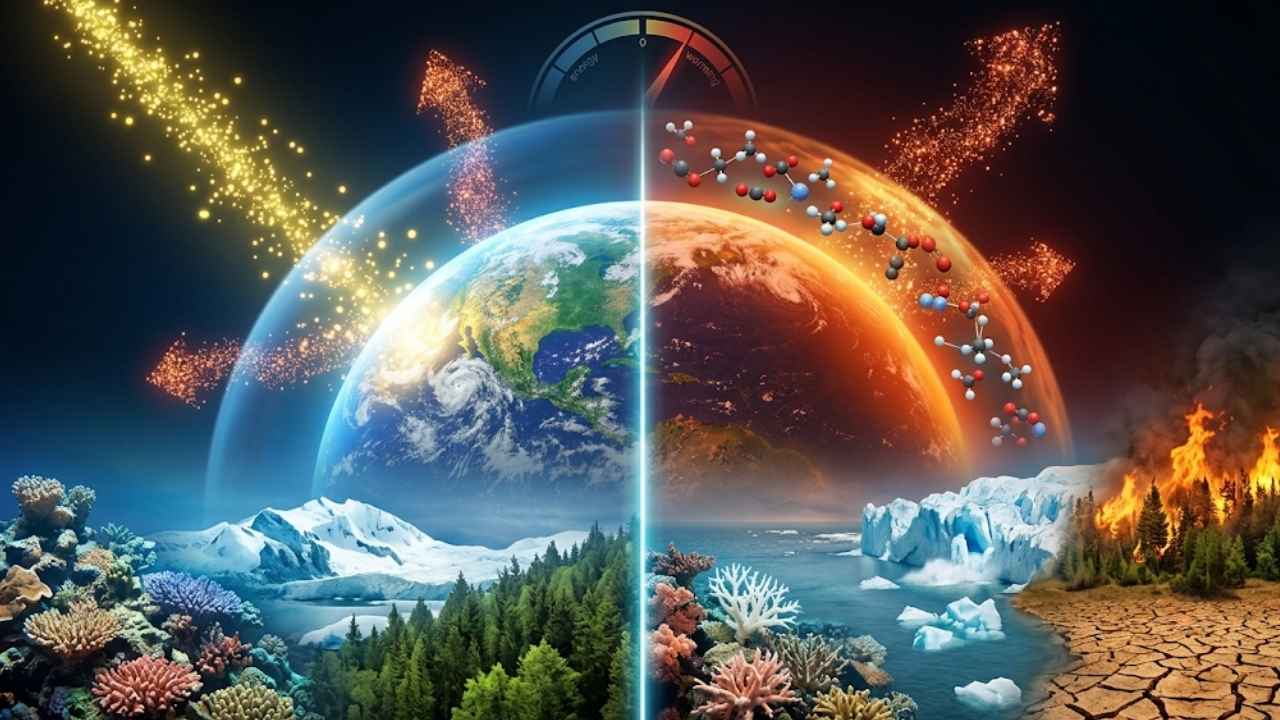
You see it on the news every single night. Record-breaking heatwaves baking entire continents, coastal towns desperately pumping out floodwaters, and wild, unpredictable swings in our seasonal weather patterns.
We are living through a massive global shift, but underneath the loud headlines and the endless political arguments, a fundamental physical process is driving the chaos. If we want to understand what is coming next, we need to bypass the noise entirely and look straight at the physics driving this planetary transformation.
If you are looking for climate change science explained, you are in exactly the right place. We are going to break down how Earth’s climate engine actually operates and why it is running hotter today than it has in millions of years. We will dive deep into the latest, verified data from 2025 and 2026 to see exactly where we stand as a species. No jargon, no hidden agendas—just the cold, hard facts about our rapidly warming world. Let’s strip away the confusion and look directly at the mechanics behind the heat.
The Core Mechanics Behind a Warming Planet
Solar Radiation and Atmospheric Transparency
To truly grasp why our planet is heating up, you first need to understand how sunlight interacts with the air we breathe. Every second of every day, the sun blasts massive amounts of energy across the vacuum of space, hitting the Earth primarily as visible light and ultraviolet radiation. Our atmosphere is a brilliant design; it acts like a giant, transparent window for this shortwave radiation.
The vast majority of this incoming solar energy passes right through the oxygen and nitrogen in our sky without hitting any resistance. When this light reaches the surface, our oceans, deep forests, and sprawling concrete cities absorb the energy, causing the physical surface of the planet to warm up naturally. Without this initial absorption, the Earth would be a barren, frozen rock hovering at an average temperature of zero degrees Fahrenheit, entirely hostile to human life.
The Exact Physics of the Greenhouse Effect
Once the surface of the Earth gets hot, it immediately tries to cool itself down by radiating that exact same energy back out toward the freezing void of space. However, it does not send the energy back out as visible light. Instead, the Earth radiates longwave infrared energy, which we feel as heat. This is where the entire system flips. Certain trace gases in our atmosphere have complex molecular structures that act like a one-way mirror.
They happily let the visible sunlight pass through, but they act like a solid brick wall for the outgoing infrared heat. When that heat tries to escape, molecules of carbon dioxide and methane absorb it, vibrate violently, and then shoot that thermal energy back in every direction—including straight back down to the ground. This physical mechanism traps heat close to the surface, creating the exact same sweltering effect you feel when you step into a closed car on a sunny summer afternoon.
The Unprecedented Rise in Heat-Trapping Gases
For thousands of years before the Industrial Revolution, the amount of these heat-trapping gases in our sky remained perfectly stable. Carbon dioxide hovered reliably around 280 parts per million, allowing the Earth to maintain a balanced, predictable climate that allowed human agriculture to flourish. But when we discovered how to dig up millions of years’ worth of ancient, stored carbon—in the form of coal, oil, and natural gas—and set it on fire to power our cities, we rapidly thickened that atmospheric blanket.
We are quite literally changing the chemical composition of the sky. By thickening this invisible blanket, we are forcing the Earth to trap far more heat than it can radiate back into space. The physics are entirely unforgiving; if you trap more energy in a closed system, the temperature of that system must rise.
|
Greenhouse Gas |
Primary Human Source |
Heat-Trapping Power (Compared to CO2) |
Current Trend Status |
|
Carbon Dioxide (CO2) |
Burning fossil fuels, massive global deforestation |
1x (The absolute baseline) |
Rising rapidly every year |
|
Methane (CH4) |
Agriculture, landfills, natural gas pipeline leaks |
~28x stronger over a 100-year period |
Accelerating due to agriculture |
|
Nitrous Oxide (N2O) |
Synthetic fertilizers, industrial chemical processes |
~265x stronger over a 100-year period |
Steady, concerning increase |
|
Fluorinated Gases |
Refrigeration systems, air conditioning coolants |
Up to 23,000x stronger |
Phasing out, but highly potent |
Climate Change Explained Science: The 2025–2026 Data Revolution
The Unprecedented Global Temperature Anomalies
People frequently ask how scientists can be so confident about global warming, and the answer lies entirely in the raw, verified data we collect every single day. The numbers from the last three years have completely shattered previous climate models. According to the European Copernicus Climate Change Service and the European Centre for Medium-Range Weather Forecasts (ECMWF), 2024 remains the hottest year ever documented in human history, hitting a shocking 1.60°C above pre-industrial levels.
Then came 2025, which clocked in as the third-hottest year on record at 1.47°C above the baseline. What makes this data truly alarming is the relentless consistency of the heat. The 2023–2025 timeframe marked the very first time in instrumental history that a three-year period averaged more than 1.5°C above the pre-industrial limit. This massive accumulation of thermal energy proves we are pushing the planet into completely uncharted territory.
The Keeling Curve 2026 Milestone
The most important scientific record we have for tracking the root cause of this heat is the Keeling Curve. Started in 1958 at the Mauna Loa Observatory high on a volcano in Hawaii, this instrument tracks the exact daily concentration of carbon dioxide in our atmosphere, far away from local city pollution. The curve shows a terrifying, relentless climb that ignores all political treaties and economic shifts. When the measurements began in 1958, CO2 sat at a relatively modest 315 parts per million.
Fast forward to May 2026, and scientists at the Scripps Institution of Oceanography reported that atmospheric CO2 reached an astonishing, record-breaking peak of 433.95 ppm. Thanks to ancient ice cores drilled miles deep into Antarctica, we know with absolute certainty that CO2 levels have not naturally crossed the 300 ppm threshold at any point in the last 800,000 years.
The Massive Accumulation of Ocean Heat
We often focus on air temperatures, but the true victims—and the real danger—lie in our global oceans. The world’s oceans are the ultimate climate shock absorbers, quietly absorbing more than 90% of the excess heat trapped by our greenhouse gas emissions over the last century. Without the oceans soaking up this thermal energy, the surface of the Earth would already be unlivable. But the oceans are finally reaching their physical limits.
Data from 2024 and 2025 shows that global sea surface temperatures have remained at historically catastrophic highs. This deep ocean warming acts like a massive thermal battery, storing heat that will eventually dictate extreme weather patterns for decades to come. Furthermore, this warm water physically expands as it heats up, driving aggressive sea level rise that directly threatens the existence of coastal communities from Miami to Mumbai.
|
Climate Measurement Tool |
What It Actually Tells Scientists |
Current Verified 2025/2026 Finding |
|
Ancient Ice Cores |
Historic CO2 levels and ancient global temperatures |
Current CO2 is the highest in at least 800,000 years. |
|
Copernicus Satellites |
Real-time global surface and atmospheric air temperatures |
The 2023-2025 average exceeded 1.5°C over historical levels. |
|
Ocean Buoy Networks |
Deep and surface ocean heat absorption capacity |
Sea surface temperatures hit absolute record highs recently. |
|
The Keeling Curve |
Daily atmospheric carbon dioxide concentration levels |
Peaked at nearly 434 ppm in May 2026 in Hawaii. |
Debunking the Natural Cycles Argument
Milankovitch Cycles vs Modern Emissions
Whenever you discuss the reality of a warming world, you will inevitably hear someone argue that the Earth’s climate has always changed naturally. They are entirely correct; the planet has gone through deep ice ages and sweltering hothouse periods long before the very first human walked upright. However, when you look deeply at climate change explained science, you quickly discover why these natural cycles cannot explain the violent warming happening right now.
Historically, massive climate shifts were driven by “Milankovitch cycles”—incredibly slow, subtle wobbles in Earth’s orbit around the sun that change how sunlight hits the northern hemisphere over tens of thousands of years. The explosive warming we are documenting today is happening over just a few short decades. Based purely on natural orbital cycles, the Earth should actually be in a very slow cooling phase right now. We have completely overpowered the natural orbital cycle with our industrial emissions.
Solar Activity and Atmospheric Signatures
Another common myth is that the sun itself is simply burning hotter, naturally raising the temperature of the Earth. This sounds logical at first, but the physics completely destroy the argument. If solar output were genuinely increasing, we would see warming throughout every single layer of our atmosphere, from the ground all the way up to the edge of space.
Instead, advanced satellites measure intense warming in the lower atmosphere (the troposphere) while simultaneously documenting that the upper atmosphere (the stratosphere) is actually cooling down. This is the precise, undeniable physical signature you expect from greenhouse gases trapping heat near the surface and actively blocking it from radiating out into the higher altitudes. If the sun were the culprit, the entire sky would be hot.
Volcanoes vs Human Industrial Output
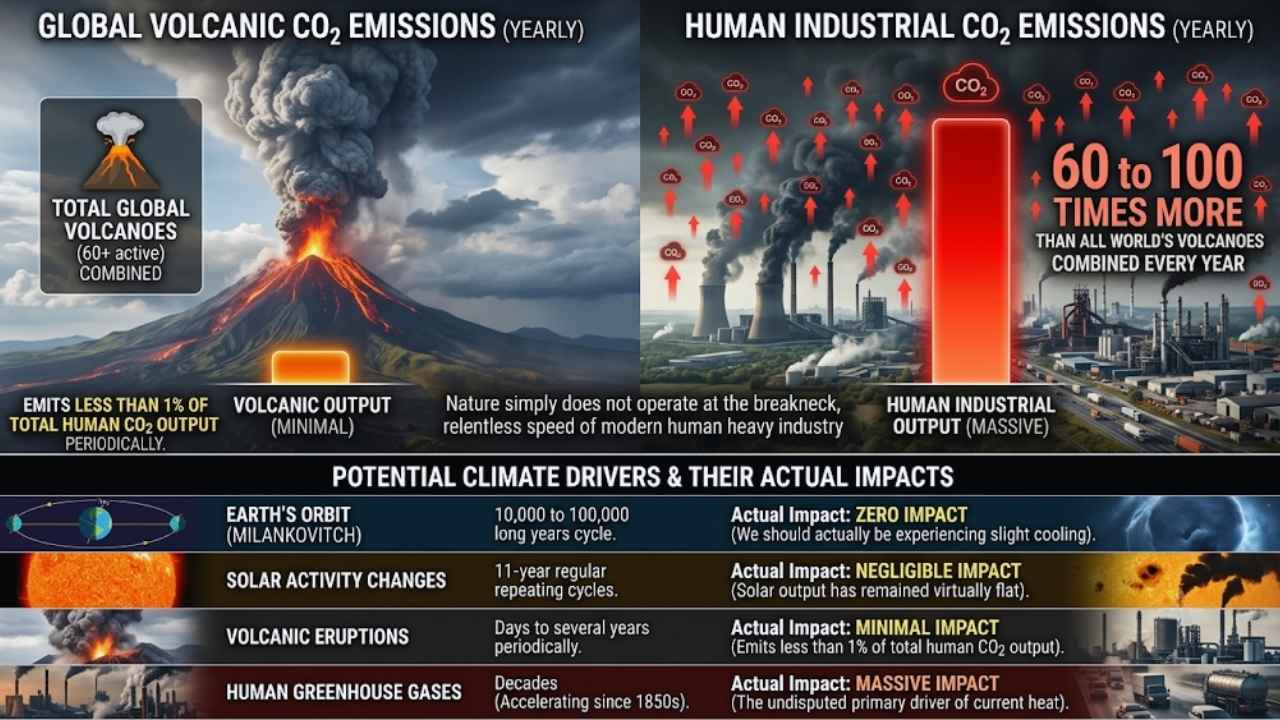
Volcanoes are the final, popular scapegoat for climate skeptics. The argument suggests that a single massive volcanic eruption pumps more carbon dioxide into the atmosphere than humans ever could. While it is true that massive eruptions do release CO2, the mathematical reality simply does not support the claim. According to global geological surveys, human activities emit roughly 60 to 100 times more carbon dioxide every single year than all the world’s volcanoes combined.
You would need the equivalent of hundreds of Mount St. Helens erupting simultaneously every single day to match what our global economy pumps out through coal plants, tailpipes, and industrial manufacturing. Nature simply does not operate at the breakneck, relentless speed of modern human heavy industry.
|
Potential Climate Driver |
Typical Natural Cycle Timeframe |
Actual Impact on Current Global Warming Spike |
|
Earth’s Orbit (Milankovitch) |
10,000 to 100,000 long years |
Zero impact (We should actually be experiencing slight cooling). |
|
Solar Activity Changes |
11-year regular repeating cycles |
Negligible impact (Solar output has remained virtually flat). |
|
Volcanic Eruptions |
Days to several years periodically |
Minimal impact (Emits less than 1% of total human CO2 output). |
|
Human Greenhouse Gases |
Decades (Accelerating since 1850s) |
Massive impact (The undisputed primary driver of current heat). |
Real-World Impacts Happening Right Now
Extreme Weather and Altered Precipitation
This crisis is no longer an abstract problem reserved for future generations or polar bears; the physics of a hotter atmosphere are aggressively altering our daily lives, destroying infrastructure, and disrupting the global economy right now. A warmer atmosphere inherently holds significantly more moisture. For every single degree Celsius increase in global temperature, the air can hold about 7% more water vapor.
The physics are remarkably simple: what goes up must eventually come down. When it rains now, the total volume of water is massively higher, leading to catastrophic flash floods that completely overwhelm urban drainage systems that were designed for mild, 20th-century weather patterns. We are seeing cities from Dubai to New York completely paralyzed by sudden, biblical downpours that the concrete infrastructure simply cannot swallow.
Ocean Expansion and Coastal Threats
As the atmosphere traps heat and transfers it to the oceans, we face a dual threat regarding global sea levels. First, as we mentioned earlier, hot water physically takes up more space than cold water through a process called thermal expansion. Second, this extreme atmospheric heat is relentlessly melting the massive, miles-thick ice sheets sitting on top of Greenland and Antarctica. When this land-based ice melts, it dumps trillions of gallons of completely new water directly into the ocean.
The combination of thermal expansion and glacial melt is driving sea levels up faster every single decade. Coastal cities are already dealing with routine “nuisance flooding” during high tides, where ocean water bubbles up through street drains on perfectly sunny days. More dangerously, this rising saltwater is actively intruding into underground freshwater aquifers, threatening the drinking water supply for millions of people living near the coasts.
Ecosystem Collapse and Agricultural Disruption
On land, hotter temperatures evaporate moisture from the soil much faster than normal. This brutal evaporation turns standard dry spells into severe, prolonged flash droughts that bake the earth until it cracks. This creates perfect tinderboxes for aggressive wildfires that burn hotter and move faster than historical fires, devastating communities and destroying massive swaths of timber. For our food supply, this is a nightmare scenario.
Crops require stable temperatures and predictable rainfall to yield enough food to feed eight billion people. Shifting growing seasons, sudden deep freezes caused by a destabilized jet stream, and brutal summer heatwaves are destroying crop yields globally. This disruption directly drives up food prices at the grocery store, creating economic instability that hits the poorest nations the absolute hardest.
|
Impact Category |
Real-World Physical Consequence |
Economic and Human Cost of the Disruption |
|
Extreme Weather Events |
Heavier atmospheric rainfall, stronger hurricanes |
Billions lost in destroyed infrastructure and lives. |
|
Sea Level Rise |
Coastal erosion, saltwater intrusion into aquifers |
Forced relocation of vulnerable coastal communities. |
|
Ocean Acidification |
Changing water chemistry, dead coral reefs |
Complete devastation of commercial fishing industries. |
|
Agricultural Disruption |
Shifting growing seasons, severe flash droughts |
Soaring grocery prices and deep global food instability. |
The Tipping Points and Feedback Loops
Arctic Permafrost Thawing Rapidly
One of the most terrifying aspects of our current trajectory is the activation of global feedback loops. These are vicious cycles where the initial effects of warming actually trigger natural biological processes that release even more greenhouse gases, putting the whole climate system on fast-forward. The most pressing example is the Arctic permafrost. Millions of square miles of frozen ground in the far north hold absolutely massive amounts of ancient, dead plant and animal matter.
Because it has been frozen solid for millennia, this organic material never decomposed. But as the Arctic warms four times faster than the rest of the planet, this permafrost is thawing. As it thaws, bacteria finally begin to eat that organic matter, burping out massive plumes of methane—a greenhouse gas that is roughly 28 times stronger than CO2 at trapping heat. We warm the planet, the permafrost melts, it releases methane, and the planet warms even faster.
The Amazon and Carbon Sink Weakening
Historically, the Earth’s natural systems—like the vast Amazon rainforest and massive ocean algae blooms—absorbed about half of the carbon we threw into the sky. We call these life-saving systems “carbon sinks.” But recent data shows that the global land carbon sink is under massive, unprecedented stress. As tropical ecosystems bake in record heat and suffer through deliberate deforestation, they risk flipping entirely from absorbing carbon to emitting it.
When a massive section of the Amazon burns in a wildfire driven by drought, it doesn’t just stop absorbing CO2; it instantly releases decades of stored carbon back into the atmosphere in a matter of days. If we lose the Amazon as a carbon sink, we lose one of our greatest natural defenses against runaway atmospheric heating, making it infinitely harder to stabilize the global temperature.
The Devastating Ice Albedo Effect
The ice albedo feedback loop is another massive physical mechanism accelerating our crisis. “Albedo” simply refers to how reflective a surface is. Pure white sea ice in the Arctic acts like a giant mirror for the Earth, reflecting up to 80% of incoming solar radiation directly back into space without it ever warming the planet. However, as greenhouse gases warm the Earth, that highly reflective sea ice melts away, exposing the deep, dark ocean water underneath.
Dark ocean water absorbs roughly 90% of the sunlight that hits it. Therefore, as the ice melts, the Earth absorbs more heat, which warms the water further, which melts even more ice the following year. It is a runaway physical loop that is radically altering the entire energy balance of the northern hemisphere, driving weird weather patterns far beyond the Arctic Circle.
|
Major Feedback Loop |
The Physical Climate Mechanism |
The Resulting Danger to Global Stability |
|
Arctic Permafrost |
Thawing soil releases ancient trapped methane gas |
Massive, unstoppable acceleration of atmospheric warming. |
|
Tropical Forests |
Heat and drought trigger massive, fast-moving wildfires |
Forests burn, releasing decades of stored CO2 instantly. |
|
Ice Albedo Effect |
Melting white ice exposes dark, heat-absorbing ocean |
The Earth loses its mirror, absorbing much more heat. |
|
Ocean Stratification |
Hot surface water blocks deep ocean nutrient mixing |
Kills marine life, reducing the ocean’s ability to trap carbon. |
Global Solutions and the Path Forward
Decarbonizing the Energy Grid Immediately
The situation is incredibly serious, but we absolutely possess the tools to stabilize it. Because we understand the exact mechanics causing the problem, we know the precise mechanics required to fix it. We have to stop pulling carbon out of the dirt and throwing it into the sky. The immediate transition to renewable energy is the cornerstone of human survival over the next century. The good news is that economics are finally on our side.
Solar and wind power generation are now significantly cheaper than building new coal and gas plants in almost every major market on Earth. We are also seeing exponential, rapid growth in grid-scale battery storage technology. These massive battery banks effectively solve the old intermittency problem, allowing us to store excess solar power generated at noon to keep the lights on long after the sun goes down.
Electrifying Transportation Globally
Next, we have to completely change how we move people and goods around the planet. Traditional internal combustion engines are terribly inefficient machines, losing the vast majority of their energy as useless heat and loud noise. Electric vehicles, on the other hand, convert battery power directly into forward motion with incredible efficiency. Shifting to EVs rapidly eliminates the localized air pollution that chokes modern cities and slashes global oil demand.
When we combine a fully electrified transportation sector with a clean, renewable energy grid, we instantly kill the fastest-growing sector of global emissions. Furthermore, investing heavily in electrified mass public transit, like high-speed rail, can move millions of people daily with a fraction of the carbon footprint required by a highway packed with individual gas-powered cars.
Urban Adaptation and Green Infrastructure
While we aggressively cut emissions to prevent the worst possible future outcomes, we must also adapt our immediate surroundings to the warming that is already locked into the physical system. Cities, which currently account for roughly 70% of global greenhouse gas emissions, are finally stepping up to the challenge. Urban planners are completely rethinking modern infrastructure to handle the new extremes.
We are seeing major metropolises converting traditional, impermeable concrete roadways into porous surfaces and temporary drainage channels during extreme flash floods to prevent massive property destruction. Planting millions of urban trees dramatically lowers the “heat island” effect, saving lives during brutal summer heatwaves. We have to redesign our habitats to survive the weather of the 21st century while we fight to keep the 22nd century livable.
|
Solution Strategy |
Required Immediate Action |
Direct Impact on the Climate Crisis |
|
Clean Energy Grid |
Rapidly scale solar, wind, and next-gen battery storage |
Decarbonizes the baseline foundation of the entire economy. |
|
Transportation Shift |
Mandate EV adoption and expand mass public transit |
Eliminates localized air pollution and slashes fossil fuel demand. |
|
Urban Adaptation |
Redesign city infrastructure for massive flood control |
Protects human life and billions in property during storms. |
|
Land Management |
Halt global deforestation and practice regenerative farming |
Turns the Earth’s damaged soil back into a massive carbon sink. |
Final Thoughts
When you pull back the curtain on climate change-explained science, the entire narrative shifts immediately from stressful political posturing to undeniable, straightforward physics. We are actively digging up millions of years of ancient, stored carbon, setting it on fire, and wrapping our fragile planet in an ever-thickening thermal blanket. The data from deep ocean buoys, ancient ice cores, and orbital satellites all scream the exact same reality.
The hurdles we face in the coming decades are monumental—ranging from relentless extreme weather events to violently shifting agricultural belts that threaten our food supply. But the solutions are sitting right in front of us, ready to be deployed. We have the technology, the capital, and the precise scientific understanding to power modern human civilization without destroying the fragile atmospheric balance that makes our lives possible. The data is settled, and the physics are clear. Now, it is entirely a matter of human execution.
Frequently Asked Questions (FAQs) About the Climate Crisis
Does a La Niña year mean global warming finally stopped?
Absolutely not. La Niña is just a natural ocean cycle that pulls cooler water up to the surface in the Pacific Ocean. This action drops the global average temperature slightly for a year or so. However, 2025 featured weak La Niña conditions and it still went down as the third-hottest year in recorded human history. The massive, underlying greenhouse warming trend easily crushes these temporary natural dips. The background heat is simply too strong now.
If the Arctic melts, will sea levels rise and flood our cities?
It entirely depends on which ice you are talking about. Sea ice floating in the Arctic Ocean is already taking up physical space in the water. When it melts, sea levels do not change—just like a melting ice cube does not overflow your drink. But when land-based ice melts (like the massive, miles-thick glaciers sitting on top of Greenland and Antarctica), that adds entirely new water to the ocean basin. That specific melting is what drives dangerous, unstoppable sea level rise.
Can we just build giant machines to suck the CO2 out of the sky?
Direct air capture technology is a real thing, but it is definitely not a magic wand that fixes our mistakes overnight. Right now, it takes massive amounts of energy and astronomical amounts of money to run these machines at scale. Think of it like trying to bail out a rapidly sinking boat with a coffee mug while a firehose is still blasting water into the hull. We have to turn off the firehose (by cutting our emissions) before the mug (carbon capture) can do any real, measurable good for the atmosphere.