

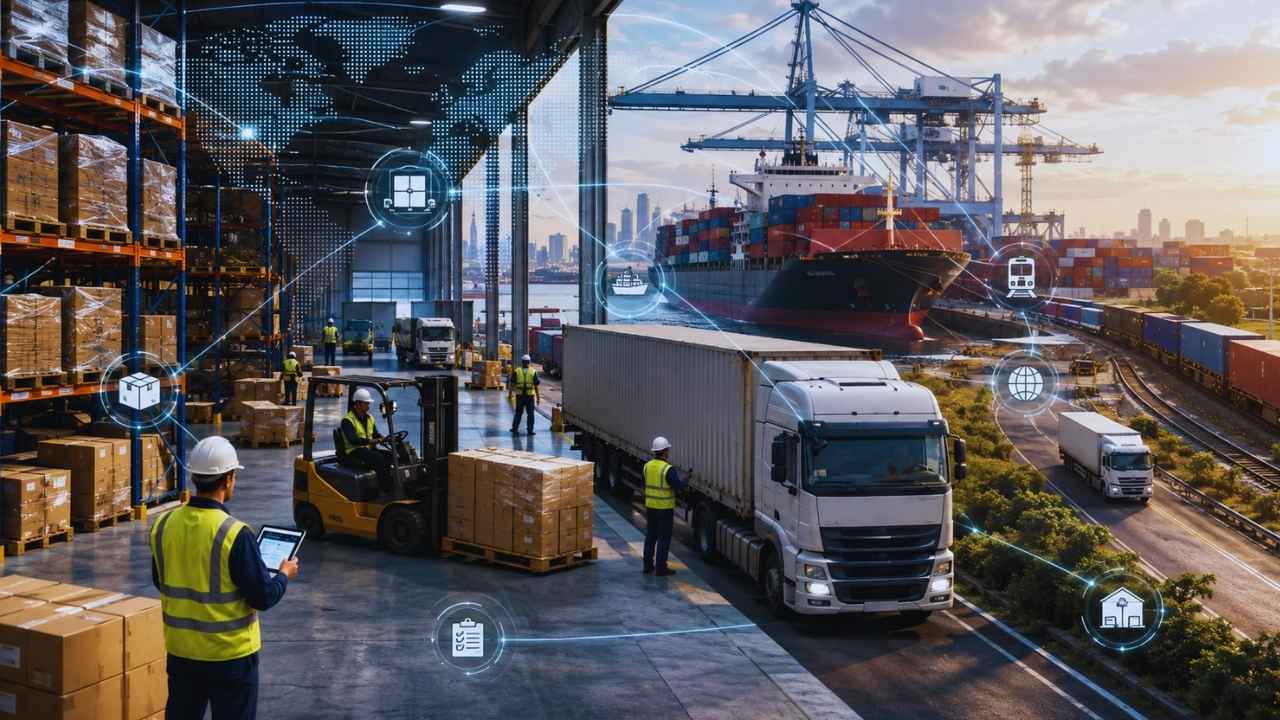
You hit “Buy Now” on a Tuesday night. By Thursday afternoon, a cardboard box is sitting on your porch. It feels like magic, right? But there is absolutely zero wizardry happening here. Behind that insanely fast delivery sits a massive, highly coordinated global machine. Getting a product from a raw idea in a sketchbook to your actual front door takes serious planning.
Brands have to negotiate prices, build components, and ship materials across multiple continents before you even see an ad for the item. If you want to understand the exact mechanics of this global system, you need to know how supply chain management works. It is the invisible backbone of modern business. When it runs smoothly, you just get what you ordered and never think twice about it.
When it breaks, the global economy stalls, shipping containers pile up at ports, and your local store shelves sit completely empty. Let’s ditch the boring corporate jargon and textbook definitions. We are going to look at the actual steps, strategies, and digital systems companies use right now to keep their physical products moving. Plus, we will dive into real-time 2026 data to show you exactly where the logistics industry spends its cash and faces its biggest hurdles.
The SCOR Model: How Supply Chain Management Works Step-by-Step
At its core, managing a supply chain just means controlling the flow of goods, data, and money from the very beginning to the very end. It starts when a brand buys raw materials and finishes when you unbox the final retail product in your living room. To keep this incredibly complex process organized, logistics professionals use something called the Supply Chain Operations Reference model, commonly known as the SCOR model. Think of it as a standard playbook that massive corporations and small businesses alike use to measure their performance.
Recently updated to the SCOR Digital Standard, it treats the whole process as a continuous loop rather than a straight line. Managers rely on this exact framework to find out where they are losing money, how to speed up factory production, and why deliveries might be running late. By breaking down millions of moving parts into six distinct phases, companies can pinpoint errors before they spiral out of control. Understanding these phases is the absolute best way to see the daily grind of the industry.
|
SCOR Phase |
Main Goal |
Daily Tasks |
Final Output |
|
1. Plan |
Balance supply with demand |
Demand forecasting, inventory checks |
Master production schedule |
|
2. Source |
Secure raw materials |
Vendor selection, price haggling |
Signed contracts, raw goods |
|
3. Make |
Build the actual product |
Assembly, quality tests, packaging |
Finished retail products |
|
4. Deliver |
Move products to buyers |
Warehousing, transport, fulfillment |
Delivered customer orders |
|
5. Return |
Handle unwanted items |
Defect tracking, refunds, recycling |
Processed returns, restocked items |
|
6. Enable |
Support the whole system |
IT support, HR, compliance tracking |
Smooth overall operations |
Planning and Demand Forecasting
Before buying a single piece of plastic or steel, managers have to guess what you will actually buy. We call this demand planning. Brands look at past sales, market trends, and even the weather to figure out how many units they need. Guess too high, and they waste money storing unsold junk. Guess too low, and they hand sales straight to competitors. The goal is to keep just enough safety stock on hand without freezing up all the company’s cash.
Sourcing and Procurement
Once a brand knows what to build, it needs suppliers. This step goes way beyond scoring the cheapest price. Smart logistics managers look at the big picture. Can this factory crank out more units if a social media video makes the product go viral? Are their labor practices ethical? Do their delivery trucks show up on time? Vendor relationships absolutely make or break a business.
Manufacturing and Transforming Goods
This is the phase where things actually get built. A factory takes steel, glass, and lithium and builds a smartphone. Managers track production speeds and test for quality control. Time is literally money here. They watch the lead time—the total time from placing an order to getting the finished product. A single delay on the assembly line messes up the rest of the chain.
Delivery and Order Fulfillment
Logistics is the muscle of the operation. It covers everything from storing boxes in giant warehouses to loading them onto cargo ships, freight trains, and delivery vans. Moving boxes effectively is exactly where companies lose or save the most money. It requires intense scheduling and route planning.
Handling Returns (Reverse Logistics)
You buy a shirt, hate the fit, and send it back. Now, the whole system runs backward. The company takes the item, inspects it, issues your refund, and decides if it goes back on the rack or into the trash. It is a messy, expensive process, but bad return policies destroy customer trust instantly.
Essential Business Strategies Keeping the Chain Moving
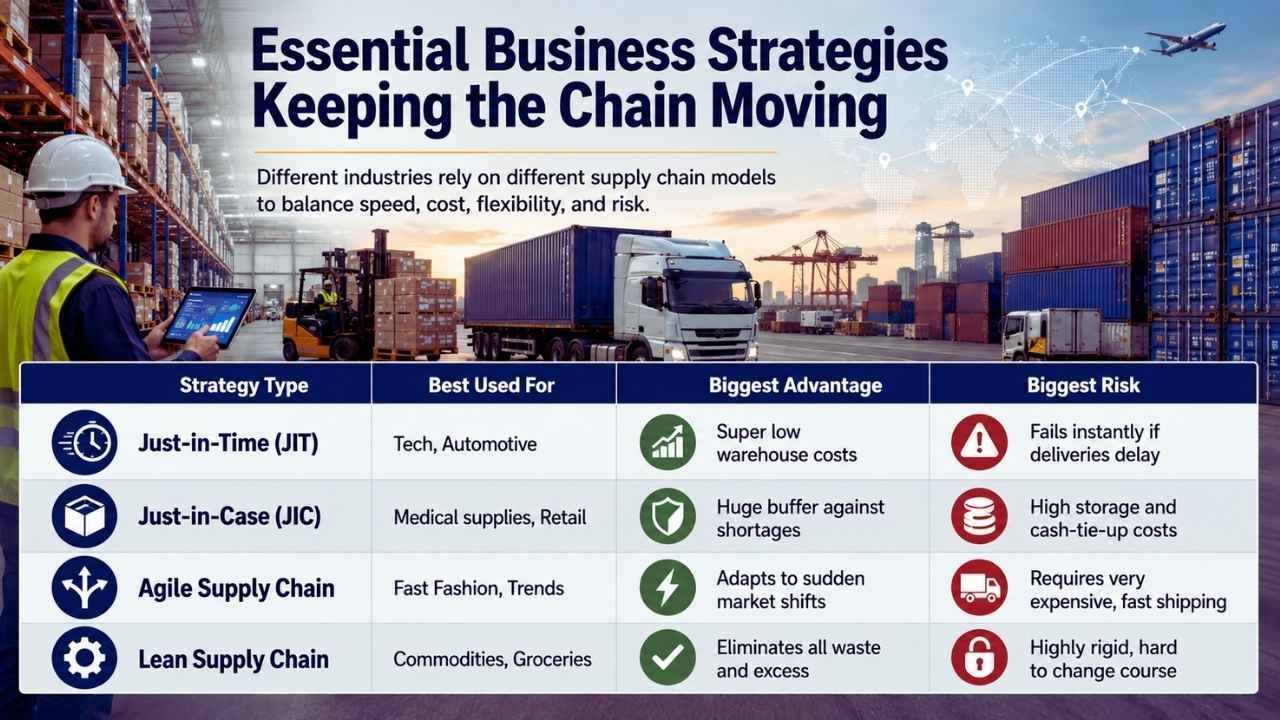
Different brands need completely different things out of their logistics network to survive. A local grocery store needs extreme speed and temperature control so their apples do not rot on the truck. Meanwhile, a luxury Swiss watchmaker needs intense security, precision, and low-volume handling to protect their high-end goods. Seeing these distinct differences helps explain exactly how supply chain management works across various competitive fields. Companies must choose a strategy that perfectly aligns with their customer expectations and their cash flow limits.
Some brands want to save money by keeping their warehouses completely empty until the last possible second. Others prefer to spend heavily on massive storage facilities just to ensure they never run out of stock during a crisis. Every single choice carries a unique financial risk. If a brand picks the wrong strategy, they can easily bankrupt themselves by tying up all their cash in unsold inventory or losing furious customers because of constant backorders.
|
Strategy Type |
Best Used For |
Biggest Advantage |
Biggest Risk |
|
Just-in-Time (JIT) |
Tech, Automotive |
Super low warehouse costs |
Fails instantly if deliveries delay |
|
Just-in-Case (JIC) |
Medical supplies, Retail |
Huge buffer against shortages |
High storage and cash-tie-up costs |
|
Agile Supply Chain |
Fast Fashion, Trends |
Adapts to sudden market shifts |
Requires very expensive, fast shipping |
|
Lean Supply Chain |
Commodities, Groceries |
Eliminates all waste and excess |
Highly rigid, hard to change course |
The Just-in-Time Method
Toyota perfected this model decades ago. Instead of keeping a warehouse stuffed with spare parts, they get parts dropped off exactly when the assembly line needs them. It saves a fortune on storage rent. The catch? If a snowstorm delays a single delivery truck, the whole factory shuts down because they have zero backup inventory.
Nearshoring and Friendshoring
For a long time, brands relied on single factories overseas because labor was cheap. After massive shipping nightmares a few years ago, smart companies changed their tune. Now, they practice nearshoring—moving production closer to home. Think of a US brand moving its manufacturing from Asia to Mexico. They also friendshore, buying materials from politically allied countries to dodge sudden tariffs and trade wars.
The Bullwhip Effect
Hang around logistics folks long enough, and you will hear about the bullwhip effect. Think about cracking a whip. A tiny flick of your wrist creates a huge wave at the end. In retail, a tiny bump in sales causes massive overproduction at the factory. If a store sells 10 extra laptops, the manager orders 20 just to be safe. The distributor sees the spike and orders 50. Soon, the factory is building 100 laptops. Good managers use shared data to stop this panic buying.
Technology and Data Driving Modern Logistics
Clipboards, physical spreadsheets, and manual phone calls are completely dead in the modern logistics world. Custom software and artificial intelligence completely changed how supply chain management works from the ground up over the last five years. Today, tracking data accurately matters just as much as moving the physical cargo itself. The global logistics software market is exploding at an unprecedented rate, heavily driven by the sudden need for digital automation and complete visibility.
According to Fortune Business Insights, the global supply chain management market is projected to hit nearly $32.9 billion in 2026, and could expand to over $72.8 billion by 2034. Brands realize that if they cannot see exactly where their cargo ships and delivery trucks are in real-time, they will lose millions of dollars to inefficiencies. Cloud-based platforms now dominate the industry, giving executives the power to make instant decisions from their laptops. Artificial intelligence steps in to crunch numbers faster than any human, predicting exactly what you want to buy before you even log into a website.
|
Technology Type |
How Brands Use It |
The Real-World Benefit |
|
AI & Predictive Analytics |
Forecasting demand, routing trucks |
Cuts shipping times, avoids stockouts |
|
Cloud-Based ERP Systems |
Centralizing business data |
Connects finance, HR, and warehouse teams |
|
RFID & IoT Sensors |
Tracking containers and pallets |
Real-time location and temperature alerts |
|
Robotics & Automation |
Warehouse picking, sorting boxes |
Speeds up fulfillment, lowers labor costs |
Cloud Systems and AI
Companies spend billions on cloud-based Enterprise Resource Planning (ERP) systems. The cloud segment is expected to hold over 64 percent of the market share in 2026. These platforms use artificial intelligence to look at your search history and seasonal trends. Amazon literally moves products to a warehouse near your house before you even hit checkout. That is exactly how you get a blender delivered in four hours.
RFID Tags and Smart Sensors
Shipping expensive medicine? You cannot let it get warm. Brands drop smart Internet of Things (IoT) sensors and RFID tags into shipping containers. If the temperature spikes by a single degree, a manager gets an alert on their phone halfway across the world. They fix the cooling unit before the goods spoil. Using RFID tech pushes inventory tracking accuracy through the roof.
The Rise of Control Towers
Because supply chains are scattered everywhere, huge brands build control towers. It is not an actual building out on a runway. It is a massive digital dashboard. Managers see every truck, ship, and warehouse on one screen. If they spot a delayed ship in the Pacific, they can instantly reroute domestic trucks to cover the missing stock on the shelves.
Overcoming Global Disruptions and Bottlenecks
A supply chain is only ever as strong as its absolute weakest link, and we have all seen what happens when those links suddenly snap. Managers spend a massive chunk of their day putting out literal and metaphorical fires while dodging global disasters. From sudden factory bankruptcies to massive labor strikes at shipping ports, the threats to physical inventory are constant and incredibly expensive. Geography heavily dictates logistics, meaning a single drought in a major canal can force ships to take a three-week detour around an entire continent.
Climate change now forces brands to redraw their shipping maps constantly, using predictive software to dodge hurricanes and flooded highways. Furthermore, political tensions mean tariffs can spike overnight, instantly ruining a brand’s profit margins if they rely on just one country for manufacturing. Smart companies survive these bottlenecks by diversifying their factory locations, investing in green logistics, and constantly monitoring global news feeds for early warning signs of trouble.
|
Common Bottleneck |
The Impact on Business |
How Companies Fix It Today |
|
Supplier Bankruptcy |
Sudden halt in raw materials |
Multi-sourcing (having backup factories) |
|
Climate & Weather Events |
Ports close, roads flood |
Predictive AI, instantly rerouting ships |
|
Geopolitical Tariffs |
Sudden spikes in import costs |
Nearshoring, shifting factory locations |
|
Labor Shortages |
Trains and trucks stop moving |
Automating warehouses, offering better pay |
Chokepoints and Geography
Look at a map. A huge chunk of global trade squeezes through tiny strips of water, like the Suez or Panama Canals. When droughts drop water levels or conflicts block a route, the global economy bleeds billions daily. Geography dictates logistics entirely, and smart brands always map out backup routes just in case a major port suddenly shuts down.
Green Logistics and ESG
Shoppers care about the planet, and laws are getting stricter. Let’s face it, shipping is a dirty business. Cargo ships burn nasty fuel, and cardboard creates mountains of waste. Now, brands track their Environmental, Social, and Governance (ESG) scores closely. They swap single-use cardboard for reusable plastic totes. It saves money in the long run and keeps eco-conscious buyers happy.
The Role of Third-Party Logistics and Last-Mile Delivery
Most retail brands absolutely do not own the delivery trucks that pull up to your house, nor do they own the massive warehouses holding their inventory. They hire outside experts to do all the heavy lifting so they can focus purely on marketing and product design. If you truly want to know the secret behind your favorite online clothing store, you need to look deeply at outsourced logistics providers. These third-party companies process the orders, pack the boxes, print the shipping labels, and hand the packages over to national couriers.
This specific handoff leads to the most notoriously difficult and expensive phase of the entire journey, famously known as last-mile delivery. Getting a massive cargo container holding ten thousand televisions across the Pacific Ocean is surprisingly cheap and easy. Getting just one of those televisions from a local distribution center to your specific front porch is a total logistical nightmare. Traffic jams, incorrect addresses, aggressive dogs, and porch pirates make this final step incredibly costly for everyone involved.
|
Logistics Provider |
What They Actually Do |
Who Uses Them |
|
1PL (First Party) |
You make it and ship it yourself |
Local bakeries, small farms |
|
2PL (Second Party) |
Owns the transport (ships, planes) |
Freight airlines, major shipping lines |
|
3PL (Third Party) |
Stores and ships goods for you |
E-commerce brands, mid-size retailers |
|
4PL (Fourth Party) |
Manages 3PLs and your whole strategy |
Massive global enterprise corporations |
What is a 3PL?
A 3PL handles the physical heavy lifting. You ship your bulk shirts to their warehouse. When a customer buys one on your site, the 3PL packs and ships it. A 4PL takes it further. They do not just move boxes; they run your whole logistics strategy, hiring the 3PLs and negotiating freight rates.
The Brutal Last Mile Problem
Shipping a container across the ocean is the cheap, easy part. The last mile—getting a package from a local warehouse to your specific front door—is a total nightmare. Traffic jams, wrong addresses, and porch pirates make this step incredibly expensive. Believe it or not, last-mile delivery eats up an incredible 53 percent of total shipping costs. Brands pour massive amounts of money into routing software just to shave a few pennies off this final trip.
Final Thoughts
The days of making a product and just hoping it finds a shelf are long gone. Understanding how supply chain management works means understanding how the modern world actually survives. It is a high-stakes balancing act of speed, cost, and constant risk.
Whether a brand uses AI to predict winter trends or reroutes ships to dodge a storm, the goal never changes. They want to get the right product, to the right place, at the right time, without going broke. The next time a package lands on your doorstep two days after you bought it, take a second. Appreciate the thousands of miles, hundreds of hands, and complex data networks that made it happen.
Frequently Asked Questions (FAQs) About How Supply Chain Management Works
What is the Global Supply Chain Pressure Index?
If you want to know how stressed the global shipping system is on any given day, you look at this index. Financial experts and economists use it to measure the intensity of disruptions across worldwide trade networks. It tracks specific data points like delivery times, port backlogs, and raw freight costs. When the index spikes, it means ports are completely clogged and shipping costs are about to skyrocket for everyday consumers.
How does “affreightment” work in shipping?
This sounds like an ancient legal term, and it basically is. Affreightment is simply the formal process of chartering a massive cargo vessel to ship your goods across the ocean. When a massive enterprise needs to move thousands of containers, they do not just buy a standard shipping ticket. They sign a contract of affreightment with a shipowner. This contract rents out the vessel’s space and dictates exactly how and when the physical cargo moves.
What is a blanket waybill versus an invoice?
An invoice is just a standard financial bill showing what you bought and what you owe. A blanket waybill is a critical legal document issued by the actual carrier moving the goods. It acts as a master receipt and a strict contract of carriage. It provides every single detail about the shipment, the physical route, and the cargo itself. This ensures customs agents and dock workers know exactly what sits inside those locked metal containers.
How do brands tackle physical warehouse bottlenecks?
Warehouse traffic jams completely destroy delivery schedules. To fix this, managers have to get aggressive before a truck ever backs into the loading dock. They conduct hyper-accurate inventory counts, pre-stage packages based on exact delivery routes, and meticulously calculate the maximum load capacity of every single vehicle. If a manager accidentally overloads a delivery truck or miscalculates the route schedule, the entire daily operation quickly collapses.