


You flip on the financial news, and the headlines are always the same. A tech giant buys out a promising artificial intelligence startup. Two massive airlines decide to team up to control more routes. Reporters usually lump these events together under the catch-all acronym M&A, which stands for Mergers and Acquisitions. Because we constantly hear them grouped together, it is incredibly easy to assume they mean the exact same thing.
They do not. If you peel back the public relations spin and look closely at the boardroom power dynamics, the legal paperwork, and the stock market fallout, they are completely different beasts. Understanding the merger vs acquisition dynamic helps you make sense of massive market shifts. It explains why your portfolio suddenly dropped or why your employer’s culture radically changed overnight.
Corporate dealmaking is a massive industry. Data shows global deal values hit nearly five trillion dollars in 2025. Trillions of dollars change hands every year in these corporate marriages. Yet, oddly enough, deep research notes that up to 90 percent of them fail to create any actual value for shareholders. Let us cut the jargon entirely. We are going to break down exactly what sets these two corporate maneuvers apart, how they happen in the real world, and why companies risk billions trying to pull them off.
The Core Difference: Merger vs Acquisition
Let’s get straight to the point. The main difference comes down to power and survival. In the corporate world, true equality almost never exists. One company usually holds more cash, a bigger market share, or a stronger strategic advantage. A merger happens when two companies of roughly the same size decide they are better off joining forces. Instead of fighting each other for customers, they combine their assets, staff, and debts to build a brand-new business.
This requires brutal negotiation. Both sides have to compromise on leadership, branding, and long-term goals. An acquisition is a straight-up purchase. One company buys another, and the buying company swallows the target whole. The smaller company usually vanishes as an independent legal entity. The buyer dictates the terms, controls the board of directors, and owns the assets.
While the phrase implies equal options, true mergers almost never happen. Most deals you read about are acquisitions hiding behind polite press releases. Nobody wants to admit they got taken over by a rival. Chief executives routinely frame acquisitions as a merger of equals to save face, protect egos, and keep employees from panicking.
|
Feature |
Merger |
Acquisition |
|
Power Dynamic |
A negotiated marriage of equals. |
The buyer calls the shots. |
|
Corporate Identity |
A brand-new company is born. |
The buyer swallows the target. |
|
Stock Status |
Old shares swap for new company stock. |
Target’s stock dies; bought out for cash or stock. |
|
Management |
A blended mix of both executive teams. |
The buyer’s management takes full control. |
|
Public Vibe |
Seen as a cooperative, mutual move. |
Often viewed as a takeover. |
What Actually Happens in a Merger?
When a genuine merger goes down, it takes months or even years of secretive talks. Because both sides sit on equal footing, the details get sticky quickly. Executives must figure out who gets to be the chief executive, where the new headquarters will sit, and what they will name the new company. Lawyers and investment bankers spend thousands of hours arguing over these details before the public even hears a rumor.
Financially, a merger typically relies on a stock swap to make the math work. The stock tickers for the original companies disappear from the stock exchange completely. Shareholders of both original companies receive shares of the newly minted company based on a pre-determined valuation ratio. A classic example is the historic union of Exxon and Mobil.
Valued at tens of billions of dollars, these two oil giants realized they could crush the global energy market if they stopped fighting each other. They pooled their massive infrastructure to form a new global heavyweight. You can only pull off that kind of strategic tear-down in a true merger. When two companies truly merge, they dissolve their old identities to build a shared future from the ground up.
|
Merger Type |
How It Works |
Real-World Example |
|
Horizontal |
Direct competitors combine to dominate a market. |
Exxon and Mobil forming ExxonMobil. |
|
Vertical |
A company merges with its supplier or distributor. |
An automaker merging with a battery plant. |
|
Market Extension |
Similar companies in different markets join up. |
A US bank merging with a European bank. |
|
Product Extension |
Companies selling related products combine. |
A toothbrush brand merging with a toothpaste brand. |
|
Conglomerate |
Two entirely unrelated businesses merge. |
A media network merging with real estate. |
How Acquisitions Really Work?
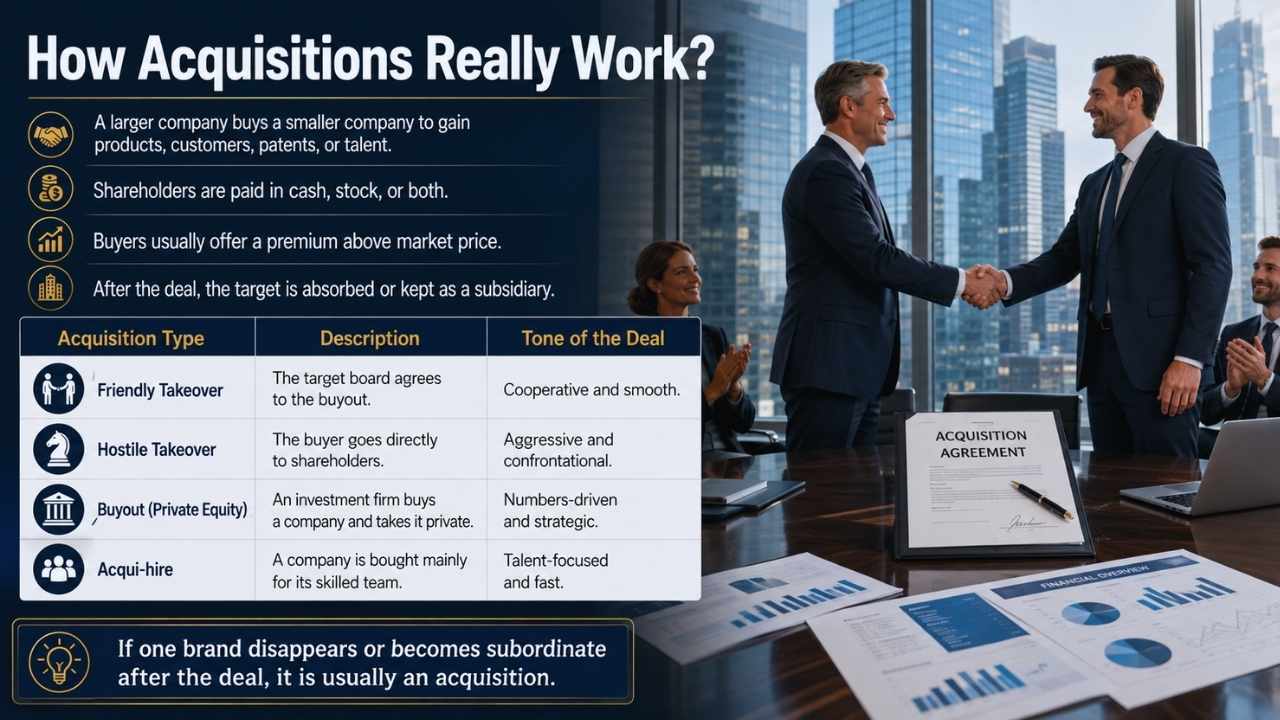
Acquisitions are vastly more common, and they happen much faster than mergers. A large corporation spots a smaller company that has something it desperately needs. It could be a killer product, a loyal customer base, or a specific patent that blocks competitors. In an acquisition, the buyer writes a check directly to the target company’s shareholders. They pay in cold hard cash, their own stock, or a mix of both to get the deal done.
To convince the target’s shareholders to sell, the buyer has to offer a premium price notably higher than what the stock trades for on the open market. Once the deal clears, the target company belongs entirely to the buyer. Often, the buyer kills the target’s brand name entirely and rolls the products into its own catalog. Other times, if the brand holds massive consumer trust, they keep it running as a subsidiary.
Look at Microsoft’s massive purchase of Activision Blizzard, which gave them total control over massive video games. If one brand vanishes or completely bows to the other a year later, you are looking at an acquisition. The acquiring firm always absorbs the smaller fish.
|
Acquisition Type |
Description |
Tone of the Deal |
|
Friendly Takeover |
The target’s board agrees to the buyout and smiles for the cameras. |
Cooperative and smooth. |
|
Hostile Takeover |
The buyer bypasses the board and goes straight to shareholders. |
Aggressive and nasty. |
|
Buyout (Private Equity) |
An investment firm buys a public company to take it private. |
Cold and numbers-driven. |
|
Acqui-hire |
Buying a company just to hire its talented staff. |
Talent-focused and fast. |
2025 Global M&A Statistics and Market Trends
Why do companies push for these deals despite the crazy risks? You have to look at the sheer scale of the global market to understand the motivation. Private equity cash, shifting interest rates, and the fear of falling behind fuel the fire. According to PitchBook’s 2026 Annual Global M&A Report, 2025 was an absolute monster of a year. Deal volume neared a staggering five trillion dollars across more than fifty thousand transactions globally. Megadeals valued over one billion dollars drove the vast majority of the market.
Technology completely rules the space right now. Tech deals, specifically artificial intelligence, cybersecurity, and cloud infrastructure, dominated the high-end market. Legacy companies are terrified that AI will put them out of business. Instead of spending years building their own tech, they just buy startups that already figured it out. But here is the harsh reality you rarely hear on earnings calls.
Between 70 percent and 90 percent of these deals fail to create shareholder value. Executives consistently overestimate the financial perks and vastly underestimate how hard it is to blend two different company cultures together. Companies keep chasing these deals because the fear of irrelevance outweighs the fear of failure.
|
M&A Metric |
Recent Data / Statistic |
What It Means for the Market |
|
Global Deal Value (2025) |
Nearly $5 Trillion |
Deal volume smashed records despite a shaky economy. |
|
Total Transactions (2025) |
Over 50,000 |
Tens of thousands of companies changed hands. |
|
Megadeal Impact |
Over 50% of global value |
Deals over $1B drove the vast majority of the market. |
|
Top Sector Trends |
Tech & AI dominance |
Buyers desperately bought up AI and software. |
|
Historical Failure Rate |
70% to 90% |
Most deals fail to make shareholders any richer. |
The Strategy: Why Companies Combine Forces?
Boards do not approve billion-dollar buyouts just for the thrill of it. Executives have to prove the deal makes clear financial sense to their shareholders. The most common buzzword you hear during these deals is synergy, which sounds great on an earnings call. But let’s be honest, synergy is usually just corporate slang for firing people and cutting redundant costs. If two regional banks merge, they do not need two human resources departments, two accounting teams, or two finance chiefs.
By cutting those duplicate jobs and closing overlapping branches, the new company instantly boosts its profit margins. Speed is another massive driver in the modern business landscape. Imagine a traditional retail bank wants to launch a sleek financial application for younger customers. They could spend five years and hundreds of millions of dollars trying to build it from scratch.
Or, they could just buy a Silicon Valley startup that already has a working app and a million users. Buying innovation is almost always faster, and often cheaper, than building it internally. Corporate leaders know that buying their way into a new market is a shortcut to instant relevance.
|
Strategic Goal |
The Motivation |
The Harsh Reality |
|
Synergy (Cost Cutting) |
Combining departments to save money and boost profits. |
Usually means heavy layoffs in HR, IT, and legal. |
|
Market Share Expansion |
Buying a competitor to steal their customers. |
Reduces consumer choice and hikes prices. |
|
Buying Innovation |
Cheaper to buy a tech startup than build it. |
Startups often lose their edge under corporate rules. |
|
Diversification |
Expanding into new industries to lower risk. |
Complicates management and dilutes the brand. |
The Financial and Cultural Impact on Stakeholders
The ripple effects of a corporate buyout hit absolutely everyone involved. Shareholders obsessively watch their portfolios while executives negotiate their golden parachutes. Employees worry about their jobs, and customers pray their prices do not go up. The stock market reaction perfectly highlights the reality of these massive transactions. When a company announces it is getting bought, its stock price almost always shoots up immediately.
If a target’s stock sits at fifty dollars, the buyer might offer sixty-five dollars a share to convince the board to sell. The open market instantly adjusts the target’s stock price up near that higher mark. Conversely, the buying company’s stock often drops significantly. Wall Street knows that integrating two companies is incredibly hard and incredibly expensive. Investors punish the buyer’s stock because they assume the chief executive overpaid for the target.
Then you have the cultural impact, which is infinitely harder to manage. You can merge two balance sheets flawlessly on a spreadsheet, but merging human beings is a lot messier. When a fast-moving tech startup gets acquired by a slow corporation, the startup team usually hates the new bureaucracy.
|
Stakeholder Group |
Typical Impact |
Why It Happens |
|
Target Shareholders |
Usually make an immediate profit. |
The buyer pays a premium to force the sale. |
|
Buyer Shareholders |
Stock often dips in the short term. |
Acquisitions drain cash, add debt, and carry huge risks. |
|
Employees |
High anxiety, layoffs, culture clashes. |
Management slashes jobs to pay for the deal. |
|
Customers |
Potential price hikes or bad service. |
Less competition means companies don’t have to try as hard. |
Common Reasons Why Deals Fail?
If most deals fail to deliver their promised value, you have to wonder what goes wrong. It rarely has to do with the initial math presented by the investment bankers. It almost always comes down to ego, bad planning, and human error during the integration phase. The most famous disaster is the AOL and Time Warner deal back in the early two thousands. It was supposed to marry old media television with new media internet platforms.
It failed miserably because the aggressive AOL executives violently clashed with the conservative Time Warner executives. They fought over everything from email platforms to marketing budgets. The cultures never meshed, the bubble burst, and the deal destroyed billions in shareholder value. Another major trap is the winner’s curse, where a buyer gets caught in a bidding war and pays way too much.
When they finally take control, they realize the target company can never generate enough revenue to justify the massive price tag. Poor technology integration also ruins deals, causing lost orders, crashed software, and angry customers. A deal that looks perfect on paper can easily fall apart in the real world.
|
Failure Point |
Description |
Example / Outcome |
|
Culture Clash |
Employees from both sides refuse to work together. |
The disastrous AOL and Time Warner merger. |
|
Overpaying |
The buyer gets caught in a bidding war and pays too much. |
Stock tanks; massive write-downs occur years later. |
|
Bad Integration |
Failing to merge IT systems and customer data. |
Lost orders, crashed software, and angry customers. |
|
Lost Focus |
Management spends all their time on the merger. |
Competitors steal market share while the boss is distracted. |
Legal and Regulatory Hurdles
You cannot just buy your biggest competitor whenever you feel like it. The government will step in and stop you to protect the market. If companies get too big, they form monopolies that hurt everyday consumers. Monopolies hurt consumers by driving up prices, stifling wages, and killing overall innovation. Before any mega-deal goes through, antitrust regulators rip it apart to look for red flags. In the United States, the Federal Trade Commission and the Department of Justice handle this heavy lifting.
They analyze the market to see if the new company will hold too much pricing power. If a massive soda company tried to buy its only rival tomorrow, the government would laugh them out of the room. That deal would give one company near-total control over the market, leaving consumers with no choices.
Even if a deal is not a total monopoly, regulators will still force companies to sell off certain assets before approving the transaction. Globally, the European Commission is notoriously ruthless with American tech giants. Navigating these legal hurdles takes years and costs millions of dollars in lawyer fees.
|
Regulatory Body |
Jurisdiction |
Primary Goal in M&A |
|
Federal Trade Commission (FTC) |
United States |
Stops anti-competitive business practices. |
|
Department of Justice (DOJ) |
United States |
Sues to block deals that create illegal monopolies. |
|
European Commission (EC) |
European Union |
Reviews EU deals; famously strict on big tech. |
|
CFIUS |
United States |
Reviews foreign investments for national security threats. |
Final Thoughts
The business world moves insanely fast. Corporate giants constantly look for ways to grow their footprint, crush their rivals, and invent entirely new markets. While the media uses M&A as a lazy catch-all term, knowing the reality of a merger vs acquisition gives you a massive advantage. You start to see the business world clearly and can predict market moves before they happen.
A true merger is a rare, complex blending of two equals building a shared future from the ground up. An acquisition is a straightforward buyout. Sometimes it is friendly, sometimes it is hostile, but it always ends with one company completely swallowing the other.
Whether it results in a brilliant team-up like Disney and Marvel, or a toxic culture clash like AOL and Time Warner, these mega-deals reshape the products we buy, the apps we use, and the economy we live in. Next time a massive deal hits the news, look past the public relations spin. Just wait a few months and see whose name actually stays on the building.
Frequently Asked Questions (FAQs) About Merger vs Acquisition
What happens to a company’s debt during an acquisition?
When a buyer buys a company, they buy its baggage right along with it. If the target has one hundred million dollars in debt, the acquiring firm now has to pay it off. This is exactly why buyers ruthlessly audit a target’s books during the due diligence phase to make sure they know what they are walking into.
Can a smaller company acquire a much larger one?
Yes, though it is incredibly rare to see in the wild. Finance professionals call it a Pac-Man defense or a reverse takeover. A smaller, highly profitable company borrows a massive mountain of money to buy out a larger, struggling competitor before the competitor can strike first.
What is a reverse termination fee?
It is a brutal penalty clause written into the contracts. If the buyer backs out of the deal—or if regulators block it entirely—the buyer has to pay the target company a massive fee. We are talking hundreds of millions of dollars to compensate the target for wasting their time and disrupting their business operations.
Do employees get severance if they are laid off after a deal?
Usually, yes, they do receive compensation. When a buyer cuts redundant jobs, they typically offer standard severance packages to avoid massive lawsuits and terrible press coverage. In hostile takeovers, top executives often have golden parachute clauses that guarantee them millions of dollars if they get fired.