If you look at a map of Europe, you see a patchwork of independent, historically distinct countries. Yet, if you travel there, you’ll notice invisible borders, a shared currency in many places, and a collective political weight that rivals the world’s biggest superpowers. Grasping how the European Union works is essential for anyone interested in global politics, economics, or even just planning a long-term trip across the continent.
It’s an intricate balancing act between preserving national identity and building a unified powerhouse. Instead of acting completely alone, these nations decided that sharing a marketplace and a common rulebook was a much smarter way to thrive in the modern world.
What Exactly Is the EU?
To put it simply, the EU is a highly integrated political and economic partnership made up of 27 sovereign European nations. It is not a single federal country like the United States, but it also goes far beyond a simple free-trade agreement like NAFTA. Political scientists call this a “supranational organization,” meaning the member countries voluntarily pool parts of their sovereignty.
They agree to be bound by shared laws and decisions made by central institutions in areas like trade, agriculture, and environmental protection. This setup allows countries like Italy and Spain to maintain their unique languages, governments, and cultures while presenting a massive, unified front on the global stage. By working together, they form a market of nearly 450 million consumers, giving them immense leverage in international negotiations.
|
Aspect of the EU |
Description |
|
Classification |
Supranational political and economic union |
|
Total Members |
27 Sovereign Nations |
|
Combined Population |
Approximately 450 Million Citizens |
|
Global Influence |
Acts as a single, massive economic bloc in global trade |
Why Was the European Union Created?
You really can’t understand the modern system without looking back at the ashes of World War II. After decades of devastating conflicts that repeatedly tore the continent apart, European leaders desperately needed a way to guarantee lasting peace. In 1950, figures like Robert Schuman proposed a radical idea: if historic rivals France and Germany combined their coal and steel industries—the raw materials needed to wage war—they could make future conflicts physically and economically impossible.
What started in 1952 as a small pact between six countries (Belgium, France, Germany, Italy, Luxembourg, and the Netherlands) proved incredibly successful. Over the decades, this coal and steel community expanded its focus to include a broader common market, eventually transforming into the robust political and economic union we recognize today.
|
Historical Milestone |
Significance |
|
1952: Coal & Steel Community |
Tied the war industries of six nations together to ensure peace. |
|
1957: Treaty of Rome |
Created the European Economic Community for broader trade. |
|
1993: Maastricht Treaty |
Officially established the modern EU and set the stage for the Euro. |
|
2004: Massive Expansion |
Brought in ten new countries, mostly from Eastern Europe. |
The Core Pillars: Key EU Institutions Explained
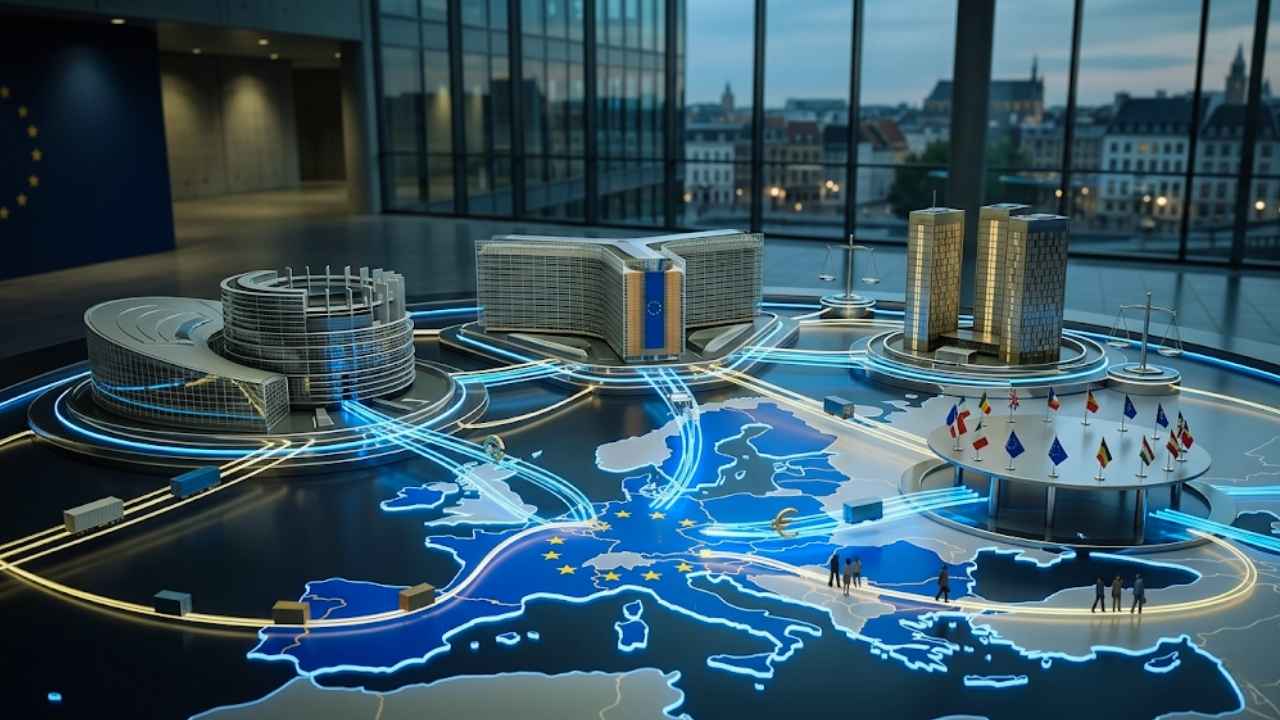
When people complain about “Brussels” making decisions, they are usually talking about the complex web of institutions that run the bloc. To truly understand how the European Union works, you have to look at its governance structure, which relies on a strict system of checks and balances. Three main bodies drive the daily lawmaking process, while specialized courts and banks handle the legal and financial heavy lifting.
The European Commission: The Executive Branch
The European Commission acts as the engine room of the entire bloc, based primarily in Brussels, Belgium. It is composed of 27 Commissioners—one from each member state—who are legally bound to put the interests of the EU ahead of their home countries. This institution holds the unique and powerful “right of initiative,” meaning it is the only body that can officially propose new EU laws.
Aside from drafting legislation, the Commission manages the day-to-day business of implementing policies and dispersing the collective budget. It also acts as the “Guardian of the Treaties,” constantly monitoring member states to ensure they are actually following the rules they agreed to. If a country ignores an environmental regulation or breaks a trade rule, the Commission is the one to take them to court.
|
Commission Role |
Functional Detail |
|
Proposing Laws |
Holds the exclusive right to draft and suggest new legislation. |
|
Managing the Budget |
Allocates funds for agriculture, regional development, and research. |
|
Enforcing Rules |
Acts as a watchdog to ensure all 27 countries follow EU laws. |
|
Global Representation |
Negotiates international trade agreements on behalf of the bloc. |
The European Parliament: The Voice of the People
If the Commission represents the union’s collective interests, the European Parliament represents you, the citizen. It is the only directly elected body within the EU structure, with hundreds of millions of eligible voters heading to the polls every five years. The 720 Members of the European Parliament (MEPs) do not sit in groups based on their nationality; instead, they sit with lawmakers who share their political ideologies, such as greens, conservatives, or socialists.
This Parliament shares the ultimate power to pass or reject laws and approve the massive annual budget. They also exercise intense democratic oversight over the Commission, possessing the power to approve the Commission President and even force the entire team of Commissioners to resign if they lose trust in their leadership.
|
Parliament Feature |
Practical Impact |
|
Direct Elections |
Gives citizens a direct democratic voice in Brussels. |
|
Legislative Power |
Must approve, amend, or reject laws proposed by the Commission. |
|
Budgetary Control |
Holds the purse strings alongside the national governments. |
|
Political Groupings |
Members vote based on ideology (e.g., liberal, socialist) rather than nationality. |
The European Council and The Council of the European Union
This is where beginners often get tripped up due to the confusingly similar names. The European Council is essentially a strategic summit where the Presidents and Prime Ministers of the 27 countries meet to set the broad political goals and handle major crises. They don’t pass laws; they steer the ship. On the flip side, the Council of the European Union (often just called the Council) is a hands-on legislative body.
Here, national ministers meet to vote on the laws proposed by the Commission. The people in the room change depending on the topic; if the law is about farming, the 27 agriculture ministers meet. A new rule typically cannot become law unless both this Council of national ministers and the European Parliament agree on the exact same text.
|
Institution Name |
Who Attends |
Primary Function |
|
European Council |
Heads of State (Presidents, Prime Ministers) |
Sets broad strategy, political direction, and crisis response. |
|
Council of the EU |
National Ministers (e.g., Finance, Environment) |
Debates, amends, and votes to pass actual legislation. |
The Court of Justice of the European Union: The Legal Guardian
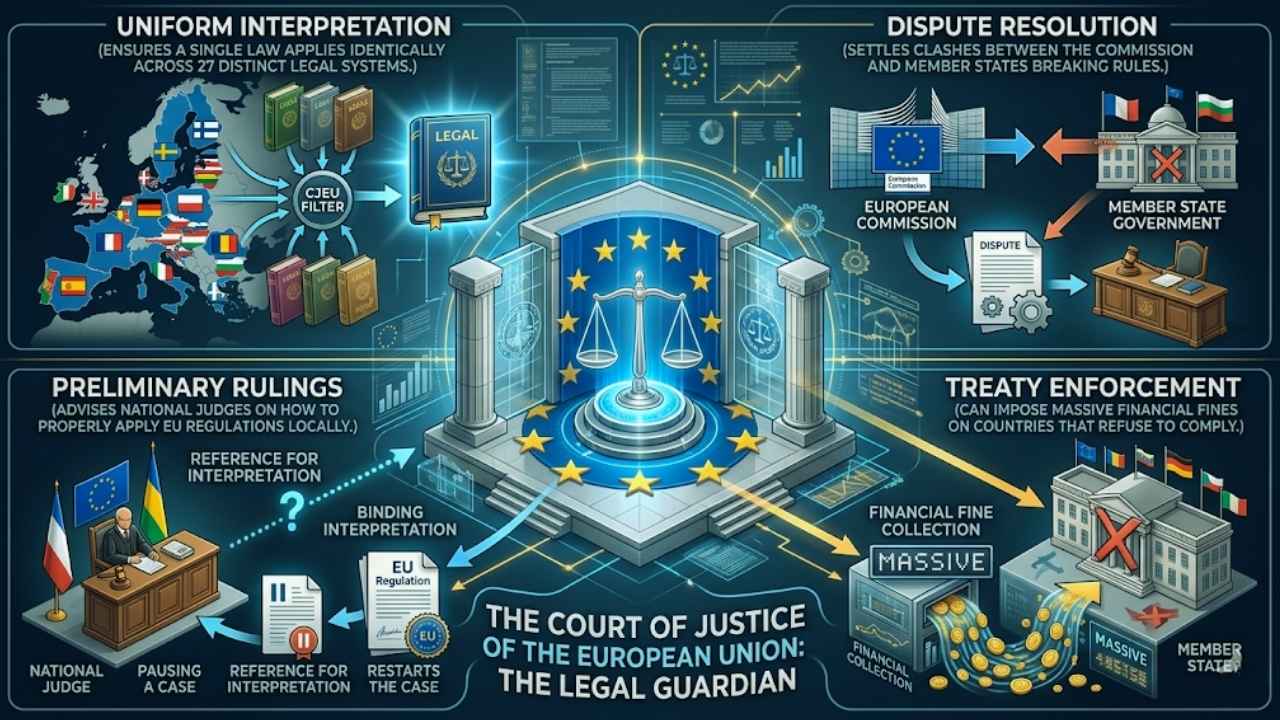
A shared set of rules is useless if every country interprets them differently. The Court of Justice, located in Luxembourg, guarantees that EU law means the exact same thing in Dublin as it does in Warsaw. It reviews the legality of acts passed by the institutions to make sure they don’t violate the founding treaties. The court settles complicated legal disputes between national governments and EU bodies.
Furthermore, if a local judge in a member state is confused about how to apply a European regulation to a local case, they can pause the trial and ask this Court for a binding interpretation. This keeps the massive legal framework of the bloc consistent and fair across all borders.
|
Court Responsibility |
How It Works |
|
Uniform Interpretation |
Ensures a single law applies identically across 27 distinct legal systems. |
|
Dispute Resolution |
Settles clashes between the Commission and member states breaking rules. |
|
Preliminary Rulings |
Advises national judges on how to properly apply EU regulations locally. |
|
Treaty Enforcement |
Can impose massive financial fines on countries that refuse to comply. |
The European Central Bank and the European Court of Auditors
Money and accountability require their own specialized overseers. The European Central Bank (ECB), headquartered in Frankfurt, Germany, is the architect of the Euro. It completely controls the monetary policy for the countries that use the single currency, focusing relentlessly on keeping inflation stable so your money holds its value.
Meanwhile, the European Court of Auditors acts as the independent financial watchdog for the entire bloc. They meticulously track the money collected from member states and audit how it is spent. Their goal is to ensure that every euro is used legally, efficiently, and for the intended purpose, releasing public reports that keep the massive bureaucracy accountable to the taxpayers.
|
Institution |
Core Mission |
Key Tool / Output |
|
European Central Bank |
Maintain price stability and manage the Euro. |
Sets interest rates for the entire Eurozone. |
|
Court of Auditors |
Ensure the EU budget is spent legally and effectively. |
Publishes independent audits and financial reports. |
How EU Laws Are Made Step by Step
The process of turning an idea into a continent-wide rule is famously slow, but it is slow by design. This procedure, known as the Ordinary Legislative Procedure, ensures that no single country or institution can force their will on the others. Every law must pass through a gauntlet of research, debate, and compromise.
The Proposal Stage
Everything starts with the European Commission taking the initiative. Before a single word of a law is officially proposed, the Commission conducts massive “Impact Assessments” that can take years. They study the economic, environmental, and social fallout of the potential new rule.
They open public consultations, inviting citizens, giant corporations, environmental groups, and academics to submit their opinions. Once they have gathered all the data and drafted a balanced document, they send the formal proposal simultaneously to the European Parliament (representing the people) and the Council of the EU (representing the national governments).
|
Proposal Step |
Description |
|
Impact Assessment |
Deep research into the potential side-effects of a new policy. |
|
Public Consultation |
Gathering input from industry experts, NGOs, and everyday citizens. |
|
Drafting |
The Commission writes the legal text balancing all competing interests. |
|
Submission |
Sending the draft to the Parliament and Council to kick off the debate. |
The Review and Amendment Stage
Once the proposal hits the desks of the Parliament and the Council, a complex ping-pong match of negotiations begins. The Parliament will assign the law to a specialized committee, draft a report, and vote on a list of changes they want to see. At the exact same time, the national ministers in the Council are doing their own review and preparing their own amendments.
If the Council completely agrees with the Parliament’s changes, the law passes immediately—but this almost never happens on the first try. Usually, the proposal bounces back and forth across up to three “readings.” To speed things up, leaders from the three institutions often hold closed-door meetings called “Trilogues” to hammer out compromises and find a text everyone can stomach.
|
Stage of Review |
Action Taken |
|
First Reading |
Parliament and Council review the draft and propose their initial changes. |
|
Second Reading |
Institutions review each other’s changes and attempt to find common ground. |
|
Trilogues |
Informal, high-level meetings to rapidly negotiate sticky disagreements. |
|
Conciliation Committee |
A final, formal attempt to merge competing versions of the law. |
The Adoption and Implementation Stage
Once the Parliament and the Council finally agree on the exact wording, the law is officially adopted. But the story doesn’t end there; the type of law determines what happens on the ground. A “Regulation” becomes a binding law immediately across all 27 countries, word-for-word as written.
A “Directive,” however, simply sets a mandatory goal (like requiring 30% renewable energy use) and gives the member states a deadline to pass their own local laws to hit that target. After the law is active, the Commission switches back to its role as the enforcer, carefully watching the member states. If a country drags its feet or ignores the law entirely, they can be dragged before the Court of Justice and hit with punishing daily fines.
|
Law Type / Action |
Practical Meaning |
|
Regulation |
Applies instantly and identically across all member states (e.g., Data Privacy rules). |
|
Directive |
Sets a goal but lets national governments decide exactly how to achieve it. |
|
Implementation |
Countries update local systems and enforcement agencies to match the new rules. |
|
Infringement |
The legal process of punishing a country that fails to follow the adopted law. |
The Single Market: The Core of the EU Economy
When business leaders talk about how the European Union works, they are almost exclusively focused on the Single Market. This is the crown jewel of the European project. It effectively erases national borders for economic purposes, treating the territories of 27 distinct nations as one massive, domestic marketplace.
By removing tariffs, synchronizing safety standards, and cutting red tape, it creates an environment where businesses can scale up to compete globally, while consumers enjoy lower prices, better quality, and an incredibly wide variety of products.
Understanding the Four Freedoms
The entire economic engine runs on four foundational rules known as the “Four Freedoms.” First, the free movement of goods allows a car part made in Germany to be shipped to an assembly line in Slovakia without stopping for customs checks or import taxes. Second, the free movement of services lets an accounting firm in Madrid handle the books for a tech startup in Berlin without needing special foreign permits.
Third, the free movement of capital ensures that citizens and companies can invest, buy real estate, or open bank accounts anywhere in the bloc without penalty. Finally, the free movement of persons guarantees that an EU citizen can move to any other member state to work, study, or retire under the exact same conditions as the local population.
|
The Freedom |
Real-World Benefit |
|
Movement of Goods |
Cheaper supermarket prices and faster shipping across the continent. |
|
Movement of Services |
Professionals like architects or IT consultants can operate anywhere easily. |
|
Movement of Capital |
You can seamlessly invest your savings in businesses across different countries. |
|
Movement of Persons |
You can take a job in Paris or study in Amsterdam without applying for a visa. |
The Schengen Area: Traveling Without Borders
While the Single Market makes it easy for money and goods to move, the Schengen Agreement makes it effortless for human beings. Although the EU and the Schengen Area are not perfectly identical—some EU countries are still waiting to join, while non-EU countries like Switzerland and Norway are already inside—they heavily overlap.
Schengen abolished physical border checkpoints and passport controls between participating nations. Today, you can board a train in Lisbon, Portugal, and travel all the way to Helsinki, Finland, without ever once having to show your passport to a border guard. This drastically speeds up supply chain logistics for freight trucks and provides a massive boost to the cross-border tourism industry.
|
Schengen Fact |
Practical Reality |
|
No Border Checks |
You can drive across national borders at highway speeds without stopping. |
|
Common Visa Policy |
A tourist visa for one Schengen country allows travel through all of them. |
|
Police Cooperation |
Law enforcement agencies share databases to track criminals across borders. |
|
Non-EU Members |
Countries like Iceland and Switzerland participate despite not being in the EU. |
The Euro and the Eurozone
Creating a single market was a massive step, but dealing with dozens of different currencies was still a nightmare for cross-border trade. The creation of the Euro was the ultimate financial unifier. It eliminated the cost of exchanging money, protected businesses from wild currency fluctuations, and made comparing prices across different countries incredibly simple.
Who Uses the Euro?
Currently, 20 of the 27 EU member states have replaced their historic national currencies with the Euro. This specific group is known as the Eurozone. When a new country joins the EU, they are legally committed to adopting the Euro eventually, though they must first meet strict economic benchmarks to ensure their economy is stable enough.
Some countries, like Denmark, negotiated legal “opt-outs” decades ago and proudly keep their own currency. For those inside the Eurozone, the shared currency has resulted in deeper economic integration, making trade frictionless and drastically simplifying travel for millions of citizens who no longer have to visit exchange bureaus at every border.
|
Currency Status |
Examples |
|
Eurozone Members |
France, Germany, Italy, Spain, Greece, Ireland |
|
Legally Opted-Out |
Denmark (Uses the Danish Krone) |
|
Working Towards Joining |
Poland, Hungary, Romania, Sweden |
|
Key Benefit |
Eliminates exchange rate risk for international businesses. |
Managing Inflation and Monetary Policy
When 20 countries share a single currency, they surrender the ability to adjust their own interest rates or print money to solve local crises. Instead, all monetary policy is dictated by the European Central Bank. The ECB’s primary, almost exclusive mandate is to maintain “price stability.” They aim to keep inflation symmetrical at around two percent over the medium term.
This is a highly complex balancing act; the bank must set an interest rate that works for booming tech hubs in Ireland while not stifling slower-growing economies in Southern Europe. By keeping the currency stable and reliable, the ECB ensures that the Euro remains one of the world’s premier reserve currencies, attracting massive global investment.
|
Monetary Concept |
How the ECB Handles It |
|
Interest Rates |
Sets a single baseline rate that affects borrowing costs across all 20 countries. |
|
Inflation Target |
Adjusts monetary levers aiming for a steady, predictable 2% inflation rate. |
|
National Control |
Individual countries lose the power to devalue their currency to boost exports. |
|
Global Strength |
Maintains the Euro’s status as the second most traded currency in the world. |
Member States and European Expansion
The geographical map of the EU is constantly evolving. What started as an exclusive club of six Western European nations has expanded eastward and southward, transforming the geopolitical landscape. Understanding how the European Union works requires acknowledging that it is an active project, constantly managing the diverse needs of its current members while preparing to integrate new ones.
The Current 27 Member States
As of 2026, the union consists of 27 highly diverse nations. You have massive economic powerhouses like Germany, which boasts the largest population and highest GDP, sitting at the same negotiating table as small island nations like Malta and Cyprus. Despite these massive disparities in wealth, military strength, and size, the institutional framework is designed to give everyone a meaningful voice.
Voting systems in the Council often require a “double majority”—meaning a law needs the support of 55% of the member states representing at least 65% of the total EU population. This clever math prevents the big countries from bullying the small ones, while ensuring tiny populations can’t unreasonably block progress.
|
Member State Diversity |
Notable Examples |
|
Largest Population |
Germany (Over 83 million people) |
|
Smallest Population |
Malta (Around 500,000 people) |
|
Largest Land Area |
France (Massive agricultural and geographic footprint) |
|
Voting Power |
Weighted to balance population size with the rights of smaller states. |
How Countries Join the European Union?
Joining the bloc is a grueling, transformative process that can easily take ten to twenty years. A candidate country cannot simply sign a treaty; they must completely overhaul their domestic laws to meet the “Copenhagen Criteria.” They must prove they have deeply entrenched democratic institutions, unwavering respect for human rights, and a robust, functioning market economy that won’t collapse under the pressure of the Single Market.
Furthermore, they must copy and paste the “Acquis Communautaire”—the massive, accumulated body of all existing EU laws—into their own national legal code. Countries currently in this rigorous pipeline include Ukraine, Moldova, and several nations in the Western Balkans.
|
Joining Requirement |
What It Means in Practice |
|
Political Criteria |
Must guarantee fair elections, independent courts, and minority rights. |
|
Economic Criteria |
Must have a capitalist economy capable of competing without massive subsidies. |
|
Legal Alignment |
Must adopt tens of thousands of pages of existing EU regulations. |
|
Unanimous Approval |
All current 27 member states must agree to let the new country in. |
Common Misconceptions About How the European Union Works
Because the system is multi-layered and often terrible at public relations, a massive amount of misinformation surrounds the EU. Euroskeptics often paint it as a tyrannical super-state, while overly enthusiastic supporters sometimes ignore its flaws. To really get a grip on how the European Union works, we need to separate the dramatic political myths from the actual legal realities.
Does the EU Overrule National Laws Entirely?
A very common myth is that Brussels dictates every detail of European life and has stripped countries of their sovereignty. In reality, the EU operates strictly on the “Principle of Conferral.” This means the EU only has power over issues that the member states explicitly gave it permission to handle in the founding treaties. In exclusive areas like international trade deals, the EU has total control.
But in vital areas like national defense, healthcare systems, income taxes, and public education, the national governments remain completely in charge. When an EU law does clash with a local law in a shared policy area, the EU law takes priority, but the scope of that priority is strictly boxed in by the treaties.
|
Policy Area Control |
Who Makes the Rules? |
|
Exclusive EU Control |
Customs union, competition rules, international trade agreements. |
|
Shared Control |
Environmental protection, consumer rights, transportation networks. |
|
National Control |
Healthcare administration, school curriculums, police, military forces. |
|
Legal Supremacy |
EU law beats national law, but only in areas governed by the treaties. |
Is the European Union Undemocratic?
Critics frequently complain about a “democratic deficit,” arguing that the system is run by “unelected bureaucrats” in the Commission. While it is true that you cannot directly vote for a Commissioner, the process is highly democratic. Your elected national government nominates the Commissioner, similar to how a US President nominates a cabinet secretary.
Furthermore, this nominated Commission cannot take office without the explicit approval of the directly elected European Parliament. Most importantly, the Commission cannot pass a single law on its own. Every regulation must be approved by the Parliament (representing the voters) and the Council (representing the elected national governments), making the process highly representative.
|
Democratic Complaint |
The Structural Reality |
|
“Unelected Commission” |
Commissioners are chosen by elected national leaders and vetted by Parliament. |
|
“Faceless Bureaucrats” |
Civil servants draft the text, but only elected officials vote to make it law. |
|
“Loss of Voter Voice” |
Citizens vote directly for MEPs who hold massive power over the budget and laws. |
|
“Forced Legislation” |
Laws require broad consensus, making it impossible for a minority to dictate terms. |
Final Thoughts
Figuring out how the European Union works doesn’t have to be an intimidating task reserved for political science majors. At its core, it is simply a highly advanced mechanism for cooperation. By willingly pooling their sovereignty, 27 independent nations have figured out how to secure lasting peace, elevate their economic power, and protect the rights of their citizens on a scale that no single country could manage alone.
Yes, the legislative process can be incredibly slow, and the maze of Commissions, Councils, and Parliaments can seem overly bureaucratic. However, these complex checks and balances are exactly what keep the system fair, ensuring that a massive bloc of 450 million people moves forward together without leaving the smaller nations behind. Whether it’s enforcing strict data privacy rights on global tech giants, ensuring your food is safe, or simply letting you travel from Spain to Germany without a passport, the daily mechanics of the EU fundamentally shape modern European life.
Frequently Asked Questions (FAQs) About How European Union Works
What happens if a country refuses to follow an EU law?
If a member state blatantly ignores a directive or violates a treaty, the European Commission launches “infringement proceedings.” This starts as a formal warning and dialogue. If the country still refuses to comply, the Commission takes them to the Court of Justice. The Court can issue binding rulings forcing compliance and can levy massive, daily financial penalties until the country fixes the issue.
Can a country be kicked out of the EU?
Interestingly, there is no legal mechanism in the treaties to forcibly kick a country out against its will. However, under Article 7 of the Treaty on European Union, if a country persistently breaches core democratic values (like destroying the independence of its judges), the other members can vote to suspend certain rights, including freezing their access to EU funds and stripping them of their voting power in the Council.
How does the EU get its money if it doesn’t collect income taxes?
The EU has its own budget, funded largely by a percentage of each member country’s Gross National Income (GNI). It also collects revenue from customs duties charged on goods imported from outside the bloc, a small standardized percentage of the Value Added Tax (VAT) collected by member states, and recent levies like a contribution based on non-recycled plastic packaging waste.
What is the difference between the Council of Europe and the European Union?
This is a massive point of confusion. The Council of Europe is a completely separate international human rights organization with 46 member states, famous for the European Court of Human Rights. It is not an EU institution at all. The European Union is the 27-member political and economic bloc we have discussed in this article.