

Job interviews have changed. Recruiters now use AI screening, video interviews, skills tests, and structured hiring scorecards. But one old question still makes candidates nervous:
“What are your weaknesses?”
It sounds simple. It isn’t. Say something too honest, and you may raise doubts. Say something fake, and the interviewer may stop trusting you. Say “I’m a perfectionist,” and you may sound like every other candidate in the waiting room.
That’s why the “What are your weaknesses?” interview question still matters in 2026. Employers don’t expect a perfect person. They want someone self-aware, honest, coachable, and mature enough to improve.
The best answer is not dramatic. It is clear, safe, and practical. You name a real weakness. You explain how it shows up at work. Then you show what you are doing to fix it.
Why Employers Still Ask “What Are Your Weaknesses?” in 2026
This question is not just about your weakness. It is about your judgment. A recruiter is not asking you to list every flaw you have. They are checking how you think about your own work. Can you spot a gap? Can you improve without being forced? Can you talk about a weakness without blaming others?
That matters even more now because hiring is more skills-focused. NACE’s 2026 hiring research shows that about 70% of employers use skills-based hiring. That means employers are looking for practical evidence, not just polished claims. AI is also changing the interview process. iCIMS reports that 69% of organizations use AI in talent acquisition. Greenhouse also reports that 63% of U.S. job seekers have already experienced an AI interview.
So your answer needs to work in more than one setting. It should sound natural to a human interviewer. It should also be clear enough for a structured screening process. A strong answer tells the interviewer that you know yourself. It shows that you take feedback seriously, do not hide from your gaps, and are already working on the issue. That is the real purpose of the question.
|
Key Point |
What It Means for Candidates |
|
Skills-based hiring is growing |
Employers want proof that you can learn, adapt, and improve. |
|
AI is now part of many hiring funnels |
Short, clear, structured answers matter more than before. |
|
Soft skills remain important |
Self-awareness, teamwork, and communication are still under review. |
|
Interviews are more structured |
Recruiters compare candidates using similar questions and scoring methods. |
|
Competition is still real |
A weak answer can hurt you when candidates have similar experience. |
|
Employers value coachability |
Your response shows whether you can accept feedback without getting defensive. |
|
Generic answers stand out for the wrong reason |
Recruiters have heard fake weakness answers too many times. |
What Interviewers Really Want to Hear?
Interviewers want a professional answer, not a confession. That is the first rule. You do not need to reveal personal problems, private struggles, medical issues, family stress, or deep insecurities. Keep the answer tied to work behavior.
For example, “I’m improving how early I ask for help” is a good professional weakness. “I panic under pressure” is too risky. One shows growth. The other creates concern.
A strong answer should include four things: a real weakness, a short workplace context, a clear action step, and a sign of progress. The progress part matters most. A weakness without action sounds like a problem. A weakness with action sounds like growth.
Yale’s career guidance also supports this approach. It warns candidates not to use a key job requirement as a weakness. If the job needs Excel, don’t say technology is your weakness. If the job needs customer service, don’t say you struggle with people.
This is where many candidates fail. They try too hard to sound honest and accidentally make themselves look unfit. A good answer feels balanced. It is honest enough to be believable, but smart enough to protect your chances.
|
Interviewer Is Testing |
Strong Signal |
Weak Signal |
|
Self-awareness |
“I noticed this pattern in my work.” |
“I don’t really have weaknesses.” |
|
Honesty |
You name a real but safe weakness. |
You give a fake humblebrag. |
|
Growth mindset |
You explain what you are doing to improve. |
You say, “That’s just how I am.” |
|
Role fit |
The weakness does not damage the job. |
The weakness attacks a core job skill. |
|
Communication |
Your answer is calm, brief, and clear. |
You ramble or overshare. |
|
Accountability |
You explain your own action steps. |
You blame managers, teams, or past companies. |
|
Professional maturity |
You keep the answer work-related. |
You share private or emotional details. |
What Are Your Weaknesses Interview: The Best Answer Formula?
Use this simple formula:
Weakness + Context + Action + Progress
Here is the basic version:
“One area I’m working on is [weakness]. I noticed it when [brief work context]. To improve, I started [specific action]. That has helped me [progress].”
Here is a polished answer:
“One area I’m working on is being more concise in updates. I used to give too much background because I wanted to be thorough. I realized managers often need the main point first. Now I use a simple format: issue, impact, and next step. It has made my updates clearer and easier to act on.”
That answer works because it sounds real. It does not pretend the weakness is secretly a strength. It also shows the candidate changed their behavior. For the what are your weaknesses interview question, do not spend too much time explaining the flaw. Spend more time explaining the fix.
The interviewer does not need a long story. They need proof that you can reflect, adjust, and improve. A good structure makes your answer sound confident. It also stops you from rambling.
|
Step |
What to Do |
Example |
|
Step 1 |
Name one real weakness |
“I’m working on being more concise.” |
|
Step 2 |
Give brief work context |
“I used to give too much background in updates.” |
|
Step 3 |
Explain your fix |
“Now I use a three-point update format.” |
|
Step 4 |
Show progress |
“It has made my updates clearer and faster.” |
|
Step 5 |
Keep it short |
Aim for 45 to 60 seconds. |
|
Step 6 |
Stay professional |
Avoid private or emotional details. |
|
Step 7 |
Connect it to growth |
Show that you are learning, not making excuses. |
How to Choose a Safe and Strong Weakness?
A good weakness should pass three tests.
First, it should be true. Don’t invent something just because it sounds safe. Interviewers can sense a fake answer, especially when they ask follow-up questions.
Second, it should be fixable. “I’m improving public speaking” works because you can practice it. “I’m bad with people” does not work because it sounds broad and risky.
Third, it should not hurt your fit for the job.
If you are applying for a writing role, don’t say writing clearly is your weakness. If you are applying for accounting, don’t say details are hard for you. If you are applying for sales, don’t say you dislike talking to people. Choose a weakness that sits near the job but does not attack the job.
Good options include being more concise, asking for help earlier, delegating sooner, building confidence in public speaking, prioritizing competing tasks, handling ambiguity better, explaining technical ideas clearly, and improving documentation habits. These answers sound human. They also show that you are already working on the issue. That is exactly what an interviewer wants.
Read Also: Top 12 Recession-Proof Careers to Consider in 2026
|
Good Weakness Type |
Why It Works |
Example |
|
Fixable skill gap |
Shows learning ability |
Public speaking, data storytelling, advanced Excel |
|
Work habit |
Shows self-awareness |
Over-explaining, asking for help late |
|
Communication style |
Shows emotional intelligence |
Being too brief, not speaking up early |
|
Experience gap |
Works for freshers and career changers |
Limited exposure to large teams |
|
Process gap |
Easy to improve with tools |
Prioritization, documentation, time estimation |
|
Leadership gap |
Works for managers |
Delegating late, giving feedback late |
|
Confidence gap |
Works for junior roles |
Speaking up in meetings, presenting ideas |
|
Tool gap |
Safe only when not central to the role |
Learning a reporting platform or AI tool |
Best Weakness Examples for 2026 Interviews
Some weaknesses work better than others because they sound real, fixable, and safe. The key is to explain the weakness through a work habit, not a personal flaw.
Example 1: Over-Explaining
“I’m working on being more concise. Earlier, I sometimes gave too much background when a manager only needed the key point. Now I lead with the main message, then add details if needed. It has made my updates faster and clearer.”
This works well for writers, analysts, developers, and SEO professionals. It shows that you care about accuracy, but you are learning to respect people’s time.
Example 2: Asking for Help Late
“I can be very independent, so I used to spend too long trying to solve problems alone. Now I set a time limit. If I’m still stuck after trying the obvious steps, I ask a focused question and explain what I’ve already tested.”
This answer works because it shows ownership without stubbornness. It also shows that you value team time.
Example 3: Public Speaking
“I’m still building confidence in public speaking. I’m comfortable in small meetings, but larger groups used to make me nervous. I’ve started volunteering for short updates and preparing notes before presentations. That has helped me stay calmer.”
This is a safe weakness for many junior, technical, or remote roles. It is common, honest, and easy to improve.
Example 4: Delegating Too Late
“I used to hold on to tasks too long because I wanted to protect quality. I’ve learned that good delegation needs clear instructions, not constant control. Now I define the goal, deadline, and check-in points early.”
This works well for managers. It shows that you are learning to trust the team.
Example 5: Overcommitting
“I used to say yes too quickly because I wanted to help. That sometimes stretched my schedule. Now I check deadlines and priorities before committing. It helps me support the team without hurting quality.”
This answer is useful for team roles. It shows that you are helpful but learning better boundaries.
Example 6: Time Estimation
“I’m improving how I estimate time for unfamiliar tasks. I used to be too optimistic when I didn’t know all the details. Now I break work into smaller steps and add buffer time for unknowns.”
This is a strong answer for project-based work. It shows that you are building a better process.
|
Weakness |
Best For |
Why It Works |
|
Over-explaining |
Analysts, writers, technical workers |
Shows care for clarity while improving brevity. |
|
Asking for help late |
Independent workers |
Shows ownership and better teamwork. |
|
Public speaking nerves |
Junior, technical, and remote roles |
Common, fixable, and easy to explain. |
|
Delegating too late |
Managers and team leads |
Shows leadership growth. |
|
Overcommitting |
Helpful team players |
Shows you are learning boundaries. |
|
Time estimation |
Project-based roles |
Shows planning improvement. |
|
Too much detail in reports |
Data, SEO, finance, and research roles |
Shows audience-focused communication. |
|
Staying quiet in large meetings |
Freshers and introverted professionals |
Shows confidence-building. |
Weakness Answers You Should Avoid
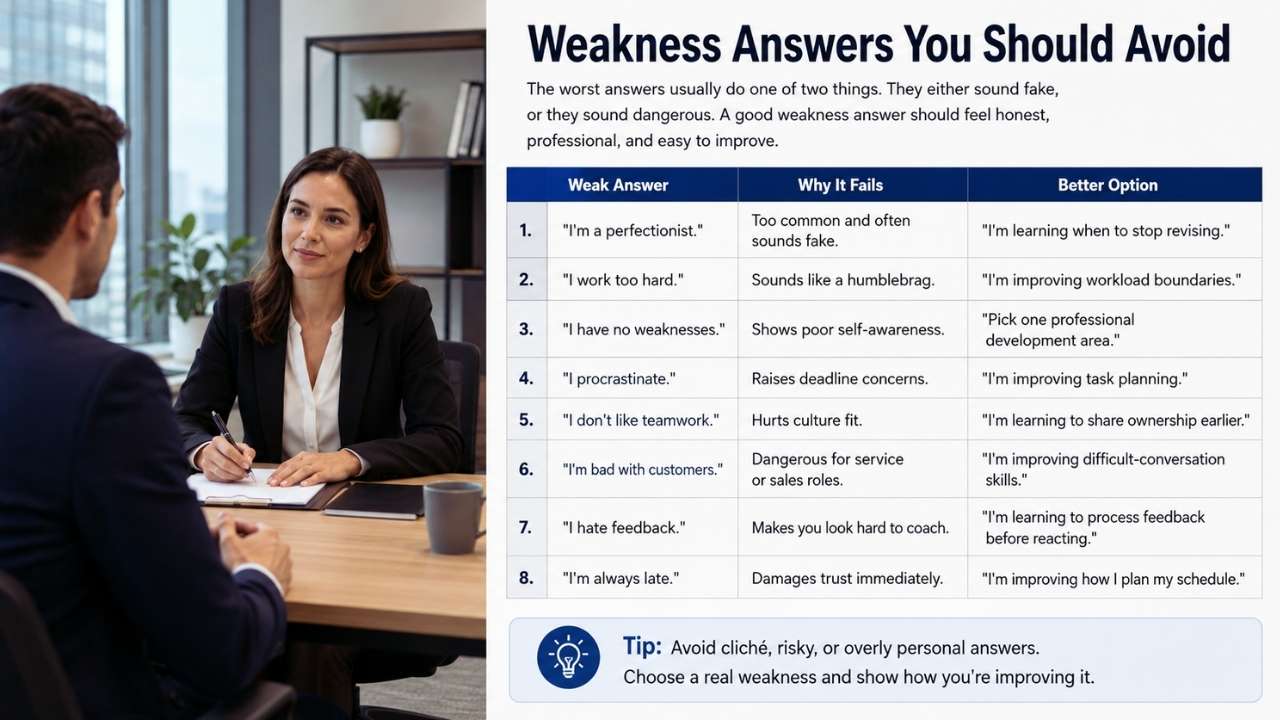
The worst answers usually do one of two things. They either sound fake, or they sound dangerous.
“I’m a perfectionist” is the classic fake answer. It sounds safe, but most interviewers have heard it too many times. It can also sound like you are trying to turn a weakness into praise.
A better version is more specific:
“I can spend too long refining details after the work is already strong enough. I’m improving by setting review limits before I start.”
That sounds more believable. It also shows a fix.
Avoid answers that create doubt about your reliability. Don’t say you miss deadlines, hate feedback, dislike teamwork, avoid responsibility, or struggle with basic communication. Also avoid oversharing. Keep the answer about work. You don’t need to discuss private issues, past drama, health details, or conflicts with old managers. A good weakness answer should make the interviewer think, “That is normal, and this person is handling it well.”
|
Weak Answer |
Why It Fails |
Better Option |
|
“I’m a perfectionist.” |
Too common and often sounds fake. |
“I’m learning when to stop revising.” |
|
“I work too hard.” |
Sounds like a humblebrag. |
“I’m improving workload boundaries.” |
|
“I have no weaknesses.” |
Shows poor self-awareness. |
Pick one professional development area. |
|
“I procrastinate.” |
Raises deadline concerns. |
“I’m improving task planning.” |
|
“I don’t like teamwork.” |
Hurts culture fit. |
“I’m learning to share ownership earlier.” |
|
“I’m bad with customers.” |
Dangerous for service or sales roles. |
“I’m improving difficult-conversation skills.” |
|
“I hate feedback.” |
Makes you look hard to coach. |
“I’m learning to process feedback before reacting.” |
|
“I’m always late.” |
Damages trust immediately. |
“I’m improving how I plan my schedule.” |
How to Answer in AI, Video, Phone, and Panel Interviews?
AI interviews are now common. Video interviews are normal. Phone screens still happen. Panel interviews still test your confidence.
The format may change, but the answer should stay clear.
For AI or one-way video interviews, use this timing:
10 seconds: name the weakness
15 seconds: give brief context
20 seconds: explain your action
10 seconds: show progress
Sample answer:
“One weakness I’m improving is asking for help earlier. I used to spend too long trying to solve a problem alone. Now I give myself a time limit, document what I’ve tried, and ask a focused question. That helps me move faster and keeps the team informed.”
Short. Clean. Easy to understand.
For a live panel interview, slow down. Don’t rush because several people are watching. Answer the group, not just the person who asked the question. For a final interview, connect your answer to the role:
“Because this role involves cross-functional work, I’ve been improving how I explain technical details to non-technical teammates. I now lead with the business impact first, then add technical details if needed.”
That answer sounds tailored. That matters.
|
Interview Type |
Best Approach |
What to Avoid |
|
AI interview |
Keep the answer structured and under 60 seconds. |
Rambling or using vague phrases. |
|
Video interview |
Look at the camera and speak naturally. |
Reading every word from a script. |
|
Phone interview |
Speak slowly and use clear transitions. |
Talking too fast because there is no visual feedback. |
|
Panel interview |
Answer the whole group. |
Speaking only to the person who asked. |
|
Final interview |
Add role-specific context. |
Giving a generic answer from the internet. |
|
Recruiter screen |
Keep it simple and job-safe. |
Giving a long personal story. |
|
Technical interview |
Pick a process or communication gap. |
Saying you lack a core technical skill. |
|
Executive interview |
Choose a leadership growth area. |
Using a junior-level weakness. |
Role-Based Sample Answers
Different roles need different answers. A weakness that sounds safe for a writer may sound risky for a sales role. A weakness that works for a fresher may sound weak for a manager.
Content Writer
“One weakness I’m improving is organizing research before writing. I used to collect too many notes and sort them later. Now I outline the article first and research section by section. It keeps the draft focused.”
This answer works because it does not attack writing ability. It shows a better workflow.
SEO Specialist
“I’m working on making SEO reports more direct. Earlier, I included too many metrics. Now I connect each metric to a business point, such as ranking movement, traffic quality, or conversions.”
This is strong because SEO roles require both data and communication. The weakness shows that the candidate is learning to translate data into decisions.
Software Developer
“I sometimes spend too much time thinking through edge cases early in a project. That can help quality, but timing matters. Now I confirm must-have requirements first and track lower-priority improvements separately.”
This works because it protects the candidate’s technical value while showing better prioritization.
Project Manager
“I’ve been improving how early I delegate. In the past, I kept tasks too long because I wanted to protect quality. Now I assign ownership earlier and set clear check-in points.”
This answer shows leadership growth. It also shows trust in the team.
Customer Support
“Earlier in my career, I sometimes took difficult customer comments personally. I’ve worked on separating the customer’s frustration from my reaction. Now I focus on the issue, repeat the concern, and move toward a solution.”
This is honest but controlled. It shows emotional maturity.
Sales
“I’m improving how much I listen during discovery calls. I used to jump in too quickly with solutions. Now I ask follow-up questions before recommending anything.”
This is a smart sales answer because it turns the weakness into better customer discovery.
Fresher
“My main weakness is that I’m still learning professional workplace communication. Academic projects are different from team workflows. I’m improving by sending clearer updates and asking better questions.”
This works because freshers are not expected to know everything. They are expected to learn fast.
|
Role |
Safe Weakness |
Smart Framing |
|
Content Writer |
Organizing research notes |
Better workflow and clearer drafts |
|
SEO Specialist |
Too much data in reports |
Stronger business-focused reporting |
|
Software Developer |
Spending too long on edge cases |
Better balance between quality and speed |
|
Project Manager |
Delegating too late |
Stronger team ownership |
|
Customer Support |
Taking complaints personally |
Better emotional control |
|
Sales |
Talking too much in discovery calls |
Better listening |
|
Designer |
Getting attached to first ideas |
Better feedback process |
|
Data Analyst |
Over-detailed reports |
Clearer insights |
|
Fresher |
Limited workplace experience |
Learning mindset |
|
Career Changer |
Industry knowledge gap |
Active upskilling |
How to Tailor Your Answer by Career Stage?
Your career stage matters. A student should not answer like a senior manager. A manager should not answer like a fresher. Choose a weakness that fits where you are right now.
Student Example
“I’m still building experience with workplace-style communication. In college projects, updates were less formal. I’m improving by sending clearer progress notes and confirming expectations earlier.”
This sounds realistic. It shows the student understands the difference between school projects and professional work.
Fresher Example
“I’m still building confidence in meetings. I used to wait until I felt fully sure before speaking. Now I prepare one or two points before discussions so I can contribute earlier.”
This answer is simple and believable. It also shows action.
Mid-Career Example
“I’m improving how I manage competing priorities. I used to try to move everything forward at once. Now I confirm urgency, impact, and dependencies before deciding what needs attention first.”
This sounds mature. It shows that the candidate understands trade-offs.
Manager Example
“I’m working on giving feedback earlier. I used to wait until I had a complete picture, but that sometimes delayed small corrections. Now I give quick, specific feedback while the issue is easier to fix.”
This is a strong leadership answer. It shows the manager is improving team communication.
Career Changer Example
“Since I’m moving into a new industry, I’m still building deeper domain knowledge. I’m closing that gap by studying industry reports, following key companies, and connecting my past experience to this role’s needs.”
This works because it admits a real gap without sounding unprepared.
|
Career Stage |
Best Weakness Type |
Example Angle |
|
Student |
Limited workplace exposure |
Learning professional communication |
|
Fresher |
Confidence in meetings |
Speaking up earlier |
|
Mid-career professional |
Prioritization |
Managing competing requests |
|
Manager |
Delegation or feedback |
Giving feedback earlier |
|
Senior leader |
Strategic focus |
Stepping back from details |
|
Career changer |
Industry context |
Building domain knowledge |
|
Remote worker |
Async communication |
Sharing updates before meetings |
|
Freelancer |
Boundary setting |
Clarifying scope and deadlines earlier |
How to Make Your Answer Sound Natural?
Many candidates write a good answer but deliver it badly. They memorize every word. Then they sound stiff. Or they over-explain and lose the interviewer halfway through.
The best answer sounds like a real person speaking.
Use simple words. Use short sentences. Don’t use corporate filler like “growth journey,” “areas of opportunity,” or “leveraging feedback loops.”
Say it plainly.
For example, don’t say:
“I am currently optimizing my interpersonal communication framework to better align with cross-functional stakeholder expectations.”
Say:
“I’m working on making my updates clearer for people outside my team.”
That sounds human. That is what you want. A natural answer should feel calm, not dramatic. You are not apologizing for being imperfect. You are showing that you can improve.
|
Technique |
Why It Helps |
Example |
|
Use everyday language |
Makes the answer sound human |
“I’m working on being clearer.” |
|
Avoid big words |
Keeps the message simple |
Don’t say “developmental opportunity.” |
|
Use “I noticed” |
Shows self-awareness |
“I noticed I was giving too much detail.” |
|
Mention one habit change |
Makes improvement believable |
“Now I use a three-point update.” |
|
Keep it short |
Prevents rambling |
Aim for one minute. |
|
Practice out loud |
Helps you sound natural |
Don’t just read it silently. |
|
Don’t memorize word for word |
Prevents a robotic tone |
Remember the flow instead. |
|
End with progress |
Leaves a strong final impression |
“It has made my updates faster.” |
Practice Checklist Before the Interview
Before the interview, write your answer in four short lines.
Weakness: I over-explain updates.
Context: I used to include too much background.
Action: I now use issue, impact, next step.
Progress: My updates are clearer and faster.
Now turn it into a natural answer:
“I’m working on being more concise in updates. I used to include too much background because I wanted to be thorough. Now I use a simple structure: issue, impact, and next step. It has made my updates shorter and easier to act on.”
Practice it out loud. Don’t memorize every word. Memorize the flow.
You can also record yourself once. Listen for three things:
- Are you speaking too fast?
- Are you giving too much detail?
- Does the answer sound honest?
If it sounds like a script, simplify it. The goal is not to sound perfect. The goal is to sound prepared and self-aware.
|
Step |
What to Do |
Why It Helps |
|
Read the job description |
Identify must-have skills. |
Avoid risky weaknesses. |
|
Pick one weakness |
Keep the answer focused. |
Prevent rambling. |
|
Add a real example |
Make it believable. |
Shows self-awareness. |
|
Explain your fix |
Show ownership. |
Proves growth. |
|
Time your answer |
Aim for 45 to 60 seconds. |
Keeps it sharp. |
|
Prepare a backup |
Have a second weakness ready. |
Useful if asked for more. |
|
Practice out loud |
Check your tone and pace. |
Helps you sound natural. |
|
Remove filler |
Cut anything that does not help. |
Makes the answer stronger. |
Labor Market and Skills Context for 2026 Job Seekers
The job market is not frozen. But it is not easy either.
The latest verified BLS data used for this article shows that the U.S. added 172,000 jobs in May 2026, while unemployment stayed at 4.3%. BLS also reported 7.6 million job openings in May 2026.
That means candidates still have opportunities. But employers are careful. They want people who can communicate, learn, adapt, and work well with others.
The World Economic Forum’s Future of Jobs Report also highlights analytical thinking, resilience, flexibility, leadership, and social influence as major workplace skills.
This is why a strong what are your weaknesses interview answer should do more than sound honest. It should show adaptability.
You are not just saying:
- “Here is my flaw.”
You are saying:
- “Here is how I improve.”
That is a much stronger message.
|
Verified 2026 Data Point |
Why It Matters |
|
172,000 U.S. jobs added in May 2026 |
Hiring continues, but competition is still real. |
|
4.3% U.S. unemployment rate in May 2026 |
The market is steady, but not effortless. |
|
7.6 million U.S. job openings in May 2026 |
Opportunities exist, but employers still screen carefully. |
|
About 70% of NACE employers use skills-based hiring |
Candidates need to show practical ability. |
|
69% of organizations use AI in talent acquisition |
Interview answers must be clear and structured. |
|
63% of U.S. job seekers have faced AI interviews |
Candidates need to prepare for non-traditional interviews. |
|
Analytical thinking remains a top workplace skill |
Employers value problem-solving and judgment. |
|
Resilience and flexibility matter |
Weakness answers should show adaptability. |
Best Weaknesses by Job Type
Different jobs need different weakness answers. That is why copying one answer from the internet is risky. The answer that works for a designer may not work for an accountant. The answer that works for a fresher may sound weak for a senior manager.
For creative roles, you can talk about getting attached to early ideas. That shows you are learning to accept feedback and test different directions. For technical roles, you can talk about explaining complex topics too deeply. That shows you are improving communication with non-technical people.
For admin roles, you can talk about prioritizing when many tasks arrive at once. That shows better planning. For sales roles, you can talk about jumping to solutions too quickly. That shows you are learning to listen better.
For leadership roles, delegation and feedback are often safe answers. They show that you are thinking about team growth, not just your own output.
The key is simple: match the weakness to the role without making yourself look unqualified.
|
Job Type |
Safe Weakness |
Why It Works |
|
Creative roles |
Getting attached to early ideas |
Shows openness to feedback. |
|
Technical roles |
Explaining complex ideas too deeply |
Shows communication growth. |
|
Admin roles |
Prioritizing when everything feels urgent |
Shows better task management. |
|
Sales roles |
Jumping to solutions too quickly |
Shows stronger listening. |
|
Customer roles |
Taking difficult feedback personally |
Shows emotional control. |
|
Leadership roles |
Delegating too late |
Shows trust-building. |
|
Research roles |
Spending too long gathering information |
Shows better decision-making. |
|
Remote roles |
Waiting too long to share updates |
Shows better async communication. |
Final Thoughts
The what are your weaknesses interview question is not about making yourself look bad. It is about showing that you know yourself. Pick one real weakness. Keep it work-related. Make sure it does not attack the main job requirement. Explain what you are doing to improve. Then stop.
A strong answer tells the interviewer three things:
- You know yourself.
- You take feedback seriously.
- You are getting better.
That is the kind of candidate employers want in 2026.
Frequently Asked Questions (FAQs) About What Are Your Weaknesses Interview
What if my real weakness is required for the job?
Reconsider applying for that specific position. If you still go for it, choose your second biggest weakness—one that is secondary to the job’s daily functions. Never admit you fail at the job’s core duty.
Should I bring up personal struggles?
Keep it 100% professional. Hiring managers don’t need to know about your personal life, relationships, or private anxieties. Keep it focused on workplace habits or technical gaps.
How many weaknesses should I prep?
Have at least two, preferably three ready to go. Recruiters sometimes ask for a second example just to see how you handle pressure. Having backups keeps you from freezing up.
Can I use a weakness I already fixed?
No. Bringing up a past weakness that you completely resolved sounds evasive. They want to know what you manage today, not five years ago. Focus on an ongoing work-in-progress.