


You finally land a sales call. You talk through the scope, click with the client, and then they drop the big question: “So, what is this going to cost?” If your chest tightens, you aren’t alone. Quoting work causes huge anxiety for independent contractors. Pitch too high, and you lose the job.
Quote too low, and you end up working 60-hour weeks for pocket change. The secret to quoting projects with total confidence does not mean pulling a number out of thin air. It comes down to picking the right freelance pricing models for the specific job in front of you. When you know whether to charge by the hour, quote a flat project fee, or bill based on business value, you stop leaving cash on the table. You transform from a nervous contractor into an established professional. Let’s break down exactly how these structures work, dive into real 2026 market data, and figure out exactly how you should price your next big project.
Why Your Choice of Freelance Pricing Models Matters
How you bill shapes your daily life, sets your income ceiling, dictates the types of clients who hire you, and determines whether you spend your evenings tracking minutes or growing your business. The financial gap between billing strategies is massive in the current landscape. Independent workers using value-based pricing report a median annual income of $96,000. Meanwhile, freelancers billing strictly by the hour report a median of $58,000. That is an extra $38,000 in your pocket every single year just for changing how you frame your quote.
High earners rarely rely on just one rate structure, as they split their work strategically across multiple freelance pricing models to maximize their take-home pay. For instance, freelancers pulling in over $150,000 a year allocate 62 percent of their projects to value-based pricing, 28 percent to retainers, and just 8 percent to hourly rates. You do not need to lock yourself into one pricing structure forever, and the smartest freelancers switch up their approach depending on what the client actually needs. By adapting your pricing model to match the client’s business maturity and project scope, you position yourself as a strategic partner rather than a disposable commodity.
|
Pricing Model |
Main Focus |
Earning Potential |
Best Work Scenario |
|
Hourly Rate |
Time spent on tasks |
Hard ceiling based on hours worked |
Early career, unclear scope |
|
Fixed-Rate |
Deliverables produced |
Medium; grows as you work faster |
Defined projects, routine tasks |
|
Value-Based |
Client revenue or outcomes |
High; tied to business impact |
Strategic work, high-ROI deals |
|
Retainer |
Guaranteed availability |
Steady, reliable monthly floor |
Ongoing support, long-term work |
The Hourly Rate: Trading Time for Dollars
Charging an hourly rate is the default starting point for most freelancers because it feels simple, safe, and transparent. You pick a rate, track your minutes with an app, and send an invoice at the end of the week. Billing by the hour works beautifully when you sell raw capacity and cannot predict where a project will lead, such as auditing a messy database or fixing random software bugs. An hourly structure shields you from working for free when the client changes their mind or drops new tasks on your desk.
However, the biggest downside to hourly billing is that it penalizes you for getting better at your job. As your skills grow, you complete tasks faster, which means your income drops unless you constantly raise your rates. In 2026, the average hourly rate for US freelancers sits at $47.71, while the global median rate is around $58 per hour. To earn more on an hourly setup, you either have to work longer hours or fight for constant rate increases. That dynamic often creates tension with clients who end up scrutinizing your timesheets instead of celebrating your excellent work.
|
Hourly Rate Advantages |
Hourly Rate Drawbacks |
Required Action Steps |
|
Simple to calculate and explain to clients |
Creates an absolute cap on your daily earnings |
Use reliable time-tracking software daily |
|
Guarantees pay for every minute worked |
Punishes speed and overall work efficiency |
Increase your rate every 6 months |
|
Shields against shifting client goals |
Encourages annoying client micromanagement |
Set minimum weekly billable hours |
Fixed-Rate Pricing: Charging by the Project
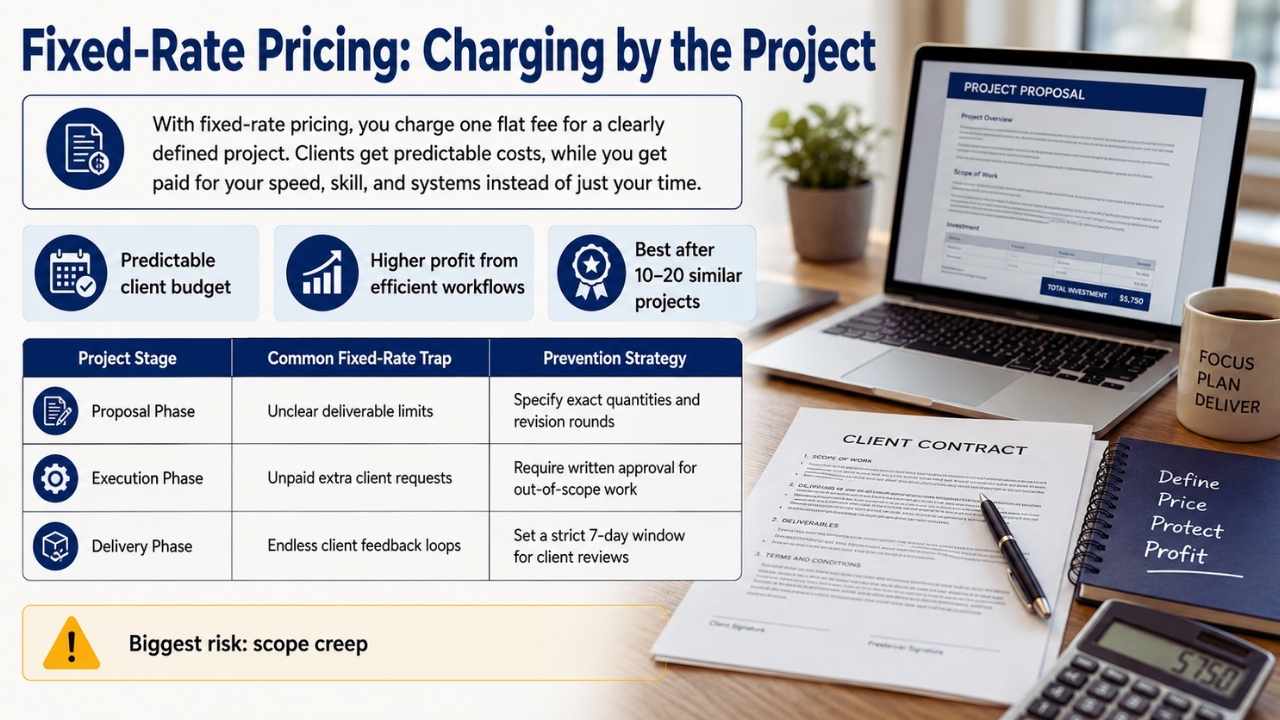
Once you build a solid workflow and realize hourly billing is costing you money, it makes perfect sense to shift to fixed-rate, or project-based, pricing. You quote one flat fee for a clearly outlined list of deliverables, which clients love because it entirely eliminates budget surprises. If you quote $3,000 to design a five-page website, your client knows exactly what to budget before the work even begins. For you, flat fees completely decouple your earnings from the time you spend working.
If you build 20 websites and create custom templates that let you finish a $3,000 build in 10 hours, your effective hourly rate hits $300. You get paid for your speed, skill, and systems rather than raw time. A good rule of thumb is to switch a specific service to fixed pricing once you have completed it 10 to 20 times, as your time estimates will be accurate enough to protect your profit margins. The single biggest risk with flat-rate projects is scope creep, which happens when a client asks for just one little tweak until a profitable contract turns into endless unpaid revisions.
|
Project Stage |
Common Fixed-Rate Trap |
Prevention Strategy |
|
Proposal Phase |
Unclear deliverable limits |
Specify exact quantities and revision rounds |
|
Execution Phase |
Unpaid extra client requests |
Require written approval for out-of-scope work |
|
Delivery Phase |
Endless client feedback loops |
Set a strict 7-day window for client reviews |
Value-Based Pricing: Charging for Results
Value-based pricing completely flips traditional billing on its head because instead of asking how long a task takes, you base your fee on the financial return your work generates for the client. Imagine an e-commerce brand hires you to overhaul their checkout page, and you discover the new flow will reduce abandoned carts to add $150,000 in yearly sales. By pricing your fee at 10 percent of that financial gain, you can charge $15,000 for a project that might have only billed $1,500 hourly.
The client doesn’t care if that checkout flow takes you five hours or 50 hours; they care about adding $150,000 to their bottom line. Paying $15,000 for a guaranteed $150,000 return is an easy decision for any data-driven business owner. Value pricing isn’t for brand-new freelancers, as it requires strong business intuition to uncover client revenue numbers, a proven track record of case studies showing past results, and the right clients with high profit margins. If a small local shop making $50,000 a year approaches you, they simply cannot afford value-based rates, making it vital to qualify your leads before pitching this model.
|
Value-Based Requirement |
Why It Matters |
How to Put It to Use |
|
Discovery Calls |
Uncovers the client’s financial targets |
Ask clients: “What is a new customer worth to you?” |
|
Proven Case Studies |
Proves you can deliver measurable results |
Show before-and-after revenue metrics on your site |
|
Tiered Proposals |
Gives clients options at different price points |
Present 3 pricing tiers anchored to expected outcomes |
Retainer Contracts: Creating Monthly Stability
Retainers are not a separate billing philosophy, but they solve the worst part of freelancing by creating a predictable and stable monthly income. A retainer is an agreement where a client pays you a set fee every month to reserve your time or cover recurring deliverables. Having three clients paying $2,000 a month on retainer gives you $6,000 in recurring revenue before the month even starts, letting you turn down bad projects and negotiate from a position of strength.
Industry data from 2026 shows that retainer relationships churn at roughly 18 percent annually, compared to 42 percent for project work, and retainer clients stay around 56 months versus 24 months for project clients. Whenever possible, you should pitch deliverable-based retainers instead of hours-based retainers. That way, as your workflow gets faster, your profit margins grow while your monthly income stays securely locked in. To avoid clients hoarding unused hours and dumping massive projects on you unexpectedly, you must write a strict expiration policy into your agreement that forces hours to expire at the end of every calendar month.
|
Retainer Setup Style |
Primary Risk |
Best Solution |
|
Hours-Based |
Client hoards unused hours for months |
Use a strict monthly use-it-or-lose-it clause |
|
Deliverable-Based |
Client demands extra work beyond scope |
Define exact monthly outputs in writing |
|
Emergency Support |
Client expects 24/7 access to you |
Set clear response windows and working hours |
Industry Income Data and Benchmarks
Pricing decisions need to be grounded in real market data, and understanding average rates across different industries helps you spot exactly where you are undercharging. The global independent workforce has matured significantly, and the financial benchmarks for 2026 highlight just how lucrative specialized freelancing has become. Full-time knowledge-work freelancers earn a median income of $85,000, and millions of independent professionals earn well over six figures annually. Specialization heavily drives these higher earnings, particularly in technical fields or roles leveraging artificial intelligence.
Freelancers who use AI tools or offer specialized technical services command a 40 percent hourly premium over generalists, as they can deliver higher quality outputs in less time. Entry-level freelancers typically charge $20 to $40 per hour, mid-career professionals jump to $75 to $150, and AI or machine-learning specialists command $100 to $200 per hour. Relying on these verified figures helps you justify rate increases to your clients during annual reviews and protects your business from racing to the bottom on price.
|
Field / Role |
Entry-Level (0 to 2 Yrs) |
Mid-Weight (2 to 5 Yrs) |
Experienced (5+ Yrs) |
|
Web Development |
$30 to $50 / hr |
$55 to $95 / hr |
$100 to $180+ / hr |
|
Graphic Design |
$25 to $40 / hr |
$45 to $75 / hr |
$80 to $130+ / hr |
|
Copywriting |
$30 to $50 / hr |
$55 to $90 / hr |
$100 to $200+ / hr |
|
SEO Consulting |
$35 to $60 / hr |
$65 to $110 / hr |
$120 to $220+ / hr |
Final Thought
Your pricing strategy is never set in stone, as it is a living tool that you must adjust as your skills improve, your portfolio grows, and your professional network expands. You should start with hourly rates to cover your bases and protect your time while learning exactly how long specific tasks take in the real world. As you build repeatable systems and gain speed, you must move to flat project fees to capture the financial benefits of your newfound efficiency.
Once you can connect your work directly to a client’s bottom line and prove your impact, shift toward value-based freelance pricing models to unlock your true earning potential and break free from the time-for-money trap. Stop guessing what your services are worth and start aligning your prices with the real value you deliver to your clients. By building firm scope boundaries into your contracts and choosing the right billing structure for every unique project, you will create a highly profitable freelance business that supports the lifestyle you actually want to live.
Frequently Asked Questions (FAQs) About Freelance Pricing Models
What should I do with unused retainer hours?
Write a strict expiration policy into your agreement. Unused hours should expire at the end of every calendar month. If a client insists on rollover hours, cap them strictly at 30 days and limit the rollover to 25% of their total monthly allocation. Otherwise, a client will try to bank 40 hours and dump a massive project on your plate with zero notice.
Should I offer discounts to clients who sign long-term retainers?
No. A retainer reserves your capacity and blocks you from taking on other paid work. Instead of discounting your standard rates, frame the retainer as a priority access fee that guarantees quick turnarounds and keeps their projects at the top of your queue.
How do I pitch value-based rates without hard sales data?
Use verified industry benchmarks. If you don’t have personal case studies yet, cite industry standards during your sales call: “Data shows that updating checkout flows in your industry increases conversions by an average of 12%.” Use those baseline metrics to calculate potential ROI and justify your fee.
How do I know it’s time to raise my rates?
If you win more than 80% of the proposals you send out, your prices are too low. Raise your rates for every new client by 15% to 20% until your close rate settles between 40% and 60%. That sweet spot maximizes your total revenue while keeping your workload manageable.