


The job market has shifted entirely over the last few years, making old application strategies completely useless today. If you are looking for work right now, you have probably realized that the old rules no longer apply. A resume is no longer just a boring timeline of places where you have worked in the past. In today’s digital hiring environment, it serves as a highly targeted marketing document designed to prove you can handle a specific role before you even get an interview.
Learning how to write a resume 2026 requires a completely fresh perspective on how companies find, filter, and vet their talent. Hiring managers do not care about your generic job titles anymore; they want specific, hard proof of your actual capabilities. With the massive rise of skills-based hiring and the heavy integration of artificial intelligence in corporate HR departments, your application needs to be smarter than ever. This guide will walk you through exactly how to build a document that stands out to high-tech software and the real human recruiters who sift through hundreds of applications every single day.
The Big Shifts in the 2026 Job Market
The Death of the Generic Application
Sending the exact same document to fifty different employers is a guaranteed way to remain unemployed in today’s market. The “spray and pray” method of job hunting has completely died because employers now expect a highly tailored approach from serious candidates. Customization is the only way to get noticed. Every single job you apply for deserves a customized document that speaks directly to the needs outlined in the job description.
Recruiters can spot a generic, copy-pasted application immediately, and in a competitive market, they will just throw it out. You need to read the job posting carefully, identify the specific problems the company is trying to solve, and position your past experience as the exact solution they need. It takes more time to apply this way, but sending ten highly targeted applications will yield far better results than sending one hundred generic ones.
Almost every mid-to-large company now uses some form of artificial intelligence to rank and filter applicants before a human ever looks at a screen. These advanced Applicant Tracking Systems do not just look for exact word matches anymore; they look for deep contextual relevance. They want to see that your past experience directly mirrors the core requirements of the open position.
You cannot just stuff your document with keywords and hope to trick the machine. Modern screening software can easily detect when a candidate has over-optimized their text with meaningless buzzwords. You have to write naturally for the human reader while structuring the data logically for the machine reader. Finding this perfect balance is the hardest part of modern job hunting, but it is entirely possible once you understand how these algorithms actually process text.
|
Market Shift |
Impact on Job Seekers |
Strategy to Adopt |
|
Skills-Based Hiring |
Degrees matter less than proven abilities. |
Highlight specific projects and certifications. |
|
AI Resume Screening |
Software reads context, not just keywords. |
Integrate job description terms naturally into sentences. |
|
Tailored Applications |
Generic resumes face instant rejection. |
Rewrite your summary and skills for every single application. |
|
Remote Work Demand |
Location matters less, self-management matters more. |
Emphasize asynchronous communication skills. |
Step 1: Choosing a Layout That Wins
The Hybrid Format Takes the Lead
The layout you choose forms the very first impression you make on a hiring manager, and the hybrid format is currently the absolute best choice. This layout places a heavy emphasis on your core skills and professional summary right at the top of the page, followed by a condensed, chronological work history below. It works perfectly because it gives the AI screening software exactly what it wants right away, while giving the human recruiter a clear timeline of your career growth.
The hybrid format is especially powerful for career changers, tech professionals, and anyone who wants to highlight their versatility before detailing their past job titles. By front-loading your biggest achievements, you force the reader to focus on your value rather than your age or your previous employer’s brand name.
Why Simple Design is Better?
You might feel tempted to use a highly creative, colorful template filled with multiple columns, photos, and graphical progress bars to show off your skills. Do not do this under any circumstances unless you are handing a physical paper copy directly to a hiring manager. Many modern screening systems still struggle to parse text that sits inside tables, text boxes, or complex multi-column layouts.
Stick to a clean, single-column design. Use standard, easy-to-read fonts like Calibri, Arial, or Roboto. Keep your margins standard and use plenty of white space so the document does not look like a massive wall of overwhelming text. If the computer software cannot easily extract your contact information and work history due to a messy design, you will automatically end up in the rejection pile.
Length and Scaling
The old rule stating that your resume must absolutely fit on a single page is mostly dead, though you still need to be concise. If you are a recent graduate or have less than five years of experience, you should still stick to a one-page limit. However, if you have been in your industry for over a decade and have a long list of highly relevant projects, stretching to two pages is perfectly acceptable and often preferred.
The key is to ensure that your absolute best information—your summary, top skills, and most impressive recent role—sits on the top half of the first page. This area is prime real estate. Make sure you do not waste space on outdated jobs from fifteen years ago that have nothing to do with your current career trajectory.
|
Layout Type |
Best Candidate Profile |
ATS Compatibility |
|
Hybrid Format |
Tech workers, career changers, most professionals. |
Excellent |
|
Chronological |
Traditional industries, steady career progressions. |
Excellent |
|
Functional Format |
Freelancers, gig workers, extreme employment gaps. |
Poor |
|
Creative/Graphic |
Graphic designers submitting direct portfolios. |
Very Poor |
Step 2: The Header and Contact Section
Essential Links for 2026
Your contact header needs to be incredibly clean and instantly functional for the person reading it. Include your legal name or preferred professional name in a slightly larger font, followed by your phone number and a simple, professional email address. If your email address still ends in an outdated provider name or uses a silly nickname, you need to create a new Gmail account specifically for job hunting.
More importantly, you must include a direct link to your optimized LinkedIn profile. If you work in software, design, or digital marketing, providing a link to a personal portfolio website or a GitHub repository is completely non-negotiable. Ensure these links actually work and look clean; do not paste a massive, ugly string of random letters and numbers into your header.
Location and Remote Status
You absolutely do not need to list your full physical street address anymore, and doing so is actually considered a minor security risk today. Listing your city and state is more than enough for employers to understand your general timezone and tax location. If you are exclusively applying for remote positions, you can simply write “Remote” or “Open to Relocation” instead of your current city.
Since remote work has become entirely normalized, many companies hire globally and only care about your working hours rather than your physical zip code. Keep this section incredibly brief so you can save valuable page space for the things that actually get you hired, like your experience and your technical skills.
|
Header Element |
Status for Modern Resumes |
Reasoning |
|
Professional Email |
Absolutely Required |
Demonstrates basic professional maturity. |
|
LinkedIn URL |
Absolutely Required |
Allows recruiters to check your network and endorsements. |
|
Portfolio/Website |
Required for Specific Fields |
Shows actual proof of your technical or creative work. |
|
Full Street Address |
Do Not Include |
Takes up space and raises basic privacy concerns. |
Step 3: Writing a High-Impact Professional Summary
Focusing on Results
The professional summary has entirely replaced the outdated objective statement, which you should never use again. Nobody cares what you want to get out of the job; employers only care about what value you can bring to their specific team. This section should consist of three or four punchy, value-driven sentences that act as your personal elevator pitch.
You need to use natural, engaging language to describe your biggest professional win and the core strengths you offer. Skip the fluffy adjectives like “passionate” or “hard-working” because every single applicant says those things. Instead, state exactly what you do, who you do it for, and the massive results you have achieved in the past.
Tailoring for the Focus Keyword
When determining how to write a resume 2026, you must realize that this top summary section is the absolute best place to drop the exact job title you are targeting. If the job description specifically asks for a Senior Revenue Operations Manager, make sure those exact words appear in the very first sentence of your summary.
This immediate mirroring tells both the software algorithm and the human reader that they are looking at the right candidate. You should also weave in two or three of the most critical hard skills mentioned in the job posting. By making your summary highly specific to the open role, you grab the recruiter’s attention in the first three seconds of them opening your file.
|
Summary Component |
Description |
Example of Good Execution |
|
Targeted Title |
Matches the job you want. |
Senior Cloud Infrastructure Engineer |
|
Core Achievement |
Highlights a quantifiable win. |
Reduced server latency by 40% across global systems. |
|
Value Proposition |
Explains how you help companies. |
Scaling enterprise platforms while cutting operational costs. |
|
Key Technologies |
Lists your primary tools. |
Expert in AWS, Kubernetes, and Python automation. |
Step 4: Mastering the Experience Section
The STAR Method in Action
Your experience section is the main engine of your application, and it needs to hit incredibly hard. You must move far beyond simply listing your daily chores and responsibilities. Every single bullet point under your past jobs should follow the STAR method, which stands for Situation, Task, Action, and Result.
Do not just write that you handled customer complaints or managed a budget. Instead, explain the context, the exact action you took, and the positive outcome that resulted from your effort. A bullet point like “Resolved over fifty escalated client issues weekly, resulting in a ninety-eight percent customer retention rate” tells a much better story than a boring list of basic duties.
How to Write a Resume 2026: Quantifying Your Success?
Data is your absolute best friend when trying to stand out in a crowded market. Whenever it is humanly possible, you need to attach a number, a dollar amount, or a percentage to your bullet points. Did you lead a team? Tell the reader exactly how many people were on that team. Did you increase sales? State the exact percentage of that growth.
Did you save the company time? Explain how many hours per week your new process saved the department. Numbers break up the text visually and provide the undeniable factual proof that hiring managers desperately crave. If you cannot measure the result of your work, you need to think harder about the impact you actually had on the business.
|
Weak Bullet Point |
Strong, Quantified Bullet Point |
Why It Is Better |
|
Managed social media accounts. |
Grew Instagram following by 150% in six months using targeted video campaigns. |
Shows a specific growth metric and the method used. |
|
Handled sales calls. |
Closed $45,000 in new enterprise software revenue during the third quarter. |
Attaches a specific dollar amount to the effort. |
|
Trained new employees. |
Onboarded 15 new remote hires, reducing standard training time by two full weeks. |
Highlights scale and efficiency improvements. |
|
Improved website speed. |
Optimized site architecture to decrease load time from 4 seconds to 1.2 seconds. |
Uses clear before-and-after data points. |
Step 5: The Critical Skills Section
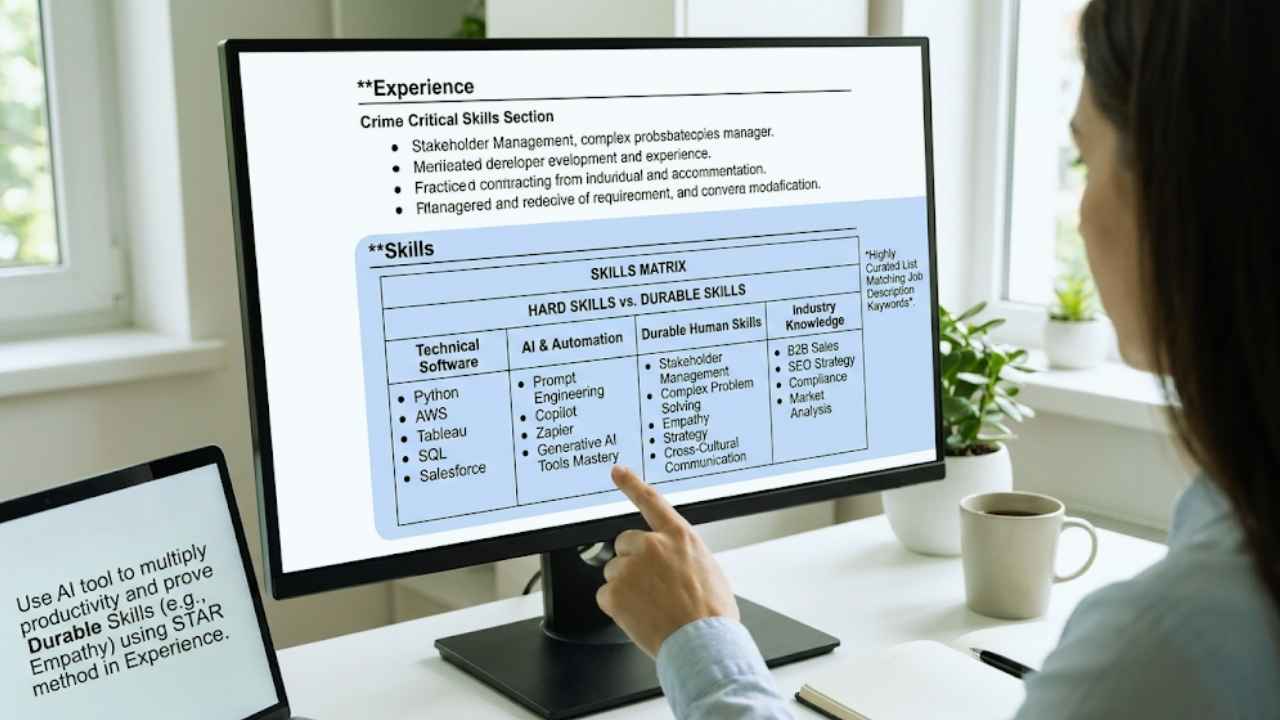
Hard Skills vs. Durable Skills
Your skills section should be a highly curated list that directly matches the specific requirements of the job description. You need to strike a balance between hard technical skills and durable human skills. Hard skills include specific software, coding languages, or certified methodologies like Agile or Six Sigma.
Durable skills, which used to be called soft skills, include things like advanced conflict resolution, strategic negotiation, and cross-cultural communication. In an era where software can write basic code and generate reports, your human-centric durable skills are actually becoming much more valuable. You should list these skills clearly, but remember that you also need to prove them in your experience section through your STAR bullet points.
Highlighting AI Literacy
Regardless of what industry you work in, showing that you understand how to leverage artificial intelligence is a massive competitive advantage. Companies want employees who can do things faster and better using modern tools. If you use generative tools to draft initial content, write basic scripts, analyze large data sets, or automate your calendar, you need to mention it.
Do not just say you know how to use basic software; specify the exact AI tools you use to multiply your productivity. Showing that you are an early adopter of these technologies signals to employers that you are highly adaptable and ready for the future of the workplace.
|
Skill Category |
Examples to Include |
Why Employers Want This |
|
Technical Software |
Salesforce, React, AutoCAD, Tableau. |
Proves you can use the specific tools they rely on daily. |
|
AI and Automation |
Prompt Engineering, Copilot, Zapier. |
Shows you can multiply your personal productivity and speed. |
|
Durable Human Skills |
Stakeholder Management, Empathy, Strategy. |
Highlights your ability to handle complex human problems. |
|
Industry Knowledge |
B2B Sales, SEO Strategy, Compliance. |
Demonstrates deep understanding of market mechanics. |
Step 6: Education and the Rise of Continuous Learning
Beyond the Degree
Your formal university education is still an important foundational element, but it is no longer the only educational metric that employers care about. They want to see that you have a growth mindset and that you actively keep your skills sharp. You should list your highest degree first, including the university name and the location.
If you graduated more than five years ago, you can safely remove the graduation year to prevent any unconscious age bias. Below your formal degree, you absolutely must include a section for recent professional development, online bootcamps, or industry-specific certifications you have completed in the last two years. This proves you do not just rest on your past accomplishments.
Relevant Coursework
If you are a junior candidate or a recent graduate with limited work experience, your education section needs to work a bit harder. You can include specific high-level coursework, capstone projects, or academic research that relates directly to the job you want. Treat your major university projects just like work experience.
Describe the problem, the tools you used, and the final grade or result you achieved. However, if you are a veteran professional with years of solid work history, keep your education section incredibly brief. Do not waste space talking about college classes when you could be highlighting real-world revenue you generated for your last employer.
|
Education Type |
Formatting Strategy |
Best Used By |
|
University Degrees |
Keep it simple: Degree, Major, School. |
All applicants, placed at the bottom of the document. |
|
Certifications |
List the certificate name and issuing body. |
Tech, healthcare, and specialized professionals. |
|
Online Bootcamps |
Highlight the specific technical skills learned. |
Career changers and recent graduates. |
|
Academic Projects |
Treat them like work experience with bullets. |
Entry-level applicants with no corporate experience. |
Step 7: Optimizing for the Modern ATS
Keywords Without the Stuffing
To get your application past the screening algorithms, you need to understand exactly how they process information. You should pick out the primary keywords from the job description and ensure they appear two or three times naturally throughout your document.
Do not try the old trick of pasting a block of keywords in white font at the bottom of the page; modern systems detect this instantly and will permanently ban your profile. Instead, weave these exact terms directly into your summary and your experience bullet points. The software looks for context. It wants to see exactly how and where you applied those specific skills during your past employment.
How to Write a Resume 2026 for Machine Learning
The newest screening systems utilize Natural Language Processing to understand semantic relationships between words. This means the system knows that client support and customer service are essentially the same thing. However, it is still the smartest strategy to mirror the exact phrasing used by the employer in their job posting.
If they ask for a project manager, do not call yourself a project coordinator. Use standard, universally recognized headings like Work Experience, Education, and Technical Skills. If you try to get clever and use headings like My Career Journey, the machine might not recognize the section, and it will fail to parse your data correctly.
|
ATS Optimization Rule |
How to Execute Properly |
Penalty for Ignoring |
|
Use Standard Headings |
Stick to “Experience” and “Education”. |
Software skips sections it cannot read. |
|
Contextual Keywords |
Put keywords inside action sentences. |
Flagged as a keyword stuffer and rejected. |
|
Avoid Header/Footer Data |
Put contact info in the main body text. |
Contact info gets deleted by the parser. |
|
Mirror Exact Titles |
Match your summary to the job ad title. |
Ranked lower than candidates who match exactly. |
Step 8: Final Formatting and Design Check
The 6-Second Rule
Recruiters are exhausted, and they spend an average of six to seven seconds on their initial scan of a new applicant. If they cannot immediately find your current job title, your top skills, and your biggest achievement within that tiny window of time, you have lost their interest.
You must use clear headings and bullet points to make the document highly scannable. Avoid writing massive, thick paragraphs of text that look exhausting to read. Use sufficient line spacing to give the text room to breathe. When a recruiter opens your file, their eyes should naturally glide down the page, catching all the most important data points without any friction.
Mobile-Friendly Design
You must assume that the first person to read your document will be viewing it on a smartphone while sitting on a train or waiting in line for coffee. This reality makes a mobile-friendly design absolutely critical. Single-column layouts work best because they scale down perfectly on small screens without forcing the user to zoom in and scroll left to right.
Always save and submit your final document as a PDF unless the job portal specifically demands a Word file. A PDF locks all your careful formatting in place, ensuring that the recruiter sees exactly what you see, regardless of what device or operating system they are using.
|
Formatting Element |
Best Practice Standard |
Reason |
|
File Format |
|
Preserves layout across all devices. |
|
Font Size |
10 to 12 point for body text. |
Ensures readability without squinting. |
|
Layout Structure |
Single column. |
Prevents text stacking issues on mobile phones. |
|
Spacing |
1.15 to 1.25 line spacing. |
Stops text from looking like a giant wall of words. |
Step 9: Tailoring for Specific Industries
Tech and Data Roles
If you are applying for software engineering, data science, or IT architecture roles, your technical stack is the most important thing on the page. You should place a dedicated technical skills table right at the top, categorized by languages, frameworks, and database types.
Hiring managers in tech care about what you have built, so linking to your active GitHub repositories or live web applications is completely mandatory. You must clearly explain the scale of the environments you worked in, such as the amount of daily active users or the terabytes of data you managed.
Creative and Media Roles
For graphic designers, writers, video editors, and marketers, your aesthetic choices matter a bit more. Your layout can be slightly more stylized, but it must remain highly readable. The single most important element of your application is the link to your digital portfolio.
A creative director will spend ten seconds glancing at your job history and ten minutes clicking through your previous work samples. Ensure your portfolio link is massive, clickable, and leads to a site that loads incredibly fast.
Healthcare and Education
In highly regulated fields like nursing, teaching, and medical administration, your specific licenses and state certifications are the gatekeepers to employment. You must list your exact credential numbers, licensing states, and expiration dates very close to the top of the document.
Hospital administrators and school boards run strict compliance checks, and if they cannot easily verify your active credentials, they will immediately move on to the next applicant in the pile.
|
Industry Focus |
Primary Resume Requirement |
Red Flag to Avoid |
|
Technology |
GitHub links and specific software stacks. |
Listing skills you cannot actually code in. |
|
Creative Arts |
Digital portfolio links. |
Typos or terrible font choices. |
|
Healthcare/Medical |
Active licenses and compliance certifications. |
Expired credentials or missing state data. |
|
Corporate Finance |
Exact budget sizes and revenue impacts. |
Vague descriptions of money management. |
Final Thoughts
Figuring out how to write a resume 2026 comes down to mastering a delicate balancing act between satisfying robotic algorithms and appealing to exhausted human readers. You must understand the technological tools that companies use to filter applications, but you must never forget that a real person will eventually make the final hiring decision.
Keep your formatting incredibly clean, focus entirely on the massive results you have achieved, and prove that you have the adaptable skills necessary to survive in a rapidly changing economy. If you follow the specific strategies outlined in this guide, you will create a powerful marketing document that bypasses the digital gatekeepers and clearly proves why you are the absolute best candidate for the job.
Frequently Asked Questions (FAQs) About How to Write Resume 2026
1. Should I include a blockchain-verified skills badge?
While digital credentials and blockchain-verified badges are growing in popularity, most standard corporate screening systems cannot process them yet. You should mention the specific certification in plain text within your education section. You can provide the verification link later during the background check phase if the employer requests it.
2. Do video resumes actually work for corporate roles?
For standard corporate, finance, or administrative roles, video submissions are usually ignored or rejected because they mess up the standardized screening process. However, if you are applying for a highly visible sales role, a social media management position, or a creative startup job, a short, professionally lit video introduction linked at the top of your document can actually help you stand out.
3. How do I list AI prompt engineering if I don’t have an official certificate?
You do not need a formal university certificate to claim AI fluency. The best way to list this is by weaving it into your experience bullets. For example, state that you “reduced content drafting time by fifty percent using advanced ChatGPT prompt engineering.” Showing the practical application of the skill is far better than simply listing it as a separate bullet point.
4. How do I handle a gap in my employment due to burnout?
Employment gaps are incredibly common and much less stigmatized today. You should add a brief, one-line entry for the gap, calling it a “Planned Career Break” or “Sabbatical.” You do not need to over-explain burnout. Simply highlight any independent learning, volunteering, or freelance consulting you did during that time to show you remained engaged with your industry.
5. Can employers detect if I used an AI tool to write my resume?
Yes, recruiters read thousands of applications and can easily spot the repetitive sentence structures and robotic vocabulary that AI tools tend to generate. While you should absolutely use AI to brainstorm ideas and organize your layout, you must rewrite the final text yourself. You need to inject your own human voice and include specific, nuanced details about your past projects that a bot could never invent.