
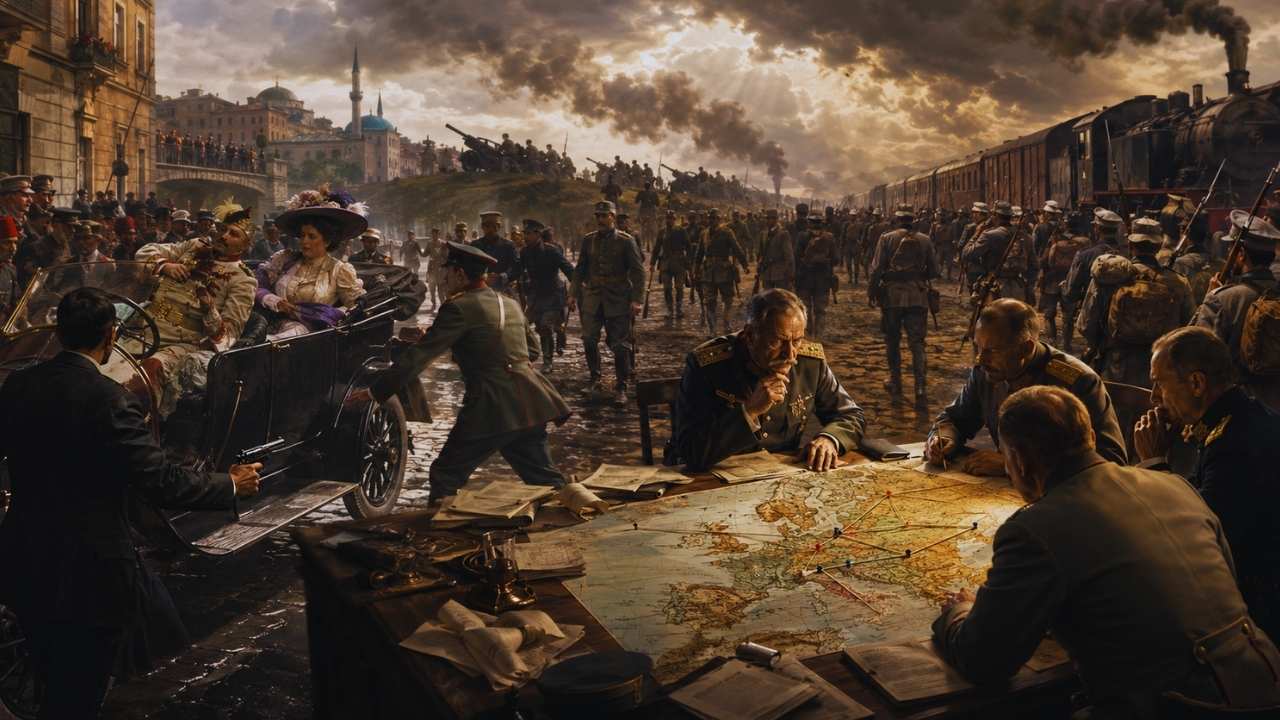
Picture Europe in the summer of 1914. People were enjoying the sunshine, economies were booming, and almost nobody thought a global apocalypse was mere weeks away. But behind closed doors, paranoid empires were hoarding weapons and signing secret, binding deals.
If you want to understand how world war 1 started, you have to toss out the idea of some evil mastermind plotting global domination. That did not happen. Instead, the war was a massive, tragic trainwreck fueled by bruised egos, terrible luck, and rigid military schedules. It escalated from a single political murder into a meat grinder that wiped out an entire generation. Let us trace the exact chain of events that turned a sunny June day into a four-year nightmare. We will look at the real data, the massive standing armies, and the exact diplomatic decisions that doomed millions of people across the globe.
The Real Story of How World War 1 Started: The Deep Roots
Before we look at the spark that blew everything up, we need to look at the gunpowder. Historians use the acronym M.A.I.N. to explain the massive pressures building up in Europe long before the shooting started. First, we have Militarism. The major powers were locked in a ridiculous, incredibly expensive arms race. Britain ruled the oceans, but Germany decided it wanted a massive navy too. Everyone was building giant armies and heavy dreadnought battleships.
By August 1914, Germany boasted a standing army of four and a half million men, with millions more in reserve. Russia had an even larger force, standing at nearly six million soldiers ready to mobilize. When you buy that many weapons, you eventually want to use them. Second, Alliances. Europe split into two heavily armed gangs. Germany, Austria-Hungary, and Italy formed the Triple Alliance. Britain, France, and Russia formed the Triple Entente. They thought these treaties would keep the peace. Instead, they built a massive trap. If one country fought, everyone fought.
Third, Imperialism. The major powers were fiercely competing for global real estate. The scramble to conquer Africa and parts of Asia caused deep jealousy. Finally, Nationalism. Toxic national pride poisoned the water. France wanted revenge on Germany for a past defeat, and Slavic groups in the Balkans desperately wanted independence. Nobody was willing to compromise, and everyone thought their nation was invincible.
|
Long-Term Cause |
What It Actually Meant |
Real Data from 1914 |
|
Militarism |
Glorifying the military and hoarding weapons |
Russia had 5.9 million standing soldiers; Germany had 4.5 million. |
|
Alliances |
Secret defense treaties |
Triple Alliance versus Triple Entente guaranteed global escalation. |
|
Imperialism |
Stealing global territory for resources |
Empires clashed constantly over African and Asian colonies. |
|
Nationalism |
Aggressive, stubborn national pride |
Fueled violent Slavic independence movements in the Balkans. |
The Spark: A Wrong Turn in Sarajevo
With Europe armed to the teeth, it only took one bad day to ruin everything. That day was June 28, 1914, which ironically was the fourteenth wedding anniversary of Archduke Franz Ferdinand. The Archduke, next in line for the Austro-Hungarian throne, visited Sarajevo to inspect troops. Sarajevo was in Bosnia, a place Austria-Hungary had recently taken over, and local Serbian nationalists hated him for it.
A secret gang called the Black Hand gave a bunch of teenagers some bombs, pistols, and cyanide capsules, and told them to kill the Archduke. The assassination plot was almost a total failure at first. One attacker threw a bomb at the Archduke’s open-top car, but it bounced off the roof and blew up the car behind him, injuring several people. The Archduke survived and angrily went about his day.
Then, the universe rolled the dice. Later that afternoon, the Archduke’s driver made a wrong turn. Realizing his mistake, he hit the brakes right in front of a café to turn around. Sitting right there was nineteen-year-old Gavrilo Princip, one of the assassins who had basically given up. Princip stepped up, fired two shots, and killed both the Archduke and his pregnant wife, Sophie, instantly changing the course of history.
|
The Players |
Their Role That Day |
What Happened to Them |
|
Franz Ferdinand |
Heir to the Austro-Hungarian empire |
Shot and killed at close range on June 28. |
|
Gavrilo Princip |
19-year-old high school student |
Arrested immediately; sentenced to twenty years in prison. |
|
Sophie, Duchess of Hohenberg |
The Archduke’s wife |
Assassinated alongside her husband in the motorcade. |
|
The Black Hand |
Shadowy Serbian nationalist group |
Armed and trained the teenage assassins for the attack. |
The July Crisis and the Blank Check
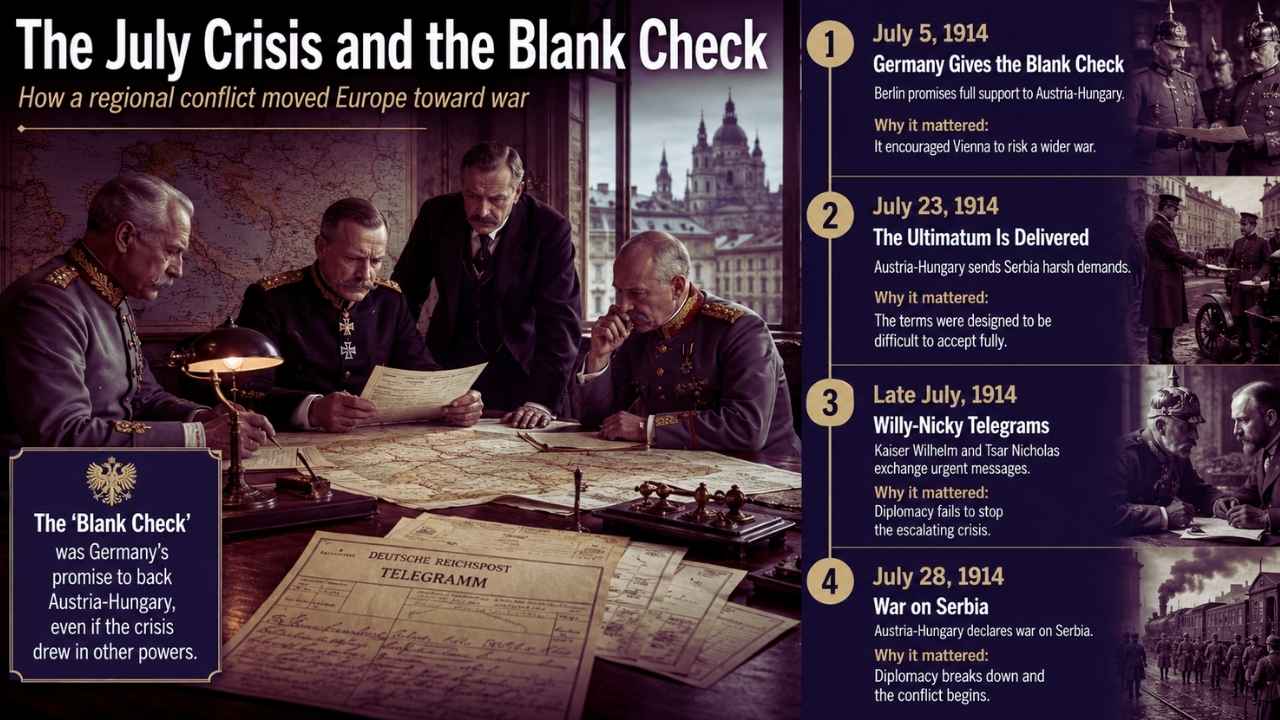
The assassination completely unhinged the leaders in Vienna. Austria-Hungary wanted to crush Serbia for funding the terrorists. But they had a massive problem in the form of Russia. Russia was Serbia’s big brother, and if Austria-Hungary attacked Serbia, Russia would absolutely step in to defend them. Vienna needed a bouncer. They called their ally, Germany. On July 5, Germany handed Austria-Hungary what we now call the Blank Check.
Germany essentially said they would back up Austria-Hungary no matter what happened or who else got involved. This moment is a massive piece of the puzzle of how world war 1 started. That Blank Check made Austria-Hungary incredibly cocky. They sent Serbia a list of extreme demands, basically asking Serbia to give up its sovereignty. Serbia actually agreed to almost all of it, but Vienna did not care.
Behind the scenes, desperate telegrams flew back and forth between German Kaiser Wilhelm and Russian Tsar Nicholas, famously known as the Willy-Nicky telegrams. Nicholas begged Wilhelm to stop his allies from going too far to avoid a European calamity. Wilhelm replied that he was trying to mediate, but the massive military machines were already taking over. Vienna cut off diplomatic ties and declared war on Serbia on July 28.
|
The Timeline |
What Happened |
Why It Was a Disaster |
|
July 5, 1914 |
Germany gives the Blank Check |
Emboldened Austria-Hungary to risk a major European war. |
|
July 23, 1914 |
The Ultimatum is delivered |
Austria-Hungary purposely made demands Serbia could not accept. |
|
Late July, 1914 |
Willy-Nicky Telegrams exchanged |
The Tsar and Kaiser failed to stop the escalating diplomatic disaster. |
|
July 28, 1914 |
War is declared on Serbia |
The exact moment diplomacy officially failed and the conflict began. |
The Domino Effect: When the Trains Started Moving
Here is a core part of how world war 1 started that most people miss entirely: rigid military timetables. In 1914, armies could not just teleport to a battlefield. Moving millions of men and horses required strict, unforgiving railway schedules. Once you started moving trains, you could not just hit pause. Russia ordered its massive army to mobilize on July 30 just to scare Austria-Hungary into backing off.
But Germany saw those Russian trains moving and completely panicked. Germany had a strict battle strategy called the Schlieffen Plan. They knew they would have to fight Russia in the east and France in the west. The plan stated Germany must destroy France in exactly six weeks before the slow Russian army could reach the German border. Because of this ticking clock, Germany could not afford to wait and negotiate while Russia gathered its twelve million reserve troops.
They declared war on Russia on August 1. Realizing France would jump in to support Russia, Germany preemptively declared war on France on August 3. The rigid train schedules literally forced the continent into a full-scale bloodbath because nobody wanted to be caught unprepared.
|
Country |
Mobilization Date |
Why They Fought |
|
Russia |
July 30, 1914 |
Fired up the trains to protect Serbia from Austrian aggression. |
|
Germany |
August 1, 1914 |
Panicked over Russian trains; formally declared war on Russia. |
|
France |
August 3, 1914 |
Attacked by Germany strictly due to the Schlieffen Plan timeline. |
|
Austria-Hungary |
August 6, 1914 |
Finally got around to declaring war on Russia after starting the mess. |
The Final Straw: Invading Neutral Belgium
Up until the first week of August, Great Britain was sitting on the sidelines, desperately debating whether to get involved. Germany made the decision for them. To knock out France quickly under the Schlieffen Plan, the German army had to march right through Belgium. But Belgium was strictly neutral, and Britain had signed a treaty way back in 1839 promising to protect that neutrality. Belgium had a tiny army of just over one hundred thousand soldiers, compared to Germany’s millions, but they bravely refused to let the German army pass. Germany invaded anyway.
The German Chancellor even mocked the British ambassador, calling the 1839 treaty nothing more than a scrap of paper. Britain was absolutely furious. They did not want a hostile German navy controlling the Belgian coastline right across the English Channel. Britain demanded Germany back out of Belgium immediately.
When Germany ignored them, Britain officially declared war on August 4. The British Empire brought nearly a million standing troops and massive global resources into the fray. The dominoes had all fallen, and a local dispute in the Balkans had officially become a World War.
Read Also: Cold War Explained: A Beginner-Friendly Overview
|
The Nation |
Date of Entry |
The Trigger |
|
Germany |
August 4, 1914 |
Marched into neutral Belgium to flank the French army. |
|
Belgium |
August 4, 1914 |
Fought back against overwhelming odds to defend its homeland. |
|
Great Britain |
August 4, 1914 |
Declared war to protect Belgian neutrality and secure the Channel. |
|
Montenegro |
August 5, 1914 |
Declared war on Austria-Hungary to show solidarity with Serbia. |
Final Thoughts
Looking back at how world war 1 started, it is absolutely terrifying. It was not inevitable. It was just a bunch of stubborn, proud leaders who refused to hit the brakes when the car was heading off a cliff. The long-standing rivalries built the bomb, a teenage assassin lit the fuse, and a web of secret treaties made sure everyone got caught in the blast radius.
We see how a few miscommunications, combined with the pressure of moving millions of soldiers on strict train schedules, erased any chance for peace. The kings and generals of 1914 promised their people the war would be a quick, glorious adventure. Instead, they unleashed a nightmare that destroyed four massive empires—the Russian, German, Austro-Hungarian, and Ottoman empires.
The conflict wiped out over twenty million lives and laid the bloody groundwork for World War II just twenty years later. Understanding these mistakes is crucial for ensuring modern leaders never let diplomatic tension spiral into blind destruction again. Let us break down the core lessons we take away from this tragic historical timeline.
Frequently Asked Questions (FAQs) About How World War 1 Started
Did the United States join right away?
Not even close. President Woodrow Wilson wanted nothing to do with Europe’s mess. The US stayed strictly neutral until April 1917. They finally jumped in because German submarines kept sinking American ships and Germany secretly tried to convince Mexico to invade the US.
Did Italy fight with Germany?
Nope. Italy was part of the Triple Alliance with Germany before the war, but they backed out in 1914, claiming Germany was the aggressor. A year later, the British and French secretly promised Italy a bunch of land, so Italy joined their side instead.
What happened to the kid who shot the Archduke?
Gavrilo Princip didn’t face the firing squad. Under Austro-Hungarian law, he was just a few weeks too young for the death penalty. They threw him in a brutal military prison instead. He caught tuberculosis and died in the spring of 1918, just months before the war he started finally ended.